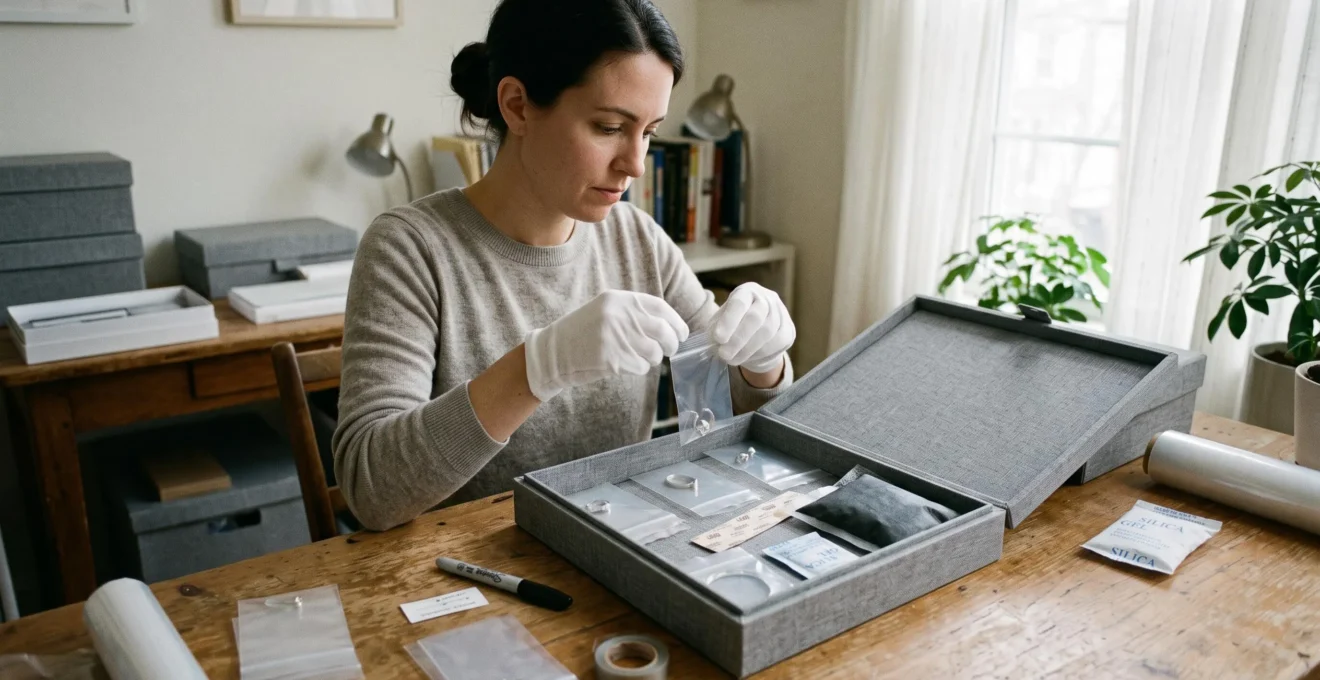
Museum-quality silver storage is achievable at home without reproducing an institutional vault. The essential requirement is a controlled micro-environment that limits exposure to sulphur-containing gases, manages relative humidity and keeps potentially harmful packaging materials away from valuable objects.
Silver tarnish is primarily a chemical reaction between the metal surface and airborne sulphur compounds. Sterling silver can develop both silver sulphide and copper sulphide. Higher humidity generally accelerates tarnishing when pollutant exposure is otherwise comparable. Repeated polishing removes some surface material, making prevention particularly important for silver-plated objects and pieces with historical finishes.
A practical preservation system therefore combines chemically stable packaging, suitable barriers, selective use of desiccants or pollutant absorbers, and periodic condition assessments. The arrangement must reflect the collection itself: solid silver tableware, plated jewellery and silver objects incorporating pearls or other sensitive materials do not necessarily require identical conditions.
Silver storage essentials
- Store clean, dry silver individually in compatible protective materials, away from sulphur-emitting substances.
- Control both humidity and airborne pollutants; silica gel alone is not complete tarnish protection.
- Monitor the storage environment and inspect objects before adjusting absorbers, seals or inspection intervals.
- Why Completely Sealed Silver Storage Requires Periodic Air Exchange
- Anti-Tarnish Strips vs Impregnated Cloths: Which Provides Longer Protection?
- How Layered Protection Systems Extend Tarnish-Free Periods From Months to Years
- The Storage Material Economy That Costs More Through Premature Failure
- How to Schedule Storage Inspections to Verify System Effectiveness
- How Activated Charcoal Absorbs Sulfur Gases From Jewelry Storage Spaces
- How to Calculate Silica Gel Quantity Needed for Your Storage Container Volume
- How Much Silica Gel Do You Actually Need for Effective Jewelry Storage?
Why Completely Sealed Silver Storage Requires Periodic Air Exchange
A sealed silver container does not automatically need periodic air exchange. Airtight storage can be highly protective when its contents are dry, chemically stable and free from damaging emissions. Ventilation becomes appropriate when condensation, trapped pollutants or deteriorating materials compromise the enclosure. The objective is controlled internal conditions, not routine exposure to fresh air.
Sealing a container reduces the entry of airborne sulphur compounds, dust and changing ambient humidity. However, it also confines whatever is present at closure. Moist fabric, residual cleaning products, adhesives and unsuitable foam can create an internal environment that is more harmful than expected.
The Canadian Conservation Institute recommendations for storing metals identify the accumulation of volatile substances as a risk in closed storage. They also emphasize chemically stable enclosures and appropriate humidity management.
Air exchange should therefore be a response to observed conditions rather than an arbitrary weekly ritual. Opening a well-performing enclosure can introduce new moisture and atmospheric pollutants, particularly in humid climates or buildings with significant outdoor air pollution.
Check for indications that the storage arrangement requires attention:
- Visible condensation: investigate trapped moisture and temperature changes before resealing.
- Persistent chemical or plastic odours: examine the enclosure, linings, adhesives and packaging for potentially unsuitable materials.
- Yellow or darker surface discoloration: inspect the object and its surrounding materials for possible tarnish development.
- Unexpectedly high humidity readings: assess the seal, desiccant condition and moisture introduced by storage materials.
Stable solid-silver pieces in compatible individual packaging may tolerate long periods with little air exchange. Silver-plated pieces deserve particularly careful inspections because aggressive tarnish removal can damage their thin silver coating. Fingerprints and polishing residues also warrant attention before any enclosure is sealed.
Importantly, saturation of silica gel or activated charcoal calls for assessment, replacement or permitted reconditioning. Merely exchanging the air does not restore an exhausted absorber.
Once the enclosure itself is suitable, the next decision concerns which anti-tarnish products actually provide continuing protection.
Anti-Tarnish Strips vs Impregnated Cloths: Which Provides Longer Protection?
Neither anti-tarnish strips nor impregnated cloths can be declared the longer-lasting option without identifying the products and their operating conditions. Protective storage cloths, polishing cloths and anti-tarnish strips serve different functions. Their effectiveness depends on their chemical technology, pollutant exposure, enclosure design and the manufacturer’s replacement or care instructions.
The most important distinction is between a cloth designed to protect stored silver and one intended to clean it. A silver polishing cloth may contain abrasives or polishing agents that remove existing light tarnish. It is not necessarily suitable as permanent wrapping.
By contrast, purpose-made tarnish-inhibiting storage fabrics may incorporate reactive materials that capture tarnishing gases before those gases contact silver. Some employ silver particles for this purpose. Commercial anti-tarnish strips can also use pollutant-capturing or other protective technologies, but their mechanisms should not be assumed identical across products.
These differences matter when planning how each product will be used.
| Criterion | Anti-tarnish strips | Impregnated cloths |
|---|---|---|
| Primary purpose | Passive protection inside a suitable enclosure, depending on product technology | Storage protection or surface polishing, depending on cloth type |
| Contact with silver | Usually placed separately, according to product directions | Storage fabric may surround silver; polishing cloth contacts the surface during cleaning |
| Useful conditions | Manufacturer-specified enclosure volume and service conditions | Compatible contact materials and intended cleaning or storage application |
| Service life | Product-dependent; affected by pollutant loading and enclosure exposure | Product-dependent; polishing performance and storage protection are different measures |
| Main precaution | Verify chemistry, compatibility and replacement instructions | Avoid unsuitable polishing residues and contact with sensitive components |
The Canadian Conservation Institute guidance on silver care and tarnish removal specifically distinguishes abrasive polishing cloths from specialized tarnish-inhibiting storage fabrics. It describes silver-particle-containing protective cloth as a useful storage option.
For a collection stored in individual protective pouches, an anti-tarnish strip may be convenient where its manufacturer supports the intended arrangement. Purpose-made protective cloth can be useful when silver needs compatible contact wrapping. A polishing cloth belongs primarily in the maintenance process, not automatically inside the enclosure.
Combining products should not be assumed to multiply protection. Activated charcoal and some other sorbents may interact with compounds released by particular products, but the effect depends on their actual chemistry. Compatibility claims require product-specific evidence.
For pearls, porous stones, delicate finishes or historic objects, avoid prolonged contact with polishing agents or impregnated cleaning products unless their suitability is established.
Once each protective material has a clearly defined role, complementary barriers can be arranged into a more reliable preservation system.
How Layered Protection Systems Extend Tarnish-Free Periods From Months to Years
Layered protection can substantially reduce the conditions responsible for silver tarnishing, potentially supporting preservation over extended periods. However, months or years of tarnish-free storage cannot be guaranteed. Performance depends on the concentration of sulphur pollutants, enclosure integrity, humidity, material compatibility and how often the stored objects are accessed.
Rather than relying on a single anti-tarnish product, use defence in depth. Each protective layer addresses a distinct pathway through which deterioration may occur.
- Individual object protection: separate compatible silver pieces with suitable archival tissue or polyethylene packaging to reduce contact damage and cross-contamination.
- Primary barrier: use a properly sealed, chemically stable pouch or enclosure to restrict outside pollutants.
- Humidity management: include suitably conditioned silica gel when humidity regulation is needed, keeping packets from damaging or abrading the object.
- Pollutant management: consider activated charcoal or an appropriate tarnish-inhibiting material, subject to product compatibility and enclosure design.
- Secondary containment: place individually protected objects in a stable outer box or cabinet that provides mechanical protection and moderates environmental changes.
The location of each absorber is important. Silica gel placed outside a fully sealed individual pouch cannot regulate the humidity inside that pouch. Similarly, an external pollutant absorber cannot be relied upon to protect the internal atmosphere of a sealed barrier package.
For an individually sealed object, suitable protective components must share the relevant enclosed airspace, while remaining physically separated where required. The outer storage container then becomes an additional barrier rather than a substitute for correct individual packaging.
A common failure is sealing silver before packaging components are dry. Another is placing an efficient absorber inside an enclosure that exchanges air so freely that it is rapidly exposed to room conditions.
Protection also needs a measurable outcome. The absence of new discoloration, appropriate relative-humidity readings and satisfactory absorber condition are more meaningful than an advertised number of protection months.
A silver object that remains visually stable over several inspections provides encouraging evidence about its particular storage conditions. It does not prove that every object in the collection will respond identically.
The durability of this arrangement also depends on material selection, where inexpensive shortcuts can produce avoidable conservation costs.
The Storage Material Economy That Costs More Through Premature Failure
The cheapest silver storage material can become the most expensive choice when it introduces harmful emissions, retains moisture or requires repeated replacement. Its true cost includes not only the purchase price but also maintenance, deterioration risk and any conservation treatment needed after a storage failure.
Ordinary household packaging is not automatically inert. Rubber, unsuitable foams, some wood-based products, wool and felt can introduce compounds that contribute to silver deterioration. Certain plastics can also degrade and release problematic substances.
Material descriptions require careful interpretation. A label such as « acid-free » or « archival » may be relevant, but does not establish that every coating, adhesive, dye or component is chemically suitable for direct contact with silver.
Prefer materials with clearly identified compositions and conservation-relevant specifications:
- Suitable polyethylene bags or stable polyethylene foam for protective separation.
- Acid-free, unbuffered, sulphur-free archival tissue where appropriate.
- Chemically stable storage containers without questionable linings or adhesives.
- Protective fabrics specifically designed for silver, with documented use instructions.
Avoid treating newspaper, unidentified foam rubber, ordinary felt and unverified household wrapping films as archival packaging. For example, polyvinylidene chloride wrapping can present degradation risks; not every transparent film is equivalent to stable polyethylene.
Before introducing an unfamiliar storage material to a valuable collection, identify its composition and review available manufacturer information. A less valuable silver sample may be observed in a separate trial enclosure for several weeks, but an unchanged sample is not proof of long-term chemical safety.
Cost comparisons should account for the intended service period rather than simply comparing shelf prices. The following framework avoids assuming that any product has a universally established life span.
| Storage option | Initial expense | Long-term cost considerations |
|---|---|---|
| Individual barrier pouches | Cost per object or pouch | Replacement following damage, opening or loss of sealing performance |
| Anti-tarnish strips | Product and quantity required | Manufacturer-specified replacement and pollutant exposure |
| Reusable inert storage box | Box, dividers and suitable lining | Cleaning, inspection and replacement of internal consumables |
| Silica gel system | Desiccant, humidity indicator and enclosure | Monitoring, permitted reconditioning and eventual replacement |
An annualized comparison can be made by dividing the total expected purchase and replacement expenditure by the chosen evaluation period. Where service life is unknown, record that uncertainty instead of assuming an arbitrary replacement frequency.
The initial investment in stable packaging is particularly valuable for plated silver, for which corrective polishing carries the risk of permanent material loss.
Even well-chosen materials require occasional review, making an inspection system the next essential part of preventive conservation.
How to Schedule Storage Inspections to Verify System Effectiveness
A silver storage inspection schedule should combine brief external checks with less frequent, documented internal examinations. The interval depends on enclosure stability, local humidity, pollutant exposure and the condition of individual objects. A new or recently modified system merits closer observation than one with a demonstrated record of stable performance.
Start with a visual check whenever handling the storage container. Look for condensation, deformation, seal damage and any changes in an external humidity indicator, where fitted.
For a more detailed inspection, open the container in a clean, stable environment and handle objects with clean cotton or suitable plastic gloves. Avoid latex rubber gloves when handling silver because some rubber formulations contain sulphur-related components that may contribute to tarnishing.
Examine reflective areas under consistent lighting. Early yellowish, reddish or bluish changes may indicate thin tarnish films, while darker changes can reflect more advanced surface reactions. Discoloration alone does not identify the exact cause.
Absorber condition also needs verification. Indicating silica gel can provide a useful visual signal if its colour-change system is correctly interpreted. Alternatively, mass measurements can help evaluate moisture uptake when the initial dry condition and relevant sorption data are known.
Neither approach justifies assuming that all products have the same saturation threshold. Activated charcoal and anti-tarnish materials may have no easily visible exhaustion indicator, so monitoring must also account for service instructions and changes in the objects themselves.
Five actions for a verifiable silver storage inspection
- Record the baseline: photograph representative silver surfaces and note their starting condition, producing an initial condition record.
- Check the enclosure: examine seals, condensation and internal materials, recording any defect that needs correction.
- Measure humidity: document the current relative-humidity reading and compare it with the selected conservation target.
- Assess protective materials: record indicator-silica status, product replacement guidance and any signs of deterioration.
- Log the outcome: enter the date, observations, corrective actions and next inspection decision in a storage register.
A minimal register can contain four fields: inspection date, object and enclosure condition, absorber status, and action taken. Optional photographs make subtle changes easier to compare.
Initially, an inspection after an environmental change, a new package installation or unexpected humidity readings helps establish whether the system is working. Subsequent intervals can be lengthened cautiously when repeated observations demonstrate stability.
Suspected active corrosion, persistent moisture or significant deterioration warrants prompt investigation. Valuable historic pieces may require a qualified conservator rather than additional home polishing.
Inspection records also help determine whether pollutant absorbers such as activated charcoal are contributing to effective protection.
How Activated Charcoal Absorbs Sulfur Gases From Jewelry Storage Spaces
Activated charcoal can help protect stored silver by adsorbing certain airborne contaminants onto its extensive internal pore surfaces. Its usefulness depends on the charcoal grade, gas concentrations, moisture, exposure time and enclosure design. Ordinary charcoal should not be assumed to provide the same performance as an activated sorbent selected for relevant gaseous pollutants.
Activation creates a porous structure that increases the surface area available for adsorption. Gas molecules approaching suitable surfaces may become retained by physical interactions. However, adsorption efficiency differs between substances: untreated activated carbon is not equally effective for every gas or every concentration.
Silver tarnishing is strongly associated with hydrogen sulphide and other sulphur-containing atmospheric compounds. Sulphur dioxide may also matter under particular environmental conditions, although its capture behaviour differs from that of hydrogen sulphide.
For meaningful protection, charcoal must be compatible with the pollutants being targeted. Products designed or tested for relevant gas removal are preferable to unspecified charcoal granules. Materials sold for aquarium or air filtration should not automatically be regarded as suitable for archival storage without checking their composition and intended use.
Charcoal also functions best where exposure is controlled. In an open jewellery box, fresh surrounding air continually introduces contaminants. In a reasonably closed system, the pollutant burden is more limited, although the effectiveness of passive sorption still depends on airflow, placement and sorbent properties.
Position a contained charcoal sachet so particles cannot escape onto jewellery or vulnerable surfaces. If objects are individually sealed, charcoal placed in the outer box does not directly treat the air already trapped inside those pouches.
Humidity and other vapours can compete for adsorption sites. Compatibility between charcoal and specialized anti-tarnish strips is product-dependent; some arrangements may be less efficient if a sorbent captures chemicals involved in another product’s protective mechanism.
Replacing charcoal should follow product guidance and observed system performance. Do not assume that a household heating cycle will regenerate a used sorbent safely or effectively. Heating is appropriate only when expressly supported by the manufacturer for that exact material.
A sulphur-like odour or localized discoloration should prompt investigation, but neither uniquely proves charcoal saturation. Where charcoal condition cannot be measured directly, enclosure monitoring and supplier instructions provide the practical basis for maintenance.
Because pollutant capture and moisture regulation are separate functions, silica gel must be evaluated independently when designing the internal climate.
How to Calculate Silica Gel Quantity Needed for Your Storage Container Volume
To estimate silica gel requirements, begin with container dimensions, then account for airtightness, initial humidity, outside humidity, desired internal conditions and the sorbent’s moisture-buffering characteristics. Container volume is only the starting variable. A reliable quantity requires product-specific guidance or a validated calculation based on moisture ingress and sorption capacity.
The first practical calculation establishes internal enclosure volume. For a rectangular box, multiply its internal length, width and height using consistent units. For example, dimensions measured in centimetres produce cubic centimetres, which can be converted to litres by dividing by 1,000.
This is a geometric calculation, not a silica gel dosage formula. The volume of bulky supports and objects can be subtracted when a better estimate of the enclosed airspace is needed, but moisture absorbed by porous materials and ongoing air exchange can be far more important than modest differences in free-air volume.
A sensible sizing process follows these steps:
- Measure the useful internal dimensions of the container and calculate its approximate volume.
- Identify its enclosure type: sealed barrier pouch, well-fitting box or frequently opened cabinet.
- Record current ambient relative humidity and select a target range appropriate to every material being stored.
- Consult the silica gel manufacturer’s moisture capacity, conditioning and sizing instructions.
- Install a suitable quantity, monitor actual conditions and adjust according to measured performance.
The Canadian Conservation Institute Technical Bulletin 33 on silica-gel humidity control demonstrates why air exchange, sorbent capacity and the target relative-humidity range materially affect sizing.
31.6 kg versus 10.5 kg
In a specific museum silver-trophy enclosure calculation involving a 1 m³ case, a 20–30% relative-humidity target and defined sorbent characteristics, improved airtightness reduces the calculated dry sorbent requirement from 31.6 kg to 10.5 kg. These figures illustrate sensitivity to air leakage and are not recommended dosages for household jewellery boxes.
Canadian Conservation Institute, Technical Bulletin 33, revised 2023.
For domestic storage, the practical implication is to improve enclosure performance before compensating for excessive air leakage with additional silica gel.
A miniature hygrometer can verify whether the chosen setup maintains the intended conditions. An initial observation period of one to two weeks is a practical starting check for a new household arrangement, not a universally validated equilibration period. Continue monitoring beyond that period, particularly across seasonal changes.
Too little gel may become unable to maintain the target humidity range. Adding excessive dry gel does not necessarily improve preservation and may create an unsuitable environment for moisture-sensitive components.
The final quantity decision should therefore be made in relation to the specific jewellery, packaging and climate rather than a universal rule expressed in grams per litre.
Key takeaways before choosing a silica gel quantity
- Identify whether the package is individually sealed, moderately airtight or frequently opened before selecting a desiccant quantity.
- Use measured relative humidity and the manufacturer’s capacity information to assess performance, not container volume alone.
- Choose humidity conditions for the complete object, including sensitive stones, organic components and mounting materials.
How Much Silica Gel Do You Actually Need for Effective Jewelry Storage?
There is no universal silica gel quantity suitable for every jewellery storage container. Begin with the manufacturer’s recommendation for the chosen product and enclosure, then verify the resulting relative humidity using an appropriate indicator or hygrometer. A sealed silver pouch, a semi-airtight jewellery box and a large, frequently opened cabinet have fundamentally different moisture-management requirements.
For a small sealed pouch holding dry, stable silver, the moisture load may be limited once the materials are properly conditioned. A compatible desiccant may provide useful additional buffering, but the required amount cannot be determined from pouch size alone.
For a semi-airtight jewellery box, the continuing exchange of air and moisture stored in fabric linings or other porous materials can increase the desiccant burden. The result must be checked after installation rather than assumed from the amount placed inside.
A large household jewellery cabinet introduces further variables, particularly frequent openings and mixed materials. In such cases, individual protective pouches may be more effective than attempting to condition the entire cabinet with silica gel.
Silica gel also has a defined limitation: it regulates moisture, not sulphur gas exposure. Preventing tarnish requires both humidity management and control of relevant pollutants. The chemical basis is clear from the Canadian Conservation Institute’s explanation of how silver sulphide develops and why increasing humidity can accelerate tarnishing.
For stable metal collections, institutional guidance identifies a relative-humidity range of 35–55% for mixed collections. Separate guidance recommends keeping silver dry, below 50% relative humidity. These are conservation reference points, not automatic targets for every composite jewellery item.
Jewellery containing pearls, coral, opals or other moisture-sensitive materials needs particular care. Extremely dry conditions that benefit bare metal may be unsuitable for these components. Their conservation requirements must determine the shared storage environment, or the objects should be separated into different arrangements.
The practical decision is therefore to select an appropriate target, obtain the product-specific dosage guidance, monitor its performance and recondition or replace the gel when necessary.
Do not treat the presence of a silica gel packet as evidence that the entire storage system is functioning. Its useful role is confirmed by stable measurements, adequate remaining sorption capacity and appropriate conditions for the objects.
Begin with one representative storage container: document its contents, verify the materials, install appropriate monitoring and assess the results before applying the arrangement across the full collection.
Can silver be stored in ordinary resealable plastic bags?
Suitable polyethylene bags can provide effective individual storage for dry silver objects. Verify the bag material and avoid assuming that all clear household plastics are chemically equivalent. Valuable pieces may also benefit from compatible archival tissue and additional protection against abrasion.
Should tarnished silver be polished before long-term storage?
Not necessarily. Tarnish removal can remove a small amount of silver, and repeated polishing is particularly risky for plated or historically significant objects. Remove harmful residues and assess the condition before storage, but avoid unnecessary abrasive cleaning. Valuable or delicate objects may require professional conservation advice.
Can a jewellery box be too dry for silver jewellery?
Yes, when the jewellery contains moisture-sensitive materials. Bare silver generally benefits from relatively dry conditions, but pearls, opals, coral and certain organic components may be adversely affected by excessively low humidity. Storage conditions should suit the complete object, not only its silver components.
Does a humidity indicator prove that an anti-tarnish system is working?
No. A humidity indicator provides information about moisture conditions, not the concentration of hydrogen sulphide or other tarnishing gases. Good humidity readings should be considered alongside the condition of the silver, enclosure integrity and the maintenance requirements of pollutant-control materials.
How can a collector tell whether silver storage needs improvement?
Compare documented surface conditions and relative-humidity readings over successive inspections. New discoloration, condensation, damaged seals or deteriorating packaging indicate that the arrangement should be investigated. Correct the underlying source of moisture or contamination rather than relying on additional polishing or repeatedly adding absorbers.