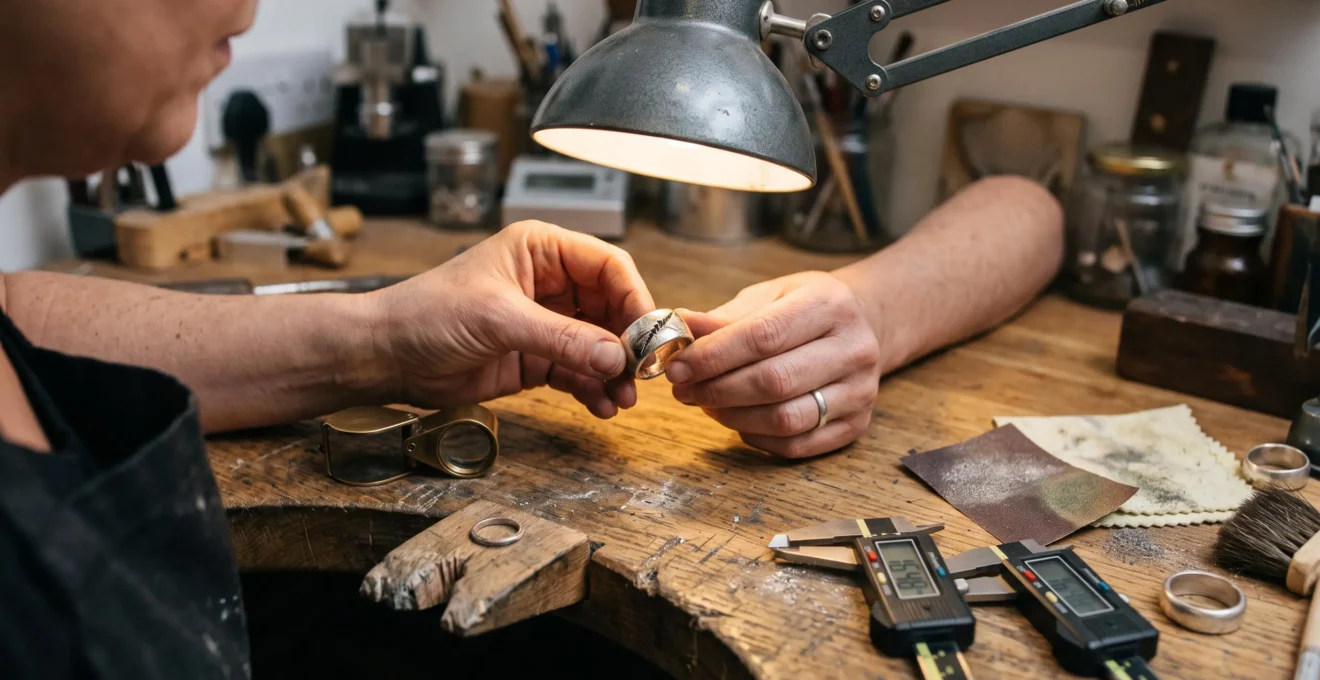
Deep scratch repair costs more than replacement value when the total expense of restoring a silver item exceeds the cost of obtaining a comparable piece in acceptable condition. The decision becomes more complicated when eliminating a groove requires substantial metal removal, rebuilding damaged areas or recreating intricate surface details.
For an ordinary silver ring, replacement may offer better financial value than extensive refinishing. For an engraved heirloom, however, the original object’s history and personal significance may justify restoration expenses that exceed its market value. These are different economic decisions, and they should not be confused.
Before authorising expensive work, establish the scratch’s depth, the remaining metal thickness, the realistic repair outcome and the item’s comparable replacement value. A professional quotation should explain what the treatment can accomplish, not merely promise to make the silver shiny again.
Deep Silver Scratch Repair: The Financial Essentials
- Replacement becomes financially preferable when the complete repair cost exceeds comparable replacement value, unless preserving the original carries additional value.
- Deep scratch removal can sacrifice original silver, decorative detail and structural thickness; some damage requires techniques beyond ordinary polishing.
- Request a condition assessment and an itemised repair estimate before attempting aggressive polishing, particularly on heirlooms or previously restored jewellery.
- Why Deep Scratches Compromise Structural Integrity Beyond Aesthetics
- How Jewellers Remove Scratches Through Controlled Metal Removal
- Professional Buffing vs DIY Scratch Removers: Cost vs Quality Analysis
- The Repair Attempt That Reduces Ring Thickness Below Safe Structural Limits
- When to Address Deep Scratches Immediately vs When Waiting Is Acceptable
- When to Re-Polish Silver: Balancing Aesthetics Against Metal Thickness Loss
- How Progressive Grit Polishing Creates Mirror Reflectivity From Scratched Silver
- How to Achieve Jeweller-Quality Mirror Finish on Silver at Home
Why Deep Scratches Compromise Structural Integrity Beyond Aesthetics
A deep scratch may affect more than a silver object’s appearance. A substantial groove reduces the metal’s local cross-section and can concentrate stress where the piece bends or carries a load. The structural importance depends on its depth, location, existing thickness and construction. Not every visible scratch represents a safety problem.
On a substantial solid silver object, an isolated groove may be primarily cosmetic. On a narrow ring shank, thin hollow bangle or already weakened joint, similar-looking damage can be more consequential. A groove across a narrow, load-bearing section deserves closer inspection than an equally visible mark on a broad decorative surface.
The fingernail test offers a useful preliminary distinction. Carefully pass a clean fingernail across the mark without applying force. A smooth scuff that cannot be felt may be suitable for light refinishing. A groove that catches the nail indicates a surface depression worth examining under magnification.
This test does not measure scratch depth or prove structural weakness. A jeweller can examine the surrounding metal with a loupe, check for distortion and evaluate whether the piece has enough material for corrective work.
Several features deserve particular attention:
- Thin bands and hollow constructions: local material loss may be significant relative to the available metal.
- Hallmarks and engraving: abrasive finishing can permanently soften or erase identification marks and original detail.
- Gemstone settings: damage near prongs or other retention points may require a separate security inspection.
- Previously repaired areas: older joints, deformations and repeated refinishing can complicate assessment.
The Gemological Institute of America’s professional guidance on securing gemstone prongs explains why loose stones can endanger both the gem and its mounting. That guidance supports inspecting potentially compromised settings, rather than assuming polishing itself will necessarily loosen a stone.
Economically, scratch depth matters because the proposed remedy may involve much more work than the visible damage suggests. A jeweller may need to preserve contours, protect adjacent features or recommend localised reconstruction rather than extensive sanding.
A scratch that leaves the original structure sound presents a different repair decision from damage that threatens the piece’s durability. That distinction determines which treatments are reasonable to price.
How Jewellers Remove Scratches Through Controlled Metal Removal
Jewellers commonly reduce scratches by carefully abrading surrounding metal until the damaged area blends into the original surface. Deeper grooves can require greater material removal, additional finishing stages or alternative restoration methods. The appropriate treatment depends on how much original metal can safely be sacrificed without changing the item’s shape, detail or strength.
Ordinary polishing smooths microscopic surface irregularities. It does not automatically eliminate a deep groove. To remove a depression completely through abrasion alone, the surrounding surface generally needs to be reduced sufficiently to blend the defect. On some objects, selective reshaping can make the scratch less noticeable without erasing it entirely.
Professional restoration may instead involve carefully adding or reconstructing metal in suitable circumstances. Such approaches require separate technical assessment and should not be treated as equivalent to routine polishing.
A typical abrasive-finishing workflow involves:
- Inspecting the alloy, construction, surface damage and existing finish.
- Selecting an appropriate corrective method and abrasive for the accessible surface.
- Reducing the damaged area while preserving as much original material as practical.
- Progressing through increasingly fine abrasives to remove marks left by previous stages.
- Applying the final finish and checking the object’s contours, details and functional condition.
The Ganoksin technical article Perfect Hand Polishing Tips describes the importance of surface preparation, suitable tools and progressively finer abrasives. It also identifies corrective techniques beyond conventional surface polishing.
The geometry of the object strongly influences feasibility. Broad, accessible surfaces may be relatively straightforward to refinish. Curved edges, narrow recesses and patterned areas demand more careful control. A textured or historically significant finish may be difficult to recreate without changing the object’s character.
Silver-plated objects carry an additional constraint: abrasive treatment can penetrate the thin silver layer and expose underlying material. A repair quotation should therefore identify whether the object is solid silver, plated or constructed from multiple materials.
Repair complexity is not proportional to scratch length alone. Depth, location, surface accessibility and the intended finish all affect the required work. No universal formula converts scratch depth into labour time or repair cost.
The most useful estimate describes the proposed method, what original material may be lost and whether the scratch can realistically disappear. These details provide the basis for comparing professional work with inexpensive home treatments.
Professional Buffing vs DIY Scratch Removers: Cost vs Quality Analysis
DIY polishing is usually worth considering only for minor surface marks on structurally sound, uncomplicated silver. Professional refinishing becomes more appropriate for substantial grooves, intricate surfaces or objects containing gemstones. Neither option is automatically economical: the deciding factors are the achievable result, potential damage, total expense and comparable replacement value.
Consumer polishing cloths and mild silver polishes may improve dullness and very fine scuffs. They cannot be expected to restore missing metal or recreate a severely damaged contour. Repeated applications may produce a bright surface while leaving the original groove visible.
A professional quotation covers more than the finishing compound. Depending on the item, it may include inspection, preparation, controlled reshaping, protection of vulnerable features, specialised finishing and additional work on damaged components.
The following comparison separates typical capabilities rather than implying fixed market prices.
| Decision criterion | DIY polishing | Professional restoration |
|---|---|---|
| Shallow scuffs | Potentially suitable on plain, sound silver | May provide a more controlled, consistent finish |
| Deep grooves | Unlikely to remove them safely | Can assess abrasion, reconstruction or partial improvement |
| Initial expenditure | Products and basic supplies | Assessment, specialist labour and materials |
| Surface preservation | Depends heavily on technique and product choice | Allows specialised assessment and controlled treatment |
| Complex designs or settings | Higher risk of unintended damage | Better suited to evaluating delicate features |
| Economic justification | Useful when the defect is minor and the risk low | Depends on total quotation, outcome and object value |
A failed home attempt can also create a second expense. Rounded edges, patchy finishes and excessive local abrasion may require further correction, with no guarantee that the original shape can be recovered.
To assess a quotation financially, compare the following:
- The full estimated repair expense, including additional work that may be necessary.
- The cost of obtaining a genuinely comparable replacement, including relevant transaction costs.
- The condition, appearance and structural durability expected after treatment.
- Any difference between ordinary resale value and the owner’s personal value for the original piece.
Hypothetical example: choosing between repair and replacement
Suppose a plain silver ring has a comparable replacement cost of $120, while a specialist estimates $160 to restore its deep scratch and original contour. If both options offer comparable usability and the damaged ring carries no special personal significance, replacement has the lower direct cost.
Now suppose the same ring is a family heirloom engraved with a relative’s initials. The owner may reasonably accept the higher restoration expense to preserve the original. The figures are illustrative, not verified market quotations.
The key distinction is between market replacement value and preservation value. A conventional financial comparison answers which choice costs less. An heirloom decision also considers what cannot be purchased again.
If a repair estimate exceeds replacement cost, request an explanation of the expected benefit before rejecting it or approving it. A costly repair is only worthwhile when the original piece delivers value that a replacement would not.
The Repair Attempt That Reduces Ring Thickness Below Safe Structural Limits
Repeated aggressive polishing can eventually remove enough metal to compromise a silver ring’s durability. The critical point depends on the ring’s design, remaining thickness, profile, existing damage and how it is worn. There is no universal safe minimum thickness established by the supplied conservation guidance, so a jeweller must evaluate the individual piece.
A ring shank experiences forces during ordinary use. When repeated refinishing reduces its cross-section, it may become more vulnerable to bending and deformation. Deep gouges can be especially problematic where a thin section already carries mechanical stress.
The concerning repair attempt is not necessarily one dramatic operation. Several rounds of surface correction may gradually alter a ring’s dimensions, particularly if previous workers removed material without preserving its original profile.
Warning signs worth documenting include:
- Visible thinning or flattening of the lower ring shank.
- Unintended changes in shape after normal wear.
- Loss of crisp edges or original decorative definition.
- A history of substantial abrasive repairs.
- Deep damage concentrated around a narrow or previously repaired area.
A noticeably lighter feel may raise questions about prior material loss, but it is not a dependable measurement on its own. Measured dimensions and professional examination are more informative than subjective weight or appearance.
Do not deliberately bend a potentially weakened ring to test its strength. A jeweller can inspect its geometry and evaluate vulnerable sections using suitable measuring equipment without imposing unnecessary stress.
The most important question is whether a proposed cosmetic improvement would leave the object fit for its intended use. Where further polishing would cause unacceptable thinning, the available choices may shift toward localised reconstruction, preserving the scratch or replacing the item.
Replacement is therefore not automatically the only possible option for a thin ring. Specialist rebuilding may sometimes be feasible, although its cost, technical suitability and impact on originality need separate consideration.
A jeweller’s warning against more polishing can be financially valuable: it prevents spending money on an attractive surface that may no longer withstand everyday wear.
When to Address Deep Scratches Immediately vs When Waiting Is Acceptable
Deep scratches deserve prompt professional attention when they create sharp edges, snag clothing, appear near potentially insecure settings or accompany visible deformation. Stable cosmetic grooves on structurally sound silver can often be monitored instead. The urgency depends on ongoing risk, not simply on how conspicuous the mark looks.
A scratch does not necessarily grow deeper merely because time passes. Nevertheless, continued wear can expose damaged areas to additional contact and loading. On an already weakened section, repeated mechanical stress may contribute to further deterioration.
Prompt inspection is particularly appropriate when:
- The damaged surface cuts, scratches or catches on the skin.
- A ring bends unexpectedly or shows signs of a developing crack.
- A gemstone appears loose or its mounting has been damaged.
- A plated area exposes underlying metal that changes the appearance or suitability of continued wear.
- The groove sits on an area regularly subjected to bending or impact.
By contrast, an old, unchanged scratch on an infrequently worn object may not justify immediate resurfacing. Leaving an established cosmetic mark untouched can preserve original material and avoid unnecessary expense.
Where structural damage is suspected, stop wearing the piece until it has been assessed. Where the issue is purely visual, comparing quotations before deciding is generally reasonable.
Five Steps to Decide Whether to Repair or Replace Scratched Silver
- Document the damage: photograph the entire item and the groove in consistent lighting, producing a dated visual condition record.
- Identify the construction: check existing marks and available purchase information without abrasive testing, producing a note of known and uncertain material details.
- Request a professional assessment: ask whether the damage is cosmetic or potentially structural, obtaining a written description of the findings.
- Compare complete costs: obtain a repair quotation and evidence of the cost of a comparable replacement, producing a side-by-side financial comparison.
- Record the decision: note the expected outcome, acceptable material loss and sentimental considerations, producing a clear repair, monitor or replace decision.
Waiting may also be financially sensible when minor cosmetic marks can be assessed together during an already planned jewellery inspection. This does not mean postponing attention to loose stones or potentially unsafe structures.
Once immediate risks have been excluded, the question changes from urgency to preservation: how frequently should a silver object be refinished throughout its remaining life?
When to Re-Polish Silver: Balancing Aesthetics Against Metal Thickness Loss
Silver should be re-polished when the expected improvement justifies the material loss and possible alteration of its original finish. Minor tarnish or cosmetic marks do not automatically warrant abrasive treatment. Previous polishing history, surface detail, structural condition and the owner’s preservation goals should influence each decision.
Abrasive polishing is not a consequence-free maintenance activity. Every treatment that removes surface material consumes some of the original silver, even when the visible change appears slight.
The Canadian Conservation Institute’s technical note on silver polishing explains that polishing can remove underlying untarnished silver. It also discusses the loss of fine details and the vulnerability of silver-plated surfaces.
“Moreover, polishing also removes some of the underlying untarnished silver.”
This makes refinishing a cumulative preservation decision. An object polished aggressively on several previous occasions may have less tolerance for another substantial correction than an equivalent piece retaining its original dimensions.
A useful decision filter is to distinguish:
- Functional necessity: removing a hazardous sharp area or addressing a problem affecting use.
- Appearance improvement: reducing ordinary scratches or restoring surface brightness.
- Conservation priority: retaining engraving, original contours, historical marks and established patina.
Preventive handling can reduce the need for future intervention. Store pieces separately to avoid abrasive contact, avoid wearing delicate silver during activities likely to cause impact and use appropriately gentle cleaning methods.
The Canadian Conservation Institute’s broader silver-care guidance also recommends conservative treatment and preventive storage. Its museum-oriented approach is especially relevant when preserving an object’s original surface matters more than making it appear newly manufactured.
Ask a jeweller to document relevant dimensions before and after significant refinishing where practical. Although precise metal-loss measurements may not always be feasible, records of work performed and areas treated can help later specialists understand cumulative alteration.
When surface correction is justified, the finishing technique becomes the next concern. Understanding abrasive progression helps explain both the achievable result and the labour included in a professional quotation.
How Progressive Grit Polishing Creates Mirror Reflectivity From Scratched Silver
Progressive grit polishing produces a reflective silver surface by replacing coarse scratches with increasingly fine surface marks. Each abrasive stage prepares the metal for the next, while the final polish reduces remaining irregularities. A mirror-like finish depends on adequate surface preparation, suitable compounds and the object’s original geometry and finish.
Light reflects unevenly from a scratched surface because its irregular contours scatter light. As abrasives reduce these irregularities, reflections become more coherent and the surface appears smoother and brighter.
The important principle is not simply to use a very fine compound. It is to remove the defects left by the preceding stage before advancing to the next.
A professional may move through several grades of abrasive, but the starting grade and sequence vary with the alloy, defect and shape. Beginning too aggressively can remove more metal than the correction requires.
For a typical progressive-finishing process:
- Examine the deepest relevant damage and determine whether abrasive correction is appropriate.
- Use the least aggressive suitable initial abrasive to address the intended defect.
- Remove marks introduced by that treatment with a finer abrasive.
- Continue refining the surface until it is suitable for the desired finishing compound.
- Inspect the result under good lighting and identify any remaining grooves or distorted contours.
Skipping preparation stages can leave visible scratches beneath an otherwise glossy finish. Additional final buffing may increase brightness without eliminating those deeper imperfections.
The source material provides technical examples of fine abrasive particle sizes used in conservation work, but it does not establish a universal grit sequence for deep scratch removal from jewellery. A workshop must choose its own appropriate progression for the specific object.
Mirror reflectivity also has practical limits. Broad, plain surfaces are generally easier to finish consistently than tight curves, engraved details and recessed areas. Some silver pieces have intentionally matte, textured or aged finishes that should not be converted to a mirror surface without considering the loss of originality.
The financial implication is straightforward: deeper damage can demand more preparation and corrective work, but extra polishing does not guarantee a better or structurally acceptable result.
The same principles explain why home finishing should remain conservative: a shiny surface is useful only if achieving it does not unnecessarily damage the object.
Key Takeaways Before Attempting Home Polishing
- Start with the least invasive approach capable of addressing a minor cosmetic defect; do not assume a deep groove must be eliminated.
- Protect existing contours, hallmarks and decorative details, because a visually brighter finish can still reduce the object’s value.
- Compare the expected restoration outcome with replacement cost before investing in tools or removing original metal.
How to Achieve Jeweller-Quality Mirror Finish on Silver at Home
A mirror-like finish can sometimes be achieved at home on plain, structurally sound silver with only superficial scuffs. It requires careful cleaning, appropriately mild abrasives and controlled finishing. Deep grooves, fragile construction, plating, gemstones and historically significant surfaces are reasons to avoid experimental home resurfacing and seek professional advice.
The central limitation is material preservation. A home polishing session should improve minor surface imperfections without attempting major reshaping or removing an unknown amount of silver.
Before starting, examine the piece in good light. Identify hallmarks, engraved areas, joints, coatings, vulnerable edges and any attached gemstones. If its construction or finish is uncertain, do not proceed with abrasive treatment.
For a suitable plain silver item, a conservative workflow is:
- Clean the surface: remove loose dust and suitable surface contamination with a method compatible with the object’s materials. Avoid rubbing abrasive particles across the metal.
- Assess remaining marks: distinguish light scuffs from tactile grooves. Do not attempt aggressive home correction of deep damage.
- Select a mild finishing method: use a product intended for silver and follow its instructions, beginning with an inconspicuous area where appropriate.
- Work gently and systematically: for suitable unadorned metal surfaces, use controlled movements and avoid concentrating pressure on edges or details. If abrasive grades are genuinely necessary, remove the previous grade’s marks before advancing; changing work direction between grades can help reveal them.
- Finish and inspect: use a suitable soft polishing cloth or silver-specific finishing compound, remove product residue as directed and inspect the result under consistent lighting.
Powered buffing equipment requires additional training and appropriate safety precautions. Rotating tools can catch jewellery or remove material unexpectedly, so they should not be regarded as an essential part of a beginner’s home polishing method.
A silver polishing cloth may be sufficient for very fine marks and light tarnish. General-purpose metal polishes may be more aggressive than appropriate silver-specific products, while repeated treatment can progressively reduce fine detail.
For engraved heirlooms, plated jewellery or pieces containing vulnerable stones, preserving the existing finish can be more valuable than pursuing a perfect reflection. Professional advice is particularly important when the original object cannot be replaced.
Stop the process if the metal develops uneven contours, the finish changes unexpectedly or the scratch remains despite gentle treatment. Increasing pressure or using progressively harsher abrasives is not an economically sound response to an unsuitable home repair.
If a scratch catches a fingernail, the piece has already undergone repeated refinishing or restoration would alter important details, obtain a professional assessment and compare it with replacement value before authorising further work.
Can a jeweller repair a deep scratch without removing surrounding silver?
Some deep defects may be addressed through specialist reconstruction or localised corrective techniques rather than abrasion alone. Feasibility depends on the metal, damage location and object construction. Ordinary buffing cannot replace missing material, so ask the jeweller to explain whether the proposed treatment removes metal, adds metal or merely improves the scratch’s appearance.
Does professional silver polishing increase an heirloom’s resale value?
Not necessarily. Cosmetic refinishing may improve the appearance of some jewellery, but removing original engraving, hallmarks, decorative detail or historically meaningful patina can reduce an item’s desirability. Restoration expenditure should not be assumed to increase resale value by an equivalent amount. Particularly valuable or historically significant pieces warrant specialist evaluation before treatment.
Is replacing a scratched silver ring always cheaper than repairing it?
No. Minor refinishing may cost less than obtaining an equivalent replacement, while extensive reshaping or reconstruction may cost more. Compare an itemised repair quotation with the price of a genuinely comparable ring, including its material, design and condition. Personal or historical significance may also justify expenses that exceed ordinary replacement value.
Can silver plating be polished until deep scratches disappear?
Aggressive polishing can remove silver plating and reveal the underlying metal before a deep groove disappears. The safest treatment depends on the remaining coating, base material and desired result. A specialist may recommend limited cosmetic improvement, a coating-related restoration procedure or leaving the mark untouched rather than attempting complete abrasive removal.
Should a scratched heirloom be insured or valued before restoration?
For an object believed to have substantial monetary or historical value, obtaining appropriate valuation and condition documentation before significant alteration can be sensible. Insurance coverage and valuation requirements depend on the relevant policy and circumstances. Photograph the original condition and retain written treatment proposals so that changes to the object remain documented.