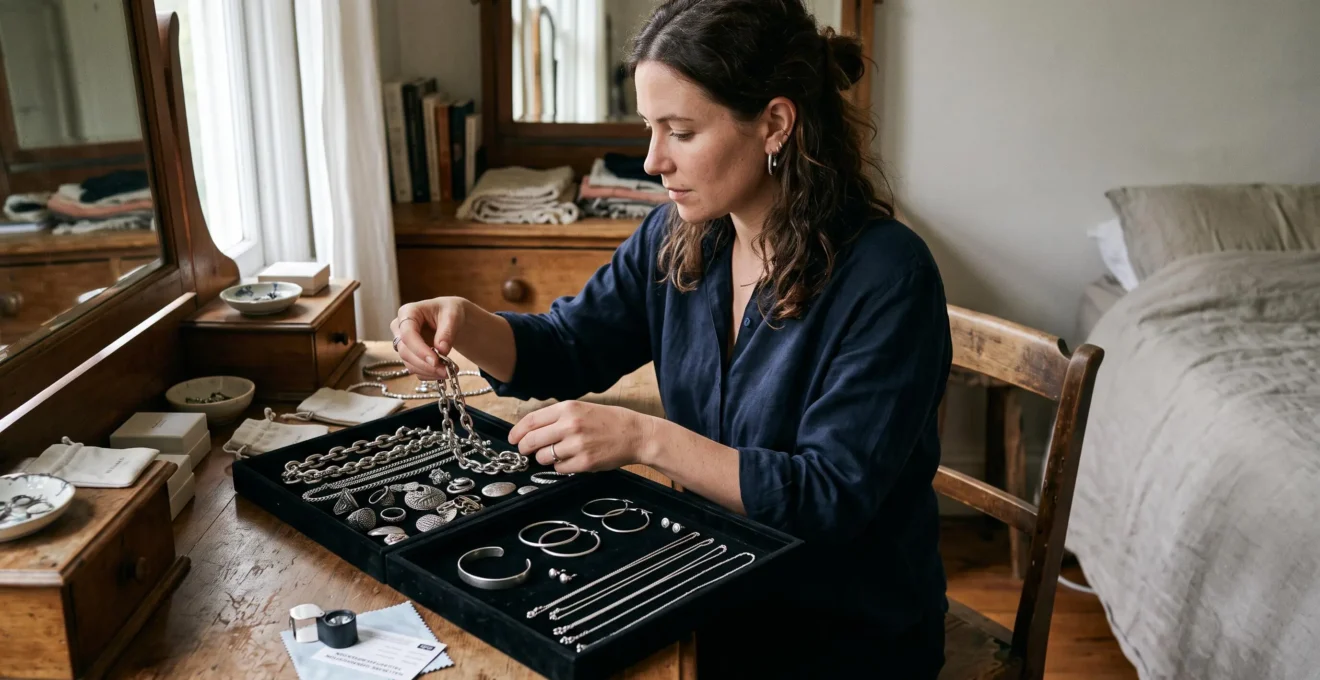
A bold silver cuff can transform an outfit today and feel overexposed next season. A simple sterling chain might never attract the same attention, yet become the piece you wear for years. Building a satisfying silver jewelry collection means recognizing that these purchases serve different purposes.
The most practical strategy is to establish a durable foundation of versatile pieces, then introduce trends selectively. That means assessing construction quality, personal styling preferences, cost per wear, and the stage of a trend before deciding what deserves a larger share of your budget.
Silver makes this balance particularly interesting because the same metal can produce minimalist staples, sculptural statement jewelry, and textured vintage-inspired designs. Its precious-metal content also creates a distinction between material value and fashion appeal. Neither a sterling hallmark nor a designer label guarantees that a particular piece will appreciate in value.
A well-balanced collection leaves room for experimentation without making your everyday wardrobe dependent on whichever aesthetic currently dominates fashion.
Silver Collection Essentials: What Matters Most
- Build your collection around well-made sterling staples that work across your most frequent outfits, then add trends that genuinely suit your style.
- Evaluate fashionable purchases by trend timing, expected wears, construction quality, and potential for future restyling rather than purchase price alone.
- Choose complementary silver finishes and versatile silhouettes so your core pieces remain appropriate for casual, professional, and formal settings.
- Why Silver Jewelry Trends Cycle Every 7-12 Years Historically
- Trend Pieces vs Classics: How to Allocate Your Silver Jewelry Budget
- How to Spot Emerging Silver Trends Before They Peak and Become Ubiquitous
- The Trend-Adoption Timing That Makes Pieces Feel Dated in 6 Months
- How to Restyle Dated Trend Pieces to Extend Wearable Life by Years
- How to Build a 5-Piece Silver Capsule Covering 20+ Outfit Combinations
- Bright Sterling vs Antiqued Finishes: Which for Daytime vs Evening Events?
- How to Match Silver Jewelry Finishes to Event Formality Without Fashion Missteps
Why Silver Jewelry Trends Cycle Every 7-12 Years Historically
Silver jewelry styles can return within a roughly seven-to-twelve-year window, but this is a useful observation framework rather than a historically established rule. Chunky chains, oxidized bohemian designs, and minimalist shapes repeatedly gain and lose visibility as designers reinterpret earlier aesthetics. Their actual revival timing depends on changing tastes, retail distribution, and cultural exposure.
Fashion revivals often draw on styles from previous decades. Silver jewelry can participate in shorter waves of renewed popularity because recognizable designs are available across different retail price points. A substantial chain necklace, for example, can move from a specialist designer’s collection into widely distributed fashion accessories without requiring the same financial commitment as some other precious-metal jewelry.
That accessibility can encourage faster adoption. Social media exposure, celebrity styling, and rapid retailer restocking may accelerate saturation, although no established evidence in the supplied sources assigns a precise number of years to these effects.
British Vogue‘s 2026 jewelry trend forecast illustrates how older aesthetics can be reinterpreted. Its coverage includes sculptural forms, substantial cuffs, and references to earlier fashion periods, alongside industry expectations for silver and mixed-metal jewelry. These are editorial observations and forecasts, not evidence of a predictable trend-cycle schedule.
A more reliable buying decision comes from identifying the current stage of a particular design rather than estimating its age.
| Trend stage | Observable signals | Buying implication |
|---|---|---|
| Emerging | Limited appearances among independent designers and niche makers | Potentially longer styling opportunity, but uncertain adoption |
| Peaking | Broad influencer exposure and availability across multiple retailers | Greater likelihood of purchasing a widely recognizable trend |
| Declining | Frequent markdowns, extensive clearance selections, and growing secondhand availability | Buy primarily for personal enjoyment rather than novelty |
| Dormant | Limited current promotion despite previous popularity | Consider whether the design works independently of its original era |
These signals are diagnostic clues, not a validated forecasting model. Discounting, for instance, can reflect ordinary inventory management rather than declining consumer interest.
Before buying a revived silhouette, look at examples from its previous period of popularity. If an older version still looks appealing with contemporary clothes, the design may have qualities that extend beyond its original trend.
Recognizing the cycle helps separate fashionable appeal from lasting usefulness. The next decision is how much of your jewelry budget should depend on each.
Trend Pieces vs Classics: How to Allocate Your Silver Jewelry Budget
Your silver jewelry budget should favor classics when you need reliable everyday accessories and allow more space for trends when statement styling is central to your wardrobe. There is no universally correct percentage. The appropriate split depends on how frequently you wear silver, how expressive your outfits are, and what you are comfortable spending on temporary novelty.
Rather than starting with a fixed allocation, assess three factors before purchasing: actual wearing frequency, preferred visual impact, and willingness to replace or retire trend-driven designs.
| Personal profile | Core collection priority | Trend purchasing approach |
|---|---|---|
| Frequent silver wearer with subtle styling preferences | Comfortable, durable staples worn repeatedly | Occasional experimental accents |
| Frequent wearer who favors statement jewelry | Well-constructed expressive pieces alongside practical basics | Selective purchases with several styling applications |
| Occasional wearer with limited novelty tolerance | Versatile pieces suitable for multiple occasions | Minimal spending on short-lived looks |
| Trend enthusiast comfortable with changing styles | A dependable core that remains usable between trends | A deliberate discretionary budget for experimentation |
Investment-grade needs careful interpretation in this context. For a personal jewelry collection, it can mean a well-made piece intended for extended ownership, not an asset expected to produce a financial return.
The Federal Trade Commission guidance on buying silver jewelry explains that sterling silver contains 92.5% pure silver and that a 925 marking indicates 925 parts of silver per thousand. Silver-plated jewelry, by contrast, has a layer of silver over another metal.
Composition is only one quality indicator. Examine clasp security, link connections, comfort, repairability, metal thickness, and the seller’s reliability. Solid construction may suit demanding everyday use, while some carefully engineered hollow designs can provide comfortable wear at lower weight. Neither construction type automatically guarantees resale value.
The simplest way to expose the cost of repeatedly replacing inexpensive trends is cost per wear: divide the purchase price by the number of times you realistically expect to wear the item.
Hypothetical comparison: One classic or repeated trend purchases?
Imagine a classic sterling necklace purchased for $120 and worn 120 times. Its purchase cost per wear is $1. A $30 trend necklace worn six times costs $5 per wear. Four such trend purchases would total $120 and deliver only 24 wears if each were worn six times.
These are illustrative assumptions, not observed consumer data. Repair expenses, resale proceeds, cleaning costs, and future wearing frequency could change the comparison.
Designer trend pieces require particular scrutiny. A high price does not transform a seasonal silhouette into an appreciating asset. Signature motifs associated with an established designer may retain collector interest better than generic interpretations, but realized resale prices and transaction costs must be investigated rather than assumed.
For long-term purchases, prioritize wearability, credible materials information, skilled construction, and emotional attachment. Consider resale potential a secondary possibility, not the justification for spending more.
Once your spending priorities are clear, the remaining challenge is deciding which emerging trends are worth entering before they become overexposed.
How to Spot Emerging Silver Trends Before They Peak and Become Ubiquitous
Emerging silver jewelry trends are easiest to recognize by comparing adoption across independent designers, influential fashion channels, and mass-market retailers. A silhouette appearing mainly among specialist makers may be relatively early, while widespread availability suggests broader adoption. This approach identifies possible opportunities but cannot guarantee that a trend will become popular or remain wearable.
Start by tracking shapes rather than individual products. Sculptural cuffs, unusual chain proportions, asymmetric earrings, and distinctive surface textures are easier to compare across collections when treated as design categories.
The following sequence offers a practical way to organize observations:
- Early adoption: Look for repeated design ideas among independent silversmiths, niche jewelry labels, and runway collections. Multiple independent interpretations are more informative than one isolated experiment.
- Mid-stage momentum: Watch for similar silhouettes entering mid-market collections, fashion editorials, and influencer styling. Availability is expanding, although the design may not yet feel ubiquitous.
- Late-stage saturation: Look for near-identical pieces across mass retailers, repeated advertising exposure, and frequent discounts. A trend can still be enjoyable at this point, but novelty may be harder to sustain.
Retail price distribution provides an additional clue. When versions of the same design simultaneously appear across budget, mid-market, and premium collections, the style has likely achieved broader commercial recognition than one offered mainly by specialist makers.
However, these stages do not necessarily happen in a fixed order. Some designs move directly from celebrity exposure to widespread retail availability. Others remain confined to an enthusiastic niche.
For a fashion-conscious collector, early adoption should be conditional on wardrobe compatibility. A distinctive piece is not automatically a worthwhile purchase simply because few people currently wear it.
Compare the prospective item against clothes you already own. Identify specific outfits and settings in which you could wear it without recreating a complete runway look. If the design needs an entirely new wardrobe to feel natural, its practical value may be limited.
Also distinguish trend momentum from personal preference. A style you continue to appreciate after several exposures is a stronger candidate than one that attracts attention only because it feels unfamiliar.
Trend recognition becomes more valuable when paired with restraint. The difference between discovering a promising style and buying it after everyone else often determines whether the purchase feels exciting or immediately familiar.
The Trend-Adoption Timing That Makes Pieces Feel Dated in 6 Months
A silver jewelry piece can feel dated within six months when it is purchased at the height of visual saturation. The material has not deteriorated, and the design has not necessarily disappeared from fashion. Instead, repeated exposure makes the accessory strongly associated with a particular moment, reducing its perceived novelty soon after purchase.
The six-month period is a possible experience, not a measured expiration date. Different consumers, communities, and jewelry styles adopt trends at different speeds.
Consider someone who first notices a chunky sculptural necklace after seeing it repeatedly in social media advertisements, fashion retail displays, and other people’s outfits. For that individual, the necklace feels like a new discovery. Across the wider market, however, the style may already be approaching peak recognition.
Entering a trend at that stage can create a compressed period of novelty. Waiting until clearance sales dominate may move the purchase even further away from the moment when the design first felt distinctive.
A practical pre-purchase test is to review the previous month:
- Have you seen essentially the same silhouette on several different people?
- Does it appear across multiple unrelated retail collections?
- Have targeted advertisements repeatedly shown close variations?
- Is its appeal tied mainly to recreating one recognizable fashion aesthetic?
Several positive answers suggest broader exposure, although they do not prove that demand is about to decline.
It helps to separate physical durability from social durability. A well-constructed sterling bracelet may remain mechanically sound for decades. Its styling relevance, however, can change as cultural associations shift.
That distinction affects how you care for different purchases. A seasonal accessory deserves realistic expectations about wearing frequency, while a high-quality trend piece that you still enjoy may deserve long-term storage even when it temporarily falls out of rotation.
Fashion revivals can make previously dated designs appealing again, but future rediscovery is uncertain. Storing a meaningful piece is a choice to preserve an option, not a forecast of renewed demand.
Even if a purchase eventually becomes associated with a previous fashion moment, it does not have to become unusable. Styling changes can give the same silver piece a different context.
How to Restyle Dated Trend Pieces to Extend Wearable Life by Years
To make dated silver jewelry wearable again, change the styling context that originally defined it. Remove excessive layering, pair one bold item with understated classics, or combine finishes in a more restrained arrangement. The goal is not to disguise the accessory but to stop reproducing the complete trend-era look that makes it feel outdated.
A chunky chain once worn alongside several oversized necklaces, for example, can become a standalone accent over a plain shirt. The design remains expressive, but its visual role changes from participating in a crowded trend to providing one deliberate focal point.
Oxidized silver rings previously associated with heavily layered bohemian styling may feel more contemporary when combined with minimal tailoring and a single polished bracelet. Similarly, a distinctive pendant can be transferred to a simpler chain, shifting attention from the original styling formula to the object itself.
Three useful changes are worth testing before abandoning a trend-driven piece:
- Reduce repetition: Wear one statement element rather than several pieces from the same original aesthetic.
- Change the surrounding wardrobe: Pair an expressive accessory with clean contemporary clothing instead of recreating the outfit from its trend peak.
- Alter the composition: Experiment with chain lengths, proportions, finishes, or placement while keeping the overall look coherent.
Physical modification offers another option when styling alone is insufficient. A jeweler may be able to shorten an oversized chain, resize a ring, or convert a pendant into a smaller charm. Feasibility depends on construction, materials, and any decorative details that could be damaged.
Before modifying a high-value, collectible, or sentimental piece, consider whether altering its original design would reduce the qualities that make it special. Request a professional assessment and written estimate rather than assuming every alteration is economical or reversible.
The strongest reason to remodel silver jewelry is continued enjoyment. Its material composition does not guarantee that the cost of professional work can be recovered through resale.
Restyling works particularly well when the rest of your collection contains flexible basics. A small, reliable capsule provides those neutral partners without requiring additional trend purchases.
How to Build a 5-Piece Silver Capsule Covering 20+ Outfit Combinations
A five-piece silver capsule can support 20 or more outfit-and-jewelry combinations when each accessory works with multiple clothing categories and can be worn alone or in selected pairings. The exact coverage depends on your wardrobe, not on a proven five-piece formula. Start with everyday earrings, a chain, a statement accent, a bracelet, and one convertible or layerable piece.
This approach adapts the principle of combining staples and expressive accessories found in Vogue’s jewelry wardrobe essentials feature. Its editorial recommendations cover everyday accessories and distinctive pieces; the five-item capsule developed here is a practical adaptation, not a formula established by that publication.
Give each item a distinct purpose so the collection can cover different outfits without unnecessary duplication.
| Capsule role | Suggested piece | Styling function |
|---|---|---|
| Everyday staple | Small sterling hoops or simple studs | Subtle finishing detail for repeated wear |
| Versatile necklace | Plain chain with a wearable everyday length | Standalone accessory or base for layering |
| Statement accent | Sculptural ring or distinctive cuff | Single focal point for simple outfits |
| Wrist staple | Slim bracelet or understated cuff | Balanced wrist detail across dress codes |
| Convertible element | Removable pendant or adjustable layerable chain | Changes proportions and combinations |
A statement cuff and wrist staple can overlap if the chosen designs are too similar. Selecting a sculptural ring for the statement role may improve versatility when a bracelet already occupies the fourth position.
Before purchasing, test the proposed pieces against three real wardrobe categories: casual everyday clothing, work or smart-casual outfits, and evening attire.
For an illustrative combination check, five pieces offer 31 mathematically distinct non-empty selections of accessories. Not every selection will be aesthetically appropriate or comfortable, and selecting several pieces together does not automatically create a good outfit.
A more practical hypothetical target is to identify seven suitable accessory arrangements for each of three clothing categories. That gives 21 documented outfit-and-jewelry pairings, provided the individual combinations genuinely work. Reusing the same jewelry arrangements with different outfits is acceptable because the outfit context changes.
Build and Verify Your Five-Piece Silver Capsule
- Photograph your three most frequently worn outfit categories and create a labeled reference set showing casual, work, and evening clothing.
- Select one candidate for each of the five capsule roles and record the complete proposed collection in a five-item inventory.
- Test each candidate against all three outfit categories and produce a compatibility grid marking which combinations look appropriate.
- Create seven workable jewelry arrangements for each outfit category, documenting 21 outfit-and-accessory pairings with notes or photographs.
- Review material quality, fit, and finish consistency; produce a final purchase or replacement list for any piece that fails the versatility test.
Finish consistency matters in a small capsule. Choosing pieces predominantly within one finish family makes layering easier and reduces the possibility of accidental visual clashes.
The capsule should also be built mainly from the timeless portion of your jewelry budget. Trend purchases can then add variety without making the entire collection feel dependent on one fashion period.
Once the essential silhouettes are established, finish selection becomes the next practical consideration, particularly when the same accessories must work throughout the day and into the evening.
Bright Sterling vs Antiqued Finishes: Which for Daytime vs Evening Events?
Bright polished sterling often suits refined evening outfits because its reflective surface produces crisp highlights under directional lighting. Antiqued silver can work especially well for relaxed daytime dressing, where darkened recesses emphasize texture and detail. These are styling tendencies rather than strict rules: design scale, clothing, lighting, and personal taste can change the effect of either finish.
High-polish silver has a smooth, light-reflective surface. On a simple hoop, cuff, or chain, that finish can create a clean appearance that complements tailored clothing and restrained eveningwear.
Antiqued or intentionally oxidized silver emphasizes recessed details through darker areas. This treatment can make decorative patterns, carved motifs, and textured surfaces more visually prominent. It often suits casual or vintage-influenced styling, although sophisticated evening designs can also use darkened silver effectively.
The maintenance implications deserve equal attention.
The Canadian Conservation Institute explanation of silver tarnishing describes how silver reacts with sulfur-containing gases, producing surface tarnish. It also explains that removing tarnish through polishing can remove small amounts of silver and that excessive polishing may damage plated objects.
Natural tarnishing and intentional decorative oxidation are not interchangeable. Darkened details deliberately created by a jeweler may form part of the design, so aggressive polishing can change the intended appearance.
For frequently worn daytime jewelry, textured finishes may make some minor surface marks less visually prominent, depending on the design. Bright polished surfaces can reveal scratches more readily under certain lighting. Neither finish is inherently maintenance-free, and scratch visibility is not determined by finish alone.
For a day-to-evening transition, a flexible combination is often more useful than relying on a single distinctive finish. Consider an antiqued bracelet with simple polished earrings, or a textured pendant worn on a restrained bright chain.
Adding one reflective accent can lift a relaxed combination for evening without requiring a complete change of accessories.
When buying a piece expected to cover several occasions, evaluate your actual calendar. The best finish is the one that works with the lighting, clothing, and maintenance routine you encounter most often.
Finish selection provides useful flexibility, but the overall formality of an outfit depends on more than surface treatment. Jewelry scale and complexity also determine whether a look feels appropriate.
Key Takeaways Before Choosing Jewelry for an Event
- Evaluate silver jewelry as part of the complete outfit: a polished piece can appear casual or formal depending on its shape, scale, and styling.
- Use simple capsule staples as your reliable fallback when the dress code is uncertain; introduce more distinctive pieces once expectations are clear.
- When combining finishes or metal colors, establish a dominant visual direction so contrasts look intentional rather than accidental.
How to Match Silver Jewelry Finishes to Event Formality Without Fashion Missteps
Match silver jewelry to an event by considering three characteristics together: visual scale, surface finish, and design complexity. Relaxed settings allow more experimentation with chunky or textured accessories, while formal occasions often benefit from controlled proportions and cohesive finishes. These are adaptable styling principles, not universal dress-code requirements, and the outfit should remain the primary reference.
The most common mismatch occurs when the visual message of an accessory conflicts with the setting. A collection of oversized, highly polished statement pieces may overpower understated casual clothing, while heavily layered oxidized bohemian jewelry can disrupt the restrained appearance expected at some formal events.
Neither combination is intrinsically unattractive. The issue is whether the jewelry supports the clothing and the expectations associated with the occasion.
| Event category | Useful silver characteristics | Styling consideration |
|---|---|---|
| Casual | Textured or antiqued finishes, expressive shapes, comfortable layering | Keep statement pieces manageable for everyday activities |
| Business or smart casual | Simple polished or softly textured designs, moderate scale | Prioritize cohesion and practicality with your clothing |
| Cocktail | Refined polished surfaces, sculptural accents, carefully balanced statement pieces | Choose one main focal point rather than competing accessories |
| Black tie | Considered proportions, cohesive metallic finishes, sophisticated shapes | Coordinate with the outfit’s neckline, fabric, embellishment, and dress code |
These pairings are flexible. A darkened silver piece can complement an elegant evening outfit, while polished sterling can work beautifully with a plain daytime shirt. Context matters more than any absolute rule about finishes.
Your five-piece capsule acts as a dependable styling safety layer. When uncertain, simple sterling hoops, a restrained chain, or a refined bracelet can complete an outfit without strongly tying it to a specific trend.
Once the dress code is understood, a sculptural cuff or more experimental combination can add personality.
Mixed metals and mixed finishes deserve similar consideration. They can create an intentional contemporary look, including for formal events, when the arrangement has a clear visual structure. A practical starting point is to choose one dominant metal family and introduce one contrasting accent.
This is a cohesion guideline rather than a prohibition on wearing more than two finishes. Proportion, repetition, and the relationship with clothing determine whether a combination succeeds.
For instance, polished silver earrings and a matching bracelet could anchor an evening outfit while a single gold-toned ring introduces contrast. Alternatively, an antiqued pendant may complement a polished chain when their shapes are visually compatible.
Maintenance and comfort should remain part of the decision. A secure clasp, appropriately sized ring, and non-snagging bracelet are more important during an extended event than achieving a theoretically perfect finish combination.
Before your next jewelry purchase, identify the outfits and occasions it must serve, check its construction and finish, and decide whether it strengthens your permanent collection or offers a worthwhile moment of experimentation. That distinction keeps trends enjoyable without making lasting versatility an afterthought.
Is sterling silver jewelry a good financial investment?
Sterling silver has precious-metal content, but jewelry prices also reflect design, craftsmanship, branding, retail margins, and other factors. A 925 marking identifies silver fineness, not an expected investment return. For most personal collections, durability and long-term enjoyment are more useful purchasing criteria than anticipated resale profits.
Should you keep silver jewelry that no longer matches current trends?
Keeping a well-made piece can make sense when you still appreciate its design or expect to restyle it. Store silver appropriately to reduce environmental exposure and avoid unnecessary polishing. A future fashion revival is possible but uncertain, so sentimental value and realistic reuse potential should guide the decision.
Can silver-plated jewelry belong in a timeless collection?
Yes, when its appearance, comfort, and expected wearing life suit your needs. However, silver plating is different from solid sterling silver and can wear over time. The underlying metal, plating quality, construction, and care requirements matter. Plated jewelry should not be valued as though it contained the same amount of silver as a comparable solid sterling piece.
How do you decide whether to repair, remodel, or replace an old silver piece?
Start by assessing the item’s condition, construction, sentimental importance, and likely future use. Ask a qualified jeweler whether repair or modification is feasible, what it would cost, and whether it could alter the original design. Compare that estimate with the benefit of continued wear rather than relying only on the original purchase price.
Does mixing bright and oxidized sterling make a collection less timeless?
Not necessarily. Mixed finishes can add depth and flexibility when pieces share compatible proportions or design details. A predominantly polished capsule with one textured accent, for example, can work across several outfits. The more important consideration is whether the accessories remain useful individually and together as your styling preferences evolve.