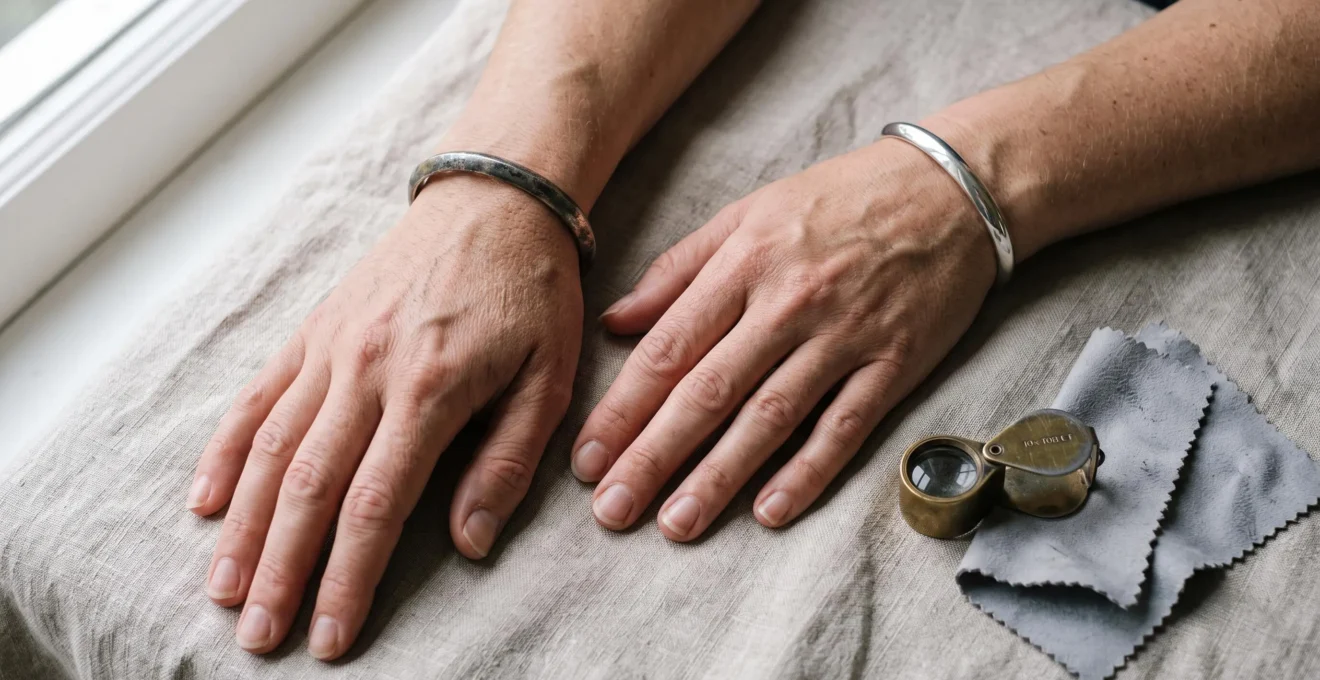
Two people can wear identical sterling silver rings and notice remarkably different results. One ring remains bright, while the other develops dark patches, leaves marks on the finger, or appears dull after repeated wear. This difference does not automatically mean that either person’s skin is unhealthy or that the jewelry is counterfeit.
Silver reacts differently because the chemical environment around each piece varies. Sweat composition, skin-surface acidity, cosmetic residues, exposure to sulfur compounds, alloy composition, and wearing habits all influence the condition of its surface. These factors interact rather than operating as a single predictable cause.
The distinction between tarnishing and an allergic reaction is especially important. A dark film on silver is generally a chemical surface change; itching, redness, or blistering may indicate irritation or contact dermatitis. Green staining introduces another possibility: corrosion products associated with copper-containing alloys.
Understanding these mechanisms helps identify whether a ring needs gentler cleaning, a protective finish, a different alloy, or medical assessment for persistent skin symptoms.
Silver and skin chemistry: the essentials
- Silver tarnish primarily involves reactions with sulfur-containing compounds; skin acidity alone cannot reliably predict tarnishing speed.
- Sterling silver contains 92.5% silver, with other metals contributing to its wear properties and potential discoloration.
- Gentle cleaning, reduced chemical exposure, and appropriate alloy selection are more useful than trying to change your skin’s natural chemistry.
- Why Acidic Skin pH Accelerates Silver Tarnish Faster Than Neutral pH
- How Diet, Medications, and Lifestyle Alter Skin Chemistry and Affect Silver Jewelry
- Clear Coatings vs Rhodium Plating: Which Barrier Best Protects Silver from Skin Oils?
- The Cosmetic and Product Buildup That Mimics Skin-Oil Tarnish but Isn’t
- How to Determine Your Personal Cleaning Frequency Based on Your Skin Chemistry
- Argentium vs Traditional Sterling Silver: Which Is Better for Nickel-Allergic or Reactive Skin?
- Left vs Right Hand Ring Symbolism: What Different Cultures Read
- What Do Different Ring Fingers and Positions Symbolise Across Cultures?
Why Acidic Skin pH Accelerates Silver Tarnish Faster Than Neutral pH
Acidic conditions can influence the corrosion behavior of metals in sterling silver, but lower skin pH does not automatically make jewelry tarnish faster. Black silver tarnish is primarily associated with sulfur-containing compounds, while the copper in sterling silver introduces additional reactions. Actual discoloration depends on several environmental and material factors working together.
Silver tarnish is commonly associated with the formation of silver sulfide (Ag₂S), a dark surface compound. The Canadian Conservation Institute identifies sulfur-containing atmospheric substances, including hydrogen sulfide, as important contributors to tarnishing. Moisture and salts may influence surface reactions, but water alone is not the principal explanation for black silver sulfide formation.
This chemistry helps distinguish two materials frequently confused in jewelry descriptions:
- Fine silver (999): approximately 99.9% silver, with very little added alloying metal. It can still tarnish through sulfur exposure.
- Sterling silver (925): 92.5% silver and 7.5% other metals, commonly including copper. Copper introduces additional possibilities for oxidation, corrosion, and colored residue.
Skin-surface pH adds complexity. Scientific measurement guidance recognizes that pH varies between anatomical sites and can be affected by environmental conditions, skin characteristics, and measurement methods. Consequently, a single pH reading cannot establish how quickly a particular ring will darken.
Nor is there reliable support in the supplied evidence for a universal claim that acidic skin makes silver tarnish four times faster. A numerical acceleration factor would require controlled comparisons of metal composition, sulfur exposure, temperature, humidity, and skin contact conditions.
A useful personal observation is whether discoloration appears repeatedly during wear and disappears after appropriate cleaning. Compare the same jewelry under reasonably similar conditions and document when changes occur. This may reveal an exposure pattern, but it cannot diagnose skin acidity.
When a previously reliable piece begins darkening unexpectedly, changes in sweat, activity, or products contacting the jewelry deserve consideration before concluding that the metal itself has changed.
How Diet, Medications, and Lifestyle Alter Skin Chemistry and Affect Silver Jewelry
Diet, medications, and lifestyle can influence human physiology, but their effects on silver jewelry are difficult to predict. Sweat contains salts and other compounds whose concentrations vary with physiological processes and sweat flow. Current evidence does not establish that particular foods, medicines, or hormonal changes consistently cause faster silver tarnishing during ordinary wear.
Human sweat is not simply water. Eccrine sweat contains sodium, chloride, potassium, and additional constituents that vary according to secretion and reabsorption processes. Material collected from the skin can also include substances contributed by sebum and surface contamination.
A scientific review of the mechanisms governing sweat composition explains why interpreting individual sweat constituents is complex. Variability in these constituents does not, by itself, establish a direct relationship between dietary changes and visible corrosion of silver.
Several everyday circumstances nevertheless change the conditions in which jewelry is worn:
- Exercise: increased perspiration and repeated friction can expose rings and bracelets to more moisture, salts, and residues.
- Hot climates: extended sweating and humid storage conditions may make consistent after-wear cleaning more important.
- Skin products: changes in sunscreen, moisturizer, or soap can introduce substances that remain on jewelry surfaces.
- Medication or hormonal changes: physiological changes may occur, but a new tarnish pattern cannot identify their cause.
Garlic, onions, red meat, antibiotics, and supplements are sometimes blamed for jewelry discoloration. The supplied scientific evidence does not demonstrate that consuming or taking these substances makes silver tarnish at a predictable rate. Treating such explanations as established would overstate what sweat physiology research shows.
A practical comparison is more informative. Note when discoloration begins, which piece is involved, whether it has been cleaned, and what external conditions have changed. If possible, observe the same ring across several ordinary wearing periods rather than relying on one unusually hot or active day.
Another wearer can provide an informal comparison, although differences in cleaning, handling, and environment prevent this from being a controlled test. A professional assessment of the alloy is more appropriate when authenticity is genuinely uncertain.
Once the pattern is reasonably clear, reducing contact with residues or introducing a protective surface barrier may be more practical than attempting to alter the body’s chemistry.
Clear Coatings vs Rhodium Plating: Which Barrier Best Protects Silver from Skin Oils?
Rhodium plating is often a practical protective finish for frequently worn silver jewelry because it creates a metallic surface barrier. Clear coatings and microcrystalline waxes offer alternatives when preserving the appearance of untreated silver matters more. Neither solution permanently prevents tarnish or skin contact, and durability depends on application quality, abrasion, and wearing conditions.
Rhodium is a precious metal applied as a thin surface finish. Its bright white appearance differs from the slightly warmer tone of untreated sterling silver. When continuous, the plating separates the underlying alloy from sweat, residues, and surrounding substances.
However, daily friction gradually affects plated surfaces. Rings, particularly those contacting other rings or hard objects, often experience substantial mechanical wear. Once the barrier becomes discontinuous, exposed areas of the underlying silver alloy may react again.
Clear protective coatings work differently. Depending on their formulation, they create an organic film over the metal. Some coatings can yellow, scratch, crack, or peel as they age. Microcrystalline wax is generally easier to remove and renew, but its protection is less durable under frequent handling or washing.
The choice becomes clearer when comparing how each option behaves in everyday use.
| Criterion | Rhodium plating | Clear coating or wax |
|---|---|---|
| Appearance | Bright, cooler white finish | Often preserves more of the original silver tone |
| Wear behavior | Gradually thins or wears through | May scratch, peel, or wear away depending on formulation |
| Frequent friction | Often a practical choice when properly applied | Generally requires more caution and maintenance |
| Renewal | Professional replating generally required | Product-dependent; some treatments can be removed and reapplied |
| Reversibility | Professional intervention may be needed | Some wax treatments are comparatively reversible |
For a daily-wear ring, discuss plating thickness, surface preparation, and future replating with a jeweler. For a pendant worn occasionally, a compatible clear protective treatment may be sufficient. Neither option should be applied indiscriminately to porous gemstones, delicate patinas, or antique jewelry.
The important distinction is between reducing environmental contact and treating a genuine skin allergy. A barrier may limit exposure while intact, but worn or damaged plating is not a dependable medical solution for someone allergic to an underlying metal.
Before paying for a protective finish, also establish whether the existing discoloration is true tarnish. Ordinary cosmetic buildup can sometimes create a remarkably similar appearance.
The Cosmetic and Product Buildup That Mimics Skin-Oil Tarnish but Isn’t
A silver ring that looks gray, cloudy, or dark is not necessarily tarnished. Sunscreen, moisturizer, soap film, cosmetics, and other residues can accumulate on its surface and reduce reflectivity. These deposits may resemble corrosion, but gentle cleaning can often remove them without the abrasion required for persistent tarnish.
The distinction matters because every unnecessary polishing session exposes the jewelry to avoidable surface wear. This is particularly important for plated pieces, engraved surfaces, decorative oxidized details, and delicate settings.
Common residue sources include:
- Hand creams and moisturizers, especially when applied immediately before putting on rings.
- Sunscreens and cosmetic products that leave persistent films.
- Soap and detergent residues remaining after washing.
- Perfumes, hairsprays, and other personal-care preparations contacting jewelry during application.
- Hand sanitizer and its accompanying formulation ingredients or displaced residues.
Surface appearance provides clues but is not a definitive chemical test. A slightly sticky or greasy film may suggest product buildup. A persistent dark layer can be consistent with tarnish, though other corrosion products, dirt, or damaged coatings are also possible.
The safest initial approach is to remove ordinary contamination before attempting tarnish treatment. Guidance from the Canadian Conservation Institute on silver care and tarnish removal emphasizes surface cleaning and warns that polishing can remove underlying silver.
For plain, uncoated sterling jewelry without vulnerable components, gentle cleaning with appropriately diluted mild detergent and water can help remove residues. Rinse and dry thoroughly. Jewelry containing pearls, porous gemstones, adhesives, or sensitive finishes requires material-specific guidance rather than routine immersion.
If discoloration remains, identify the jewelry’s finish before choosing a silver polishing cloth or specialist treatment. Strong abrasives and inappropriate chemical dips can damage plating and decorative surfaces.
Preventing buildup is equally important. Apply cosmetics before putting jewelry on, remove rings when exposure to products is likely, and avoid leaving moisture trapped beneath close-fitting bands.
After ordinary residues have been ruled out, a cleaning routine based on actual wearing conditions offers a more reliable solution than an arbitrary weekly polishing schedule.
How to Determine Your Personal Cleaning Frequency Based on Your Skin Chemistry
The best cleaning frequency is determined by how quickly your particular jewelry accumulates residue or discoloration, not by a universal timetable. Observe its appearance during normal wear, wipe it gently after use, and reserve more intensive cleaning for visible buildup that ordinary care does not remove. The aim is to maintain the finish with minimal abrasion.
Daily maintenance and periodic tarnish removal serve different purposes. A soft, clean, nonabrasive cloth can remove many surface residues after wear, while more intensive cleaning is appropriate only when the jewelry’s condition and construction permit it.
A practical starting experiment is to observe the number of days a clean piece remains acceptably bright. If it regularly becomes dull after six days, for example, try gentle preventative cleaning around the third day and assess whether that reduces accumulated residue. This half-interval method is a personal scheduling heuristic, not a scientifically validated corrosion formula.
Several variables should guide subsequent adjustments: perspiration during exercise, ambient humidity, product exposure, the presence of plating, the alloy used, and storage conditions. A frequently handled sterling ring may require a different routine from an occasionally worn pendant kept in suitable storage.
Build your five-step personal silver-care routine
- Record the starting condition: photograph the clean jewelry under consistent lighting and keep the image as a comparison reference.
- Track normal wear: note wearing duration and the first visible signs of residue or discoloration in a simple dated log.
- Separate light care from polishing: introduce a gentle after-wear wipe and record whether it removes deposits without abrasive treatment.
- Set a provisional interval: select a preventative cleaning point based on your observation window and document the proposed schedule.
- Review and adjust: compare later photographs and log entries, then lengthen or shorten the interval according to actual results.
Abrasive polishing should not become a daily habit. It removes small amounts of surface material, and repeated treatment can gradually compromise plated finishes, edges, and decorative details.
When jewelry remains bright between wears, store it clean and dry in suitable individual compartments or pouches, limiting contact with contaminants and avoiding abrasive contact between pieces.
If careful maintenance still leaves persistent discoloration or uncomfortable skin contact, changing the underlying alloy may offer a more satisfactory long-term option.
Argentium vs Traditional Sterling Silver: Which Is Better for Nickel-Allergic or Reactive Skin?
Argentium can be a useful alternative to conventional sterling silver for wearers concerned about tarnish, because its germanium-containing alloy is designed to resist discoloration. However, greater tarnish resistance does not establish that it is allergy-proof. People with confirmed nickel allergy should verify the composition of any jewelry, including conventional sterling and Argentium.
Traditional sterling silver contains 92.5% silver and 7.5% other metals, frequently copper. Argentium silver uses germanium as part of its alloying system, with compositions varying by grade. Its resistance to tarnishing is linked to protective surface chemistry rather than an externally applied rhodium coating.
An experimental study of sulfur reactions in silver-germanium alloys, published in the Journal of Materials Research and Technology in 2024, investigated silver-copper-zinc-germanium alloys using accelerated tarnish tests and computational methods. The work supports the role of germanium and protective oxide formation in improving tarnish resistance.
These laboratory findings are relevant to alloy selection but do not establish how long a specific ring will remain bright on an individual wearer. Daily friction, exposure conditions, and manufacturing differences remain relevant.
| Consideration | Traditional sterling | Argentium silver |
|---|---|---|
| Silver content | 92.5% for 925 sterling | Depends on the specified Argentium grade |
| Alloying approach | Commonly silver and copper | Germanium-containing silver alloy |
| Tarnish resistance | Can develop sulfur-related tarnish | Engineered for improved resistance |
| Nickel allergy | Exact product composition should be verified | Exact product composition should be verified |
| Availability and cost | Widely used | Availability and pricing depend on maker and product |
A 925 hallmark confirms the stated silver fineness; it does not provide a complete analytical breakdown of every alloying element, solder, plating layer, or component. Clasps and other findings can differ from the main jewelry body.
Black discoloration on metal should also be distinguished from allergic contact dermatitis. Persistent itching, redness, scaling, or blistering warrants medical assessment. A dermatologist may recommend patch testing to investigate possible contact allergens.
For people with established metal sensitivities, suitably specified titanium or platinum jewelry may be worth discussing. Fine silver is another possible option, although its mechanical properties and product construction require consideration. No material should be declared universally safe without accounting for the individual’s confirmed allergies.
Even after choosing a suitable alloy, the hand on which a ring is worn affects its practical exposure to friction, moisture, and everyday products.
Left vs Right Hand Ring Symbolism: What Different Cultures Read
Left- and right-hand ring traditions vary between cultures, religions, and personal preferences. In many English-speaking settings, wedding and engagement rings are associated with the left ring finger, while right-hand wedding traditions exist in several European communities. These symbolic choices also influence silver maintenance when they determine which rings remain on the hands throughout daily activities.
In the United States, United Kingdom, Canada, and Australia, a wedding band is commonly worn on the left ring finger. One historical explanation invokes the supposed vena amoris, or vein of love, imagined to connect that finger directly to the heart. This is cultural symbolism, not an accurate description of a unique anatomical vein.
Right-hand wedding-band traditions are found in countries and communities including Germany, Poland, and Greece, although practices differ between families, religious backgrounds, and generations. Some Jewish wedding ceremonies also involve placing a ring on the right index finger during the ritual, with later wearing customs varying.
The chemistry of silver does not change because a ring communicates marriage, engagement, or independence. Yet symbolism often influences wearing frequency, which changes the opportunities for contact with sweat, soap, personal-care products, and environmental substances.
Consider a hypothetical wearer who keeps a wedding ring on the left hand throughout ordinary daily activities but wears a right-hand fashion ring only on weekends. Even with identical alloy compositions, these pieces have different cumulative exposure histories. Differences in tarnish would not necessarily indicate different skin acidity between the hands.
Hand dominance is another practical consideration. The dominant hand may experience greater mechanical contact with objects and products, although the actual pattern depends on occupation, habits, and activities. More friction does not necessarily mean more chemical tarnish: it may also remove surface films unevenly or wear through plating.
For a ring worn continuously, accessible cleaning around the band and attention to trapped moisture are more important than cultural placement alone. Remove jewelry when appropriate for tasks involving incompatible chemicals, significant abrasion, or safety risks.
Finger selection adds another layer of cultural meaning, but ring fit, friction, and wearing habits remain equally relevant to anyone managing silver discoloration.
Key considerations before choosing a ring position
- Choose the hand and finger according to the cultural or personal message that matters to you, without assuming its meaning is universal.
- Consider how securely the ring fits and whether its position increases contact with products, friction, or trapped moisture.
- Match cleaning and alloy choice to actual wearing frequency rather than assigning a chemical property to a particular finger.
What Do Different Ring Fingers and Positions Symbolise Across Cultures?
Ring-finger symbolism depends on cultural tradition, historical context, and individual intention. The ring finger is frequently associated with romantic commitment, while index-finger, middle-finger, thumb, and little-finger rings can convey status, identity, or personal style. None has a universal meaning, and finger position does not independently determine how silver reacts with skin.
Historical ring customs developed in different social and cultural environments. Signet rings, for instance, could identify their owners or authenticate documents, whereas modern fashion rings often carry no formal symbolic meaning.
A practical overview illustrates these distinctions:
- Index finger: associated in some historical settings with authority, status, or prominent signet rings. It can also be a purely decorative position.
- Middle finger: frequently interpreted in contemporary fashion as representing balance or individuality, without a widely established universal commitment signal.
- Ring finger: strongly associated with engagement and marriage in many communities, although the preferred hand varies.
- Little finger: historically used for signet rings and sometimes connected with family or professional identity.
- Thumb: used in different periods and traditions for ornamental rings and sometimes interpreted as a sign of individuality or power.
These associations should be treated as conventions rather than fixed rules. A ring on the right index finger does not reliably identify its wearer’s relationship status, beliefs, or background.
From a jewelry-care perspective, the relevant question is how frequently the selected finger exposes the metal to skin contact and environmental substances. A middle-finger ring worn daily may accumulate more contamination than a signet ring reserved for formal occasions, regardless of the symbolic interpretation of either position.
Finger circumference, adjacent-ring contact, and fit also matter. A tight band can retain moisture and product residues, while overlapping rings may abrade each other’s surfaces. Such conditions influence maintenance needs without proving that one finger has chemically different skin.
Someone choosing a cherished silver ring can therefore combine three decisions: the message its position communicates, the alloy or protective finish appropriate for the wearer, and the effort needed to maintain the intended appearance.
Choose the finger that feels comfortable and carries the meaning you want, then observe how the jewelry behaves in normal wear. If discoloration develops, begin with gentle cleaning and exposure assessment; if persistent skin symptoms occur, seek appropriate medical advice rather than treating them as ordinary tarnish.
Why does my silver ring turn my finger green instead of black?
Green staining can result from copper-containing corrosion products in an alloy or from other materials present in the jewelry. Black tarnish is commonly associated with silver sulfide. Color alone cannot identify the exact compound or establish whether an item is genuine sterling silver.
Does black discoloration from a silver ring mean I have a metal allergy?
Not necessarily. Dark marks can result from transferred surface residues or corrosion products. Allergic contact dermatitis more typically involves symptoms such as itching, redness, or a persistent rash. If these occur repeatedly, stop wearing the suspected item and consult a healthcare professional about assessment and possible patch testing.
Can testing my skin pH predict whether silver jewelry will tarnish?
No reliable prediction can be made from skin pH alone. Tarnishing also depends on alloy composition, sulfur exposure, moisture, contamination, and wearing conditions. Skin pH varies across sites and measurement conditions, so an isolated reading cannot establish the rate of silver corrosion.
Should I stop wearing silver jewelry during exercise?
Removing silver jewelry before strenuous exercise can reduce exposure to sweat, friction, and accidental damage. It may also be advisable for safety during certain sports or activities. This is a practical preventative measure rather than proof that perspiration always causes immediate tarnishing.
Can tarnished silver become permanently damaged if I clean it too often?
Repeated abrasive polishing can remove small amounts of metal, soften decorative details, produce scratches, or damage thin plated finishes. Gentle removal of ordinary residue is different from intensive tarnish removal. The appropriate method depends on the jewelry’s construction and surface treatment.