Blog
Welcome to our jewelry and gemmology blog, a space created for anyone who has ever admired a sparkling stone and wondered what lies behind its brilliance. Whether you are choosing your first piece, curious about how a diamond is graded, or simply fascinated by the artistry of fine craftsmanship, this pillar page gathers the essential knowledge you need to navigate the world of jewelry with confidence.
Our approach is simple: education before anything else. Jewelry is often surrounded by jargon, marketing claims and myths. Here, we break everything down into clear, accessible explanations, so that every purchase decision, every question and every conversation with a jeweler becomes easier and more rewarding.
Why Jewelry Knowledge Matters More Than You Think
Buying jewelry is unlike buying almost any other product. A piece can carry emotional significance, represent a substantial financial investment, and last for generations — sometimes all at once. Yet most buyers enter a jewelry store knowing far less than they would before buying a car or even a smartphone.
Think of it this way: two rings can look identical to the naked eye, yet one may be worth three times the price of the other because of a subtle difference in cut quality, clarity or craftsmanship. Understanding these differences transforms you from a passive buyer into an informed one. That is exactly what this blog is built for.
Understanding Gemstones: The 4 Cs and Beyond
When people talk about gemstone quality, they usually refer to the famous 4 Cs, originally developed for diamonds but now extended to colored stones as well.
- Cut: the proportions and finish of the stone, which determine how light travels through it and returns to your eye. A well-cut diamond sparkles; a poorly cut one looks dull regardless of its size.
- Color: for diamonds, the absence of color is prized (graded from D to Z); for colored gemstones like sapphires or emeralds, the intensity and purity of the hue are what matter most.
- Clarity: the presence of inclusions, the tiny internal features nature leaves behind. Many inclusions are invisible without magnification and have little impact on beauty.
- Carat: a measure of weight, not size — one carat equals 0.2 grams. A one-carat round diamond may look different in size from a one-carat emerald-cut stone.
A useful analogy: think of the 4 Cs as the ingredients of a recipe. No single ingredient makes the dish — it is the balance between them that creates the result. A slightly smaller stone with an exceptional cut will often outshine a larger, poorly cut one.
Natural, Treated and Lab-Grown Stones
Modern buyers face a question previous generations rarely did: should you choose a natural gemstone, a lab-grown diamond, or a treated stone? Each has its place.
- Natural stones are formed over millions of years and carry rarity and heritage value.
- Lab-grown diamonds are chemically identical to natural ones and typically cost significantly less, making larger or higher-quality stones accessible.
- Treated stones, such as heat-treated sapphires or fracture-filled diamonds, can offer beauty at lower prices — but treatments must always be disclosed, as they affect both value and care requirements.
The key principle is transparency. A reputable seller will always tell you exactly what you are buying, including any treatments and whether a lab-grown stone is being offered.
The Craft: How a Piece of Jewelry Comes to Life
Jewelry is where art meets engineering. Behind every ring, pendant or bracelet lies a sequence of precise steps, often performed by specialists who dedicate decades to a single discipline.
- Design: the piece is sketched by hand or modeled in 3D software, defining proportions, stone placement and comfort.
- Wax modeling or 3D printing: a physical model is created to validate the shape before casting.
- Casting and shaping: metal — gold, platinum, silver or alternative alloys — is poured and worked into the basic form.
- Stone setting: the most delicate stage, where the setter secures each gem with microscopic precision, whether in prongs, bezels or pavé.
- Polishing and finishing: hours of handwork give the piece its final brilliance and smoothness.
Understanding this process helps you appreciate why craftsmanship affects price. A hand-finished piece requires many hours of skilled labor, and that quality shows in the durability and finish of the jewelry for years to come.
Metals Explained: Choosing the Right Foundation
The metal of a piece influences its color, weight, durability and price. Here is a quick orientation:
- Yellow gold: timeless and warm; pure gold is too soft for jewelry, so it is alloyed — 18-karat gold contains 75% pure gold.
- White gold: gold alloyed with whitening metals and typically rhodium-plated for a bright silver-like finish; the plating may need renewing over the years.
- Platinum: denser and more durable than gold, naturally gray-white, and prized for engagement rings; it develops a soft patina rather than wearing away.
- Silver: affordable and versatile, but softer and prone to tarnishing, best suited to occasional wear.
A practical example: for an engagement ring worn every day, platinum or 18-karat gold offers the best balance of beauty and resilience. For fashion pieces worn occasionally, silver or lower-karat gold keeps the budget reasonable without sacrificing style.
Buying with Confidence: Practical Guidance
Whether you shop online or in a boutique, a few fundamental habits protect you from disappointment and overpaying.
- Ask for certification. For significant diamonds, request a grading report from an independent laboratory. For colored stones, ask whether the gem has been treated.
- Request a written invoice describing the metal (karat or hallmark), the stones (species, weight, treatment status) and the total price.
- Compare before committing. Visit at least two or three sellers, or compare several online listings, to calibrate your sense of fair pricing.
- Check the return policy and warranty before purchase — reputable jewelers stand behind their work.
- Trust the details. Clean finishing, secure settings and crisp hallmarks are quiet signs of quality.
Think of certification as the « birthcertificate » of a gemstone: it does not guarantee beauty, but it guarantees identity — and identity is what determines value.
The Question of Price: What Should You Expect to Pay?
There is no single right budget, but there is a right value-per-dollar. A useful rule of thumb: allocate your budget toward the factors that most affect beauty — cut quality for diamonds, color saturation for colored stones — rather than chasing maximum carat weight. Many buyers later say they wish they had chosen a smaller, better-cut stone.
Caring for Your Jewelry: Making Beauty Last
Even the finest piece suffers without care. Fortunately, maintenance is simple when you know the basics.
- Remove jewelry before swimming, exercising, gardening or cleaning — chemicals and impacts are the two biggest enemies of gems and metals.
- Clean gently with lukewarm water, a drop of mild soap and a soft brush; rinse and pat dry with a lint-free cloth.
- Store pieces separately in soft pouches or a compartmented box, since gemstones can scratch one another.
- Have settings checked once a year by a professional; a loose prong caught early is a quick fix, but left alone it can mean a lost stone.
Note that some stones require special attention: emeralds, pearls and opals are more delicate than diamonds or sapphires and should never be exposed to ultrasonic cleaners.
Styles, Trends and Personal Expression
Jewelry is also a language of self-expression. Minimalist stacking rings, bold statement earrings, vintage-inspired settings and colored gemstone engagement rings have all gained popularity in recent years. Trends come and go, but a well-chosen piece reflects the wearer rather than the season.
A helpful exercise when choosing a style: look at the jewelry you already wear most often. Is it delicate or bold? Gold-toned or silver-toned? Classic or unconventional? Your existing habits are the most reliable compass for choosing new pieces you will actually wear.
What You Will Find on This Blog
This blog is organized to answer the questions real buyers and enthusiasts ask, in a logical progression from discovery to expertise:
- Gemmology explained: deep dives into diamonds, sapphires, emeralds, pearls and lesser-known gems, with clear grading explanations.
- Craftsmanship and materials: how jewelers work, how settings differ, and what makes a piece well made.
- Buying guidance: how to read a certificate, avoid common pitfalls, and choose engagement rings, wedding bands and gifts.
- Care and repair: cleaning routines, storage tips and advice on restoring heirloom pieces.
- History and culture: the stories behind famous jewels, symbolic traditions and evolving styles.
Begin Your Journey into the World of Jewelry
Jewelry does not have to be intimidating. Once you understand the basics — how stones are graded, how pieces are made, and what actually determines value — the entire world opens up. Every article on this blog is written to build that understanding step by step, with clarity and honesty.
Start with the topic that interests you most, take your time, and remember: there are no foolish questions in jewelry, only valuable knowledge waiting to be discovered. The more you learn, the more every sparkle tells you a story.

How to Integrate Decorative Silver Objects Into Modern Minimalist Interiors
A collection of inherited silver ornaments can seem difficult to accommodate in a home defined by clean lines, open surfaces and muted colours. Elaborate candlesticks, antique bowls and engraved decorative objects often carry more visual detail than contemporary minimalist interiors…
Lire la suite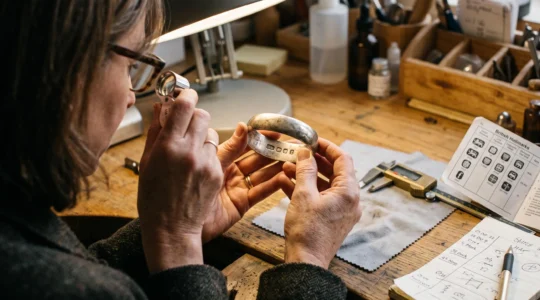
How to Decode Silver Hallmarks to Authenticate and Date Antique Pieces
An inherited silver bracelet may carry more historical information in three tiny stamped symbols than in its entire decorative design. A lion, a crown, an unfamiliar set of initials or a letter inside a shaped shield can provide clues about…
Lire la suite