Symbolism and Meanings
Jewelry has never been merely decorative. Long before the first diamond was graded on a certificate, humans were threading shells and carving bones into ornaments that carried messages: of love, of status, of protection, of belonging. Every ring, pendant, and bracelet you see today is the heir of a symbolic language thousands of years in the making. This pillar page introduces the vast field of jewelry symbolism and meanings, giving you the keys to understand what your pieces really say—and how to choose new ones with intention.
Why Jewelry Has Always Meant More Than Beauty
Think of jewelry as a silent language. A wedding band is a sentence; a mourning brooch is a paragraph; a signet ring is a signature. Throughout history, societies that could not read or write still communicated through ornament: a bead of a specific color could mark marital status, tribal affiliation, or even a prayer for safe travel.
Three functions have remained remarkably stable across civilizations:
- Identity: signaling who you are—your family, faith, or social rank.
- Protection: talismans and amulets believed to guard the wearer from harm.
- Emotion: portable tokens of love, memory, and grief.
Even in our modern, rational world, these functions persist. When someone wears their grandmother’s ring, they are not admiring its carats—they are wearing a memory.
The Symbolism of Gemstones
Gemstones are the richest vocabulary in the symbolic language of jewelry. Their meanings come from ancient mineralogy, religious texts, trade routes, and simple observation of their colors.
The Traditional Birthstone Calendar
The concept of birthstones traces back to the twelve stones of ancient breastplate traditions, later standardized into the calendar we know today:
- Garnet (January): protection and constancy.
- Amethyst (February): clarity of mind and sobriety.
- Aquamarine (March): calm and safe passage, a sailor’s stone.
- Diamond (April): invincible love, from the Greek adamas, unbreakable.
- Emerald (May): rebirth and fertility.
- Pearl (June): purity and innocence.
- Ruby (July): passion and vitality, the « king of stones. »
- Peridot (August): strength and renewal.
- Sapphire (September): truth, loyalty, and divine favor.
- Opal (October): hope and creative imagination.
- Topaz and Citrine (November): warmth and abundance.
- Turquoise and Tanzanite (December): protection and good fortune.
A practical example: a couple celebrating an April anniversary will often gravitate naturally toward diamond, not only for its brilliance but for its embedded message of enduring commitment.
Color Psychology in Stones
Beyond the calendar, color itself carries meaning. Red stones like ruby and garnet evoke blood, fire, and passion. Blue stones—sapphire, aquamarine, lapis lazuli—are associated with sky, water, and tranquility. Green stones such as emerald and jade connect to growth, nature, and luck, which is why jade remains a cornerstone of protective jewelry in many Asian traditions. Consider color a first reading, and the stone’s specific lore a deeper second reading.
Metals and Their Quiet Messages
Metals speak too, though in a lower register. Their symbolism derives largely from their physical behavior and historical rarity:
- Gold: the sun, permanence, and incorruptibility—it does not tarnish, which is precisely why it dominates wedding jewelry across cultures.
- Silver: the moon, reflection, and purity; traditionally linked to intuition and feminine symbolism.
- Platinum: endurance and discreet prestige, prized for its density and strength in settings.
- Rose gold: a modern alloy whose blush hue associates with romance and warmth.
An analogy: if gemstones are the words of jewelry’s language, metals are its grammar—setting the tone without ever shouting.
Motifs and Shapes: A Short Dictionary
Design elements carry some of the most accessible symbolism, because they are instantly recognizable:
- The heart: romantic love, but also, in older traditions, the seat of the soul.
- The infinity loop: eternal connection, popular in friendship and partnership jewelry.
- The serpent: simultaneously danger and healing, temptation and rebirth—Queen Victoria’s serpent engagement ring made it a Victorian emblem of eternal love.
- The tree of life: family, growth, and rootedness, common in generational gifts.
- The evil eye: protection from envy, found from the Mediterranean to the Middle East and now a global fashion staple.
- Claddagh hands, heart, and crown: friendship, love, and loyalty—the orientation of the crown even signals relationship status in Irish tradition.
Symbolism Across Cultures
Meaning shifts dramatically with geography. In India, the mangalsutra necklace marks marriage, its black beads serving as protection. In Chinese tradition, jade is worn to invite health and prosperity, often in the form of a butterfly for love or a gourd for longevity. Jewish wedding traditions use plain unbroken bands, symbolizing an unbroken vow. Understanding these contexts is not academic trivia—it prevents well-meaning missteps, such as gifting white flowers or pearls in cultures where they evoke mourning.
How to Choose Jewelry with Meaning: A Practical Framework
Knowing the symbolism is useful only if you can apply it. Follow this simple sequence when selecting a meaningful piece:
- Define the message. What do you want the piece to say—love, protection, remembrance, achievement?
- Match the material. Select a gemstone or metal whose traditional meaning aligns with that message.
- Layer personal history. A birthstone, a birth year engraving, or a family stone transforms generic symbolism into biography.
- Consider the wearer’s context. Cultural background, faith, and daily lifestyle should inform both the symbol and its durability.
- Document it. Keep a note of why the piece was chosen; meaning preserved is meaning doubled for future generations.
Consider a fictional case: a mother celebrating the birth of twins chooses a tree-of-life pendant set with two emeralds—green for growth, one stone per child, the tree for family. Every element works toward a single message, and decades later, the story is legible at a glance.
Wearing Symbols Today: Between Tradition and Personal Style
The contemporary wearer enjoys unprecedented freedom. You can honor a tradition, subvert it, or invent your own. Layering, for instance, allows a single wrist or neckline to carry several meanings at once: an evil eye bracelet for protection, a birthstone ring for identity, a heirloom locket for memory. The key principle of modern jewelry symbolism is intentionality—a piece chosen deliberately always carries more weight than one chosen casually.
Frequently Asked Questions
Do gemstone meanings have any scientific basis?
The protective and healing properties attributed to stones belong to folklore and symbolism, not science. Their value lies in cultural meaning and personal significance—powerful in their own way, just as a national flag has no physical power yet carries real emotional force.
Can I wear a birthstone that isn’t mine?
Absolutely. Birthstones are invitation, not restriction. Many people wear a child’s, partner’s, or loved one’s stone as a subtle token of connection.
Is it inappropriate to mix symbols from different cultures?
Mixing is generally welcomed when done with understanding and respect. Taking a moment to learn what a symbol means—rather than wearing it as a blank pattern—is what separates appreciation from appropriation.
The Lasting Power of Meaning
Jewelry endures because it compresses the intangible into the tangible. A gem can hold a promise; a band of metal can hold a lifetime. Whether you are deciphering an heirloom or choosing a future one, understanding symbolism turns every purchase from an expense into a story you can wear. Explore the detailed articles in this category to go deeper into each stone, metal, and motif—and let your next piece speak exactly what you mean.
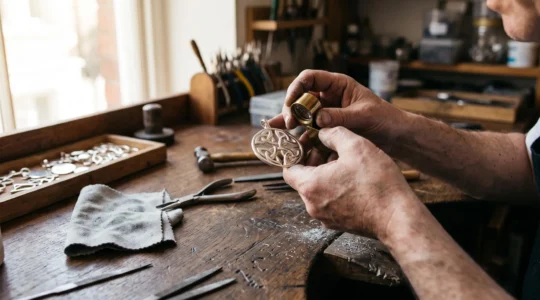
What Do Different Celtic Knot Patterns Actually Symbolise in Silver Jewelry?
A Trinity knot, a Lover’s knot and an Eternity knot can look remarkably similar when worked into silver. Yet the meaning someone attaches to each design may be quite different. The Trinity knot commonly represents threefold unity, the Lover’s knot…
Lire la suite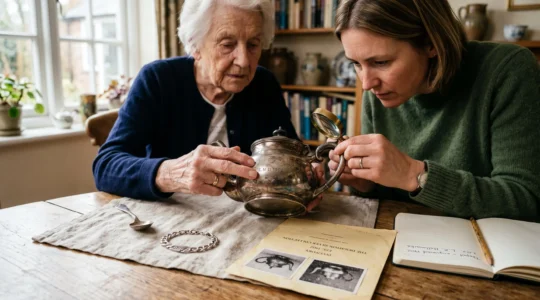
How to Transform Family Silver Into Transmitted Heritage Across Generations
A silver bracelet passed down by a grandmother may have little significance to a stranger but represent decades of family history to its inheritor. Without a record of who wore it, when it was acquired, or why it mattered, much…
Lire la suite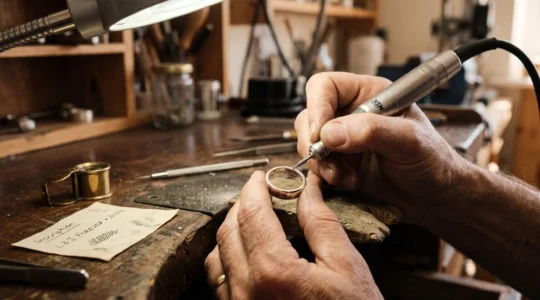
What Should You Engrave on Silver Jewelry to Ensure Lasting Meaning?
The most meaningful silver jewelry engraving is rarely the longest or most elaborate. A carefully chosen word, discreet symbol, meaningful location or brief personal dedication can express a connection that remains recognizable decades after the occasion that inspired it. Choosing…
Lire la suite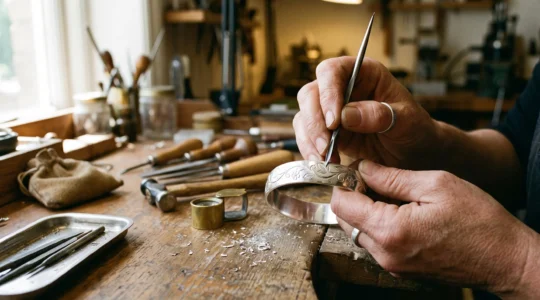
What Do Winding Vine Motifs Symbolise in Silver Jewelry Traditions?
Winding vine motifs in silver jewelry commonly evoke growth, enduring relationships, renewal and the continuity of life. Their symbolism emerges from the way living plants climb, branch, intertwine and regenerate. Yet a grapevine engraved on a historical ornament does not…
Lire la suite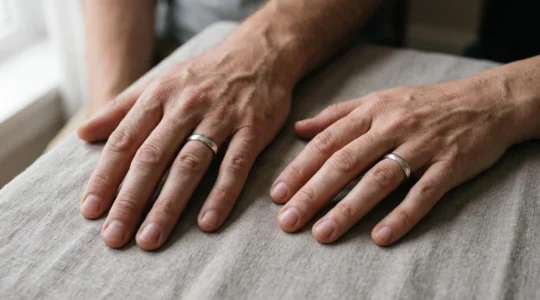
What Do Different Ring Fingers and Positions Symbolise Across Cultures?
A silver ring on the fourth finger of the left hand might suggest engagement or marriage in Britain. Move that same ring to the right hand, however, and its meaning may change considerably depending on where it is worn. In…
Lire la suite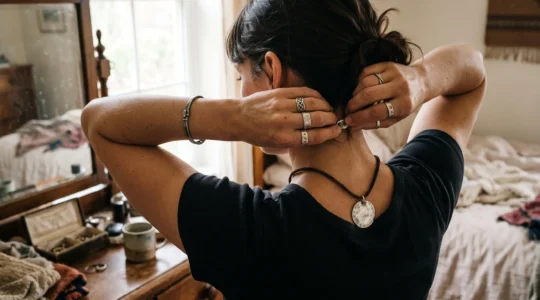
How Silver Jewelry Communicates Personal Narratives Without Words
Silver jewelry can express who you are without requiring you to explain yourself. A ring inherited from a grandparent, a pendant inspired by your heritage, or a bracelet marking a personal achievement can carry parts of your identity into everyday…
Lire la suite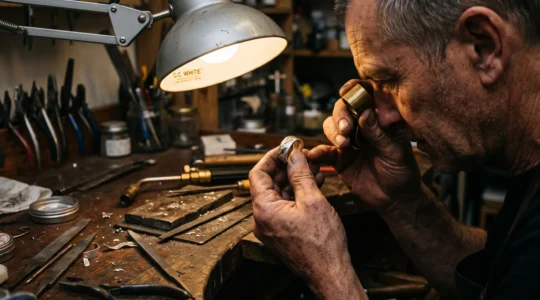
How to Verify Genuine Ethical Craftsmanship Behind Silver Jewelry Claims
A silver necklace can be described as handmade, sustainable and ethically sourced without those three claims referring to the same thing. The metal might be recycled while the piece is assembled in an undisclosed factory. A genuine artisan might use…
Lire la suite