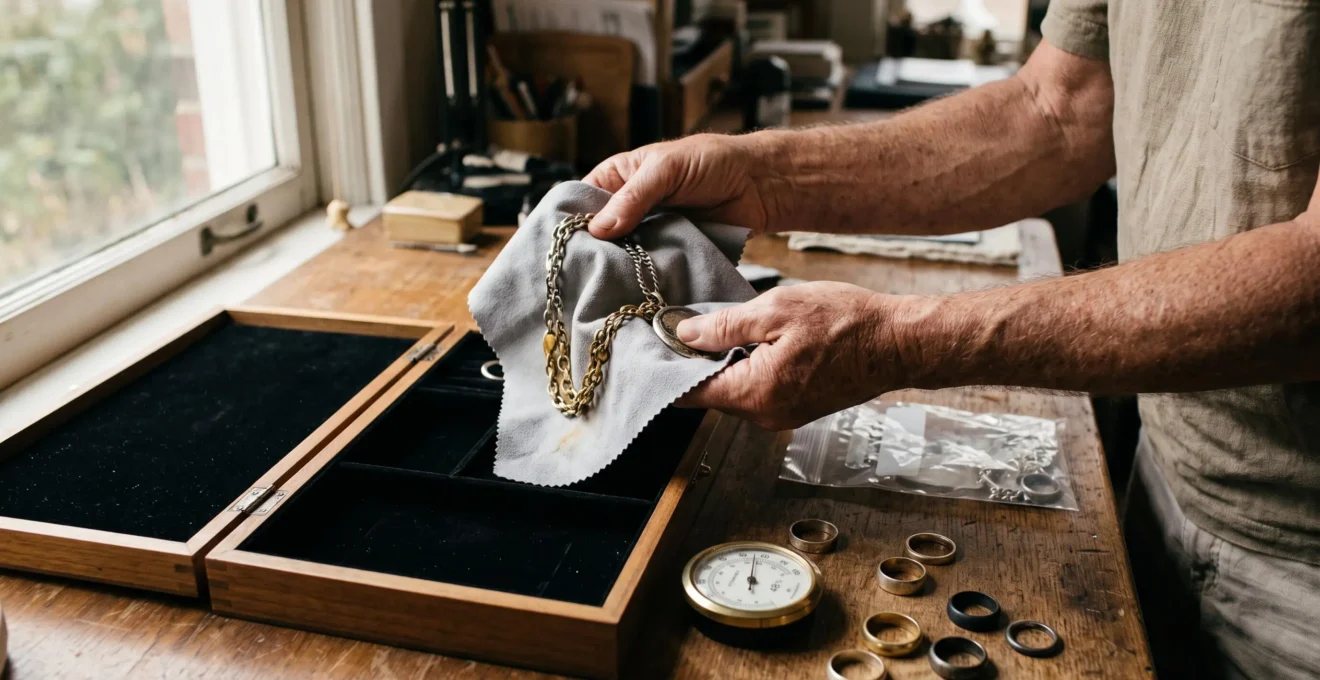
Silver does not tarnish simply because it encounters air. The familiar yellow, brown or black discoloration develops primarily when silver reacts with sulfur-containing gases, forming a thin layer of silver sulfide. Humidity, surrounding materials and storage conditions influence how quickly that reaction progresses.
Effective silver tarnish prevention begins with controlling sulfur exposure, managing moisture and limiting contact with unsuitable storage materials. Anti-tarnish fabrics, sealed polyethylene enclosures and appropriate desiccants can support these measures, but they work through different mechanisms. No single product provides permanent protection.
For collectors, understanding these distinctions matters more than finding another homemade cleaning recipe. Repeated polishing removes material, some electrochemical treatments alter surface appearance, and certain protective coatings introduce additional risks. Research in atmospheric corrosion and museum conservation offers a more reliable framework: prevent the chemical reaction where possible, inspect objects periodically and clean only when their condition genuinely requires intervention.
Silver tarnish prevention: the essential findings
- Control sulfur first: Hydrogen sulfide and other reactive sulfur gases are primary causes of silver sulfide formation. Removing nearby sulfur-emitting materials tackles the underlying problem.
- Combine appropriate barriers: Suitable sealed storage, sulfur-capturing materials and humidity control provide complementary protection. Silica gel alone cannot replace a sulfur sorbent.
- Minimize unnecessary cleaning: Abrasive polishing removes silver, while electrochemical reduction has its own limitations. Stable storage is preferable to repeatedly removing tarnish.
- What Happens Chemically When Silver Tarnishes Into Black Sulfide
- Anti-Tarnish Cloths vs Silica vs Chalk: Which Prevention Method Actually Works?
- Why Certain « Anti-Tarnish » Products Actually Accelerate Silver Degradation
- When to Remove Tarnish Before Sulfide Bonding Becomes Difficult to Reverse
- Electrochemical Cleaning vs Abrasive Polishing: Which Preserves Silver Long-Term?
- How Oxygen and Humidity React With Silver to Form Black Sulphide
- How Layered Protection Systems Extend Tarnish-Free Periods From Months to Years
- How to Create Museum-Quality Storage Environments for Silver at Home
What Happens Chemically When Silver Tarnishes Into Black Sulfide
Silver tarnishes when reactive sulfur-containing gases interact with its surface, producing silver sulfide (Ag₂S), a dark corrosion compound also known as acanthite. Sterling silver may additionally develop copper sulfide because its alloy contains copper. The resulting discoloration is a chemical surface change, not simply dirt or ordinary oxidation caused by oxygen alone.
Hydrogen sulfide (H₂S) is an important tarnishing pollutant, but it is not the only one. Carbonyl sulfide (OCS) also contributes to atmospheric silver corrosion. The simplified sulfidation reaction involving hydrogen sulfide and oxygen can be represented as:
4Ag + 2H₂S + O₂ → 2Ag₂S + 2H₂O
Oxygen can therefore participate in the overall chemistry, but exposure to ordinary oxygen by itself does not explain the characteristic black sulfide film. Reactive sulfur compounds are the decisive ingredient.
Controlled experiments reported by Franey, Kammlott and Graedel in a 1985 Corrosion Science study on atmospheric sulfur gases and silver examined hydrogen sulfide, carbonyl sulfide, carbon disulfide and sulfur dioxide. Under the experimental conditions, hydrogen sulfide and carbonyl sulfide produced sulfidation rates more than an order of magnitude higher than those associated with carbon disulfide and sulfur dioxide.
This is evidence that prevention must address reactive sulfur pollutants as a group, rather than focusing exclusively on the familiar smell of hydrogen sulfide.
Why silver changes from yellow to brown and black
Early tarnish often appears pale yellow or golden. With increasing film thickness, reddish-brown, blue and darker tones may develop before the surface looks black. These colors largely result from thin-film optical interference, not from the formation of separate yellow and brown corrosion compounds.
The Canadian Conservation Institute’s explanation of silver tarnishing describes interference colors associated with films approximately 10–100 nanometres thick. Films thicker than roughly 100 nanometres can appear black. These are illustrative optical ranges, not exact diagnostic thresholds for individual jewelry pieces.
Common sulfur sources include vulcanized rubber, wool and wool felt, protein-based glues, certain paints and adhesives, and sulfur-rich foods such as eggs. Some unsuitable paper, leather or packaging materials may also emit harmful compounds, although their safety depends on composition rather than appearance alone.
A collector who repeatedly discovers darkened silver in the same drawer should investigate the drawer lining, foam, adhesives and neighboring objects before purchasing another polish.
The next decision is choosing protective materials that interrupt this chemistry rather than merely conceal its consequences.
Anti-Tarnish Cloths vs Silica vs Chalk: Which Prevention Method Actually Works?
Silver-particle-impregnated anti-tarnish fabrics directly capture sulfur compounds, while silica gel primarily controls moisture. Ordinary chalk is not an equivalently validated sulfur-removal system. For reliable prevention, a suitable sulfur sorbent addresses the reactive pollutant and conditioned silica gel manages humidity inside an appropriately sealed enclosure. These materials serve complementary purposes rather than acting as interchangeable alternatives.
The distinction matters because the chemical reaction is driven by sulfur exposure, while humidity influences how readily corrosion progresses. Removing moisture without reducing a continuing sulfur source may slow tarnishing but does not eliminate its cause.
Properly designed silver-impregnated fabrics react sacrificially with sulfur-containing gases before those gases reach the protected objects. Their effectiveness depends on the formulation, available reactive material, pollutant exposure and storage conditions.
Silica gel adsorbs water vapor. It is useful in humid environments but is not a dedicated hydrogen sulfide sorbent. Calcium carbonate chalk may have limited moisture-related or acid-neutralizing uses, depending on its form, but the supplied conservation evidence does not establish ordinary chalk as an effective substitute for purpose-designed anti-tarnish materials.
The following comparison separates the mechanisms and practical limitations.
| Material | Main function | Practical limitation |
|---|---|---|
| Silver-impregnated anti-tarnish cloth | Captures reactive sulfur-containing gases | Finite reactive capacity; performance varies by product |
| Conditioned silica gel | Buffers or reduces relative humidity in enclosed storage | Cannot replace a sulfur sorbent; requires monitoring and conditioning |
| Ordinary chalk | Limited, formulation-dependent moisture or pollutant interaction | No established equivalence to tested conservation sorbents |
| Activated-carbon materials | Adsorb some gaseous pollutants | Hydrogen sulfide capture varies substantially with material and formulation |
Activated carbon also deserves scrutiny. A material advertised as a general odor absorber is not automatically effective against hydrogen sulfide. Conservation guidelines specifically identify poor hydrogen sulfide performance for certain activated-charcoal fabrics, although other carbon-based configurations may behave differently.
In a humid climate, measure storage humidity and improve enclosure quality before relying on extra desiccant packets. Where sulfur-emitting materials are present, removing those sources and using an appropriate sulfur-capturing material should take priority.
Silica gel has limited moisture capacity and must be replaced or reconditioned when necessary, following the manufacturer’s instructions. Temperature changes and unsuitable conditioning can compromise its usefulness. Likewise, anti-tarnish fabrics have finite service lives, but there is no scientifically established universal replacement interval for every commercial product.
Material selection is only half the problem: an incorrectly formulated or applied protective product can introduce new risks that outweigh its supposed benefits.
Why Certain « Anti-Tarnish » Products Actually Accelerate Silver Degradation
Some products sold for silver protection can contribute to deterioration when they contain reactive residues, abrasive ingredients or unsuitable coating materials. The risks are particularly significant for silver plating, porous gemstones, adhesives and antique finishes. Protection is therefore not simply a question of whether a product claims to prevent tarnish, but whether its chemistry and application are compatible with the object.
Commercial polishing cloths often contain abrasives. Their ability to brighten silver comes partly from removing surface material, which means repeated use on silver-plated jewelry can progressively reduce the thin silver layer. Protective agents left behind by polishing products may also create uneven tarnishing or other surface problems.
Deliberate oxidizing or sulfiding products, sometimes used to darken decorative recesses, are especially inappropriate when the objective is preserving a bright finish. Incorrect application can produce unwanted discoloration and complicate subsequent conservation.
Anti-tarnish strips and chemically treated fabrics also require compatibility checks. Although there is no basis for claiming that all such strips damage porous gemstones, direct chemical contact with sensitive jewelry components should be avoided unless the manufacturer has established suitability for those materials.
Why protective lacquer can become a liability
Lacquers can provide effective protection when properly selected and applied, but they are not permanent impermeable barriers. Surface defects, pinholes, aging and incomplete coverage may permit localized corrosion. Removing a deteriorated coating can itself be difficult, particularly from intricate or composite jewelry.
The Canadian Conservation Institute’s technical guidance on silver care and tarnish removal identifies the hazards of mechanical polishing, electrochemical methods, chemical residues and inappropriate coatings. These are treatment-specific risks, not proof that all commercial anti-tarnish products are harmful.
Storage materials present a related problem. Vulcanized rubber, unsuitable adhesives, some foams and certain paper products can release reactive gases. Newspaper is not an appropriate archival wrapping material because its composition and emissions are not adequately controlled.
Ordinary polyethylene zip-lock bags, however, should not be rejected categorically. Conservation guidance specifically recommends suitable sealed polyethylene bags for silver storage. The issue is material composition, additives, contamination and enclosure performance—not the zip-lock closure itself.
For uncertain materials, the most defensible approach is to use products documented as suitable for conservation storage rather than relying on appearance, odor or marketing labels.
Once an appropriate storage environment has been established, the next question is whether existing tarnish actually needs to be removed.
When to Remove Tarnish Before Sulfide Bonding Becomes Difficult to Reverse
Silver tarnish does not have a universal removal deadline. Light yellow or brown discoloration is generally easier to address gently than extensive dark deposits, but research does not establish a specific point at which silver sulfide bonds suddenly become irreversible. For valuable collections, early inspection is sensible; automatic removal at the first color change is not always beneficial.
As the sulfide layer develops, restoring a uniformly bright appearance can require more extensive treatment. However, the difficulty depends on film characteristics, surface geometry, previous treatments and the cleaning method—not simply how dark the object appears.
A visual assessment can help determine the appropriate response.
| Observed condition | Likely interpretation | Appropriate response |
|---|---|---|
| Uniform pale-yellow discoloration | Early visible tarnish may be present | Check storage conditions; consider gentle treatment only if necessary |
| Brown, blue or broadly darkened surface | More developed surface film may be present | Assess value, finish and material compatibility before cleaning |
| Localized black spots or suspected pits | Uneven corrosion or an underlying surface problem may exist | Investigate before abrasive or chemical treatment |
| Darkened engraved recesses | Possibly intentional patination | Preserve unless informed examination supports removal |
Importantly, black discoloration does not by itself prove that the underlying metal is pitted. Nor does a yellow tint automatically mean that urgent cleaning is required.
The distinction becomes critical for historical silver. Patination may be intentional, and darkened relief can contribute to the object’s appearance, interpretation and collectible value. Removing it indiscriminately can erase evidence of craftsmanship or alter an established finish.
“Tarnish need not be removed before storage.”
That conservation position also reflects another important observation: an existing tarnish layer may slow further reaction under some conditions, while freshly polished silver can tarnish relatively quickly. Tarnish is not an excuse to ignore poor storage, but cosmetic cleaning is not automatically protective.
For ordinary modern jewelry, a light polish may be appropriate when the appearance becomes unacceptable. For antique, plated, gilded or composite pieces, an assessment by a qualified conservator is a safer starting point.
When removal is justified, the choice between electrochemical reduction and abrasive polishing determines what happens to the metal surface.
Electrochemical Cleaning vs Abrasive Polishing: Which Preserves Silver Long-Term?
Electrochemical reduction can convert silver sulfide back into metallic silver without mechanically abrading the surface, whereas polishing physically removes tarnish and some underlying material. However, electrochemical cleaning is not inherently risk-free: it may produce a matte finish, alter surface texture or cause pitting under certain conditions. The safer method depends on the object’s construction, value and intended appearance.
Abrasive polishing works by physically removing surface deposits. Fine, appropriately selected polishing materials may be suitable for robust everyday silver, but even gentle abrasion can accumulate over repeated treatments. Thin silver plating is especially vulnerable because the decorative silver layer is finite.
Conservation guidance identifies precipitated calcium carbonate as a comparatively gentle polishing material. This should not be confused with coarse ground chalk or other abrasive powders, which may scratch delicate surfaces.
Electrochemical reduction relies on a different mechanism. When tarnished silver makes appropriate electrical contact with aluminum in a suitable electrolyte, a galvanic reaction permits the reduction of silver sulfide while the aluminum undergoes oxidation.
The chemistry differs from abrasive removal because part of the sulfide film can be converted back to metallic silver. This does not mean that every feature of the original polished surface is recovered. Fine texture, reflectivity and historic patination can change.
The familiar household aluminum-foil-and-baking-soda bath is related to this principle. However, the documented Canadian Conservation Institute treatment uses sodium carbonate (washing soda), not sodium bicarbonate (baking soda), in warm solution. Its findings should not be treated as direct validation of every household recipe or immersion time.
Immersion can be inappropriate for jewelry containing glued gemstones, vulnerable resins, porous stones, mixed-metal components, hollow constructions or sensitive finishes. Recessed areas may respond unevenly, and a bright original finish may become dull or matte after treatment.
| Object type | Preferred approach | Main consideration |
|---|---|---|
| Modern, solid silver with light tarnish | Careful, minimal polishing when needed | Limit cumulative abrasion |
| Ordinary, heavily tarnished solid silver | Evaluate suitability of electrochemical treatment | Surface change, pitting and immersion risks |
| Silver-plated jewelry | Avoid repeated abrasive treatment | Finite silver layer |
| Antique, valuable or composite jewelry | Professional assessment | Irreversible alteration of original materials and finishes |
No comparative mass-loss figures are established in the supplied evidence, so claims that one method preserves a specific percentage more silver than another would be unjustified.
Because every cleaning intervention has limitations, controlling the surrounding atmosphere remains the more sustainable preservation strategy.
How Oxygen and Humidity React With Silver to Form Black Sulphide
Humidity accelerates silver tarnishing mainly by supporting reactions involving sulfur-containing pollutants, while oxygen can participate in atmospheric corrosion chemistry. Neither ordinary moisture nor oxygen alone explains the characteristic black silver sulfide deposit. When reactive sulfur gases and moisture occur together, sulfidation can progress more rapidly than under drier conditions with comparable pollutant exposure.
Water molecules adsorbed on metal surfaces influence gas dissolution, surface reactions and transport processes. This is why the same silver object may tarnish at different rates in storage environments with different humidity levels.
Atmospheric corrosion research supports a water-enhanced contribution to sulfidation, but the relationship is not adequately described by a universal rule such as every increase in humidity producing an identical percentage increase in tarnish.
Air quality also matters. Sulfur dioxide, oxidizing pollutants and other contaminants can participate in complex atmospheric reactions. Some pollutants form acidic species in the presence of moisture, although their effect on silver differs from the direct formation of silver sulfide by more reactive sulfur gases.
Bathrooms and kitchens are often unsuitable storage locations because they experience fluctuating humidity, frequent handling and possible exposure to cleaning products or cooking-related contaminants. A closed bedroom cabinet in a controlled environment is generally easier to manage.
What humidity level is appropriate?
The Canadian Conservation Institute recommends storage below 50% relative humidity for silver. This provides a practical conservation benchmark rather than a guarantee that tarnish will stop entirely.
For jewelry containing wood, leather, organic adhesives or humidity-sensitive gemstones, the requirements of those materials must also be considered. Extremely dry conditions can be inappropriate for certain composite objects, and rapid humidity fluctuations may introduce additional stress.
The most defensible household objective is a suitable, relatively stable microclimate, verified with an appropriately positioned hygrometer. Readings should reflect conditions inside the actual storage enclosure rather than only the surrounding room.
Where humidity remains elevated, improving enclosure performance and maintaining an appropriate desiccant can be more useful than repeatedly cleaning silver that continues to be exposed.
These environmental controls become considerably more useful when incorporated into a coordinated system with barriers and sulfur-removal materials.
How Layered Protection Systems Extend Tarnish-Free Periods From Months to Years
Layered storage systems can protect silver more effectively than an isolated anti-tarnish product because they address several routes of deterioration simultaneously. Removing sulfur sources, enclosing objects, controlling moisture, capturing pollutants and checking conditions periodically each reduce a different vulnerability. Such systems can support long-term preservation, although no universal number of tarnish-free months or years can be guaranteed.
A practical protection system can be organized into four connected layers.
- Source control: Remove known sulfur-emitting materials, potentially reactive packaging, unsuitable adhesives and contaminated liners from the immediate storage area.
- Physical isolation: Separate silver from surrounding air using compatible wrapping and an appropriately sealed polyethylene bag or storage container.
- Microclimate management: Add suitable sulfur-capturing material and conditioned silica gel where the measured environment requires them, without allowing incompatible products to contact sensitive surfaces.
- Periodic verification: Inspect silver, check humidity, examine packaging integrity and maintain sorbents according to the conditions and product instructions.
The advantage is resilience. If an enclosure admits some outside air, a suitable pollutant sorbent may reduce part of the resulting exposure. If relative humidity changes, conditioned desiccant may help buffer fluctuations. These effects are complementary, but they should not be described as mathematically multiplicative without controlled performance data.
The Canadian Conservation Institute’s preventive-conservation guidelines for metal objects document coordinated environmental controls, protective storage materials and museum-scale examples of silver preservation.
Museum case study: National Gallery of Canada silver storage
The National Gallery of Canada has used silver-storage cabinets with tarnish-preventing fabric liners in an environment maintained at approximately 35% relative humidity. Conservation guidance describes the use of coordinated storage design, filtration, sorbents and moisture control.
In the documented institutional context, suitable silvercloth liners, desiccants and activated-charcoal systems can perform for up to 10 years. That figure reflects the specific museum arrangements and must not be interpreted as a guaranteed service life for consumer anti-tarnish products or home storage systems.
The museum example is valuable because it demonstrates system-level conservation rather than promoting a single product. The controlled storage environment and maintenance arrangements are as important as the materials themselves.
A home collector can apply the same logic at smaller scale: isolate objects, measure the environment and replace materials when their condition or the manufacturer’s guidance warrants it.
Visual inspections every few months offer a practical starting point, with greater frequency when storage conditions are uncertain or objects are handled regularly. This is an operational suggestion, not a scientifically established inspection interval applicable to every climate.
With these principles established, building an effective home-storage arrangement becomes a manageable sequence of decisions rather than an expensive attempt to reproduce a museum laboratory.
What to prioritize before setting up silver storage
- Investigate existing storage materials before adding sorbents; a sulfur-emitting lining can undermine otherwise careful protection.
- Use the object’s construction and sensitivity to determine which barriers, wrapping materials and humidity conditions are appropriate.
- Evaluate success through stable storage readings and documented object condition, not an unverified promise of permanent tarnish prevention.
How to Create Museum-Quality Storage Environments for Silver at Home
Museum-informed silver storage at home relies on compatible materials, suitably sealed containers, controlled humidity and minimal exposure to sulfur-containing pollutants. Collectors do not need specialized display cases to apply these principles. A carefully selected polyethylene enclosure, appropriate protective wrapping and periodic environmental checks can provide meaningful protection, provided the needs of gemstones, adhesives and other components are respected.
Begin by examining the existing storage area. Identify everything touching the silver, including velvet-like linings, foam inserts, drawer materials, padding and adhesives. An attractive jewelry box is not necessarily chemically suitable for long-term preservation.
Polyethylene, polypropylene and suitable polyester films are commonly used in conservation storage, but specific product formulations matter. Choosing a familiar polymer name does not establish that every additive, coating or adhesive is safe.
Acid-free archival tissue can provide a protective separation layer, particularly when combined with appropriate tarnish-preventing materials. A suitably sealed polyethylene bag can then reduce exchange with the surrounding atmosphere.
Place any desiccant or reactive sorbent according to the supplier’s compatibility instructions. Avoid loose particles and unverified chemical products contacting jewelry directly, especially if it contains porous stones or delicate surface finishes.
Five-step silver storage audit
- Inventory the collection: Record each item’s material, plating status, gemstones and visible tarnish. Deliverable: a labeled inventory with baseline photographs.
- Audit contact materials: List box linings, adhesives, foams, papers and wrapping materials, identifying known or suspected risks. Deliverable: a storage-material checklist.
- Check enclosure performance: Inspect seals, closures and gaps, and replace unsuitable storage materials with documented conservation-compatible alternatives. Deliverable: an enclosure inspection record.
- Measure humidity: Place a hygrometer where it reflects storage conditions and record readings over multiple observations. Deliverable: a dated humidity log.
- Establish maintenance: Record when sorbents or desiccants were installed, note their care instructions and schedule the next visual inspection. Deliverable: a maintenance record linked to each storage container.
For frequently worn jewelry, storage is only part of the strategy. Perspiration, skin oils, cosmetics and handling residues can remain on the silver after use. Wiping an appropriate item gently with a clean, soft cloth before storage helps remove surface contamination without making abrasive polishing a daily routine.
Jewelry with fragile coatings, porous gemstones or sensitive attachments may require a different cleaning approach. Avoid automatically rinsing or immersing pieces whose construction has not been checked.
Objects that are rarely handled should generally remain protected rather than being repeatedly unwrapped for unnecessary polishing. When an inspection reveals discoloration, compare it with baseline photographs and determine whether the cause is continuing environmental exposure, actual surface deterioration or an established decorative patina.
Long-term success should be evaluated through observable outcomes: fewer new discoloration areas, consistent environmental readings and the absence of treatment-related surface damage.
Start by auditing one storage box and photographing its contents. Correct identifiable material risks, check humidity and establish a simple inspection record before expanding the arrangement across the collection. Preventing unnecessary deterioration is more valuable than repeatedly restoring a polished appearance after the damage has occurred.
Can silver tarnish completely stop inside an airtight container?
An appropriately sealed enclosure can greatly reduce exposure to airborne pollutants, but it does not guarantee permanent protection. Residual contaminants, materials placed inside the enclosure, imperfect seals and changes in storage conditions can still influence tarnishing. Compatible wrapping, sulfur control and periodic inspection remain important.
Does sterling silver tarnish differently from pure silver?
Both can develop silver sulfide, but sterling silver contains copper, so its tarnish may also include copper sulfide. The alloy composition and environmental exposure can influence surface reactions. Preventive storage principles remain broadly similar, although other jewelry components must also be considered.
Is silica gel safe to place directly against silver jewelry?
Silica gel is used to manage humidity, not as a polishing or contact-cleaning material. Keeping it in an appropriate, intact sachet or separate compartment reduces the risk of loose particles contacting jewelry. Its moisture capacity should be monitored, and handling or reconditioning instructions should be followed.
Are commercially available zip-lock bags suitable for long-term silver storage?
Suitable polyethylene zip-lock bags are recommended in conservation guidance. However, the composition and condition of the actual bag matter. Avoid unknown additives, contaminated packaging and unsuitable materials enclosed alongside silver. For especially valuable collections, select products documented for conservation use.
Can a silver object become tarnish-free again without polishing?
Electrochemical reduction can convert silver sulfide back to metallic silver without mechanically abrading the surface, but it is not appropriate for every object and may change the finish or produce pitting. For valuable, historic or composite jewelry, professional assessment is preferable to experimenting with household cleaning baths.