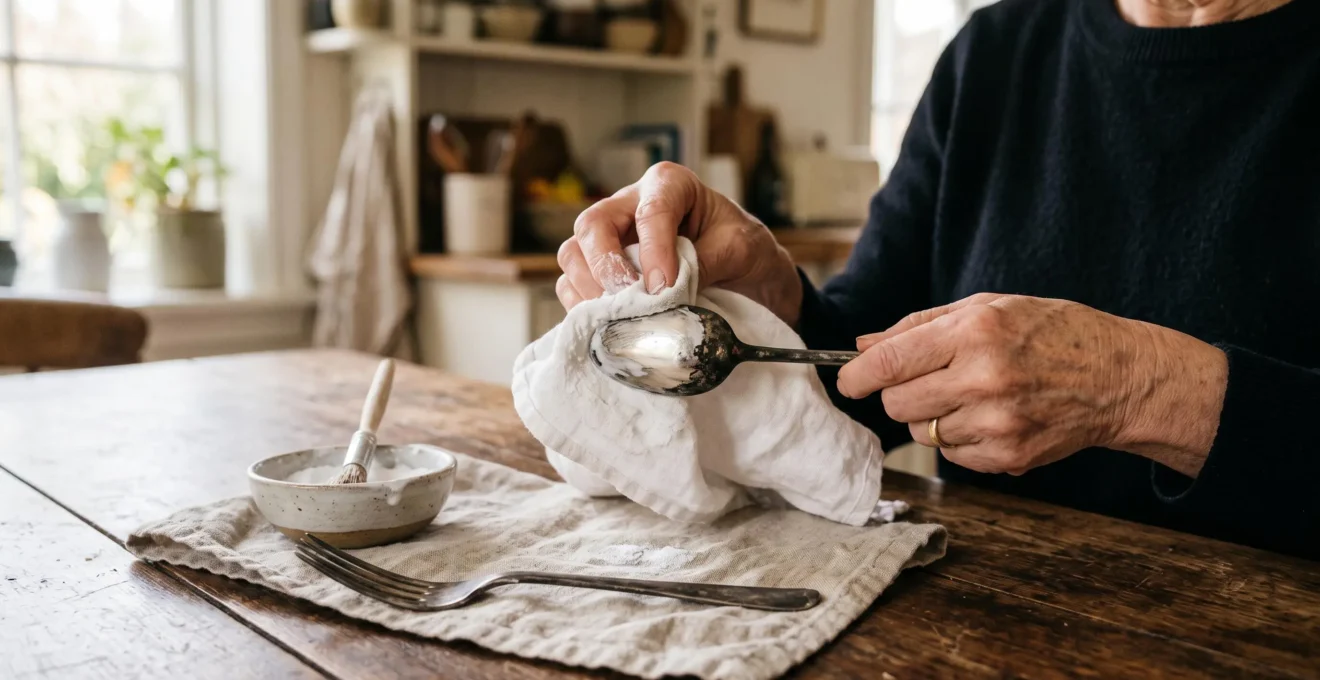
Warm water, mild dish soap, baking soda and aluminium foil are familiar household materials that can help clean silver, but they are not equally safe for every object. The best choice depends on whether the surface is solid silver, silver-plated, coated or decorated with gemstones. It also depends on whether the problem is ordinary dirt or chemical tarnish.
For routine cleaning, diluted mild dish soap and a soft cloth are usually the least aggressive starting point for suitable, water-resistant pieces. Baking soda paste introduces abrasion, while an aluminium-foil bath relies on an electrochemical reaction that has its own limitations. Neither should be treated as universally harmless.
Understanding what actually causes silver to darken makes it easier to choose a method that cleans without sacrificing valuable surface detail. This guide explains the chemistry, practical household options, situations requiring extra caution and storage habits that reduce the need for repeated cleaning.
Safe silver cleaning at a glance
- Start gently: mild dish soap, lukewarm water and a soft cloth are the preferred first step for compatible, intact silver objects.
- Use baking soda cautiously: paste can scratch or alter finishes, while foil-based electrochemical cleaning is unsuitable for many composite and gemstone-set pieces.
- Prevent recurring tarnish: thorough drying and protected storage reduce unnecessary polishing and cumulative surface wear.
- Why Ammonia-Based Cleaners Strip Silver Surface Layers Over Time
- Baking Soda Paste vs Commercial Dips: Cleaning Speed vs Long-Term Safety
- How Aluminium-Foil Electrochemical Cleaning Removes Tarnish Without Abrasion
- Why Ultrasonic Cleaners Can Loosen Stone Settings Over Time
- How to Adjust Cleaning Solutions When Silver Contains Sensitive Gemstones
- How Electroplating and Rhodium Finishing Protect Silver Without Harsh Home Cleaning
- Electrochemical Cleaning vs Abrasive Polishing: Which Preserves Silver Long-Term?
- What Actually Prevents Silver Tarnish According to Materials Science?
Why Ammonia-Based Cleaners Strip Silver Surface Layers Over Time
Ammonia-containing cleaners can damage some silver objects, especially sterling silver and silver-plated pieces, but not simply because ammonia steadily dissolves their silver surface. A documented concern is that ammonia can react with exposed copper in silver alloys or beneath plating. Residues trapped in crevices may contribute to corrosion, making repeated or poorly rinsed cleaning particularly undesirable.
Sterling silver contains 92.5 % silver and 7.5% copper. That copper improves the alloy’s practical properties but introduces an additional chemical vulnerability. The Canadian Conservation Institute explains that ammonia in certain silver polishes can form soluble copper-ammonia complexes, allowing copper to dissolve and potentially contributing to green corrosion products.
This mechanism is important because damage can develop in places that are difficult to inspect or rinse, including seams, hollow details and decorative recesses. Protective coatings and attached materials may introduce further compatibility concerns, although ammonia damage to lacquer cannot be assumed without identifying the particular coating.
Some glass cleaners and household cleaning formulations contain ammonia. Before applying an unfamiliar product, examine its ingredient information for terms such as ammonium hydroxide or aqueous ammonia. Product composition varies, so the category or familiar household name alone does not establish whether ammonia is present.
Likewise, a homemade mixture is not necessarily mild. A recipe described as natural or inexpensive may still contain substances that react with metal, coatings, adhesives or gemstones.
Dull areas, uneven reflectivity or localized pitting are reasons to stop cleaning and examine an object more carefully. They do not, by themselves, establish previous ammonia exposure. Abrasive polishing, unsuitable chemical dips, damaged plating and other forms of corrosion can produce overlapping visual symptoms.
The Canadian Conservation Institute’s technical note on silver care and tarnish removal distinguishes these chemical and mechanical cleaning risks, rather than treating every fast-acting cleaner as equivalent.
Removing ordinary dirt with a soft cloth and an appropriate mild soap solution first reduces exposure to unnecessary chemicals. Once the surface is clean, any remaining tarnish can be assessed separately instead of attacked with a stronger mixture.
Baking Soda Paste vs Commercial Dips: Cleaning Speed vs Long-Term Safety
Baking soda paste and commercial silver dips remove discoloration through different mechanisms, and neither is the safest universal choice. Baking soda paste acts partly through mechanical abrasion, whereas chemical dips dissolve tarnish. Both can compromise decorative finishes or remove desirable dark contrasts. Gentle cleaning without aggressive tarnish removal is generally preferable when preservation matters more than immediate brightness.
A baking soda paste is easy to make using a small amount of sodium bicarbonate and enough water to create a soft mixture. Its practical advantage is accessibility, but the particles can abrade the surface when rubbed against silver. Using less pressure may limit scratching without eliminating that risk.
On an inexpensive, undecorated solid-silver item whose finish is not particularly delicate, a cautious trial may be reasonable. Avoid treating a paste as a routine polishing solution for silver plating, rhodium finishes, antiques or engraved details.
If considering a paste on a suitable object, apply a small amount to an inconspicuous area using a soft cloth or clean fingertip, move lightly rather than scrubbing, and rinse and dry thoroughly when immersion is appropriate. Stop if the finish becomes dull or uneven. This is a cautious household approach, not a conservation-approved procedure for valuable silver.
A chemical dip may work quickly, but speed is not evidence of long-term safety. Such formulations can remove tarnish from detailed areas faster than intended, potentially reducing contrasts that define an object’s original appearance.
The following comparison helps distinguish cleaning efficiency from preservation.
| Decision factor | Baking soda paste | Commercial chemical dip |
|---|---|---|
| Primary action | Mechanical abrasion | Chemical dissolution of tarnish |
| Immediate results | Dependent on rubbing and tarnish condition | Can be rapid |
| Main risk | Fine scratching and finish wear | Over-cleaning and surface damage |
| Engraved or antique silver | May disturb desirable patina | May remove dark contrast in recesses |
| Plated silver | Risk of wearing thin plating | Compatibility depends on formulation and condition |
| Routine maintenance | Not the gentlest default | Not the gentlest default |
Choosing between them requires considering the age, condition, coating and significance of the object. For an antique silver box, darkened engraving may be an intentional visual feature. For an ordinary modern spoon, surface brightness may be more desirable, but repeated material removal still matters.
A small-area test can reveal immediate incompatibility. Inspect the cleaned spot after drying and again later for visible changes, without assuming that a 24-hour observation proves long-term safety. Valuable or uncertain objects should be assessed professionally rather than tested with abrasive recipes.
For ordinary household cleaning, the better middle path is often to remove grease and dirt first and accept some remaining tarnish rather than repeatedly pursue a mirror-bright surface.
How Aluminium-Foil Electrochemical Cleaning Removes Tarnish Without Abrasion
Aluminium-foil cleaning uses an electrochemical reaction to convert silver sulfide tarnish back toward metallic silver while aluminium is oxidized. Unlike abrasive polishing, the process does not depend on rubbing away a surface layer. However, it can leave a matte appearance or cause damage under unsuitable conditions, so it should not be considered automatically safe for valuable or complex objects.
The dark film on tarnished silver primarily contains silver sulfide, Ag₂S. In an electrochemical arrangement, aluminium supplies electrons that help reduce the tarnish, provided the metals are electrically connected and an appropriate electrolyte allows the reaction to proceed.
The process is often described online as tarnish simply transferring onto foil. More precisely, aluminium is oxidized while silver sulfide is reduced; the sulfur-containing species participate in the reaction rather than a complete silver coating moving between objects.
There is also an important distinction between two familiar white powders. The Canadian Conservation Institute documents a treatment using sodium carbonate, or washing soda, in warm water. That is not the same compound as sodium bicarbonate, commonly sold as baking soda. Its conservation guidance cannot automatically validate every baking-soda-and-foil recipe circulated online.
For a robust, plain silver item suitable for immersion, the underlying procedure involves these stages:
- Identify the silver surface and confirm that the object contains no vulnerable attachments, sealed cavities, adhesives or moisture-sensitive materials.
- Place aluminium foil in an appropriate heat-resistant container and establish direct contact between the silver and aluminium.
- Use a suitable warm electrolyte solution. The documented conservation method employs sodium carbonate; the available evidence does not establish a universally safe household concentration or temperature.
- Observe the surface during treatment rather than assuming that longer immersion necessarily improves the result.
- Stop if deterioration, an uneven finish or unexpected discoloration appears. Rinse appropriately and dry the object thoroughly.
This explains the variables that matter without inventing a precise dosage, soaking period or temperature threshold. For an important object, lack of a validated protocol is itself a reason to seek expert advice.
Foil contact is essential to the electrochemical process, but forcing aluminium into delicate recesses or tightly wrapping complex pieces may create additional handling risks. An uneven result does not justify aggressive manipulation or repeated treatment.
Electrochemical reduction can produce a less reflective surface because the resulting silver may have a different microscopic texture. Under adverse conditions, the process can also contribute to pitting. The absence of abrasive particles does not mean that all surface consequences have been avoided.
Objects incorporating glued gemstones, hollow sealed elements, wooden handles or incompatible components should not be immersed in this kind of bath. These limitations distinguish a simple piece of cutlery from a decorated ring or a valuable historic object.
For uncomplicated silverware, electrochemical treatment may be an option when properly assessed. For jewelry with attachments or uncertain construction, gentle localized cleaning is a more defensible starting point.
Why Ultrasonic Cleaners Can Loosen Stone Settings Over Time
Ultrasonic cleaners use high-frequency vibrations and cavitation to dislodge contamination, but the same mechanical forces can affect vulnerable gemstones and settings. Stones with filled fractures, delicate treatments or unsuitable mountings may be damaged or loosened. The risk depends on construction and condition; there is no substantiated universal percentage of settings that fail after repeated cleaning.
When an ultrasonic device operates, microscopic bubbles form and collapse in the liquid. This agitation helps remove debris from difficult-to-reach surfaces. It may also place stress on fragile materials, existing fissures and weakened settings.
The GIA‘s jewelry care and ultrasonic-cleaning recommendations identify fracture-filled stones, organic gem materials and several treated or heat-sensitive stones as particularly unsuitable for ultrasonic treatment.
The following characteristics should trigger caution:
- Organic materials: pearls, amber and coral should not be placed in an ultrasonic cleaner.
- Fracture-filled gemstones: ultrasonic exposure may affect the filling material or the stone’s structural condition.
- Heat-sensitive and treated stones: opal, turquoise, malachite and certain other gemstones require additional precautions.
- Uncertain settings: visibly loose stones, worn prongs, fragile vintage assemblies and glued components warrant professional examination.
- Coated gemstones: surface treatments may be incompatible with ultrasonic cleaning.
An apparently durable stone does not automatically make its setting safe. A diamond, for example, may resist scratching while its mounting contains a weakened prong. Likewise, a gemstone’s treatment history may matter more than its mineral name alone.
Before cleaning, examine the jewelry under good lighting. Look for a visibly raised prong, an off-center stone, gaps around a bezel or damage to adhesive joints. Avoid deliberately pressing or twisting a fragile setting to test whether it moves.
Five checks before cleaning silver jewelry at home
- Identify the metal: record whether the object is sterling silver, plated silver or of uncertain composition.
- Identify every stone: make a short list of gemstone types, treatments and any unknown materials.
- Inspect the settings: use good lighting to document visible gaps, cracks or loose components before proceeding.
- Select the least aggressive method: record whether a dry cloth, localized damp cloth or gentle soap cleaning is appropriate for the entire assembly.
- Check the result: inspect and dry the piece, confirming that no visible residue, moisture or new damage remains.
For many compatible gemstones, lukewarm water, mild dish soap and a soft brush can remove everyday grime without ultrasonic vibration. Nevertheless, this is not permission to immerse every piece of jewelry: moisture-sensitive components, glued stones and uncertain constructions may require only limited surface cleaning.
A conservative cleaning method may take more care, but it avoids exposing fragile assemblies to unnecessary mechanical stress. Gemstone identification becomes the next essential step when adapting household solutions.
How to Adjust Cleaning Solutions When Silver Contains Sensitive Gemstones
When silver contains gemstones, choose the cleaning method according to the most sensitive component, not the metal alone. A mild, near-neutral soap solution is often preferable to acidic or strongly alkaline mixtures, but even water can be unsuitable for certain porous, treated or assembled materials. Localized cleaning reduces exposure when different parts of the jewelry have different tolerances.
Gemstone compatibility depends on mineral composition, surface treatments, fractures, porosity and the way a stone is mounted. For example, carbonate-based materials can react with acids, while some treated or moisture-sensitive stones may be damaged by immersion or heat.
A practical classification is useful, provided it is understood as a screening guide rather than a guarantee of safety.
| Gemstone group | Main concern | Conservative household approach |
|---|---|---|
| Pearls, malachite and other sensitive materials | Acids, abrasion, unsuitable chemicals and moisture exposure | Soft cloth; minimal moisture only where appropriate for the material |
| Opal, emerald, turquoise and treated stones | Heat, fractures, treatments or water sensitivity | Carefully controlled localized cleaning; avoid soaking without confirmed compatibility |
| Untreated diamond and sapphire | Generally durable minerals, but settings and treatments still matter | Mild soap and lukewarm water when the entire assembly is compatible |
Cleaning chemistry matters because pH measures how acidic or alkaline a solution is. Household vinegar is acidic; baking soda solutions are mildly alkaline. Neither characteristic guarantees compatibility with a gemstone or its treatments.
For mixed-material jewelry, avoiding unnecessary pH extremes simplifies decision-making. However, a neutral-pH formulation should not be interpreted as safe for immersion when adhesives, porous materials or sensitive treatments are present.
Cleaning by zones can help. Use a soft, slightly damp cloth on accessible silver surfaces and a lightly moistened cotton swab around compatible settings. Keep the applicator controlled rather than flooding the gap beneath a bezel or another enclosed joint.
After cleaning, remove accessible moisture with a soft, lint-free cloth. Allow suitable pieces to finish drying in a well-ventilated location without direct heat. If the construction allows it, position the jewelry so water can drain away from crevices rather than collect beneath stones.
Pearl strands and other threaded or assembled jewelry deserve additional attention because moisture can affect the materials holding their components together. Where cleaning has introduced water into inaccessible spaces, a professional assessment may be safer than attempting to accelerate drying with a hair dryer.
For jewelry with delicate finishes, another long-term option is to preserve an existing protective surface instead of repeatedly removing tarnish. This introduces the role of professional rhodium plating.
How Electroplating and Rhodium Finishing Protect Silver Without Harsh Home Cleaning
Rhodium plating protects silver by adding a thin, tarnish-resistant metallic surface. It can reduce exposure of the underlying silver to substances that cause discoloration, limiting the need for repeated cleaning. However, plating gradually wears with use, and applying or restoring it requires professional equipment and material-specific decisions, particularly when gemstones are present.
Rhodium is a precious metal commonly used to give jewelry a bright, cool-white finish. A plated surface acts as a barrier between the underlying silver and its environment, provided that the coating remains intact.
According to GIA’s comparison of silver, white gold and rhodium plating, rhodium plating can help protect silver against tarnishing while changing its appearance.
That protective advantage does not make rhodium indestructible. Rings and other jewelry exposed to regular contact can develop worn areas. Water and chemicals in soaps or shampoos may also affect the finish’s appearance.
Because coating wear depends on use, thickness and other circumstances, there is no reliable universal interval for replating based on the supplied evidence.
Recognizing an existing coating is useful before attempting household polishing. A particularly bright white appearance may raise suspicion of rhodium plating, but appearance alone does not prove it. Ordinary silver hallmarks identify metal content rather than reliably confirming a rhodium coating.
A jeweler can examine the finish and help determine whether a coating is present. This matters because abrasive pastes and repeated polishing may wear through a thin protective layer, exposing the underlying metal.
Electroplating itself is not a household silver-cleaning method. Professional work involves controlled electrical and chemical processes and must account for the compatibility of any gemstones or attached materials. Depending on the piece, a specialist may need to protect sensitive components or determine whether plating is appropriate at all.
The available evidence supports rhodium’s tarnish-resistance benefit but does not establish a universal gemstone-protection procedure during plating. Consequently, an unverified home electrolysis setup is not a substitute for professional finishing.
Rhodium plating may suit selected contemporary jewelry, while historically significant silverware can have conservation priorities that make altering the original finish undesirable. For objects left unplated, the distinction between chemical reduction and mechanical polishing remains particularly important.
Electrochemical Cleaning vs Abrasive Polishing: Which Preserves Silver Long-Term?
Neither electrochemical cleaning nor abrasive polishing is universally superior for long-term silver preservation. Abrasive polishing removes a small amount of metal and can gradually weaken plating or soften fine details. Electrochemical cleaning reduces tarnish chemically without depending on abrasion, but it may produce a matte finish, pitting or faster subsequent tarnishing under some conditions.
The central difference is what happens to the silver surface. During polishing, abrasive material removes tarnish together with some underlying metal. Even an apparently soft polishing cloth may contain mild abrasive substances.
Electrochemical cleaning instead changes the chemical state of silver sulfide through a reduction reaction. This can avoid the metal removal associated with scrubbing, yet the resulting surface may not retain the same microscopic structure or reflective appearance.
The following preservation comparison captures the trade-offs.
| Factor | Electrochemical reduction | Abrasive polishing |
|---|---|---|
| How tarnish is removed | Chemical reduction | Mechanical material removal |
| Underlying silver | Not routinely scraped away, but surface alteration remains possible | Some metal is removed during polishing |
| Surface finish | Can become matte or uneven | Can appear brighter while accumulating fine scratches |
| Engraving and fine detail | Immersion and chemical compatibility must be considered | Repeated use may soften delicate details |
| Composite jewelry | Generally unsuitable without material-specific evaluation | Risk depends on pressure, abrasives and coatings |
| Heritage objects | Requires conservation judgment | Requires conservation judgment |
An important consequence is that tarnish does not always need immediate removal. Conservation research recognizes that an existing tarnish film can sometimes slow subsequent tarnishing. Removing it purely for cosmetic reasons may therefore be unnecessary when an object’s historical significance outweighs the desire for brightness.
There is also a distinction between dark corrosion and intentional patina. The darker areas in decorative recesses may provide visual depth. Removing that contrast can permanently change the object’s character, regardless of whether the cleaning method uses chemicals or abrasion.
For routine household care, a hybrid approach should begin with minimal intervention: remove dust and grease using an appropriate gentle technique, dry the object thoroughly, then reassess whether tarnish removal is needed at all.
If polishing is justified on a suitable piece, a silver polishing cloth may offer a controlled option for light tarnish. It still causes some abrasion and should not be considered harmless for plating or historic surfaces. Electrochemical treatment should likewise be reserved for compatible objects and appropriate conditions rather than automatically scheduled as frequent maintenance.
Both methods become less necessary when silver is stored to minimize tarnish formation. Prevention therefore offers a more sustainable foundation than alternating aggressive treatments.
What to remember before the next cleaning
- Match the method to the most vulnerable component: silver plating, decorative patina, gemstones and protective finishes require different precautions.
- Do not assume that removing tarnish without abrasion prevents every form of surface alteration.
- Reduce cleaning frequency through controlled storage rather than relying on increasingly strong household mixtures.
What Actually Prevents Silver Tarnish According to Materials Science?
Silver tarnish is best prevented by reducing exposure to sulfur-containing compounds, especially gases such as hydrogen sulfide, rather than simply avoiding oxygen. Controlled storage, suitable protective materials and thorough drying help slow discoloration. These measures preserve the surface while reducing the need for chemical baths or abrasive polishing, making prevention the most sustainable household silver-care strategy.
The chemistry explains why seemingly clean silver can darken inside a cupboard. Silver reacts with sulfur-containing substances in its surroundings to form silver sulfide, Ag₂S, a dark surface compound. Sterling silver can also develop copper sulfide because the alloy contains copper.
The Canadian Conservation Institute’s explanation of tarnish chemistry identifies hydrogen sulfide as a significant environmental contributor. An educational demonstration using a hard-boiled egg illustrates how sulfur exposure can produce discoloration.
92.5% silver
Sterling silver normally contains 92.5% silver and 7.5% copper. The copper component influences its tarnishing behavior, which differs from that of pure silver.
Canadian Conservation Institute, Understanding how silver objects tarnish
This composition matters because a surface-cleaning technique appropriate for a piece of pure silver may not interact identically with the alloy or with a thin silver coating over another metal.
Protective storage focuses on limiting environmental exposure. The following measures are useful for suitable household and collectible silver:
- Use well-sealed storage: appropriate polyethylene bags or closed storage containers help limit the exchange of contaminated air.
- Choose suitable wrapping: sulfur-free archival tissue and soft protective materials help separate objects and avoid avoidable contact.
- Control moisture: dry silica gel can help manage humidity in storage environments when used and maintained appropriately.
- Consider pollutant adsorbents: activated charcoal is identified in conservation guidance as a useful preventive storage material.
- Keep pieces separate: individual soft compartments reduce contact damage and scratching during storage.
Common advice sometimes suggests placing chalk in a silver box. Chalk is not established by the provided conservation evidence as an equivalent to appropriately maintained silica gel or activated charcoal for managing silver’s relevant environmental risks. It should not replace a controlled storage approach.
Plastic bags can be practical when they are clean, suitable for the object and properly sealed. Avoid sealing damp silver or moisture-sensitive assemblies inside an airtight container, since moisture retained within the package can introduce different problems.
Wearing silver regularly is sometimes said to prevent tarnish. The actual effect depends on contact conditions, skin chemistry, surrounding contaminants and cleaning habits. Skin oils and perspiration cannot be assumed to provide a consistent protective benefit.
Applying lacquer or wax may also seem like a shortcut, but protective coatings can age or deteriorate unevenly and produce undesirable patterns of subsequent tarnish. Coating valuable objects without material-specific knowledge can complicate future care.
A prevention-first routine is therefore straightforward: inspect silver before use, remove ordinary contamination gently, dry it fully and return it to suitable protected storage. More aggressive cleaning should be a deliberate response to a specific condition, not a fixed monthly requirement.
Begin with one practical change: examine how your silver is currently stored and identify whether a clean, dry, well-sealed arrangement would reduce exposure to sulfur-containing contaminants. For most collections, improving storage is a more sustainable next step than preparing another cleaning paste.
Can regular dish soap remove black tarnish from silver?
Mild dish soap can remove grease, fingerprints and ordinary surface dirt from compatible silver pieces. It does not necessarily remove the silver sulfide responsible for black tarnish. If dark discoloration remains after gentle cleaning, assess whether tarnish removal is necessary before choosing a more aggressive method.
Is white vinegar safer than baking soda for cleaning silver?
Not automatically. Vinegar is acidic, while baking soda is mildly alkaline and can act as an abrasive paste. Their risks differ according to the silver finish, gemstones, coatings and attached materials. The available conservation sources do not establish either as universally safe, so mild soap and limited moisture remain preferable starting points for compatible items.
Can toothpaste be used as a homemade silver polish?
Toothpaste is not a recommended default for valuable silver. Many formulations contain abrasive particles or additional cleaning substances, and their suitability for plated or finished silver is not established by the cited evidence. A product designed for teeth should not be assumed suitable for preserving delicate metal surfaces.
Should every dark area be removed from antique silver?
No. Darkened recesses can contribute to the intended appearance and historical character of a silver object. Repeated cleaning may remove metal, soften detail or eliminate desirable contrast. For valuable antiques, conservation priorities should take precedence over creating a uniformly bright finish.
How often should household silver be cleaned?
There is no universal cleaning interval established by the supplied evidence. Frequency depends on use, contamination, storage, alloy, finish and condition. Clean gently when necessary, avoid removing tarnish purely out of habit, and improve storage to reduce how often more intensive treatment becomes desirable.