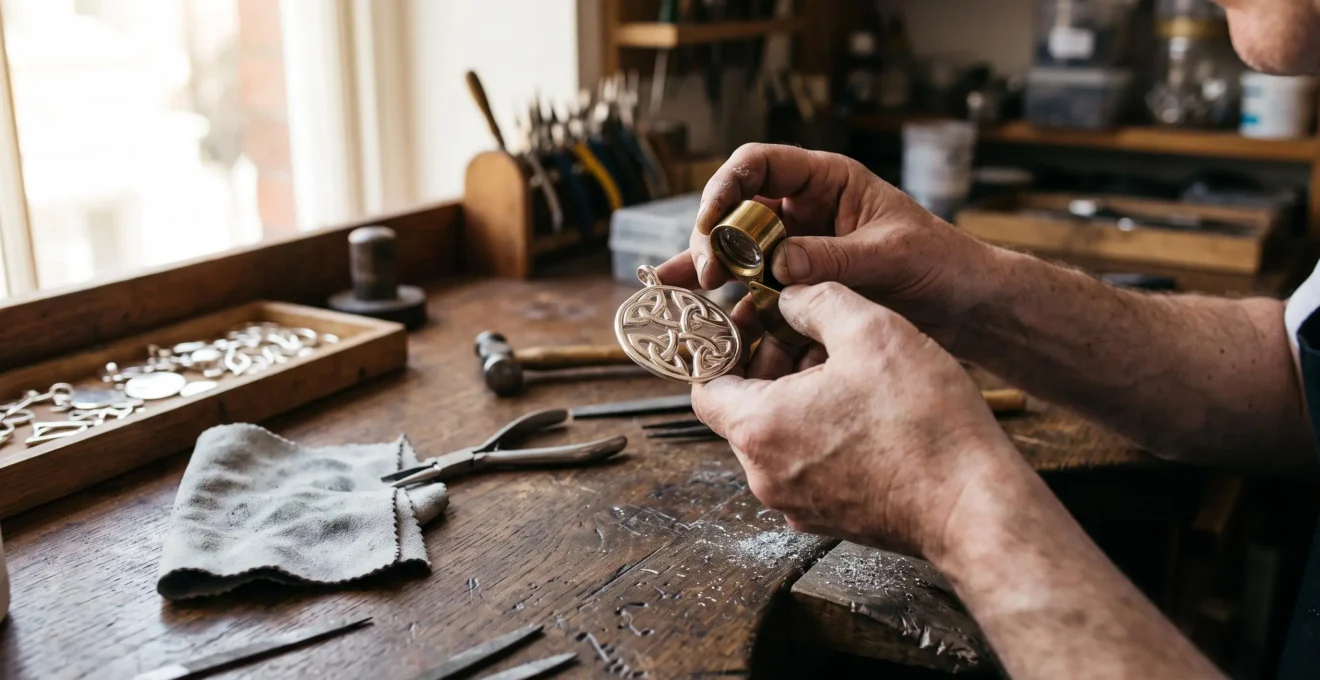
A Trinity knot, a Lover’s knot and an Eternity knot can look remarkably similar when worked into silver. Yet the meaning someone attaches to each design may be quite different. The Trinity knot commonly represents threefold unity, the Lover’s knot suggests a bond between two people, and an endless interlace can express continuity or lasting commitment.
These interpretations are useful, but they are not a definitive dictionary of ancient Celtic beliefs. Historical knotwork developed through several artistic traditions, while many meanings now associated with silver jewelry have been shaped by religious interpretation, cultural revival and contemporary design.
The most reliable way to understand a knot is to examine its structure, establish what can genuinely be documented about its origins, and consider what the wearer wants it to represent. A pendant celebrating personal faith may use the same geometry as a gift marking family connection, without carrying the same intended message.
Understanding that distinction makes it easier to select a piece whose symbolism remains meaningful long after the occasion for which it was given.
Celtic knot symbolism at a glance
- Trinity knots express threefold unity and may carry Christian, spiritual or personal meanings.
- Lover’s and Eternity knots are commonly associated with partnership and continuity, but their commercial names do not guarantee ancient origins.
- Historical authenticity and personal symbolism are different questions. Examine the weave, verify the claimed source and explain the meaning intended for the recipient.
- Trinity vs Lover’s vs Eternity Knots: Which Symbolises What Commitment?
- Where Do Different Celtic Knot Patterns Originate Historically and Culturally?
- Religious vs Secular Interpretations: What Celtic Knots Mean to Different Wearers
- The « Celtic » Knot Invented by Marketing With No Historical Basis
- How to Personalise Celtic Knot Patterns Without Disrespecting Tradition
- Why Vine Motifs Represent Growth and Connection Across 12 Cultural Traditions
- Graduation vs Marriage vs Parenthood: Which Symbolic Elements Suit Each Milestone?
- How to Commission Silver Jewelry That Authentically Commemorates Life Milestones
Trinity vs Lover’s vs Eternity Knots: Which Symbolises What Commitment?
The Trinity knot is generally the clearest choice for threefold unity, while a Lover’s knot can represent partnership and an Eternity knot can express lasting continuity. These distinctions describe common contemporary interpretations, not three historically standardised Celtic symbols. The correct choice depends on the visible geometry and the particular commitment the wearer wishes to express.
The Trinity knot, or triquetra, has three interconnected pointed lobes. Its triangular arrangement makes it suitable for relationships or beliefs involving three elements. In Christian settings, it can represent the Father, Son and Holy Spirit. Other wearers interpret the same structure through personal or spiritual groupings, such as mind, body and spirit.
A Lover’s knot generally emphasises two connected elements. Contemporary silver designs may depict intertwined hearts, paired loops or two strands woven together. Unlike the triquetra, however, the name does not identify one universally recognised historical Celtic pattern.
An Eternity knot commonly uses uninterrupted interlace to suggest an enduring connection. This is principally a modern descriptive category: different retailers may use the same name for quite different patterns.
The following comparison separates recognisable features from the meanings commonly attached to them.
| Feature | Trinity knot | Lover’s knot | Eternity knot |
|---|---|---|---|
| Typical geometry | Three connected lobes or points | Two interlinked elements, sometimes hearts | Continuous-looking interlace or a closed path |
| Common interpretation | Threefold unity | Partnership and affection | Continuity and lasting connection |
| Potential gift context | Faith, personal balance or a three-person bond | Romantic relationship or partnership | Anniversary, remembrance or enduring commitment |
| Historical caution | Modern meanings are not all documented ancient meanings | Retail naming is structurally inconsistent | No single fixed historical pattern is established by the name |
To decode a particular pendant or ring, count its visible points, distinguish separate strands and trace whether each line returns to itself. A design with three lobes remains structurally triquetra-like even when advertised as a Lover’s knot. Conversely, two joined hearts may communicate partnership without reproducing a documented medieval knot.
Counting crossings and strands describes construction; it does not prove historical symbolism. An apparently unbroken line is especially useful when continuity is the intended metaphor, but it cannot establish what medieval makers believed.
Once the geometry is clear, the next distinction is historical: a meaningful contemporary design need not be an unchanged survival from ancient Celtic culture.
Where Do Different Celtic Knot Patterns Originate Historically and Culturally?
Celtic knotwork in its familiar manuscript and carved forms is especially associated with early medieval Insular art in Ireland and Britain. It developed within a wider environment of interlaced ornament, rather than representing one unchanged pagan symbolic system inherited from remote antiquity. Surviving manuscripts and carved stones provide firmer evidence for its history than modern claims about each knot’s supposed ancient meaning.
Insular art flourished across the early medieval centuries, combining spirals, interlaced ribbons, animal forms and geometrical ornament. Manuscripts such as the Book of Durrow and the Book of Kells preserve elaborate examples of these techniques.
Trinity College Dublin‘s research on manuscript interlace describes Insular art across the sixth to twelfth centuries and examines the ribbons, crossings and repeated patterns used by its makers.
These features belonged to a broader artistic environment involving late Roman decorative traditions and Germanic interlace. Norse art also developed complex animal and ribbon ornament, with interactions between Viking and Insular artistic traditions contributing to later regional styles. Such connections should be assessed for individual objects rather than treated as proof that every Irish or Scottish knot has a Norse origin.
The term Celtic itself needs care. Historically, it refers to related peoples, languages and cultures, including Irish, Scottish Gaelic, Welsh and Breton traditions. In modern jewelry marketing, it often operates as a much broader visual label for interlace-inspired decoration.
Stone carvings add another dimension. At Dyce in Scotland, an early medieval cross-slab combines Christian imagery with traditional Pictish symbols. Historic Environment Scotland‘s history of the Dyce Symbol Stones identifies a cross filled with interlace on the later monument, demonstrating the coexistence of different artistic and religious elements.
Historical example: the Dyce Symbol Stones
The Dyce monuments preserve different phases of early medieval Scottish carving. The earlier symbol stone is associated with approximately AD 600, while the later cross-slab dates from after approximately AD 700.
The later stone combines interlace within a Christian cross and traditional Pictish imagery. Its surviving decoration demonstrates cultural and religious coexistence, but does not establish a specific modern meaning for a Lover’s or Eternity knot.
When examining a knot, three broad visual categories can help identify its artistic relatives: spiral ornament built around curved forms, plaitwork composed of crossing bands, and zoomorphic interlace in which animal bodies become part of the weave. None is an exact dating instrument on its own.
For a silver design described as an adaptation of the Book of Kells or a Scottish high cross, the maker should be able to identify the particular manuscript page, carving or documented pattern used. This provides a more meaningful authenticity claim than a generic reference to ancient Celts.
Historical context establishes where motifs appear; the personal and religious meanings attached to them require a separate kind of interpretation.
Religious vs Secular Interpretations: What Celtic Knots Mean to Different Wearers
A Celtic knot can express religious faith, personal spirituality, cultural belonging or a secular relationship, depending on the wearer and context. The triquetra is particularly adaptable because its threefold structure supports several readings. Nevertheless, contemporary interpretations should not automatically be presented as beliefs documented among the people who created early medieval knotwork.
For a Christian wearer, a Trinity knot may represent the Holy Trinity: Father, Son and Holy Spirit. This reading can make a silver pendant appropriate for a religious celebration, especially when the recipient recognises the design as a Christian symbol.
Other wearers associate the three points with the triple goddess, stages of life or mind, body and spirit. These interpretations can carry genuine personal significance. However, describing a modern triple-goddess interpretation as the established original meaning of every medieval triquetra would go beyond the available historical evidence.
The difference matters because symbolic meaning is not always inherited unchanged. A motif can acquire new interpretations while retaining recognisable geometry.
For secular wearers, interlace often offers a deliberately open symbol. A continuous line might stand for loyalty between friends, an enduring family connection or resilience through successive life changes. Such meanings arise from the wearer’s chosen interpretation, not from an authenticated ancient code.
Context also affects how other people perceive a piece. A triquetra worn at a religious gathering may be understood as a declaration of Christian faith even when its owner sees it as a symbol of personal balance. Within a family strongly attached to Irish Christian traditions, that difference may be particularly relevant.
A useful gift-giving method is to describe the intended meaning without claiming exclusive authority over the design. For example: « The three connected points represent you and your two children, while the uninterrupted line represents your continuing bond. »
An accompanying card or discreet engraving can make this personal interpretation explicit. That explanation is particularly helpful when the recipients come from different religious backgrounds.
Personal meaning is legitimate without invented antiquity. The same principle becomes essential when evaluating the historical claims used to sell modern knot-pattern jewelry.
The « Celtic » Knot Invented by Marketing With No Historical Basis
Some knots sold as ancient Celtic symbols are modern creations, adaptations or combinations of historical ornament. A familiar commercial name is not, by itself, evidence that the exact pattern or its advertised meaning existed in medieval Ireland or Scotland. The responsible distinction is between documented historical motifs, later artistic reinterpretations and designs whose supposed ancient identity cannot be verified.
The Celtic Revival provides a well-documented example of how older ornament entered modern commercial design. From the nineteenth century onward, designers increasingly adapted interlace and related motifs for jewelry, decorative metalwork and other objects.
One important figure was Archibald Knox (1864–1933), whose work for Liberty & Co. incorporated Celtic-inspired forms into commercially produced objects.
The V&A‘s account of Archibald Knox and Celtic Revival design documents this reinterpretation, including jewelry produced around 1900. The museum also describes the growing commercial interest in Celtic decoration during the 1880s and the influence of major exhibitions.
Such objects demonstrate that modern Celtic-inspired jewelry can be historically significant in its own right without being a literal reproduction of medieval work.
Several retail labels deserve examination, particularly when presented as ancient categories with fixed meanings. « Celtic Lover’s knot », « Eternity knot » and similarly descriptive names may refer to different geometries across sellers. That inconsistency warrants verification, although it does not prove that every use of these names was invented during the Celtic Revival.
Before accepting a product’s heritage claim, ask three questions:
- Is the exact motif documented? Look for an identifiable manuscript, carved monument or historical object rather than a general reference to Celtic tradition.
- Is the name historically attested? A modern label may describe an older geometry without being the name historically used for it.
- Is the claimed meaning supported? Evidence that a pattern existed does not establish that it represented marriage, protection or eternal love.
These checks distinguish three degrees of adaptation: reproduction or repurposing of a documented motif, recombination of historical visual elements, and creation of an entirely new knot-inspired pattern.
A newly designed silver pendant can be excellent craftsmanship. The concern arises when its maker or seller claims an unverified ancient identity or asks buyers to pay for historical provenance that has not been established.
Once the origin of a design is described accurately, it becomes possible to personalise the ornament without misrepresenting the cultural tradition behind it.
How to Personalise Celtic Knot Patterns Without Disrespecting Tradition
Personalising Celtic knotwork is generally compatible with contemporary artistic practice when the design’s cultural references are acknowledged accurately. Altering strand counts, integrating stones or developing new interlace compositions need not imply disrespect. The crucial distinction is between an openly contemporary adaptation and a design falsely presented as an ancient inherited symbol with a fixed traditional meaning.
Personalisation should begin with the relationship being commemorated. Someone celebrating three generations of a family might request three distinguishable interlaced elements. A couple might prefer two visibly joined strands, while a parent could choose a pendant combining a continuous weave with individual birthstones.
These choices create personal symbolism through design. They should not be described as established traditional rules governing the number of family members represented in historical Celtic knotwork.
Practical options include changing the number of strands, incorporating initials into the surrounding frame, adding stones at carefully chosen intersections, and adjusting the motif’s scale to suit a ring, pendant or brooch.
Structure matters. Enlarging a small knot for a pendant may preserve its geometry, while compressing the same design into a narrow ring can make individual crossings difficult to distinguish.
If the intended meaning depends on an endless line, ask the silversmith to demonstrate that the proposed weave retains its continuous path. Adding an initial directly across a strand, for example, could interrupt the very feature chosen to represent continuity.
Working with a maker knowledgeable about the relevant Irish, Scottish, Welsh or Breton traditions can also improve historical accuracy. Request the story behind a design and, when possible, the particular source that inspired it. This approach recognises those traditions as living practices rather than treating Celtic ornament as anonymous decorative material.
There is no single universal rule governing all contemporary adaptations. The most defensible approach is to distinguish documented heritage, current design practice and newly assigned personal meaning.
Plant ornament offers another possibility: a vine can introduce a visual sense of growth while allowing the knot to retain its association with continuity.
Why Vine Motifs Represent Growth and Connection Across 12 Cultural Traditions
Vine motifs often suggest growth and connection because their branching stems, tendrils and recurring forms provide a visual language for development and interdependence. Related plant ornament appears across numerous artistic traditions, although its meaning varies considerably. In silver jewelry, combining a vine with a continuous knot can express both a changing relationship and a bond intended to endure.
The title’s reference to twelve cultural traditions should not be understood as evidence of twelve identical inherited meanings. Different societies have used vines, foliage and interlaced plants in distinct religious, decorative and cultural settings.
Consider the following twelve contexts as a comparative framework, not as a claim that each shares one universal symbolism:
- Irish Insular art: interlace and plant-derived ornament belong to a rich medieval decorative vocabulary.
- Scottish medieval art: carved and manuscript decoration incorporates intertwined and stylised natural forms.
- Welsh decorative traditions: later Celtic-inspired design provides contexts for adapting foliage and interlace.
- Breton artistic traditions: plant ornament can participate in regional decorative and revival styles.
- Norse art: interlaced forms and stylised natural imagery appear within distinctive ornamental systems.
- Byzantine art: vine and foliage ornament can appear in religious and architectural decoration.
- Islamic artistic traditions: vegetal arabesques use stylised, repeating plant forms with meanings dependent on context.
- Classical Greek art: vines are closely associated with Dionysian imagery in appropriate settings.
- Roman art: vine scrolls appear across decorative media, including contexts related to abundance and cultivation.
- South Asian artistic traditions: vegetal ornament appears in varied architectural and decorative forms.
- East Asian artistic traditions: scrolling plants and botanical motifs carry meanings specific to their particular cultural settings.
- Māori artistic traditions: forms inspired by natural growth can express relationships or ancestry in culturally specific contexts and should not simply be classified as Celtic-style vines.
This comparison identifies possible artistic parallels, not a documented common origin or a uniform symbolic meaning across the twelve contexts.
For a commissioned silver pendant, the distinction between vine and knot can be made visually. A branching stem suggests outward movement, new possibilities or a developing relationship. A closed interlace can add the intended idea of continuing connection.
That combination is particularly appropriate for milestones involving beginnings: a graduation, the arrival of a child or the start of a new family chapter.
However, vines may evoke more specific associations, including fertility, religious symbolism or remembrance, depending on the design’s actual source. Borrowing a culturally distinctive motif without understanding that context risks replacing a meaningful tradition with an overly general interpretation.
The historical coexistence of plant ornament and interlace supports creative combinations, but does not make every cross-cultural hybrid historically Celtic.
For a commemorative gift, this vocabulary becomes most valuable when matched to the life event rather than chosen solely for its decorative appeal.
Graduation vs Marriage vs Parenthood: Which Symbolic Elements Suit Each Milestone?
Graduation generally suits imagery of growth and future possibility, marriage lends itself to two joined elements, and parenthood can be represented through multiple connected strands or points. These are contemporary design recommendations rather than historically fixed Celtic rules. The strongest choice reflects the recipient’s values and the specific milestone, not simply the commercial name of a knot.
Milestone jewelry should communicate something about the event without becoming irrelevant as the wearer’s circumstances change.
| Milestone | Suggested elements | Intended message | Meaning to confirm |
|---|---|---|---|
| Graduation | Vine, emerging branch or open-ended decorative composition | Growth and the beginning of a new chapter | A continuous closed knot should not unintentionally suggest that the journey is complete |
| Marriage | Two interlaced strands or paired heart forms | Partnership and continuing commitment | A Trinity motif may carry a religious meaning for the recipient |
| Parenthood | Three or more connected elements, adapted to the family | Care, connection and evolving family relationships | The number of elements represents a personal choice, not an ancient Celtic rule |
For graduation, a vine incorporated into the edge of a knot can suggest progress beyond a completed stage of study. An uninterrupted knot may still be meaningful if the graduate values lifelong learning or continuity with family.
For marriage, two distinguishable strands offer a visual representation of two people retaining their identities while sharing a connection. If a triquetra is chosen instead, discuss whether the couple intends a religious reading, a threefold personal interpretation or simply appreciates the geometry.
For parenthood, a silversmith can adapt a pattern so that its visible elements correspond to particular family members. Adding a birthstone at an intersection may create a further personal reference.
Structural personalisation can communicate relationships through the design itself. Engraving can add names or dates without changing the knot’s geometry. Neither approach is inherently more authentic; they serve different purposes.
A useful long-term consideration is whether the piece can accommodate new interpretations. A family pendant might later be layered with another commemorative charm, while a deliberately simple knot could continue to represent connection across changing circumstances.
Once the milestone and intended symbolism are clear, commissioning offers a way to translate those ideas into a specific silver object while documenting the artistic decisions behind it.
Key takeaways before commissioning
- Define the relationship or milestone in one sentence before selecting a knot pattern.
- Choose whether historical reference, personalised geometry or a combination of both matters most.
- Ask for sketches that demonstrate the weave clearly and identify which elements carry the intended meaning.
How to Commission Silver Jewelry That Authentically Commemorates Life Milestones
Commissioning meaningful Celtic-inspired silver jewelry begins with a clear symbolic brief, followed by a documented design reference and a discussion of personal adaptations. A suitable silversmith should be able to explain the weave, show relevant previous work and clarify practical terms before production. The finished piece should have an understandable personal meaning without requiring an unsupported claim of ancient provenance.
Begin with the event and the recipient rather than a product catalogue. State what the piece should commemorate and why a particular structure seems appropriate. For example, a pendant might represent two siblings who remain connected despite living in different countries.
Next, decide whether the design should reference a specific historical motif. If authenticity is central, request a drawing informed by an identifiable manuscript page, carved stone or documented artistic object. Ask the maker to distinguish faithful elements from new additions.
Evaluating craftsmanship is equally important. Look at previous knotwork pieces and check whether crossings are clean, the visual rhythm remains coherent, and intended continuous strands can actually be followed.
The material also requires verification. Sterling silver is conventionally described by a fineness of 925 parts per thousand, but marking and hallmarking rules vary by country.
In the United Kingdom, the British Hallmarking Council‘s practical hallmarking guidance identifies the compulsory components of a conventional hallmark: a sponsor’s mark, a metal and fineness mark, and an assay office mark. The guidance also identifies a silver weight exemption threshold of 7.78 grams. Buyers should confirm the currently applicable requirements, especially when purchasing outside the UK.
A hallmark verifies precious-metal characteristics, not cultural authenticity. It does not establish that a knot has a particular historical origin or symbolism.
Before approving production, obtain written terms covering the estimated completion date, deposit, revision arrangements, final price, delivery and responsibility for the custom design. Stone-setting and engraving should be identified explicitly because they can affect both the design and the agreed cost. Clarify whether the finished pattern is exclusive and what rights, if any, the buyer receives to reproduce it.
Five checks before approving a Celtic knot jewelry commission
- Write the symbolic brief: produce one sentence identifying the milestone, recipient and meaning the knot should communicate.
- Identify the design reference: save a documented motif or record explicitly that the piece is a contemporary Celtic-inspired creation.
- Approve the weave: obtain an annotated sketch showing the strand arrangement, intended continuous paths and personalised elements.
- Verify materials and craftsmanship: request relevant examples of the silversmith’s work and written confirmation of silver fineness and applicable marking arrangements.
- Confirm the agreement: retain a written quotation covering specifications, deposit, revisions, delivery arrangements and design-ownership terms.
The final design should be explainable in ordinary language: « This knot represents our family’s enduring connection because its three strands remain visibly intertwined. »
If that sentence feels forced or contradicts the geometry, revise the design brief before manufacturing begins. A clear explanation is more useful than attaching an elaborate historical story that cannot be substantiated.
Choose a documented reference where historical authenticity matters, discuss the interpretation with the recipient where appropriate, and ask the maker for a sketch that makes the meaning visible. This produces a stronger foundation for commemorative silver jewelry than an appealing pattern supported only by a commercial name.
Does a Celtic knot need to be made from one continuous strand?
No. Historical and contemporary interlace can use different arrangements of ribbons, crossings and connected elements. A continuous path is particularly appropriate when the intended symbolism is endurance, but continuity is not a universal requirement for every design described as Celtic knotwork.
Can the same Celtic knot symbol have different meanings in different countries?
Yes. Meanings can vary by religious setting, cultural tradition, community and individual wearer. Irish, Scottish, Welsh and Breton heritage should not be treated as interchangeable, and contemporary jewelry interpretations may differ from historically documented uses. A shared visual motif does not necessarily imply a shared inherited interpretation.
Is an antique-looking silver knot pendant necessarily historically authentic?
No. Aged finishes, traditional-looking ornament and elaborate interlace can all be reproduced in contemporary jewelry. Historical authenticity depends on identifiable evidence connecting a design to a documented source. The age or composition of a silver object is also a separate question from the historical origin of its decorative motif.
Does a 925 stamp prove that a Celtic knot pendant is genuine?
A 925 stamp indicates a claimed silver fineness of 925 parts per thousand. The stamp alone does not independently verify the metal’s composition or establish that the knot design is historically Celtic. Where applicable, recognised hallmarking provides stronger evidence of precious-metal content, while cultural provenance requires separate documentation.
Can an original Celtic-inspired knot design become a family heirloom?
Yes. A newly commissioned design can acquire lasting significance through family use, gifting and the stories associated with it. Its value as an heirloom does not depend on claiming that the motif is ancient. Keeping the design sketch, the maker’s information and a short explanation of its intended symbolism can help future generations understand why the piece was created.