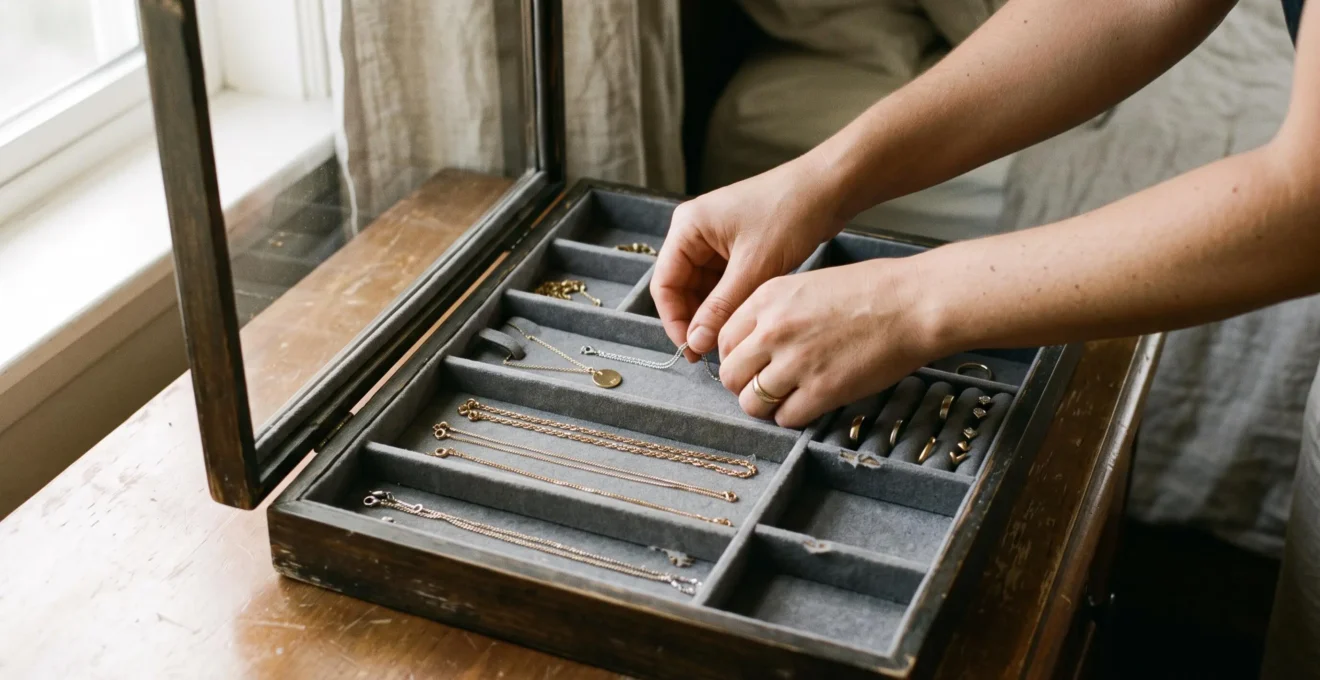
A jewelry storage system should do more than accommodate a collection. It should prevent pieces from touching unnecessarily, protect vulnerable materials from damaging environments, and make frequently worn jewelry easy to retrieve without disturbing everything else.
The most effective approach starts with the collection itself. Chain lengths determine how necklaces should be separated. Ring profiles influence slot dimensions. Sterling silver requires attention to sulfur-containing storage materials, while pearls and opals may be damaged by excessively dry conditions. A single organizer cannot necessarily provide ideal conditions for every piece.
Storage efficiency also depends on how frequently jewelry is worn. A necklace used every morning belongs in a different access zone from a delicate heirloom worn twice a year. Separating those functions can reduce daily searching without exposing an entire collection to repeated handling.
The objective is a practical storage architecture: individual protection, measured compartment capacity, controlled environmental exposure, and frequency-based accessibility. Each decision should solve a specific risk rather than simply maximize the number of pieces that fit inside a box.
Jewelry Storage Design: Essential Principles
- Separate chains, rings, earrings, and delicate pieces into individually protected spaces to prevent tangling, scratching, and compression.
- Choose storage linings according to material compatibility, especially for sterling silver, pearls, and opals.
- Keep frequently worn jewelry accessible while protecting occasional pieces in appropriate enclosures; use silica gel only where controlled drying is suitable.
- Why Individual Compartments Prevent Chain Tangling That Can Take 15 Minutes to Undo
- Felt vs Microfibre vs Acid-Free Tissue: Which Lining Protects Without Sulfur?
- How to Calculate Compartment Dimensions for Your Jewelry Collection’s Sizes
- The Overcrowding Mistake That Damages Delicate Silver Through Pressure
- How to Balance Daily Accessibility With Maximum Protection in Storage Design
- Why Rubber Bands and Wool Pouches Turn Silver Black Overnight
- How to Calculate the Right Silica Gel Quantity for Your Storage Container Volume
- How Much Silica Gel Do You Actually Need for Effective Jewelry Storage?
Why Individual Compartments Prevent Chain Tangling That Can Take 15 Minutes to Undo
Individual necklace compartments prevent tangling by stopping chains, clasps, and pendants from interacting during storage. Fine links can catch on neighboring jewelry, especially when pieces are repeatedly moved or lifted from a shared compartment. Separating each necklace removes most opportunities for these cross-chain catches, protecting delicate links and reducing the time needed to retrieve a piece.
A necklace does not need to move far to become tangled. When several chains share a drawer, retrieving one can drag another across its clasp. A pendant may also pass through a loop of neighboring chain, creating a knot when tension is applied.
The finer the chain, the more difficult it may be to separate the trapped links without applying damaging force. Repeated attempts to pull apart a knot can distort delicate components or place stress on the clasp.
The GIA’s jewelry care recommendations identify jewelry boxes with individually padded ring slots and posts for hanging necklaces and bracelets as suitable storage arrangements.
However, a dedicated compartment is protective only when the necklace fits its layout. There are two principal configurations:
- Flat storage: Suitable for heavy necklaces, substantial pendants, and designs whose weight makes prolonged hanging undesirable. The chain should rest without forced folds or overlapping other pieces.
- Hanging storage: Convenient for lightweight necklaces when each hook has sufficient separation and the chain can hang without striking neighboring jewelry or the organizer’s base.
For a straight, fully extended necklace, a horizontal channel would need an internal length greater than the necklace’s opened length. Most compact jewelry boxes cannot provide that space, so an isolated, loose serpentine arrangement may be more practical. The essential requirement is that bends remain relaxed and the clasp is positioned away from fine links.
Pendant necklaces may benefit from a dedicated recess, hook, or retaining slot that prevents the pendant from turning into the chain. Individual separation should extend to the full necklace, not merely the chain’s central section.
The often-mentioned 15 minutes spent undoing a tangle is a hypothetical scenario, not a scientifically established average. Its usefulness lies in making the cost of disorganization measurable.
Hypothetical example: the annual cost of tangled necklaces
Suppose a collector encounters one difficult knot requiring 15 minutes to resolve each month. Over 12 months, that represents 180 minutes, or three hours spent untangling necklaces.
If tangling happens less often, the annual time cost falls accordingly. A personal log recording incidents and minutes lost provides a more useful estimate than assuming every knot requires the same effort.
Preventing tangles begins with physical isolation. The next design decision is whether the material surrounding each isolated piece protects its surface or introduces a different form of damage.
Felt vs Microfibre vs Acid-Free Tissue: Which Lining Protects Without Sulfur?
No single lining is automatically safe for every jewelry material. Felt provides cushioning but may contain wool or chemical treatments associated with sulfur emissions. Microfibre can offer a soft, low-abrasion surface, provided its composition and treatments are appropriate. Archival-quality, sulfur-free, acid-free tissue is a documented protective option for silver, while pearls and opals require additional consideration of moisture conditions.
For sterling silver, the most important chemical risk is exposure to sulfur-containing compounds. These react with silver surfaces to produce dark tarnish. A beautifully padded organizer can therefore be unsuitable if its lining, adhesive, or structural materials introduce harmful gases.
The distinction between a material’s physical softness and its chemical suitability is fundamental. A lining may prevent scratches while still contributing to discoloration.
The following comparison separates practical advantages from limitations that should be checked before choosing a material.
| Criterion | Felt | Microfibre | Archival-quality tissue |
|---|---|---|---|
| Physical protection | Soft cushioning and positional support | Smooth contact surface with limited abrasion | Protective separation and wrapping |
| Sulfur considerations | Wool felt and some treatments may be problematic | Composition, dyes, and treatments require verification | Specify sulfur-free as well as acid-free |
| Typical use | Ring supports and padded compartments when chemically suitable | Removable wraps or verified soft liners | Individual silver wrapping and protective interleaving |
| Main limitation | Softness does not establish chemical safety | Not all products are validated for long-term conservation | Provides limited structural cushioning by itself |
The Canadian Conservation Institute recommends archival-quality, sulfur-free, acid-free, unbuffered tissue for protecting silver objects. This distinction matters because an ordinary product labeled simply « acid-free » is not necessarily certified sulfur-free.
For sensitive gemstones, lining choice must be considered alongside the surrounding environment. Pearls and opals can suffer when stored under excessively dry conditions, so a storage configuration optimized to keep silver exceptionally dry should not automatically be applied to them.
Anti-tarnish storage materials can benefit silver when appropriately selected, but they should not be presumed compatible with every gemstone or organic jewelry component. Similarly, absorbent microfibre should not be treated as an automatic humidity-control solution.
A practical preliminary check is to compare the condition of silver pieces stored against different materials over time. If tarnishing repeatedly appears faster in one compartment, inspect that compartment’s lining, adhesive, and enclosure. Visible tarnishing is a warning sign, not a definitive chemical test for sulfur. Differences may also reflect humidity, handling, and previous surface contamination.
Once suitable contact materials are identified, the compartments themselves must be designed around actual jewelry dimensions rather than the organizer’s advertised capacity.
How to Calculate Compartment Dimensions for Your Jewelry Collection’s Sizes
Calculate compartment dimensions by measuring the jewelry that must fit, adding sufficient clearance for safe placement and removal, and reserving capacity for future additions. Measure the maximum length, width, height, and protruding features within each jewelry category. The finished compartment should allow its intended piece to rest without forced bending, contact with neighboring jewelry, or pressure from the lid.
Start by creating a simple collection inventory. Divide the pieces into necklaces, bracelets, rings, earrings, brooches, and unusually shaped items. These categories have different space requirements, so counting total pieces alone does not reveal the organizer’s required dimensions.
For each category, record the largest relevant measurements:
- Necklaces: Opened length, pendant dimensions, chain thickness, and whether the piece should lie flat or hang.
- Rings: Maximum external diameter, setting height, and the width of unusually substantial bands.
- Earrings: Total drop length, backing dimensions, and the space needed to prevent paired pieces from touching.
- Bracelets: External diameter or opened length, clasp profile, and any rigid elements.
These measurements can be converted into minimum internal compartment dimensions by adding clearance wherever a piece might contact a divider or lid. No single universal allowance is appropriate because jewelry geometry varies substantially.
For example, consider a hypothetical pendant measuring 32 mm across and 8 mm thick. A compartment measuring exactly 32 mm internally would leave no lateral clearance. The design therefore needs additional usable width and depth, determined by the surrounding lining, pendant shape, and lid position.
For rings, padded vertical slots or dedicated racks are generally preferable to loose stacks. A ring’s setting should remain above or between supports without being pressed by adjacent rings. Tall settings may require their own deeper compartments.
A useful planning relationship is:
Required internal dimension = maximum jewelry dimension + handling clearance + protective clearance.
This is a design relationship, not an independently validated standard. The appropriate clearance is established by testing representative pieces inside the proposed layout.
Oversized compartments are not necessarily beneficial. A large undivided section allows several items to migrate together and recreate the original tangling problem. Conversely, compartments fitted too tightly force jewelry against padding, walls, or neighboring pieces.
To accommodate growth, classify planned purchases by their expected storage format. Modular partitions and removable trays make future adjustments easier than permanently fixed compartments.
Five Steps to Produce a Jewelry Compartment Design
- Inventory every piece by jewelry type and frequency of use. Deliverable: a category-based collection list.
- Measure the largest pieces and their protruding settings. Deliverable: a measurement sheet showing the relevant dimensions.
- Assign each piece or compatible pair a dedicated storage position. Deliverable: a compartment allocation map.
- Test proposed compartment widths, depths, supports, and lid clearance with representative pieces. Deliverable: a revised layout with confirmed usable dimensions.
- Identify future storage needs and mark adjustable spaces. Deliverable: a modular expansion plan.
Correct dimensions provide sufficient space for each piece. That protection disappears if compartments are subsequently overloaded, which makes storage density the next essential consideration.
The Overcrowding Mistake That Damages Delicate Silver Through Pressure
Overcrowding damages jewelry by increasing contact, friction, and compression between pieces. Thin silver bands, delicate settings, and protruding gemstones are especially vulnerable when stacked objects carry weight or press against a closing lid. A compartment that accommodates several pieces visually may still be unsuitable if those pieces cannot rest independently without pressure.
Scratching is the most obvious consequence of overcrowding, but compression can be less visible. When jewelry is stacked, upper pieces transfer their weight to those underneath. Under sufficient force, thin metal components may bend, settings may become stressed, and delicate surfaces may acquire impressions.
The actual risk depends on the construction of each piece, the load applied, and how that load is distributed. Prolonged contact alone does not establish that silver will deform, but inappropriate pressure can create mechanical damage.
Lid interference is particularly easy to overlook. If a jewelry box closes only when its contents are pushed downward, the lid is functioning as a compression surface rather than a protective cover.
A useful inspection begins with the lid open. Check whether rings are stacked, chains cross over one another, and prominent settings rest against harder objects. Then close the lid slowly without forcing it. Any resistance attributable to the jewelry should prompt a layout adjustment.
Look for potential warning signs such as parallel scratches, localized impressions, altered ring profiles, or components that no longer sit correctly. These signs can have different causes, so they should not automatically be attributed to storage pressure.
The safest general arrangement is one vulnerable piece per protected storage position. If two compatible items must share a larger compartment, provide physical separation. Archival-quality, sulfur-free, acid-free tissue may be appropriate for certain silver items, but a divider or separate pouch generally offers more reliable positional control.
A planning allowance of 20–30% unused space can be adopted as a practical capacity target. For example, in a hypothetical tray with 20 comparable storage positions, reserving four to six positions would leave room for reorganizing or adding pieces. This is an optional design buffer, not a conservation standard established by the cited sources.
Unused capacity is not wasted space when it prevents forced stacking or unnecessary handling. It also reduces the likelihood that every new acquisition triggers a complete reorganization.
A comfortably spaced organizer may protect its contents, but it must also support efficient selection. The next challenge is positioning pieces according to how often they are needed.
How to Balance Daily Accessibility With Maximum Protection in Storage Design
The most practical jewelry storage system separates rapid-access pieces from those requiring longer-term protection. Frequently worn items should be easy to retrieve without disturbing the wider collection, while occasional and delicate jewelry belongs in more protective compartments or enclosures. This two-level arrangement avoids forcing every piece into the same compromise between immediate accessibility and environmental protection.
Start by identifying a small rotation of jewelry worn regularly. For some collectors, three to five pieces may provide a manageable daily selection, although this is a suggested starting point rather than a demonstrated optimum.
These pieces can occupy a shallow, covered tray or readily accessible compartment close to the dressing area. The location should be dry, clean, and away from conditions that accelerate deterioration.
Organize the remaining collection by frequency of use:
| Frequency | Recommended access zone | Protective priority |
|---|---|---|
| Daily | Accessible covered tray or upper compartment | Quick retrieval without neighboring-piece contact |
| Weekly | Individually divided compartments in a main organizer | Reliable separation and straightforward identification |
| Occasional | Individual pouches, suitable protective boxes, or designated lower-access compartments | Reduced handling and material-specific environmental protection |
| Fragile or high-value | Dedicated protective enclosure with suitable support | Physical protection, compatible materials, and appropriate security |
A common design mistake is maximizing accessibility by exposing the entire collection on an open dresser display. Although this can make pieces visible, it also increases opportunities for dust deposition, accidental contact, and exposure to the surrounding environment.
Bathroom storage is particularly problematic when humidity fluctuates frequently. For silver, moisture and sulfur-containing pollutants can contribute to tarnishing conditions. A covered organizer in a more stable room is generally preferable.
Daily accessibility does not require leaving jewelry uncovered. An easy-opening lid, clearly organized tray, or individually assigned compartment can reduce search time while maintaining a reasonable protective barrier.
Establish a rotation check during an existing maintenance routine. A monthly review is one possible schedule: return pieces that are no longer worn regularly to their main storage positions, inspect their condition, and update the daily selection.
The monthly interval is a household organization suggestion, not a conservation requirement. More important is that jewelry does not remain indefinitely in an exposed temporary holding area.
Once the physical layout and access zones are established, inspect materials that may cause chemical damage even when jewelry remains separated and untouched.
Why Rubber Bands and Wool Pouches Turn Silver Black Overnight
Rubber bands and wool pouches can accelerate silver tarnishing because certain rubber products and wool materials release sulfur-containing compounds. These gases can react with silver to form dark surface sulfides. Visible blackening overnight is possible only under particular exposure conditions and should not be treated as a universal outcome; the actual rate depends on material composition, pollutant concentration, humidity, and exposure duration.
Silver tarnishing is a chemical process rather than simply an accumulation of dirt. Sulfur-containing gases, including hydrogen sulfide, can react with the metal surface to form silver sulfide, Ag2S. Tarnish on sterling silver may also contain copper sulfide, reflecting the alloy’s composition.
The Canadian Conservation Institute’s explanation of silver tarnish identifies vulcanized rubber, wool, wool felt, certain adhesives, and some paints as potential sources of sulfur-containing gases.
This has important consequences for jewelry storage. An elastic band used to hold chains together may introduce a chemical risk while also placing mechanical tension on the chains. A wool pouch may provide soft cushioning but be unsuitable for long-term silver protection.
Other storage components deserve inspection, including:
- Rubber bands, rubberized fasteners, and some latex products.
- Wool felt lining or untreated wool storage pouches.
- Adhesives and coatings used to attach compartment linings.
- Certain paints, finishes, and construction materials inside enclosed cabinets.
- Unverified foams or cushioning materials whose chemical composition is unknown.
Not every product in these categories releases the same quantity of pollutants. Newspaper, fingerprints, and unverified packaging may present additional contamination or storage concerns, but their presence alone does not establish a sulfur-emission mechanism equivalent to vulcanized rubber.
The consequences of tarnishing go beyond appearance. Removing tarnish through repeated polishing can remove a small amount of metal. Decorative surfaces, plated finishes, and intentionally darkened details may be particularly vulnerable to inappropriate cleaning.
The Canadian Conservation Institute’s silver care guidance recommends preventive storage and cautions against unnecessary tarnish removal. The significance is greatest for delicate, decorated, or historically important objects where the original surface should be preserved.
If silver darkens after contact with a questionable material, remove the material and isolate the affected piece in suitable storage. Inspect the jewelry before attempting treatment.
For plain, robust silver jewelry, gentle cleaning with an appropriate product may be possible. However, chemical dips and abrasive polishing should not be applied indiscriminately to jewelry with pearls, porous gemstones, delicate settings, plated surfaces, or intentional oxidation. A qualified jeweler or conservator should assess uncertain cases.
Removing problematic materials reduces chemical exposure, but storage conditions also influence metal preservation. Humidity control therefore deserves attention, provided it does not endanger moisture-sensitive jewelry.
How to Calculate the Right Silica Gel Quantity for Your Storage Container Volume
Calculate silica gel requirements by first determining the container’s internal volume, then evaluating its sealing quality, humidity exposure, opening frequency, and target storage conditions. Volume alone cannot establish a safe quantity for jewelry. A tightly sealed container holding susceptible metal objects differs fundamentally from a frequently opened wooden box or an enclosure containing pearls and opals.
For a rectangular container, calculate the internal volume using length, width, and height. When dimensions are measured in centimetres:
Volume in litres = (internal length × internal width × internal height) ÷ 1,000.
For a cylindrical container, use the internal radius and height:
Volume in litres = (π × radius² × height) ÷ 1,000.
The calculations establish the available enclosure volume, not the required mass of desiccant. The latter depends on the desired humidity level and the amount of moisture entering or released inside the container.
The CCI’s technical note on preparing silica gel for metal storage provides a worked example using a sealed container measuring 30 cm × 20 cm × 10 cm.
6 L container = 300 g silica gel
The Canadian Conservation Institute’s worked example uses 50 g of regular-density silica gel per litre for specialized, tightly sealed metal storage. It targets extremely low relative humidity, below 5%, and is not a recommended dosage for mixed jewelry collections.
Canadian Conservation Institute, Preparing Silica Gel for Contained Storage of Metal Objects, 2019.
This distinction is essential. The metal-conservation example addresses extremely dry conditions suitable for particular vulnerable objects. Applying the same ratio to jewelry containing pearls, opals, or other moisture-sensitive materials could produce unsuitable storage conditions.
For household jewelry storage, the calculation should therefore follow a decision process:
- Measure internal container volume and identify whether the enclosure seals effectively.
- Identify jewelry materials that may require separation from dry metal-storage conditions.
- Determine the storage objective and appropriate humidity conditions for the compatible contents.
- Select a suitable desiccant arrangement based on enclosure performance and product instructions.
- Monitor humidity and adjust the arrangement according to observed conditions rather than assuming an arbitrary quantity will remain effective indefinitely.
A container opened several times daily exchanges air with its surroundings. Additional silica gel may extend moisture-absorption capacity, but it cannot prevent that exchange. A poorly sealed wooden box also behaves differently from a tight-fitting polyethylene or polypropylene enclosure.
Humidity-indicating cards are useful for assessing conditions inside an enclosure. Certain indicating silica gel products also change color as their moisture content changes, but the meaning of that color depends on the manufacturer’s indicator chemistry. A color change should be interpreted according to the product specification, not as a universal measure of safe humidity for jewelry.
Ordinary silica gel may be regenerated by heating under appropriate conditions. The Canadian Conservation Institute describes drying procedures at 60°C for approximately six to seven hours or at 120°C for approximately one to two hours for the material covered in its technical note. These temperatures and durations must not be transferred automatically to packaged consumer sachets.
Packet materials can have lower temperature limits. The same technical guidance specifies conditioning polyethylene nonwoven packets below 90°C. Follow the manufacturer’s instructions, and never heat sachets unless their contents and packaging are confirmed suitable for regeneration. Cobalt chloride indicators should also be avoided because of their associated health concerns.
A saturated desiccant no longer has the same capacity to absorb additional moisture. That does not mean every saturated packet inevitably releases water into the enclosure; moisture exchange depends on surrounding conditions.
Finally, physically separating pearls from silica gel inside one shared, unpartitioned enclosure does not necessarily protect them from drying, because they still share the same air. Moisture-sensitive materials may require an independently controlled enclosure.
The calculation identifies how to evaluate a container. The final decision is whether silica gel is appropriate at all, and how to verify that the chosen arrangement continues to work.
Key Takeaways Before Choosing a Desiccant
- Establish material compatibility and enclosure quality before choosing any silica gel quantity.
- Distinguish specialized, extremely dry metal storage from the needs of mixed jewelry collections.
- Plan a monitoring and replacement routine instead of relying on the initial desiccant quantity alone.
How Much Silica Gel Do You Actually Need for Effective Jewelry Storage?
There is no universal silica gel quantity suitable for every jewelry box. The appropriate amount depends on which materials are being stored, the humidity conditions they require, the container’s air-tightness, and how frequently it is opened. Some protective storage arrangements may benefit from monitored desiccant use, while collections containing moisture-sensitive gemstones may require a different strategy entirely.
The first priority is the container itself. A well-designed, suitably sealed enclosure can reduce uncontrolled exchanges with room air. By contrast, increasing the number of silica gel packets in a frequently opened or porous box does not correct the underlying enclosure limitations.
Location comes next. Avoid storing jewelry near showers, sinks, cooking areas, or other sources of repeated humidity fluctuations. Select a stable location with minimal unnecessary exposure to heat and moisture.
Only then should silica gel be considered. For compatible metal jewelry requiring drier conditions, a monitored desiccant arrangement may be useful. For pearls, opals, and other potentially moisture-sensitive pieces, extremely dry conditions may be harmful.
Silver also requires protection from sulfur-containing pollutants. Desiccation is not a substitute for sulfur-free lining materials, suitable individual enclosures, or careful separation from incompatible storage components.
A practical hierarchy of protective decisions is:
- Separate incompatible materials: Prevent contact damage and avoid grouping pieces with conflicting moisture requirements.
- Choose a protective enclosure: Match sealing, support, and compartment design to the intended storage duration.
- Select a stable location: Limit avoidable exposure to humidity, heat, and pollutants.
- Add humidity control only when appropriate: Choose silica gel and monitoring arrangements according to the specific storage objective.
- Verify performance: Inspect the enclosure and jewelry periodically, correcting the source of problems rather than simply adding more desiccant.
After several weeks, review the storage conditions. Look for condensation, unusual odors, visible deterioration, and changes in humidity indicators. These observations may reveal a problem, but the absence of condensation or musty odors does not prove that the humidity is ideal or that sulfur-containing pollutants are absent.
A humidity-indicating card or suitable hygrometer provides more useful information about environmental conditions than visual inspection alone. Monitoring frequency should reflect how often the container is opened and how sensitive its contents are.
For example, a sealed container used for long-term storage of compatible metal-only jewelry may require relatively infrequent intervention once its conditions have been established and verified. A tray opened multiple times each day offers less environmental isolation, making container selection and maintenance habits more consequential than simply increasing silica gel mass.
Desiccant cannot prevent scratches, tangling, or deformation caused by overcrowding. These are mechanical problems requiring individual compartments, suitable supports, and adequate clearance. Nor can silica gel reliably eliminate the chemical risk posed by sulfur-emitting materials inside an enclosure.
Effective jewelry storage therefore works as a coordinated system rather than a collection of isolated accessories: material-compatible contact surfaces, correctly sized compartments, suitable capacity, controlled access, and appropriate environmental management.
Begin with a collection inventory and a compartment layout, then test the enclosure using representative pieces. Once the physical organization works without pressure or unnecessary contact, evaluate storage materials and humidity conditions for each jewelry category. This sequence creates a system that is easier to use daily and more defensible from a preservation perspective.
Should sterling silver and pearl jewelry be stored in the same box?
They can be organized within the same broader storage system if they are physically protected and their environmental needs are compatible. However, silver storage designed to maintain extremely low humidity should not share an uncontrolled airspace with pearls. Separate enclosures may be necessary because pearls can deteriorate under excessively dry conditions.
Is an expensive jewelry organizer automatically safer than a basic storage box?
No. Protection depends on compartment design, lining compatibility, enclosure conditions, and the way jewelry fits inside. A simple organizer with individually protected compartments and appropriate materials may be preferable to a more elaborate box containing unsuitable padding, poorly spaced sections, or excessive pressure points.
Can anti-tarnish strips replace individual silver storage bags?
Not necessarily. Suitable anti-tarnish products can help reduce exposure to certain tarnishing pollutants, but they do not provide the same physical separation as individual enclosures. For long-term silver protection, compatible bags or wrapping materials can reduce contact damage and limit environmental exposure. Product compatibility and replacement instructions still matter.
How can a collector tell whether a jewelry box is becoming too small?
A jewelry box is approaching its practical limit when pieces begin overlapping, individual compartments must hold incompatible items, settings touch the lid, or retrieving one piece regularly displaces another. These functional signs are more informative than the percentage of compartments occupied. Adding a modular tray or reorganizing storage zones is preferable to forcing additional pieces into insufficient space.
Does every jewelry storage box need silica gel?
No. Silica gel is useful only when moisture reduction is appropriate for the stored materials and the enclosure allows that reduction to be maintained and monitored. It is not a universal requirement for jewelry care. Stable storage conditions, compatible materials, and appropriate physical separation should be established before considering desiccants.