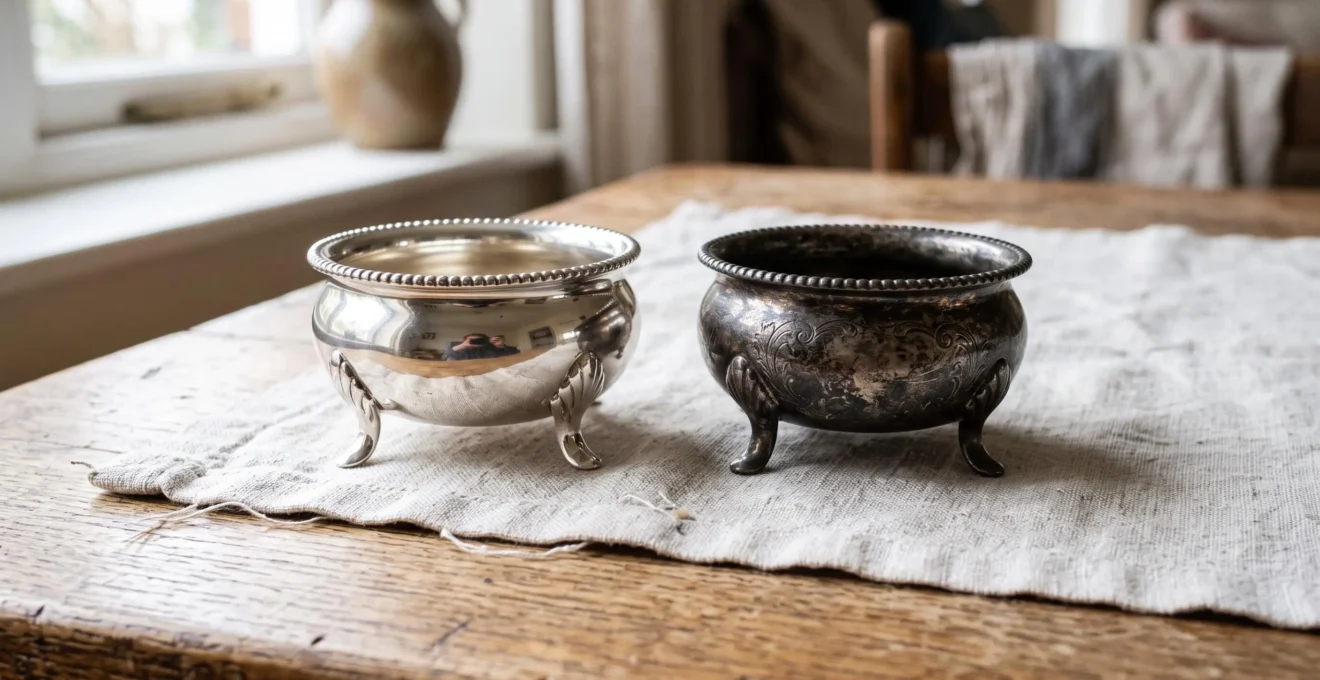
Two people can polish identical silver jewellery on the same day, store it with equal care and discover entirely different results weeks later. One person’s silver remains bright. The other’s develops a yellowish haze or dark coating. The difference often lies not in the cleaning routine but in the atmosphere surrounding the metal.
Silver reacts with airborne sulphur compounds, particularly hydrogen sulphide. Indoor humidity, pollution, storage materials and the composition of the silver alloy influence how quickly these reactions occur. Consequently, a humid room containing sulphur-emitting materials can tarnish silver much faster than a dry, relatively pollutant-free space.
Understanding the environmental causes of tarnish offers a more effective solution than increasing polishing frequency. Measuring humidity, identifying nearby pollutant sources and improving storage conditions can reduce exposure without unnecessarily removing metal from treasured pieces. The most useful approach is to investigate the home’s microclimate before changing the jewellery-care routine.
Why silver tarnishes differently between homes
- Atmospheric sulphur is the principal trigger: silver reacts with sulphur-containing gases to develop a surface layer of silver sulphide.
- Humidity and storage conditions determine exposure: damp surroundings, unsuitable packaging and continuously renewed polluted air can accelerate blackening.
- Prevention is more sustainable than repeated polishing: suitable enclosures, humidity monitoring and pollutant-absorbing materials can help preserve silver.
- Why Coastal Homes Experience 3× Faster Silver Tarnish Than Inland Properties
- How Oxygen and Humidity React With Silver to Form Black Sulphide
- Tarnish vs Corrosion: What’s Actually Happening to Your Silver Chemically?
- When Do Seasonal Humidity Spikes Require Protective Storage Measures?
- The Household Product That Accelerates Silver Oxidation by 400%
- How Activated Charcoal Absorbs Sulfur Gases From Jewelry Storage Spaces
- Why 40-50% Relative Humidity Prevents Both Tarnish and Brittleness
- How Much Silica Gel Do You Actually Need for Effective Jewelry Storage?
Why Coastal Homes Experience 3× Faster Silver Tarnish Than Inland Properties
Coastal homes can expose silver to more moisture and airborne salt than inland properties, creating conditions that may accelerate surface deterioration. However, there is no established universal rule that silver tarnishes three times faster beside the sea. Actual rates depend on indoor humidity, sulphur pollution, ventilation, storage materials and the silver alloy itself.
Ocean air carries salt-containing particles, including chlorides, while coastal climates frequently experience elevated moisture levels. These factors contribute to a potentially aggressive environment for metals. For silver specifically, the principal blackening mechanism remains reaction with sulphur-containing gases, rather than chloride exposure alone.
Sea proximity therefore matters indirectly as well as chemically. Humid air can maintain microscopic moisture films on metal surfaces, facilitating reactions with contaminants already present indoors. A well-controlled coastal apartment may preserve silver more effectively than a poorly ventilated inland house.
The relationship between location and silver tarnish becomes clearer when several household characteristics are considered together.
| Home condition | Possible exposure | Practical interpretation |
|---|---|---|
| Coastal home with frequent condensation | Elevated moisture and potential salt contamination | Assess humidity and improve enclosure protection. |
| Inland home with stable, controlled humidity | Reduced moisture-related acceleration | Check storage materials and pollutant sources. |
| Urban apartment with outdoor pollution ingress | Possible exposure to atmospheric sulphur compounds | Prioritise pollutant exclusion and suitable storage. |
| Poorly ventilated storage room | Possible pollutant accumulation and moisture retention | Investigate both the enclosure and room environment. |
A practical self-assessment begins with observable signs. Recurrent window condensation suggests that moisture may be accumulating; rusting metal fixtures and mould on nearby materials provide additional reasons to investigate local conditions. These observations do not measure silver tarnish directly, but they help identify rooms that deserve closer monitoring.
Coastal distance alone is insufficient to rank homes. Prevailing winds, building airtightness, air conditioning and dehumidification can substantially change indoor exposure.
Other locations deserve attention, too. Kitchen cupboards near cooking emissions, bathrooms with lingering humidity and furniture containing unfamiliar adhesives or finishes may create problematic storage environments. Indoor plants themselves are not proven to be a general silver-tarnish cause, although watering can influence local moisture conditions.
Rather than assume a fixed threefold coastal penalty, compare humidity readings and storage conditions at the actual locations where jewellery is kept. This produces a more useful household risk assessment.
The next step is understanding why moisture changes the reaction rate even though it is not the principal chemical ingredient of black silver tarnish.
How Oxygen and Humidity React With Silver to Form Black Sulphide
Black silver tarnish forms primarily when silver reacts with sulphur-containing gases in the surrounding atmosphere, producing silver sulphide, Ag₂S. Oxygen can participate in atmospheric reactions, but ordinary silver blackening is not simply oxygen combining with silver. Higher relative humidity generally accelerates tarnish by facilitating reactions on the metal surface.
The essential distinction is between the contaminant driving the reaction and the environmental conditions that increase its rate. Hydrogen sulphide is an important tarnishing gas, while other atmospheric sulphur compounds can also contribute to deterioration.
The Canadian Conservation Institute’s explanation of silver tarnishing describes how higher relative humidity accelerates silver tarnishing at a given hydrogen sulphide concentration.
Moisture helps create surface conditions in which atmospheric contaminants react more readily with metal. This explains why simply cleaning a piece of silver does not eliminate the underlying problem: polishing removes existing deposits, but the environment continues supplying the gases responsible for new tarnish.
In sterling silver, copper introduces another variable. Sterling silver typically contains 92.5% silver and 7.5% copper. Copper is more reactive than silver, and the resulting tarnish may include copper sulphide alongside silver sulphide. Consequently, two otherwise similar items made from different silver alloys may deteriorate at different rates.
Indoor pollutant sources are particularly important because they can be overlooked during routine cleaning. Potential contributors include vulcanised rubber, certain paints, wool-containing materials, some foods and particular building products. Outdoor pollution can also enter through ventilation and air leakage.
86–600 parts per trillion
Reported hydrogen sulphide concentrations associated with gradual silver tarnishing in certain museum environments, as presented by the Canadian Conservation Institute citing Ankersmit and colleagues. These observations are not a measured concentration range for ordinary homes.
Canadian Conservation Institute, Understanding how silver objects tarnish.
That example illustrates how extremely small atmospheric contaminant concentrations can matter over time. A room does not need a noticeable sulphur smell for silver to tarnish.
Controlling humidity alone therefore addresses only part of the problem. Silver kept in a dry container alongside an actively sulphur-emitting material may still blacken, while reasonably dry storage without pollutant-emitting materials offers more complete protection.
Before choosing a treatment, however, it is important to determine whether visible deterioration is ordinary tarnish or a sign of more complex alloy damage.
Tarnish vs Corrosion: What’s Actually Happening to Your Silver Chemically?
Silver tarnish is itself a form of surface corrosion, usually involving a thin layer of silver sulphide. The practical distinction is between relatively superficial tarnish and more damaging corrosion affecting the alloy or object structure. Uniform darkening may be removable, whereas pitting, persistent deposits and structural deterioration require greater caution.
The difference matters because removing tarnish is not the same as restoring lost metal. A surface film can often be reduced using suitable conservation techniques, but deep pits and damaged plating cannot be repaired through routine polishing.
The appearance of tarnish also changes as the layer develops. Very thin films can produce yellow, reddish-brown or bluish colours before the surface becomes predominantly black. According to the Canadian Conservation Institute, early interference colours are associated with films approximately 10–100 nanometres thick, while blackening is associated with thicker films.
Visual inspection provides useful preliminary clues, although appearance alone cannot identify every corrosion product or confirm the depth of deterioration.
| Visible condition | Possible interpretation | Suggested response |
|---|---|---|
| Even yellow, brown or black surface discoloration | Potential sulphide tarnish | Inspect gently and assess the item’s construction before cleaning. |
| Greenish deposits on sterling silver | Possible copper-associated corrosion products | Avoid aggressive treatment and seek specialist advice for valuable pieces. |
| Visible pits or roughened metal | Potential deeper corrosion or mechanical damage | Do not assume polishing can restore the original surface. |
| Patchy appearance on silver plating | Possible coating loss, exposed base metal or uneven tarnish | Check for wear before using abrasive products. |
Silver-plated jewellery deserves particular care. Its silver layer may be thin, so repeated polishing can eventually expose the underlying metal. Antique finishes, deliberate patination, inlays and delicate settings introduce additional risks.
The Canadian Conservation Institute’s silver-care guidance emphasises that repeated tarnish removal can take underlying silver away from the object. For ordinary jewellery, gentle cleaning may be appropriate when the construction is straightforward, but this principle becomes especially important for heirlooms and plated objects.
Green residues should not automatically be labelled as one specific copper compound: identifying corrosion chemistry reliably requires more information than colour alone.
If surface blackening keeps returning without visible damage, the priority shifts from restoration to preventing repeated environmental exposure.
When Do Seasonal Humidity Spikes Require Protective Storage Measures?
Seasonal humidity spikes justify additional silver protection when elevated moisture persists where jewellery is stored, rather than appearing as an isolated short-lived reading. Humid summers, rainy periods and changes in household heating can increase exposure. Monitor the storage location and strengthen enclosure protection when damp conditions persist or tarnishing becomes noticeably faster.
Seasonal calendars are less reliable than measurements because indoor humidity depends on building construction, ventilation and local weather. One home may experience its highest storage humidity during summer, while another develops damp conditions during rainy winter months or when heating is switched off.
A small hygrometer placed beside the jewellery box provides a more meaningful reading than an outdoor weather report. Record measurements under typical conditions, preferably at consistent times, to identify whether the storage area experiences persistent elevation.
The Canadian Conservation Institute recommends storing silver in relatively dry conditions, generally below 50% relative humidity. This offers a useful reference for silver-only storage, although jewellery containing sensitive organic materials may require a different compromise.
A graduated response avoids unnecessary interventions:
- Stable, moderate humidity: maintain suitable wraps and enclosed storage while checking conditions periodically.
- Repeated elevated readings: assess enclosure sealing, introduce an appropriate moisture sorbent and monitor the internal humidity.
- Persistent dampness or condensation: relocate jewellery away from affected walls or windows and investigate the room’s moisture problem.
- Unattended seasonal storage: verify environmental conditions before leaving valuable pieces enclosed for an extended period.
Moving house creates another risk window. Jewellery may spend weeks in cardboard packaging, unfamiliar furniture or storage spaces where humidity is uncontrolled. Seasonal packing and travel introduce similar uncertainty.
Five-step home audit for silver tarnish prevention
- Measure relative humidity at the actual jewellery-storage location and create a dated record of readings.
- Inspect nearby packaging, rubber, fabrics and finishes; produce a list of materials to remove or investigate.
- Check for window condensation, damp surfaces and visible corrosion on neighbouring metal objects; record any warning signs.
- Move a suitable silver item into clean, protective storage and document the enclosure and any humidity-control materials used.
- Recheck the enclosure’s humidity and photograph the silver at regular intervals, creating a comparison record to evaluate whether conditions improved.
These actions do not precisely measure airborne sulphur gases, but they provide a practical way to identify controllable environmental risks without specialised laboratory equipment.
Once moisture has been assessed, the next potential cause is often found inside the jewellery box itself rather than in the surrounding room.
The Household Product That Accelerates Silver Oxidation by 400%
Rubber bands and certain sulphur-containing rubber products are significant potential accelerators of silver tarnish when stored near jewellery. However, no universal 400% increase is established by the supplied conservation evidence. The actual effect depends on product composition, sulphur emissions, exposure duration, enclosure conditions and the susceptibility of the silver item.
The problem is especially easy to overlook because rubber bands are frequently used as an apparently harmless way to secure small jewellery packets. Some rubber formulations can release sulphur-containing compounds, which react with nearby silver and create dark surface deposits.
Vulcanised rubber is a recognised concern, but not every rubber or synthetic polymer has the same chemical composition or emission behaviour. Material selection matters more than broad product labels.
Other materials warrant attention, including certain latex products, wool felt, selected paints and unsuitable paper-based packaging. Cardboard and tissue paper should not automatically be considered chemically inert simply because they look clean and dry.
Cleaning sprays present a different type of uncertainty. Their risks depend on their ingredients and whether residues reach the jewellery; it would be inaccurate to assume that all household cleaners release sulphur gases.
For storage, the goal is to avoid introducing contaminants into the protective enclosure.
| Material | Potential concern | Preferable approach |
|---|---|---|
| Rubber bands or vulcanised rubber | Potential release of sulphur-containing gases | Remove from silver storage. |
| Ordinary newspaper or unknown wrapping paper | Uncertain chemical composition and potential contaminants | Use suitable archival, sulphur-free tissue. |
| Unknown felt or decorative fabric | Possible wool or chemically reactive components | Choose materials specifically suitable for silver conservation. |
| Clean polyethylene storage bags | Generally suitable for protective wrapping when appropriately selected | Use clean bags without unsuitable additives or internal pollutant sources. |
| Specialised anti-tarnish materials | Performance depends on formulation and conditions | Check manufacturer documentation and monitor results. |
The Canadian Conservation Institute’s silver care and tarnish removal note recommends appropriate protective materials, including acid-free, unbuffered, sulphur-free tissue paper and suitable sealed polyethylene storage.
Anti-tarnish claims deserve scrutiny. A product described as protective may work by absorbing pollutants, by limiting contact with contaminated air or through another mechanism. Its expected service life and effectiveness depend on the material and environment.
Look for a clear description of the protective mechanism, compatibility with silver and any available supporting technical information. Observing whether silver remains bright under comparable storage conditions is useful, but an informal household comparison cannot establish a precise percentage reduction in tarnishing.
When potentially harmful packaging has been removed, pollutant-absorbing materials can provide an additional layer of protection inside an appropriately designed enclosure.
How Activated Charcoal Absorbs Sulfur Gases From Jewelry Storage Spaces
Activated charcoal can reduce sulphur-containing gases inside suitable enclosed jewellery storage by adsorbing contaminant molecules onto its extensive porous surface. Its effectiveness depends on the charcoal formulation, quantity, enclosure sealing and sources of pollution. It works best when incoming contaminated air is limited and the storage materials do not continuously emit tarnishing gases.
Adsorption differs from absorption into a liquid or bulk material. Activated charcoal provides an extensive internal surface onto which certain gas molecules can attach. This can lower the concentration of pollutants available to react with silver.
It is important to distinguish ordinary charcoal from a material specifically designed and evaluated for gas sorption. Activated charcoal products can have different pore structures and surface treatments, so equal masses need not provide equivalent protection.
The Canadian Conservation Institute’s preventive conservation guidelines for metals describe activated charcoal as a useful sorbent for several atmospheric pollutants, including hydrogen sulphide and sulphur dioxide.
500 g/m³
Illustrative activated-charcoal loading described for a well-sealed museum enclosure without internal pollutant-emitting materials. Under the stated conditions, pollutant concentrations may be reduced by approximately a factor of ten compared with room air. This is not a validated universal dosage for domestic jewellery boxes.
Canadian Conservation Institute, Caring for metal objects – Preventive conservation guidelines for collections.
Charcoal therefore needs to be considered as part of an enclosure system rather than as a decorative sachet. In an open jewellery display, room air is continually replaced, limiting the practical benefit of a small quantity of sorbent.
A reasonably sealed box offers a more favourable environment because the volume of incoming contaminated air is restricted. However, placing rubber or another sulphur-emitting product inside the same box can continuously replenish the pollutants that the charcoal is intended to capture.
Activated charcoal and silica gel address different problems:
- Activated charcoal: targets certain atmospheric pollutant gases, with performance depending on the sorbent material.
- Silica gel: adsorbs water vapour and helps manage relative humidity inside enclosures.
- Specialised anti-tarnish papers or fabrics: may capture particular pollutants or provide other protective functions, depending on their formulation.
These approaches can complement one another when the jewellery and surrounding materials tolerate the chosen environmental conditions.
Maintenance remains essential. Charcoal has finite sorption capacity, and its useful life depends on pollutant exposure. The conservation guidelines describe an approximately one-year service period for a specific documented museum configuration, not a universal household replacement interval.
There is no reliable visual household test that establishes precisely how much gas-adsorption capacity remains. A charcoal sachet looking unchanged does not prove that it is still effective. Manufacturer guidance, environmental exposure and changes in tarnish behaviour can inform replacement decisions, although tarnish alone cannot isolate charcoal performance from humidity and other variables.
Technical regeneration methods described for specialised conservation materials should not be applied automatically to unknown consumer sachets or their packaging.
Gas removal addresses one part of the storage atmosphere; selecting an appropriate humidity target is equally important, particularly when silver is combined with sensitive gemstones or organic materials.
Why 40-50% Relative Humidity Prevents Both Tarnish and Brittleness
A relative humidity range around 40–50% can be a useful conservation compromise for certain objects combining metal with moisture-sensitive materials. It limits moisture-related silver tarnish acceleration without creating the extremely dry conditions that may be unsuitable for some organic components. However, this range does not guarantee protection against tarnish or prevent brittleness in every gemstone.
The distinction between silver-only and mixed-material jewellery is fundamental. For uncomplicated silver metal storage, drier conditions can help slow atmospheric reactions. For jewellery containing pearls, organic components or certain moisture-sensitive gemstones, very low humidity may introduce separate conservation concerns.
The Canadian Conservation Institute discusses approximately 40–50% relative humidity as a compromise for particular composite conservation situations. This should be interpreted as a context-dependent guideline rather than a universal requirement for every jewellery collection.
Different materials respond differently to moisture. Some organic materials may be vulnerable to excessive drying, whereas other components can deteriorate through prolonged dampness. Pearls, amber and opals should not be treated as interchangeable: their structures and environmental sensitivities differ.
Temperature, pollutant concentrations, duration of exposure and environmental fluctuations further influence risk. Even at 45% relative humidity, silver may tarnish if enough reactive sulphur compounds reach its surface.
A practical humidity-control routine begins with measuring conditions inside or close to the actual storage enclosure. Hygrometer placement matters because a reading beside a window or heat source may not reflect the conditions experienced by jewellery elsewhere in the room.
For a collection containing different materials, use the following decision framework:
| Collection type | Primary concern | Storage principle |
|---|---|---|
| Uncomplicated solid silver | Humidity-assisted tarnishing | Prioritise dry, low-pollutant storage. |
| Silver with pearls or other moisture-sensitive components | Balancing metal protection with material stability | Avoid aggressive drying without considering the specific components. |
| Mixed-material heirlooms | Different materials requiring different conditions | Use a conservation-oriented compromise or specialist guidance. |
| Silver jewellery exposed to persistent dampness | Accelerated atmospheric reactions | Improve enclosure conditions and investigate moisture sources. |
When adjusting humidity, avoid abrupt or excessive changes. A well-sealed enclosure and appropriately selected humidity-control material can offer more stable conditions than frequent adjustments to the temperature of the whole room.
Monitoring the actual result is essential. A target range is useful only if measurements confirm that the jewellery experiences the intended conditions.
Once an appropriate humidity goal has been chosen for the specific collection, the remaining practical question is how to use silica gel without overdrying the contents or relying on an ineffective quantity.
Key takeaways before choosing silica gel
- Select the humidity target according to the jewellery’s materials, rather than using one dry-storage rule for every piece.
- Enclosure sealing and opening frequency influence how long any moisture-control material remains effective.
- Verify humidity inside the container instead of assuming that a sachet provides adequate protection.
How Much Silica Gel Do You Actually Need for Effective Jewelry Storage?
There is no universal silica gel quantity suitable for every jewellery box. The required amount depends on enclosure volume, airtightness, initial moisture, surrounding humidity, opening frequency and the desired internal humidity. A sealed container with monitored conditions is more predictable than an open box containing a few unmeasured sachets.
Silica gel adsorbs water vapour onto its porous surface. By reducing moisture inside an enclosure, it can help create conditions that slow humidity-dependent metal deterioration. However, ordinary silica gel does not replace dedicated removal of sulphur-containing gases.
For effective storage, begin with the enclosure rather than the sachet. A container that continually admits humid room air places an ongoing moisture load on the gel, shortening the period during which it remains effective.
The Canadian Conservation Institute’s technical note on preparing silica gel for metal storage describes a specialised dry-storage example using 50 grams of silica gel per litre of enclosure volume.
Its worked example considers a box measuring 30 × 20 × 10 centimetres, giving a volume of 6 litres. At that illustrative loading, the required gel mass is 300 grams. For a suitably sealed enclosure, the documented approach can maintain very low humidity for an extended period.
Documented conservation example: silica gel in a sealed box
In the Canadian Conservation Institute’s technical guidance, a well-sealed polyethylene or polypropylene container with a 6-litre internal volume is used to illustrate dry metal storage with 300 grams of desiccated silica gel.
The publication describes maintaining relative humidity below 5% for several months under the stated conditions. This is a specialised metal-conservation example, not a recommended humidity target or universal silica-gel dosage for jewellery containing moisture-sensitive components.
This distinction is crucial. A technique intended for metal requiring extremely dry conditions may be unsuitable for a necklace containing pearls, organic materials or other moisture-sensitive components.
Silica gel performance also depends on its initial conditioning. Some humidity-control products are designed to stabilise conditions around a particular relative humidity rather than produce extremely dry air. Material that has already adsorbed substantial moisture may provide less remaining drying capacity than freshly prepared gel.
Changes in the surrounding atmosphere can also cause moisture to be released from certain sorbents as the system moves toward a new equilibrium. Accordingly, a sachet should not be assumed to lower humidity indefinitely.
A compact hygrometer or appropriate humidity-indicating card inside the enclosure helps assess performance. Check the reading after the container has stabilised, then repeat measurements after normal opening and closing cycles.
Replacement and regeneration depend on the gel formulation and packaging. The Canadian Conservation Institute describes specialised regeneration procedures involving controlled heating, but these cannot safely be generalised to every consumer sachet. Follow the specific product instructions, particularly where packaging or colour indicators are present.
Colour-changing indicator beads are not always a substitute for measuring relative humidity. Some indicators, including older cobalt-chloride formulations, also raise material-safety concerns. Indicator colour should be interpreted according to the product’s documentation.
For everyday storage, the most reliable strategy is to combine an appropriately selected enclosure, compatible protective wrapping, a suitable moisture-control material and actual humidity monitoring. If conditions remain unsuitable, reassess the seal, the gel’s condition and the storage location before automatically adding more sachets.
Start by measuring the humidity inside the current jewellery container and identifying any nearby sulphur-emitting materials. Those two observations provide a practical basis for deciding whether the next improvement should be better sealing, fresh silica gel, pollutant removal or a different storage location.
Can silver tarnish even inside a completely closed jewellery box?
Yes. A closed box may already contain polluted air, moisture or materials that release sulphur-containing compounds. Closing the lid does not eliminate contaminants trapped inside. Protective storage works best when the enclosure contains suitable materials, limits pollutant ingress and maintains appropriate humidity.
Does silver turning black quickly mean it is fake?
No. Genuine silver reacts with atmospheric sulphur compounds, and sterling silver can tarnish readily because it contains copper. Rapid blackening alone does not establish authenticity or identify the precise alloy. Hallmarks, construction and appropriate professional testing provide more useful evidence.
Can silver tarnish without any visible humidity problem?
Yes. Sulphur-containing gases can react with silver even when condensation and other obvious signs of dampness are absent. Lower humidity generally slows tarnishing, but it does not eliminate the reaction. Storage materials and atmospheric pollutant concentrations remain important.
Should silver jewellery be stored together with pearls and opals?
Shared storage requires care because different materials can have different environmental needs. Very dry conditions intended for metal conservation may be inappropriate for some moisture-sensitive jewellery components. Separate protective wrapping and material-specific storage guidance are sensible for valuable or delicate mixed collections.
Will an airtight plastic bag permanently prevent silver tarnish?
No. A suitable clean polyethylene bag can reduce exposure to outside contaminants, but it cannot guarantee permanent protection. Moisture and pollutants initially trapped inside, imperfect sealing and repeated opening can still allow tarnishing. Clean packaging, compatible materials and environmental monitoring improve its usefulness.