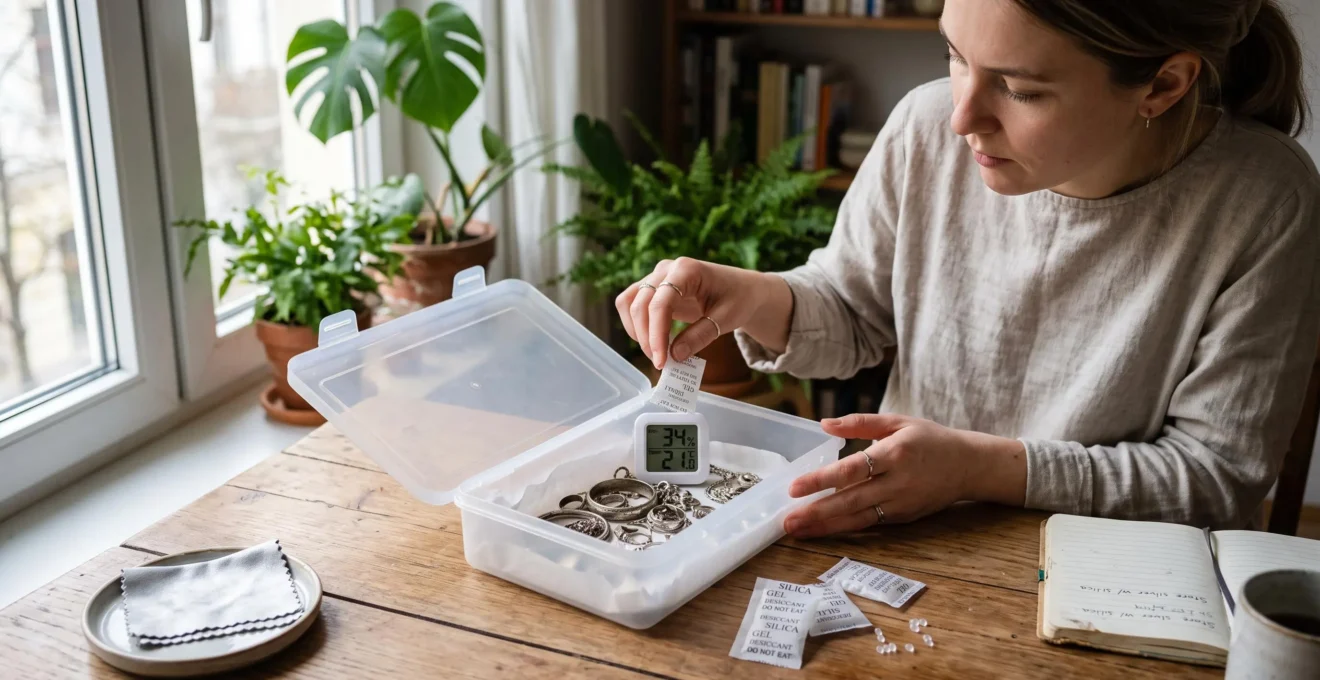
A handful of silica gel packets might keep your silver jewelry dry—or provide almost no protection at all. The difference depends on the container’s internal volume, how much outside air enters, what materials are stored alongside the jewelry, and how much moisture the silica gel can actually absorb.
For silver jewelry, the objective is not to remove every trace of humidity. It is to maintain a controlled environment that slows tarnishing without exposing pearls, opals, organic components or certain treated gemstones to damaging dryness. That requires measuring relative humidity (RH), selecting an appropriate desiccant quantity, and checking whether the system remains effective over time.
A practical starting point for mixed-material jewelry is a moderate humidity band around 40–50% RH, with adjustments for vulnerable materials. Plain silver can be stored considerably drier. Neither approach can be maintained reliably simply by counting packets.
The following method applies the principles of preventive conservation to ordinary jewelry boxes, display cases and sealed home-storage containers.
Silica Gel for Jewelry Storage: Essential Decisions
- Choose the humidity target first. Below 50% RH is recommended for silver, but mixed collections containing pearls or opals need more cautious treatment.
- Calculate capacity, not packet count. Container volume, leakage, storage duration and moisture-absorbing materials determine the required silica gel mass.
- Verify performance with a hygrometer. Monitor RH trends, regenerate packets when control deteriorates, and separate moisture-sensitive jewelry from aggressively dried storage.
- Why 40-50% Relative Humidity Prevents Both Tarnish and Brittleness
- How to Calculate Silica Gel Quantity Needed for Your Storage Container Volume
- When to Regenerate Silica Gel Packets for Continued Humidity Control
- The Over-Desiccation Mistake That Causes Metal Stress and Gemstone Cracking
- How to Monitor Storage Humidity Using Affordable Hygrometers Under £20
- When Do Seasonal Humidity Spikes Require Protective Storage Measures?
- Why Completely Sealed Silver Storage Requires Periodic Air Exchange
- How to Create Museum-Quality Storage Environments for Silver at Home
Why 40-50% Relative Humidity Prevents Both Tarnish and Brittleness
Maintaining approximately 40–50% relative humidity is a practical compromise for many mixed-material jewelry collections: it limits the moisture that accelerates silver tarnishing while avoiding the aggressive dryness that can harm some organic materials and gemstones. However, this range is not a universally established optimum. Plain silver and moisture-sensitive jewelry have different conservation requirements.
Silver tarnishes primarily through reactions with sulfur-containing gases. Hydrogen sulfide is particularly important because it contributes to the formation of silver sulfide (Ag2S), the dark compound responsible for much of silver’s characteristic discoloration. Sterling silver can also develop copper sulfide because of its copper content.
Humidity accelerates these reactions. At a given hydrogen sulfide concentration, higher RH increases the rate of tarnishing, although the chemistry does not establish a single universal humidity threshold at which tarnish suddenly begins.
The Canadian Conservation Institute resource on silver tarnishing recommends storing silver below 50% RH and reducing exposure to sulfur-emitting materials.
Yet extremely dry storage introduces a different risk. Leather, wood and certain gemstones contain or interact with moisture, and excessive drying can affect their dimensional stability or appearance. For mixed collections, the most vulnerable component should influence the humidity target.
| Storage condition | Potential benefit | Important limitation |
|---|---|---|
| Very dry, below 40% RH | Can reduce humidity-assisted silver tarnishing | May be unsuitable for pearls, opals and moisture-sensitive organic materials |
| Approximately 40–50% RH | Practical moderate-humidity starting range for many mixed collections | Not a guaranteed optimum for every gemstone or treatment |
| Above 50% RH | May be tolerated by some materials | Increasing humidity accelerates silver tarnishing when reactive pollutants are present |
Humidity is only part of the equation. Wool felt, vulcanized rubber, certain adhesives and some coatings can emit tarnish-promoting compounds. Even a relatively dry jewelry box may allow silver to discolor when these sources are present.
If silver tarnishes within weeks despite indoor storage, investigate both the measured RH and the materials surrounding it. Fast tarnishing alone cannot identify which factor is responsible.
Once the target is established, the next problem is determining how much silica gel can maintain it inside the actual container.
How to Calculate Silica Gel Quantity Needed for Your Storage Container Volume
Calculate silica gel quantity by estimating the moisture entering your container over the intended storage period, then comparing that load with the desiccant’s usable adsorption capacity. Container volume, air leakage, external humidity and target RH all matter. A fixed number of packets per litre ignores these variables and cannot guarantee effective protection.
The first measurement is the container’s internal air volume. For a rectangular box, multiply its internal length, width and height, using consistent units. A box measuring 30 × 20 × 10 cm has a geometric volume of 6 litres, or 0.006 cubic metres, before subtracting the space occupied by jewelry and inserts.
That calculation is straightforward. Estimating the actual moisture load is more difficult.
A wooden insert, felt lining, leather pouch or paper divider can hold and release considerably more moisture than the air inside a small box. These materials may therefore dominate the initial demand placed on freshly installed silica gel.
Air leakage creates a continuing moisture load. A tightly sealed polypropylene container exchanges relatively little air with its surroundings, while a loosely closed decorative jewelry box may admit humid air repeatedly.
For defined conservation enclosures, the Canadian Conservation Institute provides a quantitative calculation in its Technical Bulletin 33 on silica gel:
Q = (Ceq × D × V × N × t) / (MH × F)
The variables are:
- Q: Required dry sorbent mass, in kilograms.
- Ceq: Equilibrium water-vapour concentration, in grams per cubic metre.
- D: Difference between external and target relative humidity, expressed as a decimal.
- V: Net enclosed air volume, in cubic metres.
- N: Number of air exchanges per day.
- t: Intended duration of humidity control, in days.
- MH: Specific moisture reservoir of the chosen sorbent, in grams per kilogram per percentage point of RH.
- F: Permitted RH fluctuation range, expressed in percentage points.
The calculation assumes compatible sorbent-performance measurements and consistent units. It estimates the quantity needed to buffer ongoing moisture exchange, not an unknown initial moisture contribution from storage linings.
1.93 ± 0.44 g/kg per 1% RH
Measured specific moisture reservoir of regular clear type-A silica gel at approximately 50% RH, over a ±10-percentage-point range. This is a tested material property, not a universal adsorption capacity for every packet.
Canadian Conservation Institute, Technical Bulletin 33; measurements on products obtained during 2013–2015.
Consider an explicitly hypothetical storage calculation: a 6-litre container at 20°C, with outside RH of 70%, a target of 50%, one air exchange per day, and a 30-day control period.
Using Ceq = 17.3 g/m³, D = 0.20, V = 0.006 m³, N = 1/day, t = 30 days, MH = 1.93 g/kg per percentage point, and F = 10 percentage points, the equation gives approximately 0.032 kg, or 32 g of dry silica gel.
With an illustrative 30% safety allowance, the result becomes approximately 42 g. This is not a purchasing recommendation for every 6-litre box: the assumed leakage rate, buffering range and sorbent performance could differ substantially in real storage.
Packets must also be compared by their dry silica gel mass and verified adsorption characteristics, not simply by quantity. A packet count has little engineering meaning without knowing what each packet contains.
Finally, install a hygrometer and observe the sealed container over several days. A persistent rise above the target suggests insufficient usable capacity, substantial moisture release or excessive leakage. RH falling below the safe range for the contents suggests that less desiccant, conditioned silica gel or separate storage may be appropriate.
Once the selected quantity performs adequately, maintaining its moisture-adsorption capacity becomes the next priority.
When to Regenerate Silica Gel Packets for Continued Humidity Control
Regenerate silica gel when monitoring shows that its remaining capacity can no longer maintain the intended relative humidity, or when a suitable indicator signals substantial moisture uptake. There is no universally reliable replacement interval: a sealed container in a dry room may retain useful capacity much longer than a frequently opened box in a humid environment.
Indicating and non-indicating silica gel require different monitoring methods. Plain translucent or white silica gel provides no visible saturation warning. Its condition must be inferred from humidity measurements, a documented maintenance schedule or controlled weighing.
Indicating silica gel changes colour as its moisture condition changes. However, colour transitions depend on the indicator chemistry. Some formulations shift from orange toward green or other shades; cobalt-based formulations have historically changed from blue toward pink.
Follow the supplier’s specific colour chart rather than assuming that every orange, green, blue or pink bead means the same thing. Indicator colour is an approximate signal, not a precise measurement of the remaining adsorption capacity throughout the packet.
The Canadian Conservation Institute recommends avoiding cobalt-chloride indicating silica gel because of associated health concerns.
Regeneration removes adsorbed water using controlled heat. According to the Canadian Conservation Institute instructions for preparing silica gel, drying methods include approximately 60°C for six to seven hours or 120°C for one to two hours under the conditions described in that guidance.
Those methods are not interchangeable for every product. Polyethylene non-woven packets must remain below 90°C, and indicating dyes or other packaging materials may impose stricter limits. The institute also cautions that excessive heating can reduce the material’s effectiveness.
For home regeneration, use the following procedure only when the product manufacturer explicitly permits oven drying:
- Identify the silica gel type, indicator chemistry and packet material. Check the permitted regeneration method and temperature.
- Keep the gel in its packet only if that packaging is approved for heating. Otherwise, follow the manufacturer’s handling instructions.
- Dry at an appropriate controlled temperature for the specified duration. Where suitable, monitor weight until further drying produces no meaningful weight reduction.
- Allow the material to cool completely in a moisture-protected environment before returning it to jewelry storage.
- Record the regeneration date and confirm that the container returns to its intended RH range.
Microwave drying should not be substituted for a validated oven procedure without product-specific instructions. Uneven heating, packaging compatibility and indicator stability make uncontrolled regeneration unreliable.
Silica gel can be reused repeatedly, but its performance is not unlimited. If a previously effective batch consistently fails to maintain humidity after proper regeneration, replacement may be preferable. Failure to recover an old recorded dry weight is a reason to investigate, not definitive proof of permanent capacity loss.
Regenerated silica gel is at its driest immediately after preparation, which makes correct handling especially important for jewelry containing delicate gemstones.
The Over-Desiccation Mistake That Causes Metal Stress and Gemstone Cracking
The principal risk of over-desiccating jewelry is not mechanical stress in solid silver. It is moisture loss from sensitive gemstones, organic materials and certain treatments. Pearls and opals are particularly important exceptions to the assumption that drier storage is always better. Jewelry containing these materials should not automatically share a strongly desiccated box with plain silver.
Silver itself generally tolerates low RH, and very dry storage can be useful for reducing humidity-assisted tarnishing. The Canadian Conservation Institute even describes a substantially drier target of 20–30% RH for certain silver conservation applications.
That does not make 20–30% RH an appropriate target for every silver ring, necklace or bracelet.
The GIA advice on caring for and storing jewelry explains that excessively dry conditions can damage pearls and opals. Moisture loss may contribute to cracking or changes in appearance, while sudden temperature changes can further increase risks for vulnerable materials.
Pearls contain an organic matrix within their nacre, and damaging environmental conditions can affect their appearance and integrity. Opals contain water within their structure, with susceptibility to cracking varying by specimen and environmental history.
Other materials require individual assessment. Amber, turquoise, treated emeralds, leather cords and glued settings do not all respond identically to humidity. Treatment type, previous damage, thermal exposure and construction can be more important than a broad gemstone category.
| Jewelry composition | Recommended approach | Reason |
|---|---|---|
| Plain sterling silver | Dry, monitored storage with pollutant control | Low RH reduces one contributor to tarnishing |
| Silver with relatively stable hard gemstones | Moderate or drier controlled storage after checking treatments | Compatibility depends on the complete setting and gemstone treatment |
| Silver with pearls or opals | Separate, moderately conditioned storage | Excessive dryness may damage moisture-sensitive materials |
| Jewelry with leather, wood or uncertain adhesives | Avoid aggressive drying until material requirements are understood | Organic components and bonded assemblies can have different environmental tolerances |
A freshly regenerated packet is not the same as humidity-buffered silica gel. Fully dried silica gel placed in a small, tightly sealed box can initially drive RH well below the desired range, particularly when the dose is large relative to the contents.
For a moderate storage target, silica gel can instead be conditioned according to a suitable conservation procedure, or introduced in a smaller quantity while readings are monitored. Simply leaving packets exposed to ordinary room air does not reliably condition them to a precise RH.
Changes worth investigating include surface cracking in opals, deterioration in pearl appearance, or movement in vulnerable settings. These observations are not uniquely diagnostic of dry storage: heat, impact, aging and prior treatments can also cause damage.
Preventing excessive dryness requires the same instrument used to detect humidity problems in the first place: a properly checked hygrometer.
How to Monitor Storage Humidity Using Affordable Hygrometers Under £20
An affordable digital hygrometer can provide useful jewelry-storage monitoring when its readings are checked and interpreted as trends rather than absolute truth. Compact models are available in the budget category under £20, although specific prices and accuracy vary. Choose one that fits inside the container, then verify its performance before relying on a narrow humidity target.
Digital capacitive hygrometers estimate RH from changes in a moisture-sensitive sensor. They are generally easier to read than miniature analog dial instruments, especially inside enclosed storage. However, inexpensive sensors may have calibration errors or drift over time.
The Canadian Conservation Institute notes that errors around five percentage points of RH are relatively common in humidity measurement. This matters when distinguishing a reading of 45% from one of 50%.
A salt-reference check offers a low-cost way to assess a hygrometer. A saturated sodium chloride mixture in a stable, sealed test environment produces an equilibrium RH near 75% under ordinary room-temperature conditions.
Place the instrument inside a suitable sealed enclosure with a small container of saturated salt slurry, ensuring the sensor cannot touch liquid or salt. Allow sufficient time for equilibrium—typically several hours or longer, depending on the enclosure and sensor response—then compare its reading with the expected value.
This test checks performance near 75% RH; it does not prove accuracy throughout the 40–50% range. An instrument with significant error, erratic readings or poor repeatability should not be relied upon for sensitive collections.
Placement is equally important. Position the sensor within the container’s representative airspace, not buried in felt, pressed against jewelry or immediately beside the silica gel packet. Avoid direct contact with surfaces where temperature or local moisture conditions may distort readings.
Opening the box changes its internal atmosphere. A reading taken immediately afterward may reflect temporary mixing with room air rather than the established storage microclimate.
| Criterion | Digital capacitive | Analog dial |
|---|---|---|
| Reading | Numerical display | Pointer and graduated scale |
| Small changes | Usually easier to observe | May be difficult to distinguish |
| Calibration concerns | Sensor error and drift | Mechanical adjustment and scale error |
| Storage suitability | Compact models can fit shallow boxes | Depends on dial depth and visibility |
| Practical priority | Check accuracy and repeatability | Check accuracy and repeatability |
Trend monitoring is more useful than isolated measurements. Record RH after the sealed container has stabilised, then repeat under comparable conditions. A persistent upward trend may indicate silica gel exhaustion, leakage or moisture released by storage materials.
A simple paper log or series of timestamped photographs can reveal this deterioration before visible silver discoloration appears. Record regeneration dates alongside the readings to establish how long each packet batch remains effective.
Once baseline humidity is documented, seasonal changes become predictable maintenance events rather than unexpected storage failures.
When Do Seasonal Humidity Spikes Require Protective Storage Measures?
Seasonal humidity spikes require additional protection when measured storage RH approaches or exceeds the collection’s safe upper limit, or when temperature changes create condensation risks. Summer humidity, damp weather and changes in heating or ventilation can alter the moisture entering a container. Protective adjustments should follow actual readings rather than calendar dates alone.
In temperate climates, indoor RH often rises during humid summer weather and falls when cold outdoor air is heated in winter. The same silica gel quantity may therefore operate under very different conditions throughout the year.
During a humid period, outside air entering a container brings additional water vapour. Silica gel absorbs this moisture until its usable buffering capacity becomes insufficient. Increased air exchange or frequent opening shortens the effective control period.
During a dry winter, the opposite problem can arise. A heavily desiccated box containing pearls, opals or organic components may experience unnecessarily low RH, even if the packet quantity was appropriate during summer.
The most useful preparation is to compare the current hygrometer trend with previous seasonal measurements. If RH rose persistently during the last humid period, regenerate or replace the desiccant before similar conditions return, reassess the container seal and remove moisture-retaining inserts where appropriate.
Sudden temperature changes introduce a separate concern. Moving a cold jewelry box into a warm, humid room can create condensation on cold surfaces if they remain below the surrounding air’s dew point.
Keep the container closed while it gradually approaches room temperature. Opening it immediately exposes cold jewelry and interior surfaces to moisture-laden air.
Location also matters. Lofts, garages, poorly insulated cupboards and safes positioned against exterior walls can experience greater environmental variability than stable interior living spaces.
Moving house or travelling with jewelry can introduce repeated transitions between air-conditioned interiors, outdoor humidity and colder transport environments. In those situations, an appropriately sealed container and a verified moisture-control system are more useful than adding random packets.
Additional silica gel is warranted only when increased moisture demand is demonstrated or reasonably anticipated and the proposed quantity remains compatible with the most vulnerable jewelry components.
Seasonal monitoring also helps determine how frequently a sealed container should be opened, inspected and returned to controlled conditions.
Why Completely Sealed Silver Storage Requires Periodic Air Exchange
Completely sealed silver storage does not inherently require routine air exchange for humidity control. A well-designed, clean, low-pollutant enclosure may perform best when opened infrequently. Periodic inspection or carefully managed ventilation becomes useful when trapped emissions, uncertain materials or changing humidity conditions need attention. The appropriate schedule depends on the container and its contents.
A sealed box minimises the entry of humid outside air. This makes silica gel more effective because the desiccant primarily needs to buffer residual moisture, the contents’ moisture exchange and whatever leakage remains.
However, sealing also confines substances already present. If the box contains sulfur-emitting felt, unsuitable rubber, certain adhesives or incompatible coatings, a tight seal does not eliminate their emissions.
For silver, these pollutants can remain chemically relevant even when RH is low. A sealed container therefore needs a material audit before it can be considered protective.
Two common storage approaches involve different trade-offs.
| Factor | Tightly sealed storage | Intermittently opened storage |
|---|---|---|
| Humidity entry | Reduced when seals are effective | Additional humid air enters during opening |
| Desiccant demand | Generally lower for equivalent contents | May increase with opening frequency |
| Trapped pollutants | Can accumulate if internal materials emit them | May be diluted during appropriate ventilation |
| Inspection | Requires deliberate access or suitable monitoring | Can coincide with regular use |
| Primary requirement | Compatible materials and reliable monitoring | Controlled reopening and adequate buffering capacity |
The practical middle ground is to keep a suitable enclosure closed during normal storage, while inspecting it when sensor trends, packet indicators, visible tarnishing or changes in the contents justify doing so.
Where ventilation is necessary to reduce suspected trapped emissions, first remove the likely pollutant source. Simply airing out an unsuitable box does not permanently correct its material compatibility problem.
When opening the container, check the humidity log, examine accessible surfaces for tarnish, inspect packets and storage materials, and assess any signs of condensation or deterioration.
If room air is humid, minimise unnecessary exposure and reseal the box after the required work. If internal pollutants are suspected, use an appropriately clean environment for inspection and reassess the materials before closing.
Do not treat periodic ventilation as a universal conservation requirement. Its purpose is conditional: inspection, corrective action or management of a known contamination problem.
The most reliable long-term strategy is to select compatible materials from the outset, reducing the need for both emergency ventilation and frequent desiccant replacement.
Key Takeaways Before Setting Up Your Storage
- Choose storage materials that do not introduce tarnish-promoting pollutants; silica gel cannot compensate for an actively contaminating enclosure.
- Design around the most moisture-sensitive jewelry component instead of forcing all items into the driest possible atmosphere.
- Use sealing, buffering capacity and measurement as a connected system, with maintenance decisions based on observed performance.
How to Create Museum-Quality Storage Environments for Silver at Home
A museum-inspired home storage system combines three protections: a stable location, chemically compatible enclosure materials, and a measured microclimate appropriate for the jewelry. The goal is not to reproduce a professional conservation laboratory. It is to apply the same preventive principles using accessible containers, carefully selected silica gel and dependable humidity monitoring.
Start with the environment outside the jewelry box. Choose an interior location away from bathrooms, kitchens, exterior-wall dampness and large temperature fluctuations. A stable room reduces the burden on every component inside the enclosure.
Next, examine the container. Polypropylene is a practical option for rigid storage, especially when fitted with a suitable seal. Clean, chemically compatible archival materials can provide physical separation without introducing unnecessary reactive substances.
Avoid assuming that all materials labelled acid-free or anti-tarnish are equally suitable. An acid-free designation alone does not establish low sulfur emissions, and commercial anti-tarnish fabrics vary in composition. Prefer materials with clear conservation-relevant specifications.
Ordinary cardboard, vulcanized rubber, wool felt, PVC and certain woods or coatings deserve particular scrutiny because of their potential emissions, moisture retention or long-term compatibility concerns.
Silicone seals may be useful where the formulation and curing characteristics are appropriate, but an unidentified sealant should not be presumed inert solely because it contains silicone.
For direct contact, use suitable archival tissue or protective storage materials selected for the jewelry’s surface and finish. Separate individual items to minimise scratching, especially when hard gemstones may contact softer metals or other stones.
The third layer is humidity control. Select a target for each storage group, calculate an initial desiccant quantity and monitor RH under normal operating conditions.
For mixed collections, it is often better to use separate compartments or containers for plain silver and moisture-sensitive jewelry than to attempt a compromise that poorly suits both.
Five-Step Jewelry Storage Setup Checklist
- Audit the storage materials. Inspect the box, lining, dividers and pouches for potentially incompatible materials. Deliverable: a written list of items to retain or replace.
- Measure the container. Record internal dimensions, calculate approximate air volume and identify moisture-retaining inserts. Deliverable: a container volume and materials record.
- Establish a desiccant starting quantity. Use the conservation calculation where the necessary parameters are available, or treat the starting dose as an estimate requiring calibration. Deliverable: a recorded dry silica gel mass and target RH.
- Check and position the hygrometer. Assess sensor accuracy, install it in representative airspace, close the container and record stabilised readings. Deliverable: a baseline humidity measurement.
- Create a maintenance and separation plan. Assign vulnerable gemstones to suitable storage and document RH checks, packet regeneration and seasonal reviews. Deliverable: a dated monitoring and maintenance log.
Budget priorities should follow risk reduction rather than equipment complexity. Removing obvious pollutant sources and choosing an appropriate RH strategy are generally more valuable than buying an expensive display case while retaining harmful linings.
A basic polypropylene enclosure, compatible protective tissue, a properly selected desiccant and a checked hygrometer can provide a useful controlled microclimate when the system is monitored and maintained.
For collections that cannot be fully reorganised immediately, begin with the pieces most susceptible to damage. Separate pearls and opals from aggressively dried silver, remove rubber and suspicious felt, and measure the humidity in the remaining storage before making further changes.
Improving the seal becomes worthwhile once the materials and humidity strategy are appropriate. Tight sealing is a means of reducing uncontrolled moisture exchange, not a substitute for conservation-compatible contents.
Begin with one storage container: inspect its materials, record its dimensions, select the correct humidity target and install a checked hygrometer. Use the first series of stable readings to adjust the desiccant rather than adding more packets without measurement.
Can I use the silica gel packets that come with shoes or electronics?
Potentially, if the packets are intact, their contents are positively identified and they have not been contaminated. However, their remaining adsorption capacity may be unknown, and the packaging may not be suitable for regeneration. For controlled jewelry storage, known dry mass and reliable product specifications make monitoring and maintenance easier.
Should silica gel packets touch silver jewelry directly?
Keep packets separate from jewelry surfaces whenever practical. Place them in a designated compartment where they can interact with the enclosed air without abrading polished finishes, interfering with settings or releasing loose beads. The packet and its packaging should also be chemically compatible with the storage environment.
Does silica gel remove the sulfur gases responsible for silver tarnish?
Ordinary silica gel primarily controls water vapour. It should not be treated as a dedicated sulfur-gas removal system. Reducing the humidity can slow tarnishing reactions, but sulfur-emitting storage materials still need to be removed or replaced. Specialist pollutant sorbents serve a different function from ordinary humidity-control packets.
Why does my jewelry-box hygrometer show different readings after I open the lid?
Opening the container mixes its controlled internal air with the surrounding room atmosphere. Temperature differences and sensor response time can also influence the display. For meaningful comparisons, record RH after the box has remained closed long enough to stabilise, under similar conditions each time.
Can silica gel stop silver tarnish completely?
No. Silica gel helps reduce the humidity contribution to tarnishing, but silver can still react with sulfur-containing pollutants under relatively dry conditions. Effective prevention combines appropriate humidity control, compatible enclosure materials, reduced pollutant exposure and periodic inspection. The objective is to slow deterioration substantially, not guarantee that tarnishing will never occur.