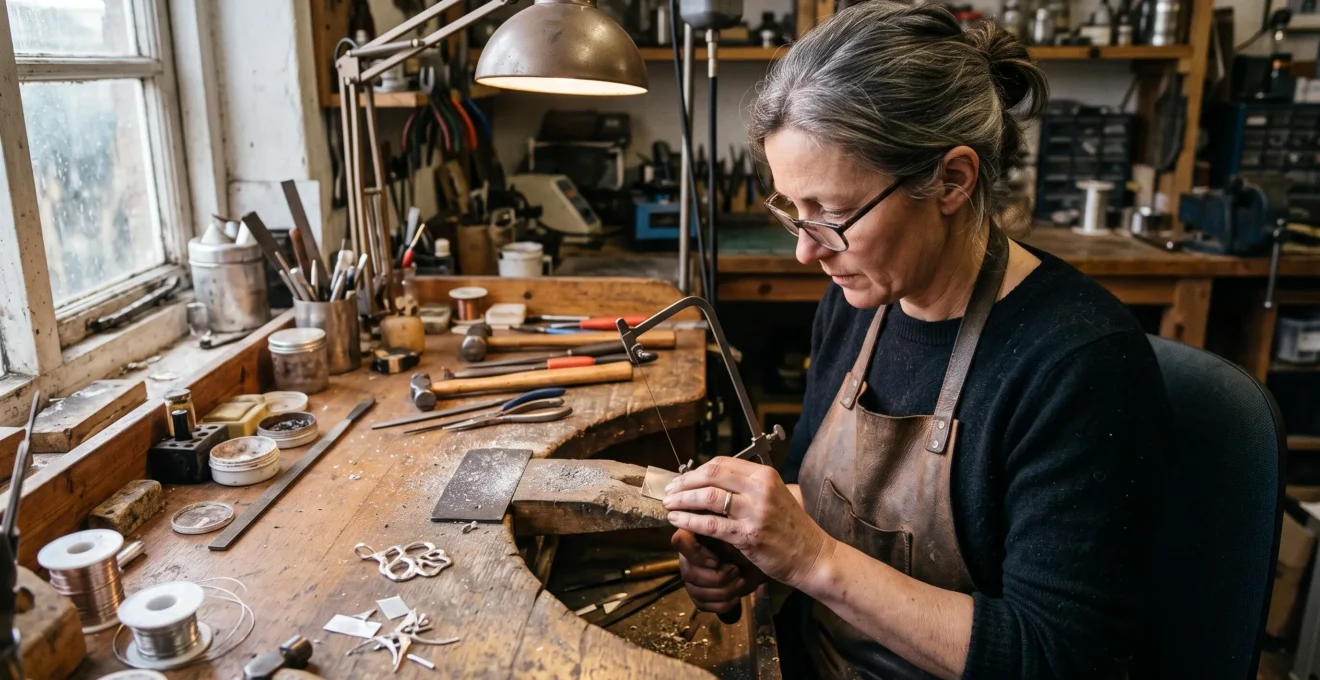
A genuinely handcrafted silver pendant can cost substantially more than a visually similar factory-produced piece, even when both contain the same amount of sterling silver. The difference often lies in the work required to transform raw metal into finished jewelry, rather than in the metal itself.
There is no universal fair price for handmade silver jewelry. A simple fabricated design may require relatively little bench time, while intricate construction, stone setting, engraving, and repeated finishing can demand many hours of skilled labor. A defensible price must cover materials, paid working time, studio expenses, and the maker’s business costs.
The difficulty for buyers is that “handmade” can describe very different production methods. A pendant fabricated from sheet and wire is not economically equivalent to one assembled from purchased components or polished after factory casting. Understanding those distinctions makes it possible to support genuine craftsmanship without automatically accepting an inflated artisan premium.
What determines a fair price for handcrafted silver jewelry?
- Labor is usually the decisive variable: assess the actual operations performed, not merely the item’s weight or appearance.
- Production methods matter: full hand-fabrication, artisan casting, hand-assembly, and mass manufacturing have different labor requirements.
- Verify before paying a premium: request specific production information and compare the asking price with realistic materials, overhead, and maker compensation.
- Why Genuinely Hand-Fabricated Silver Requires 15-40 Hours Per Piece
- Handmade vs Manufactured Silver: Value Comparison Beyond Just Price
- How to Calculate Whether Artisan Pricing Reflects Fair Maker Wages
- The « Handmade » Exploitation Where Factory Pieces Claim Artisan Status
- Independent Makers vs Corporate « Artisan » Brands: Where Does Your Money Go?
- How to Verify a Jeweller’s Credentials and Workshop Practices Before Buying
- Why Hand-Raised Silver Vessels Cost 10× More Than Spun Alternatives
- How Different Metalworking Techniques Determine Silver Jewelry Value
Why Genuinely Hand-Fabricated Silver Requires 15-40 Hours Per Piece
Complex hand-fabricated silver jewelry can require 15–40 hours because the maker must individually shape, join, refine, and finish its components. However, that range is an illustrative production scenario, not an established industry average. Simpler designs may take considerably less time, while elaborate settings or construction can take longer.
Hand-fabrication begins with raw stock such as sterling silver sheet, strip, or wire. Rather than assembling already formed decorative components, the jeweller creates the principal shapes and structures through operations such as measuring, sawing, bending, forging, filing, and soldering.
The labor extends beyond the visible construction. A maker may spend time preparing drawings, checking dimensions, fitting joints, setting stones, adjusting surfaces, and polishing areas that become difficult to reach once the piece is assembled.
Soldering is particularly important because the quality of a joint depends on preparation and controlled heating. The Gemological Institute of America‘s technical instructions for jewelry soldering explain that poor joint contact and overheating can produce weak or defective connections.
A failed joint may require cleaning, refitting, additional heating, and refinishing. Rework therefore belongs in a realistic production-time estimate, although its frequency varies and no general failure allowance can be assumed.
Consider a purely hypothetical fabricated pendant requiring 24 production hours. Its time budget might comprise three hours of design and preparation, seven hours of cutting and shaping, five hours of joining and joint correction, five hours of stone setting, and four hours of final finishing. This is a teaching example, not a measured average.
At an illustrative labor allowance of $30 per production hour, those 24 hours represent $720 in labor before silver, stones, consumables, overhead, selling expenses, or profit. The example demonstrates why a genuine multi-day fabrication process cannot be evaluated solely against the commodity value of the silver.
The distinction is especially important when comparing a fabricated pendant with one made by soldering together commercially purchased cast elements. Both may involve legitimate handwork, but the second maker does not necessarily perform the cutting, forming, and model-development work embodied in those components.
Production hours become persuasive evidence of value only when they correspond to identifiable work. The next question is whether those hours deliver advantages that justify choosing handcrafted jewelry over manufactured alternatives.
Handmade vs Manufactured Silver: Value Comparison Beyond Just Price
Handmade silver jewelry is worth a premium when its craftsmanship provides something the buyer values: distinctive construction, deliberate material choices, repairability, customization, or an identifiable maker. Manufactured jewelry can be a better purchase when consistency, availability, and affordability matter more. The strongest comparison examines production methods and practical benefits, not price alone.
Industrial production spreads design, tooling, and setup costs across multiple units. A hand-fabricated piece may concentrate much of that work in a single object. Neither model automatically produces stronger or more attractive jewelry.
Some manufactured designs use relatively thin sections to control material costs, but that is not a universal characteristic of factory jewelry. Likewise, substantial handmade construction is possible without guaranteeing durability. Thickness, joint quality, design, stone security, and suitability for everyday wear must be assessed individually.
The following comparison identifies meaningful differences rather than treating either category as inherently superior.
| Criterion | Hand-fabricated silver | Manufactured silver |
|---|---|---|
| Labor structure | Individual shaping, joining, and finishing | Repeatable production with distributed setup costs |
| Consistency | Minor variations may occur | Designed for repeatable dimensions and appearance |
| Material thickness | Can be tailored to the design | Often standardized; varies by manufacturer |
| Repairs | Maker may understand and repair the original construction | Repairability depends on construction and available services |
| Customization | Often possible through direct discussion | Usually limited to available variants |
| Price structure | More individual labor allocated to each item | Production costs spread across batches |
Lost-wax casting adds an important middle category. A jeweller can carve a wax model by hand, have it cast in silver, and individually refine the resulting piece. The original model represents genuine creative labor, while subsequent reproductions can distribute that model-development cost across several castings.
This method is neither equivalent to fabricating every component from sheet and wire nor necessarily equivalent to mass manufacturing. It can offer distinctive design and high-quality hand-finishing at a lower labor requirement per repeated unit.
Inspection can provide clues, but not definitive authentication. Hammer marks may indicate forming or decorative texturing; residual sprue areas or casting porosity may suggest casting. Solder seams can reveal joined construction, although expertly finished joints may be almost invisible. Machines can also imitate irregular textures.
Similarly, a sterling silver stamp identifies a claimed composition, not how the object was produced. Stronger evidence combines physical inspection with credible information about manufacturing steps.
A fair purchase does not require rejecting industrial jewelry. It requires recognizing what additional labor, design control, and service are being purchased—and then determining whether the requested premium supports a reasonable maker income.
How to Calculate Whether Artisan Pricing Reflects Fair Maker Wages
To assess artisan pricing, separate the retail price into materials, production labor, business costs, and selling margins. Then compare the amount available for labor with the estimated fabrication hours. This provides a practical plausibility check, but it cannot prove fair compensation without knowing the maker’s actual costs, income, and commercial arrangements.
Start with the jewelry’s approximate metal weight and the current silver spot price in the same currency. Sterling silver contains 92.5% silver by mass, so a simplified calculation is:
Estimated contained silver value = item weight × 0.925 × spot price per unit of pure silver.
This calculates contained metal value, not the maker’s purchase cost. Suppliers charge fabrication premiums for sheet and wire, and the maker may face shipping costs, tax treatment, metal losses, and additional material expenses.
Next, estimate the production hours by identifying the techniques involved. A plain hand-formed ring, an intricate fabricated pendant, and a multi-stone setting should not be assigned identical labor budgets.
$25.26/hour
Median hourly wage equivalent for US jewelers and precious stone and metal workers, based on May 2025 occupational wage data. This is an employee earnings benchmark, not an independent artisan’s required studio billing rate.
Independent makers must generally recover expenses and unpaid business activity that an employee wage figure does not capture. Customer correspondence, photography, bookkeeping, purchasing materials, maintaining tools, and attending markets can consume time without producing a saleable object.
A hypothetical calculation makes the distinction clearer.
Illustrative fair-price assessment
Assume a fully fabricated silver pendant is offered directly by its maker for $1,000. For illustration only, suppose materials and consumables cost $100, allocated studio and business overhead costs $180, selling-related expenses total $70, and production requires 20 hours.
The remaining $650 represents $32.50 per production hour before the maker accounts for income taxes, any unpaid business time not already covered in overhead, and any additional profit or contingency. The calculation does not establish that the actual maker earns $32.50 per hour.
If the same hypothetical piece requires 35 hours instead, the corresponding figure drops to approximately $18.57 per production hour. The same retail price can therefore represent very different labor economics.
Costs that are easy to overlook include saw blades, solder, abrasive materials, polishing compounds, protective equipment, equipment maintenance, rent, utilities, insurance, unsuccessful work, and payment processing. A seller using a retailer or marketplace may also surrender part of the final selling price to an intermediary.
A very low advertised price deserves investigation when the claimed construction would require extensive skilled work. Possible explanations include a simpler production process, subsidized or unpaid labor, unusually low operating costs, a business accepting unsustainable returns, or inaccurate marketing. Price alone cannot identify which explanation applies.
Fair compensation is also location-dependent. A US studio, a workshop in Taxco, and a maker in Bali may face different living costs, supplier relationships, working conditions, and market access. Applying one country’s nominal hourly wage to every production region would be misleading. Local purchasing power and the actual compensation arrangement matter.
The result is a reasoned estimate rather than a certification of fairness. It becomes especially useful when a seller’s handmade description is too vague to justify the labor assumed in the asking price.
The « Handmade » Exploitation Where Factory Pieces Claim Artisan Status
Misleading handmade marketing occurs when a seller creates the impression of extensive individual craftsmanship while disclosing only minimal manual involvement. The problem is not that casting, assembly, or machine production are inherently inferior. It is that buyers may pay for a level of personal fabrication the product did not receive, while genuinely labor-intensive makers face distorted comparisons.
The word “handmade” can appear alongside radically different workflows: fully fabricating an item from raw stock, individually finishing a casting, assembling factory-produced findings, or manually polishing an otherwise machine-produced object.
In the United States, those distinctions have regulatory significance. Under the FTC rules on handmade jewelry claims, describing an entire jewelry product as handmade or hand-wrought must satisfy specified criteria for shaping, forming, finishing, and decoration through hand labor and manually controlled methods.
Claims about individual operations, such as hand-polishing or hand-engraving, must accurately represent those operations. Performing one manual finishing step does not automatically justify a claim that the entire piece is handmade.
These are US-specific marketing standards. Other English-speaking jurisdictions have their own consumer protection frameworks, so a single international definition should not be assumed.
Several marketing patterns justify further questions:
- Repeated claims of artisanal craftsmanship without identifying the actual fabrication method.
- Anonymous workshop imagery that cannot be connected to the product or its maker.
- Descriptions emphasizing hand-finishing while suggesting that the whole object was individually constructed.
- Large collections of supposedly one-of-a-kind pieces with identical details and no explanation of production methods.
- Refusal to explain where and by whom the relevant manufacturing steps are performed.
None of these signals alone proves deception. Repeated designs can be legitimate, workshops may employ multiple craftspeople, and some makers reasonably protect proprietary production information.
For an initial check, reverse-search the product photographs, compare identical designs sold through other channels, and ask which components were fabricated, cast, purchased, assembled, and finished by hand. A named workshop or traceable maker adds useful accountability.
The economic harm of misrepresentation runs in two directions. Buyers may pay more than the disclosed process warrants. Meanwhile, genuine makers can be pressured to compete against products marketed as equivalent despite requiring substantially less individual labor.
Marketing precision is more informative than romantic storytelling. It also provides a basis for understanding how much of the purchase price may reach the people responsible for making the jewelry.
Independent Makers vs Corporate « Artisan » Brands: Where Does Your Money Go?
Buying directly from an independent maker generally creates a more direct financial relationship with the craftsperson, while a larger jewelry brand distributes revenue across production, logistics, administration, marketing, wholesale relationships, and retail operations. Neither structure guarantees fair wages or better value. The important question is how transparently each business accounts for its production and compensation arrangements.
When an independent jeweller sells a piece directly, the payment enters the maker’s business without a separate retailer necessarily taking a resale margin. However, the full amount is not personal income. Materials, equipment, premises, taxes, payment fees, and other operating expenses still need to be covered.
A corporate brand may commission work from external workshops, purchase finished inventory, or operate its own production facilities. Its retail price can include manufacturing payments, distribution costs, brand development, inventory risk, and retailer markups.
It would be inaccurate to assume that a fixed or universally small share reaches production workers. That depends on contracts, labor practices, supply-chain arrangements, and the business model, none of which can be determined from branding alone.
| Buying consideration | Independent maker | Corporate artisan brand |
|---|---|---|
| Production traceability | Potentially direct access to the person making the piece | Depends on workshop and supplier disclosure |
| Customization | May offer commissioned changes or entirely new designs | Often follows predefined product options |
| Purchase convenience | May involve longer lead times and individual arrangements | May provide established ordering, fulfillment, and customer service |
| Returns and repairs | Depend on the maker’s published terms and capabilities | Depend on the brand’s published policies and service network |
| Price transparency | Direct discussion may clarify labor and materials | May require additional supply-chain disclosure |
To evaluate an artisan-positioned brand, ask whether its product pages identify makers, workshop locations, and specific production activities. A brand that documents hand-carving, casting, stone setting, and finishing separately provides more useful information than one relying only on the adjective “artisanal.”
Independent makers should be assessed by the same standard. A personal story does not verify how every product is manufactured, and an established brand can legitimately employ highly skilled craftspeople.
There is also a broader pricing problem. If large collections of low-labor products are promoted under the same handmade terminology as individually fabricated pieces, consumers may develop unrealistic expectations about the labor involved. This is a plausible competitive pressure, not a quantified market effect established by the sources available here.
The next practical step is to replace assumptions about workshop identity and craftsmanship with verifiable information before committing to a purchase.
How to Verify a Jeweller’s Credentials and Workshop Practices Before Buying
Verify a jeweller by checking their identifiable business or maker credentials, examining evidence of the manufacturing process, and requesting clear answers about the specific piece. Hallmarks can help establish metal composition, while workshop records can support production claims. Neither a stamp nor an appealing maker biography is sufficient proof of genuine hand-fabrication.
Start with the product’s metal description. Sterling silver is normally designated 925 because the alloy contains at least 925 parts per thousand silver. A “925” or “sterling” stamp is not a certificate of handmade production, fair wages, or independent metal testing.
In the United Kingdom, eligible precious-metal articles are subject to a formal hallmarking system involving independent Assay Offices. The British Hallmarking Council guidance on precious-metal hallmarks explains that a complete conventional UK hallmark includes a sponsor’s mark, a metal-and-fineness mark, and an Assay Office mark.
For silver, the UK exemption threshold is 7.78 grams. An item within the applicable weight exemption may legitimately lack a full hallmark. Furthermore, a sponsor’s mark identifies the registered person or business submitting the item, not necessarily the craftsperson who physically made it.
In other markets, including the United States, hallmarking and precious-metal stamping practices differ. A mark’s meaning must be interpreted under the relevant jurisdiction rather than according to UK requirements.
Evidence of craftsmanship should focus on the specific product. Useful documentation includes photographs showing its components before assembly, videos demonstrating relevant bench operations, commission records, and the maker’s explanation of how joints, surfaces, and stone settings were constructed.
Craft-organization membership, teaching work, exhibitions, and completed commissions can provide independently checkable evidence of professional experience. They do not necessarily authenticate every object the person sells. Similarly, the legal treatment of terms such as “bespoke” and “handcrafted” varies by jurisdiction and advertising context.
A five-step verification checklist before purchasing
- Identify the seller and maker: record the business name, workshop location where disclosed, and the person or workshop credited with production. Deliverable: an identifiable maker or documented supplier relationship.
- Confirm the metal description: photograph or request the relevant 925 stamp, hallmark, or available assay documentation. Deliverable: a record of the metal claim and its verification status.
- Request production evidence: ask for images or a specific explanation showing how the piece was shaped, joined, cast, assembled, and finished. Deliverable: a written description of the actual methods.
- Ask a technical question: request an explanation of the most time-consuming operation or how a visible construction feature was made. Deliverable: a product-specific technical answer that can be assessed against other evidence.
- Document purchase conditions: confirm weight, dimensions, customization, estimated delivery, returns, repair arrangements, and the final price. Deliverable: a written product specification and set of purchase terms.
The amount of verification should be proportionate to the purchase. For a modest purchase, product information and a focused question may be adequate. A substantial commission may justify an in-person or virtual workshop visit, documented design approvals, and independent verification of relevant precious-metal markings.
Verifying the craft process becomes particularly important when two visually similar silver objects are made through techniques with dramatically different labor requirements.
Why Hand-Raised Silver Vessels Cost 10× More Than Spun Alternatives
A hand-raised silver vessel can cost ten times as much as a similar spun vessel when repeated hammering, annealing, and surface refinement require substantially more skilled labor. The 10× comparison is illustrative rather than a verified market ratio. Actual differences depend on vessel dimensions, complexity, production volume, finishing standards, and the methods used.
Hand-raising shapes a metal sheet progressively into a hollow form through controlled hammering over suitable stakes. The silversmith works the material through successive forming stages rather than producing the complete shape in one operation.
As silver is repeatedly deformed, work-hardening can make further shaping difficult. Annealing softens the metal for additional forming. Deep or technically demanding vessels may require multiple cycles of hammering, heating, cleaning, and checking the emerging form.
Subsequent planishing refines the surface and geometry. The density and uniformity of hammer marks, curvature, wall profile, and intended final finish can all influence the required working time.
Metal spinning follows a different production principle. A silver blank rotates on a lathe while controlled pressure forms it against a suitable profile or mandrel. Where geometry and equipment permit, spinning can shape repeated vessels efficiently after tooling and setup.
Spun vessels may still require skilled work, trimming, soldering, surface finishing, or decorative operations. A complex setup or short production run can also make spinning relatively expensive. The method is not synonymous with low quality.
To distinguish the processes, examine the interior and exterior surfaces where possible. Regular, overlapping hammer impressions may support a hand-raising explanation, while concentric tooling lines may suggest spinning. Thickness variations and weight distribution can provide additional clues.
These are indicators, not infallible tests. Both processes can be followed by extensive polishing or planishing, and decorative hammering can be applied to spun objects. Measurements and credible manufacturing records are stronger than surface appearance alone.
A hypothetical comparison illustrates how labor can dominate. If two vessels contain comparable amounts of silver but one requires many individual forming and finishing operations while the other can be repeatedly formed after setup, a substantial price difference may be economically understandable even without a significant difference in metal value.
For collectors, hand-raising may justify a premium because of the skill and individual work embodied in the object. Buyers primarily seeking functional silver hollowware may rationally prefer a well-made spun alternative.
This extreme comparison demonstrates a broader lesson: silverworking techniques cannot be assigned value simply by how handcrafted their surfaces look. What matters is the actual process and the labor required to execute it.
Key takeaways before judging the final price
- Identify the primary forming process: casting, fabrication, forging, and raising create different production-time requirements.
- Count finishing and specialist operations separately: intricate engraving and stone setting may significantly increase labor even when the base form is simple.
- Compare the method with the claimed premium: a credible price should correspond to identifiable workmanship, not merely a handcrafted aesthetic.
How Different Metalworking Techniques Determine Silver Jewelry Value
Silver jewelry value depends partly on the production technique because casting, hand-fabrication, forging, raising, engraving, and stone setting place different demands on labor and specialist skill. No fixed ranking accurately describes every design. A simple fabricated object may require less work than a highly detailed casting, while combining several difficult techniques can multiply production time.
The most useful comparison is between specific workflows of comparable design complexity, rather than broad labels such as “cast” or “forged.”
Consider the main techniques and the labor they introduce:
| Technique | Principal work | Main value considerations |
|---|---|---|
| Lost-wax casting | Model creation, mold or casting preparation, casting, cleanup, and finishing | Original model complexity, reproducibility, casting quality, and finishing |
| Sheet-and-wire fabrication | Measuring, cutting, forming, joining, and surface refinement | Number of components, joint complexity, precision, and individual construction time |
| Forging | Controlled hammer shaping and possible repeated annealing | Degree of deformation, dimensional accuracy, and finish |
| Hand-raising | Progressive hollow-form shaping through hammering and annealing | Vessel geometry, number of forming stages, and planishing requirements |
| Hand engraving | Cutting decorative lines or patterns into the surface | Design intricacy, depth, precision, and area covered |
| Stone setting | Preparing seats and securing gemstones | Stone quantity, setting type, precision, and risk of damage |
For certain repeated designs, casting can reduce unit labor after the original model and production setup have been completed. A one-off casting requiring extensive model creation and refinement may nevertheless be labor-intensive.
Fabrication from sheet and wire tends to allocate more shaping and assembly work to each individual object. Forging and raising introduce additional forming operations, while hand engraving and stone setting may add substantial specialist labor to an otherwise straightforward piece.
These techniques can also be combined. A ring may use a cast central motif, a hand-fabricated shank, individually engraved details, and hand-set gemstones. Its price should reflect the real work involved in each operation rather than forcing the entire object into a single category.
Visual inspection may provide clues. Casting can leave evidence of sprue removal or surface porosity. Fabricated pieces may contain joints positioned where separately formed components meet. Directional deformation and hammer textures may suggest forging, while engraved lines can reveal variations in cutting pressure and depth.
Yet no one visual feature reliably establishes the manufacturing method. High-quality finishing can conceal joints or casting artifacts, and machine processes can reproduce textures that resemble manual work.
The practical pricing sequence is therefore to identify the principal forming method, list the additional operations, estimate credible labor requirements, and compare those requirements with material and business costs. When disclosure is incomplete, the estimate should remain provisional.
For buyers seeking an artisan aesthetic without paying for fully individual fabrication, a hand-carved design reproduced through casting, or an object combining cast components with custom-fabricated elements, can provide a legitimate alternative. Such work deserves an accurate description and a price consistent with its actual process.
Before buying, request a concise breakdown of the actual production steps and compare it with the object’s design, documented workmanship, and selling price. Paying fairly means compensating real craft skill without paying an unsupported premium for a manufacturing story.
Is expensive sterling silver jewelry always better made?
No. A higher price may reflect skilled labor, custom work, complex construction, business costs, or retail positioning. It does not automatically establish superior material quality, durability, ethical production, or genuine hand-fabrication. Ask which specific features and operations explain the premium.
Can a cast silver piece still be genuine artisan jewelry?
Yes. An artisan may design and carve the original model, commission casting, then individually refine, engrave, or set the piece. That can represent substantial creative and manual work. However, the seller should describe the actual process accurately, and compliance with specific handmade advertising claims depends on the applicable jurisdiction.
Does recycled sterling silver cost less than newly sourced silver?
Not necessarily. Recycled silver still requires sourcing, recovery, refining, alloy preparation, or fabrication into usable stock. Its purchase price depends on the supplier, form, processing, and market conditions. Recycled content alone does not establish either a lower retail price or superior production conditions.
Should an independent silversmith disclose their exact hourly earnings?
No. A maker can offer meaningful transparency without revealing confidential financial information. Identifying the production methods, approximate labor requirements, materials, and services included in the price is often sufficient for an informed purchasing discussion. Exact personal income cannot reliably be calculated from a single retail price.
Can a silver jewelry appraisal prove that a piece was handmade?
Not automatically. An appraisal may address metal composition, gemstones, condition, identifying marks, and an assigned value for a stated purpose. Establishing fabrication methods may require specialist examination and supporting workshop documentation. The appraiser’s qualifications and the stated scope of the appraisal determine how much confidence to place in any handmade attribution.