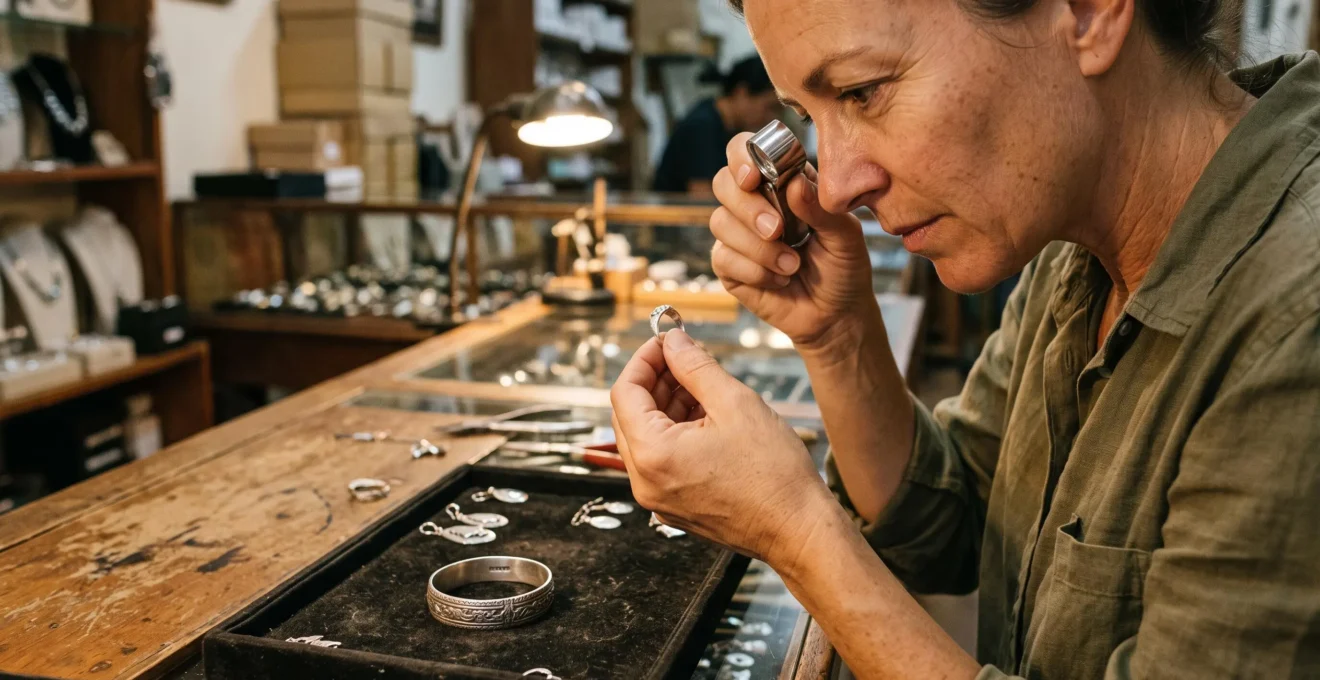
A silver bracelet marked 925 in a London jewelry shop and another carrying the same stamp in a Southeast Asian market may claim identical metal content. Yet the markings do not necessarily provide the same level of independent verification. Understanding that distinction can prevent an expensive mistake when buying jewelry abroad.
Silver purity numbers describe the proportion of precious metal in an alloy: 925 indicates 92.5% silver, 958 indicates 95.8%, and 999 indicates 99.9%. However, a purity stamp is not automatically an authenticated hallmark. Its evidential value depends on who applied it, which verification system operates in the country concerned, and whether additional marks or documentation support the claim.
For international travelers, reliable purchasing requires three separate judgments: whether the claimed silver grade suits the jewelry, whether the seller can substantiate its composition, and whether meaningful remedies will remain available after departure. The following methods help distinguish verified precious-metal markings from unsupported claims without assuming that every country follows British hallmarking rules.
Essential silver-buying rules for international travelers
- A 925 stamp claims sterling silver composition, but independent verification depends on the applicable hallmarking system.
- 925 silver is generally practical for frequently worn jewelry; 958 and 999 offer greater silver content with different durability considerations.
- Check the complete marking, examine the item, assess the seller’s documentation, and arrange independent testing when the financial risk warrants it.
- Why 925 Markings Mean Different Things in UK vs Southeast Asian Markets
- 925 vs 958 vs 999 Silver: Which Purity Grades Suit Different Jewelry Types?
- How to Verify Silver Purity Using Acid Tests in Foreign Markets
- The Fake Hallmark Scam That Fools 60% of Tourist Buyers
- When to Demand Independent Testing Before Finalising International Silver Purchases
- Why 92.5% Silver Creates the Perfect Balance of Beauty and Resilience
- Maker’s Marks vs Assay Marks: What Each Symbol Tells You
- How to Decode Silver Hallmarks to Authenticate and Date Antique Pieces
Why 925 Markings Mean Different Things in UK vs Southeast Asian Markets
In the United Kingdom, a complete legally recognised hallmark provides independent verification through an assay office. In Southeast Asian jewelry markets, a 925 stamp may instead represent a manufacturer’s declaration, depending on the country and seller. The number expresses the same claimed purity, but the supporting evidence and applicable legal protections can differ considerably.
The distinction becomes important when comparing jewelry purchased in Britain with silver sold at tourist markets in Thailand, Bali or Vietnam. A numerical stamp identifies an alloy standard; it does not reveal whether anyone independent of the seller has tested the item.
Under UK hallmarking requirements, a complete hallmark contains three compulsory components:
- Sponsor’s mark: identifies the registered person or organisation responsible for submitting the article for hallmarking.
- Fineness mark: identifies the precious-metal purity standard, such as 925.
- Assay office mark: identifies the institution responsible for testing and hallmarking the article.
The UK government guidance on hallmarking requirements also identifies an important exception: silver articles below 7.78 grams are generally exempt from compulsory hallmarking. Therefore, a small genuine silver ring without a complete hallmark is not automatically counterfeit.
7.78 g
The general UK compulsory hallmarking exemption threshold for silver. Items below this weight may qualify for exemption, subject to applicable rules.
British Hallmarking Council, official UK hallmarking guidance.
Travelers should not assume that Thailand, Indonesia and Vietnam share a single regulatory framework. Local hallmarking obligations, consumer remedies and enforcement arrangements require country-specific verification. In a market where a stamp is self-declared, a convincing 925 engraving provides considerably less assurance than an independently authenticated hallmark.
A useful buying rule is to assess the seller and the verification process before trusting the number. Check the overall weight, compare the asking price with the likely silver content, examine the markings and request evidence of testing. An implausibly low price may justify suspicion, although price alone cannot establish authenticity.
Consumer protection also changes across borders. UK purchases benefit from applicable domestic rules, while recovering money from an overseas seller can become difficult after leaving the country. Keep the receipt, declared purity and seller’s identification before completing an international purchase.
The practical lesson is not that jewelry from a particular region is unreliable. It is that the strength of the evidence matters more than the country printed on the receipt. Once verification is understood, the next question is which silver grade actually suits the intended piece.
925 vs 958 vs 999 Silver: Which Purity Grades Suit Different Jewelry Types?
925 sterling silver is generally the most practical choice for rings, bracelets, clasps and frequently worn jewelry because its alloying metals improve durability. 958 Britannia silver offers higher purity, while 999 fine silver is softer and more susceptible to scratching or deformation. The best grade depends on the item’s design, construction and expected mechanical stress.
Buying the highest numerical grade does not necessarily produce the best piece of jewelry. Purity expresses composition, not resistance to everyday wear, the quality of a clasp or the security of a gemstone setting.
The GIA comparison of silver purity and jewelry durability explains why sterling commonly includes copper or other alloying metals and why fine silver requires more care in applications subject to bending and impact.
| Consideration | 925 sterling silver | 958 Britannia silver | 999 fine silver |
|---|---|---|---|
| Declared silver content | 92.5% | 95.8% | 99.9% |
| General material characteristics | Alloyed for practical durability | Higher purity, with performance dependent on composition and workmanship | Relatively soft and prone to scratches and dents |
| Typical purchasing consideration | Daily-wear rings, bracelets and functional components | Selected crafted or decorative pieces | Protected pendants, decorative items and carefully handled designs |
| Primary concern | Tarnish and construction quality | Verification of grade and mechanical suitability | Deformation under repeated stress |
| Recommended verification | Hallmark or other reliable purity evidence | Independent grade confirmation when material | Reliable testing and documented composition |
The differences extend beyond the silver percentage. Copper-containing alloys can have greater susceptibility to tarnish reactions, particularly in environments containing sulfur compounds. Higher-purity silver may reduce some alloy-related tarnishing, but no purity number guarantees that jewelry will remain bright without maintenance.
When shopping abroad, match the claim to the design. A thin 999 ring may deform more readily than a suitably constructed sterling ring, while a substantial fine-silver pendant can be perfectly reasonable. The item’s thickness, manufacturing method and intended use all affect its durability.
Regional stock can also influence the choices offered. Rather than assuming a destination specialises in one legitimate grade, ask the seller which alloy was used and why. The appearance, color and weight of a piece are useful observations, not definitive grade identifiers.
For silver bought primarily for metal value, calculate the fine-silver content from verified weight and purity, then consider the seller’s premium and the possibility of resale. Jewelry should not automatically be treated as equivalent to investment bullion.
A suitable alloy still needs authentication. Whether the purchase is a sterling bracelet or a high-purity souvenir, physical checks can help identify suspicious claims before money changes hands.
How to Verify Silver Purity Using Acid Tests in Foreign Markets
Silver acid testing can provide a preliminary assessment of exposed metal, but it cannot conclusively verify the composition of an entire piece. Plating, test location and reagent formulation influence results. Travelers should obtain permission before any potentially damaging test and use professional verification for valuable purchases or uncertain purity grades.
An acid-testing kit works by exposing metal to a chemical reagent and observing a reaction. Because reagents and interpretation charts vary by manufacturer, there is no universally reliable color result that independently proves a piece contains exactly 92.5% silver.
Green or other unexpected reactions may indicate interaction with base metals or alloy constituents, but they do not uniquely identify nickel or prove a specific counterfeit composition. Similarly, ordinary field kits should not be relied upon to distinguish 925 from 958 with analytical precision.
A sensible preliminary inspection follows a sequence:
- Examine stamps, surfaces and joints for inconsistent color or visible base metal.
- Use a magnet as a basic exclusion screen. Strong magnetic attraction warrants investigation, but a non-magnetic result does not prove silver content.
- Compare dimensions and weight with the expected properties of the claimed material, allowing for hollow construction, gemstones and other components.
- If the owner permits chemical testing, have a competent operator follow the kit’s instructions on an appropriate testing area.
- For unresolved or significant purchases, request professional analysis and documentation.
A surface-only acid test can be fooled by plating. Testing deeper material may require creating a small filed area, which damages the finish and may be unsuitable for antique, rhodium-plated or valuable jewelry. Never file another person’s merchandise without explicit consent.
Chemical reagents can be corrosive, and carrying testing chemicals across borders may involve transport restrictions or local handling requirements. A traveler should not assume an acid kit is permitted in cabin baggage or appropriate for use in a crowded retail environment.
Professional X-ray fluorescence analysis, usually called XRF, provides another option. It measures elemental composition within an instrument’s effective analysis depth without the same destructive preparation as some chemical tests. However, thick coatings, instrument calibration and sample geometry can influence results. XRF should therefore be interpreted as a measurement with limitations, not an automatic guarantee of uniform composition throughout an object.
Five checks to complete before paying for silver abroad
- Record the markings: photograph each visible stamp clearly enough to compare its characters and symbols.
- Inspect the construction: note the item’s weight, dimensions, surface inconsistencies and any suspicious magnetic response.
- Confirm permission for testing: obtain the seller’s explicit agreement before requesting an acid test, filing or another potentially damaging inspection.
- Evaluate the evidence: request a certificate or independent test report identifying the item, claimed purity and testing provider.
- Preserve the transaction record: obtain a receipt containing the seller’s details, item description and declared silver grade.
A refusal to permit destructive testing is not, by itself, proof of fraud. A legitimate seller may reasonably protect finished merchandise from damage. Refusal to provide any meaningful documentation or alternative verification is a more serious reason to reconsider the purchase.
Testing reduces uncertainty only when its limitations are understood. Fraudulent markings present a separate challenge because a convincing number or symbol may be deliberately applied to material that has never undergone independent assessment.
The Fake Hallmark Scam That Fools 60% of Tourist Buyers
The claim that fake hallmarks fool 60% of tourist buyers should not be treated as an established international statistic. No supporting research in the supplied evidence establishes that figure. Hallmark fraud is nevertheless a genuine purchasing concern: an engraved purity number or official-looking symbol can be applied without valid independent testing.
Risk depends on the particular seller, market, product and verification arrangements. Tourists can face added uncertainty because they may not know local marking conventions, have limited time to investigate or be unable to return after discovering a problem.
Several forms of misrepresentation deserve attention:
- Unsupported fineness stamps: a 925 engraving is presented as proof of independent certification although it was applied by the seller or manufacturer.
- Imitated institutional marks: symbols resemble recognised assay-office designs but cannot be authenticated against official records.
- Plated base-metal jewelry: a coating creates a silver appearance while the underlying material differs from the claimed alloy.
- Misleading component markings: a genuine sterling clasp is used to support a purity claim about an entire necklace made from different materials.
Warning signs can include irregularly positioned markings, unusual symbol combinations, mismatched surface colors and an inability to identify the responsible testing authority. However, stamp depth, font consistency and workmanship alone cannot distinguish authentic hallmarks from sophisticated reproductions.
Consider a hypothetical purchase: a traveler finds a heavy-looking bracelet in a tourist market. The clasp reads 925, but the seller cannot identify the metal used for the bracelet links or provide a written description. A non-magnetic response does not resolve the uncertainty, and testing only the clasp would not verify the entire piece. The sensible response is to request independent evidence or decline the transaction.
Photographing the jewelry and the seller’s description creates a useful record. Where an official hallmark is claimed, compare its symbols with reference information published by the relevant assay authority rather than relying on the seller’s verbal interpretation.
If a purchase later proves misrepresented, obtain a written assessment from a qualified jeweler or testing laboratory. Contact the seller promptly and preserve payment records. Depending on the circumstances, card-dispute procedures or local consumer remedies may offer assistance, but reimbursement is not automatic. Travel insurance should not be presumed to cover an authenticity dispute.
The best protection is evidence gathered before payment. Where the value or circumstances make ordinary inspection insufficient, an independent test becomes a purchasing condition rather than an optional precaution.
When to Demand Independent Testing Before Finalising International Silver Purchases
Independent silver testing is particularly worthwhile when a purchase is expensive relative to the buyer’s budget, the claimed purity is unusually high, the item is sold as antique or investment-grade, or the seller’s documentation cannot be verified. Testing is most valuable when an incorrect purity claim would materially affect the purchase decision.
There is no universal monetary threshold at which every silver purchase must undergo professional testing. Instead, establish a personal risk limit before shopping and consider both the amount at stake and the practical possibility of obtaining a refund.
The following comparisons can guide the decision:
| Purchase situation | Principal concern | Reasonable verification response |
|---|---|---|
| Low-value sterling souvenir | Misleading composition claim | Inspect markings and obtain a written description |
| Expensive bracelet or necklace | Plated components or inconsistent composition | Request independent testing of representative areas |
| 958 or 999 purity claim | Incorrect fineness declaration | Obtain reliable grade-specific analysis |
| Antique or attributed maker’s piece | False age, attribution or hallmark | Combine metal analysis with specialist appraisal |
| Purchase intended primarily for metal value | Incorrect weight or fine-silver content | Verify weight, fineness and transaction documentation |
Independent options differ in both purpose and evidential strength. An authorised assay office or suitably qualified laboratory may provide formal precious-metal assessment where such services are available. A professional dealer may offer XRF screening, while a specialist appraiser can assess characteristics that elemental analysis alone cannot establish.
The Thermo Fisher Scientific explanation of precious-metal testing methods describes why complementary testing approaches matter, including the limitations of magnetic checks, acid testing and XRF analysis. Its discussion primarily concerns gold, so it should not be interpreted as a validated silver-specific grading protocol.
Ask the testing provider what was measured, which areas were examined and whether coatings could affect the result. A report describing only the surface composition should not be mistaken for proof that a substantial object’s interior has identical purity.
For a significant transaction, negotiate testing before committing funds. A seller might agree to independent assessment followed by payment, a documented conditional sale, or a mutually accepted third-party payment arrangement. Such protections depend on local availability and contractual enforceability; they are not universal retail practices.
Certificates deserve scrutiny too. A document printed by the same shop is primarily a seller declaration unless backed by verifiable independent evidence. Look for a named issuing organisation, identifiable test report, precise item description, stated analytical method and an accessible means of confirming authenticity.
Testing after returning home may reveal misrepresentation, but it offers less protection when the seller cannot be contacted or the transaction cannot be reversed.
Reliable analysis confirms what the metal contains; it does not determine whether its alloy is suitable for daily wear. That distinction explains why sterling’s metallurgical properties remain relevant even when a higher-purity alternative is genuine.
Why 92.5% Silver Creates the Perfect Balance of Beauty and Resilience
Sterling silver contains 92.5% silver and 7.5% other metals, commonly including copper. Alloying changes the metal’s mechanical behavior, making it more practical for many jewelry applications than relatively soft fine silver. This combination explains sterling’s widespread use in rings, bracelets, clasps and stone-set pieces.
Pure silver is workable, but its softness can become a disadvantage when jewelry experiences repeated contact, knocks or bending. Introducing suitable alloying elements can improve strength and hardness, helping a finished item retain its intended shape.
The advantage is especially relevant to components that must function reliably. A bracelet clasp needs to maintain its mechanism, a ring must withstand repeated contact with hard surfaces, and gemstone settings must hold stones securely. Design and manufacturing quality remain essential, even when the alloy itself is appropriate.
Sterling is not maintenance-free. Copper-containing silver alloys can tarnish through reactions involving sulfur-containing substances in the surrounding environment. The resulting discoloration is not necessarily evidence of poor purity or fraud.
Practical care includes:
- Wiping jewelry gently after wearing it to remove moisture and surface residues.
- Storing pieces in dry, suitable anti-tarnish packaging when not in use.
- Using cleaning methods compatible with gemstones, coatings and decorative finishes.
- Avoiding unnecessary abrasion that may damage delicate surfaces or thin plating.
Fine silver generally contains fewer alloying metals that can contribute to certain tarnish reactions, but that does not make it immune to discoloration or surface damage. Its greater softness creates a different ownership consideration.
Travelers planning to wear jewelry throughout a trip may therefore prefer well-constructed sterling pieces, particularly for rings and bracelets. Higher-purity pieces may be more appealing when the primary objective is silver content, craftsmanship or careful occasional use.
The 925 standard also has historical roots in long-established systems of silver fineness and trade. Its international familiarity makes the number commercially useful, but widespread recognition also makes it easy for a seller to imitate without proving composition.
Choosing sterling for its practical properties is reasonable only when the declared alloy is credible. A full hallmark provides a different type of information from a standalone fineness number, and understanding each component makes authentication more systematic.
Maker’s Marks vs Assay Marks: What Each Symbol Tells You
A maker’s or sponsor’s mark identifies a party associated with a jewelry article, while an assay office mark identifies the institution responsible for testing and hallmarking it. In the UK system, the sponsor is not necessarily the manufacturer. Independent assay verification and commercial identification are different forms of evidence, even when both appear together.
A complete British hallmark can be read as a structured record rather than a decorative cluster of symbols. The compulsory elements identify the registered sponsor, the stated precious-metal fineness and the responsible assay office.
The Goldsmiths’ Company Assay Office explanation of hallmarks clarifies the roles of these marks and describes optional features such as date letters.
| Mark | Information supplied | Important limitation |
|---|---|---|
| Sponsor’s mark | Registered party submitting the article | Does not necessarily identify the actual craftsperson |
| Fineness mark | Declared precious-metal standard | A standalone number is not a complete UK hallmark |
| Assay office mark | Institution responsible for official testing | The symbol must itself be genuine |
| Date letter | Year associated with hallmarking | Optional in modern UK hallmarking and not necessarily the manufacturing date |
| Historical duty mark | May indicate an earlier tax-related marking requirement | Interpretation depends on the historical period and system |
When examining British silver, first locate the apparent sponsor’s mark and fineness mark. Then identify the assay office symbol and compare the complete combination against official references. If a date letter is present, its typeface, case and surrounding shape may be essential to determining the applicable year.
The absence of a date letter on modern British jewelry is not evidence of fraud. Likewise, eligible lightweight silver articles may legitimately lack compulsory hallmarking.
International interpretation requires particular care. Some countries use trade marks, manufacturer declarations or certification practices that differ from the UK model. An official-looking symbol is not necessarily an assay office mark, and an unfamiliar hallmark arrangement should be assessed under the rules of its claimed issuing jurisdiction.
Exported jewelry may also contain markings reflecting a production location, target market or private certification scheme. The presence of several symbols is not automatically stronger evidence unless their origin and meaning can be verified.
Once the marking system is identified, historical symbols may help establish when an item was assayed. Dating antique silver, however, requires checking much more than a plausible-looking letter.
Key points before assessing antique silver
- A hallmark date establishes a marking event, not automatically the date an entire object was manufactured.
- A convincing antique attribution requires consistency between official marks, construction, wear and provenance.
- When claimed age substantially affects price, obtain a specialist assessment before the transaction becomes difficult to reverse.
How to Decode Silver Hallmarks to Authenticate and Date Antique Pieces
Antique silver hallmarks can help establish an object’s origin and hallmarking period when the symbols are authentic and correspond to documented historical records. Start by identifying the fineness standard and assay authority, then compare any date letter against the correct official table. Construction, provenance and evidence of later alterations must support the interpretation.
British silver offers a comparatively structured research path because historical hallmarking systems contain identifiable assay office symbols, sponsor’s marks and changing date-letter conventions. Other countries may use different systems or provide no comparable annual dating information.
For a British antique, examine the marks in context rather than searching for a single matching letter. A particular character can recur across different dating cycles, while its shield shape, typography and accompanying office mark can distinguish the relevant period.
A practical examination proceeds through several stages:
- Photograph the entire object and obtain sharp images of each visible marking.
- Identify the apparent precious-metal standard and marking jurisdiction.
- Compare the assay office symbol with the relevant official reference.
- Match any date letter using its exact letterform, case and surrounding shape.
- Check whether the object’s construction, surface wear and documented history are consistent with the proposed period.
The fifth step is particularly important. Antique objects may have been repaired, modified or assembled from components produced at different times. A genuine old hallmark on one component cannot independently date every part of the finished object.
Physical evidence can reveal inconsistencies that a hallmark alone cannot explain. Modern casting seams, surface finishing, soldering methods and tool marks may be incompatible with the claimed manufacturing period. Conversely, unusual construction does not necessarily prove a forgery without specialist examination.
Patina requires equally careful interpretation. Natural tarnishing and wear can develop unevenly, while artificial aging techniques can imitate some superficial characteristics. A convincing antique appearance is therefore not sufficient proof of age.
Counterfeiters may reproduce old-looking stamps on newer items, while so-called marriage pieces can combine authentic historical components into an object that did not originally exist in its present form. These possibilities affect both attribution and market value.
For international purchases, investigate applicable export and cultural-property restrictions before transporting potentially significant antique objects across borders. Rules depend on the origin country, object category and circumstances; a seller’s assurance alone does not establish export eligibility.
An authenticated hallmark can support confidence in an item’s history and potentially affect resale value, but rarity, condition, craftsmanship and provenance also matter. For expensive pieces, an independent specialist should examine the object and its marks before the buyer relies on a historical attribution.
Before purchasing antique silver abroad, request clear hallmark photographs, obtain the seller’s provenance claims in writing and compare the marks with official historical references. Where age or attribution materially increases the price, arrange a qualified appraisal before making a binding commitment.
Can genuine sterling silver be sold without a 925 stamp?
Yes. Genuine silver may lack a numerical stamp, depending on the article, applicable law and marking practices. In the UK, silver articles below the general 7.78-gram hallmarking exemption threshold may be sold without compulsory hallmarking. An absent stamp calls for further verification rather than an automatic assumption that the item is counterfeit.
Does a silver certificate issued by a foreign jewelry shop guarantee authenticity?
No. A shop-issued certificate may document the seller’s declaration without providing independent verification. A stronger report identifies an external testing organisation, the examined item, the analytical method and the reported composition. The issuing laboratory and report should be independently verifiable.
Can a magnet distinguish genuine silver from silver-plated jewelry?
Not reliably. Silver is not ferromagnetic under ordinary shopping conditions, but many metals used in imitation or plated jewelry are also non-magnetic. Strong magnetic attraction can raise suspicion, while the absence of attraction cannot establish sterling silver purity.
Can silver purity be measured without scratching the jewelry?
Professional XRF analysis can estimate elemental composition without requiring the surface damage associated with some acid-testing methods. However, the results depend on measurement depth, calibration, sample geometry and surface coatings. Thick plating or non-uniform construction may require additional analysis to assess the underlying metal.
Will a UK hallmark prove that an antique silver item was made in a particular year?
Not necessarily. An authentic historical date letter can help establish when an article or component was hallmarked. It does not automatically establish the precise manufacturing date of the entire object, particularly if repairs, alterations or replacement components are present. A credible antique attribution also requires examination of construction, condition and provenance.