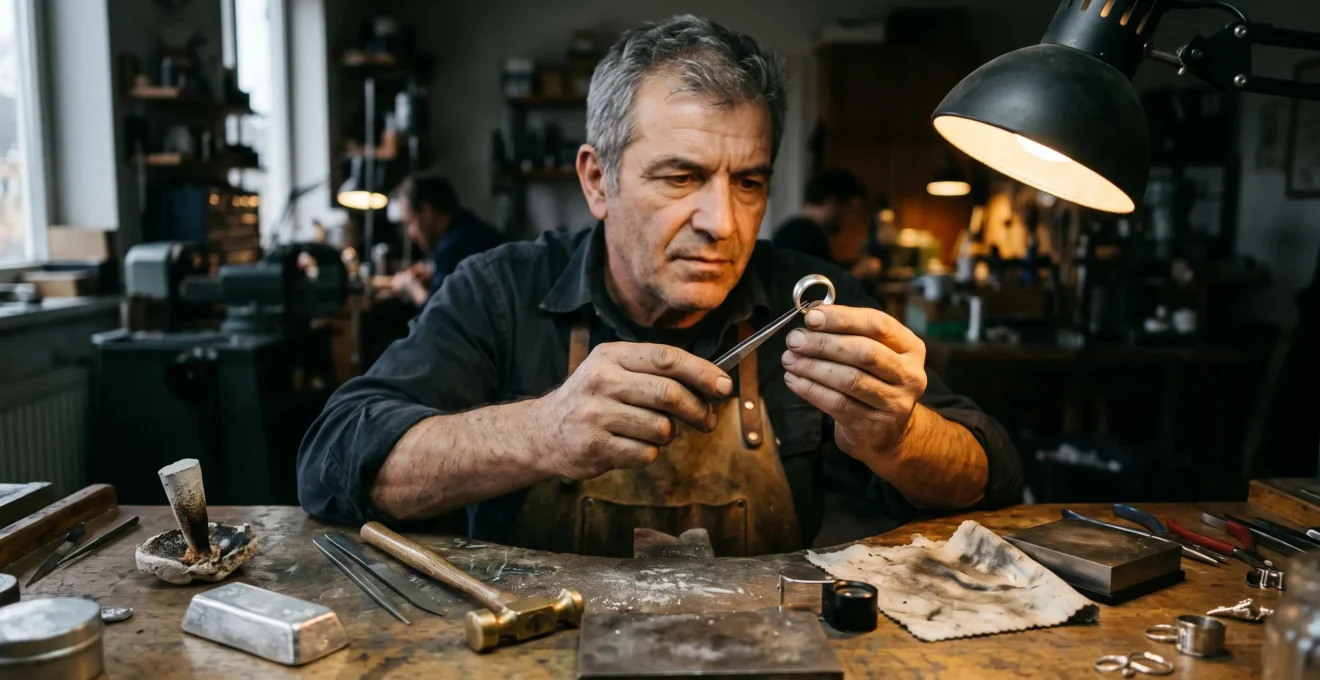
A silver engagement ring can become a treasured family heirloom, yet another piece bearing the same 925 stamp may develop damaged settings, weakened joints or an increasingly worn surface after relatively modest use. The difference rarely comes down to silver purity alone.
Alloy composition determines much of a silver jewel’s initial hardness, workability and corrosion behaviour. Manufacturing quality determines whether those properties translate into reliable construction. Environment, handling and maintenance then influence how the piece changes over decades.
For someone commissioning jewelry intended to survive generations, the essential decision is therefore not simply sterling versus pure silver. It is choosing an appropriate alloy, verifying its composition, evaluating the maker’s techniques and matching the design to the wearer’s everyday conditions.
The familiar comparison between five years and fifty years is a useful way to frame longevity, not a scientifically established lifespan for either alloy. Well-made silver jewelry can remain serviceable for generations, provided its construction, environment and care are suitable.
What Determines the Longevity of Silver Jewelry?
- Composition: Sterling contains 92.5% silver. Its remaining alloying elements affect mechanical behaviour, fabrication and resistance to environmental damage.
- Construction: Sound casting, properly fabricated joints, suitable thickness and repairable settings matter as much as the hallmark.
- Preservation: Controlling moisture, pollutants, salt exposure and abrasive cleaning helps preserve surfaces and delicate details.
- Why 92.5% Silver Creates the Perfect Balance of Beauty and Resilience
- How Copper Transforms Soft Silver Into an Alloy That Survives Generations
- 925 Sterling vs Argentium Silver: Which Resists Daily Scratches and Tarnish Better?
- How to Prevent Sterling Alloy Degradation in Humid Coastal Climates
- The Storage Blunder That Corrodes Sterling Silver Within Months
- Why Acidic Skin pH Accelerates Silver Tarnish Faster Than Neutral pH
- Left vs Right Hand Ring Symbolism: What Different Cultures Read Into It
- How to Decode Sterling Silver Purity Standards When Buying Jewelry Abroad
Why 92.5% Silver Creates the Perfect Balance of Beauty and Resilience
Sterling silver contains 92.5% pure silver and 7.5% other metals, traditionally copper. This composition offers a practical compromise between silver’s attractive appearance and the mechanical strength needed for jewelry. However, 925 fineness does not guarantee fifty years of service: alloy formulation, fabrication, design and care remain decisive.
Pure silver is relatively soft and malleable. Those qualities make it workable but also leave thin, exposed components more vulnerable to distortion during everyday wear. Introducing alloying elements changes how the metal deforms under stress, allowing jewelers to produce rings, chains and settings better suited to repeated handling.
Increasing the proportion of base metals can further change hardness and strength, but it also reduces silver purity and may introduce additional corrosion or colour-related considerations. The 925 standard is therefore a long-established compromise, not a scientifically universal optimum for every possible application.
92.5%
Minimum silver content associated with the sterling designation in the United States. The remaining 7.5% is not required to consist exclusively of copper.
Federal Trade Commission, consumer guidance on buying silver jewelry.
The distinction between fineness and construction becomes especially important for heirloom commissions. Two rings may both contain 925 silver while differing substantially in wall thickness, porosity, joint quality, stone-setting security and finishing.
A carefully fabricated ring with adequate metal around its setting may tolerate years of normal use better than a more delicate ring made from an otherwise excellent alloy. Similarly, a faulty solder joint can fail without the surrounding silver having undergone meaningful deterioration.
When assessing a future family treasure, consider three interconnected choices:
- Composition: Which silver alloy and temper are appropriate for the intended design?
- Exposure: Will the jewelry encounter perspiration, seawater, humidity or frequent cleaning?
- Handling: Can it be inspected, cleaned, repaired and stored without damaging its finish?
Once purity has been verified, the next question concerns the elements within the alloy and how their behaviour affects the finished jewel.
How Copper Transforms Soft Silver Into an Alloy That Survives Generations
Copper strengthens conventional sterling silver by modifying how its metallic crystal structure responds to deformation. It helps transform relatively soft silver into a more practical jewelry material, but it also influences oxidation, fabrication and surface discolouration. Its benefits depend on alloy processing, heat treatment and the quality of the finished piece.
Silver and copper can form solid solutions in which alloying atoms influence the movement of crystal defects called dislocations. Restricting that movement can increase resistance to permanent deformation. The extent of strengthening depends on composition, temperature history and the metal’s final condition.
Hardness is not determined by copper percentage alone. Cold working, annealing and other thermal treatments can produce significantly different results from the same nominal alloy.
The familiar 925 designation also leaves room for formulation differences. Although traditional sterling generally contains copper as its principal additional element, some commercial alloys incorporate small amounts of zinc, germanium, silicon or other constituents to influence oxidation behaviour and manufacturing characteristics.
These additions may help address particular production problems, but their presence does not automatically establish superior longevity. The jeweler’s handling of the material is equally important.
One revealing example is firestain, which can develop when heating causes copper-related oxidation beneath the surface of conventional sterling. This discolouration may remain apparent after ordinary finishing and is distinct from the superficial tarnish that develops during storage or wear.
Some finishing techniques selectively remove copper-rich surface material, leaving a silver-enriched outer layer. This can improve initial appearance, but that thin layer should not be mistaken for permanent protection throughout the life of the object.
Before commissioning an heirloom, useful questions include:
- Is the piece cast, fabricated from sheet or wire, or produced through a combination of techniques?
- Does the workshop use a conventional or deoxidized sterling formulation?
- How are firestain and porosity controlled during production?
- Are solder joints accessible for inspection and future repairs?
- Can the jeweler explain the chosen thickness and setting construction?
A loupe can reveal rough recesses, visible pits, uneven finishing or questionable joints. Weight may also help establish whether an item matches the maker’s stated specification, although heft alone cannot prove fineness or casting quality.
Copper-containing sterling remains an excellent traditional material, but newer germanium-containing formulations introduce different priorities, particularly around surface appearance and maintenance.
925 Sterling vs Argentium Silver: Which Resists Daily Scratches and Tarnish Better?
Argentium silver is designed to offer improved tarnish and firestain resistance compared with conventional copper-based sterling. Its germanium-containing formulations alter surface oxidation behaviour. Scratch resistance, however, cannot be ranked universally: both materials can acquire wear marks, and hardness depends on the specific grade, manufacturing process and treatment.
Traditional sterling typically combines 92.5% silver with copper-rich alloying constituents. Argentium uses different formulations incorporating germanium, which helps develop protective surface chemistry associated with its advertised resistance to discolouration.
Argentium’s manufacturer currently documents 940 and 960 grades containing 94% and 96% silver respectively. These are not interchangeable with a conventional 925 alloy simply because they belong to the broader silver-jewelry family.
The manufacturer’s technical materials describe specialized casting, finishing and soldering procedures. They also promote improved resistance to tarnish and firestain, although those statements should not be confused with an independent guarantee of longer service life.
Scratching and tarnishing describe different phenomena. A scratch reflects mechanical damage or surface deformation; tarnish involves chemical changes at the surface. Better resistance to one does not establish superiority in the other.
For an engagement ring worn continuously, the distinction matters. A bright, tarnish-resistant finish may reduce visible maintenance, while a raised setting or thin band can still become scratched, bent or damaged through impacts.
The following comparison separates documented composition differences from practical decisions that require individual assessment.
| Criterion | Conventional 925 sterling | Argentium silver |
|---|---|---|
| Silver content | 92.5% | Depends on grade; documented 940 and 960 formulations |
| Principal alloy characteristics | Traditionally copper-rich | Germanium-containing formulations |
| Tarnish behaviour | Susceptible to sulfur-related tarnishing | Manufacturer claims improved resistance |
| Scratch resistance | Depends on temper, construction and finish | Depends on formulation, treatment and finish |
| Repair considerations | Familiar to many traditional jewelry workshops | May require alloy-specific fabrication procedures |
| Best purchasing rationale | Traditional craftsmanship and established repair options | Reduced tarnish-maintenance priorities |
The manufacturer provides Argentium’s official alloy and fabrication documentation, including guidance for casting, mill-form materials and soldering. These resources help establish which processes a prospective workshop should understand.
Cost, availability and repair arrangements should be confirmed for the actual commission rather than assumed from the alloy name. A workshop experienced with one material may provide better long-term results than an inexperienced workshop using a supposedly superior formulation.
For daily wear, alloy selection should be made alongside setting design and planned maintenance—particularly when the wearer lives in an environment that accelerates surface deterioration.
How to Prevent Sterling Alloy Degradation in Humid Coastal Climates
Protecting sterling silver in coastal environments requires controlling moisture, salt deposits and airborne contaminants. Humidity can support corrosion processes, while salts and sulfur-containing pollutants increase risks to exposed metal surfaces. Prompt cleaning after relevant exposure, appropriate storage and regular inspection are more reliable than following a fixed polishing schedule.
Silver tarnishes principally through reactions involving sulfur-containing substances. Copper and other alloy constituents can undergo additional corrosion reactions, particularly when moisture and contaminants are present.
Coastal conditions bring several potential exposures together. Salt particles can settle on jewelry, perspiration may remain trapped beneath rings, and humid air can prolong contact between contaminants and metal surfaces.
Yet the precise rate of deterioration is highly variable. Distance from the sea, indoor ventilation, pollution levels, storage materials and the wearer’s habits can all change the outcome. There is no reliable universal rule that every coastal sterling ring will tarnish within a particular number of weeks.
The Canadian Conservation Institute‘s metal conservation guidance identifies humidity, pollutants, salts, fingerprints and unsuitable handling among the factors that can threaten metal objects. Its recommendations concern historic collections but offer useful principles for protecting jewelry.
For regularly worn sterling, practical precautions include:
- Remove jewelry before entering seawater, swimming pools or using aggressive cleaning products.
- After saltwater contact, rinse suitable plain-metal pieces with fresh water, then dry thoroughly. Seek specialist advice first for jewelry containing vulnerable stones, adhesives or organic materials.
- Wipe jewelry gently after wear to remove fingerprints, perspiration and other deposits.
- Keep pieces away from bathrooms and other locations with repeated condensation.
- Inspect links, clasps, settings and narrow recesses for signs of damage or persistent deposits.
Chlorinated environments deserve particular caution. Chemical exposure can damage susceptible alloy components, and certain stressed or delicate constructions may face risks beyond surface discolouration. Thin chains, prongs and soldered assemblies should therefore be examined when they show unexpected deterioration.
For someone living beside the ocean, observation matters more than the calendar. A ring worn during outdoor exercise may need attention more frequently than a pendant stored in a protected indoor environment.
Even jewelry worn only occasionally can deteriorate if its storage environment exposes it continuously to reactive gases or moisture.
The Storage Blunder That Corrodes Sterling Silver Within Months
One of the most damaging storage mistakes is leaving silver exposed to moisture and sulfur-containing pollutants inside unsuitable drawers or jewelry cases. Some surrounding materials release substances that encourage tarnish. Clean, dry, individually protected storage reduces exposure and helps preserve engraved details, delicate chains and heirloom finishes over time.
Traditional jewelry boxes are not automatically suitable for long-term preservation. Certain rubber components, adhesives, papers, leather treatments, paints and other materials may release contaminants under particular conditions.
Felt-lined compartments can also trap dust or moisture, depending on their construction and environment. The important distinction is not whether a box appears luxurious, but whether its materials are compatible with silver and its contents remain clean and dry.
Silver sulfide tarnish can progress through different colours before becoming dark and adherent. While superficial tarnish is often removable, repeated abrasive polishing gradually removes material from the object’s surface.
This is particularly significant for engraved, chased or milgrain details. A broad, plain surface may tolerate careful professional refinishing, while tiny decorative edges can lose definition as metal is repeatedly polished away.
Suitable polyethylene pouches, appropriate anti-tarnish materials and protective enclosures can reduce exposure to problematic atmospheres. Separate compartments also help prevent jewelry from rubbing against harder objects.
Desiccants may help manage residual moisture when used appropriately, but they need monitoring or replacement according to their condition and manufacturer’s instructions. Neither desiccants nor anti-tarnish strips compensate for putting damp or contaminated jewelry into storage.
Pieces incorporating pearls, wood or moisture-sensitive gemstones require more careful decisions. An enclosure designed primarily to protect silver may not provide suitable conditions for every associated material.
A Five-Step Heirloom Silver Storage Checklist
- Inspect the jewelry: Record visible tarnish, loose stones, damaged clasps or worn details in a short condition note.
- Clean appropriately: Remove ordinary surface residues with a suitable soft cloth and obtain specialist guidance for delicate materials. Confirm the piece is dry before storage.
- Separate each item: Place suitable plain-silver pieces in individual compatible pouches or protected compartments. Check that no chains or settings touch one another.
- Control the environment: Select a dry storage location away from suspect materials and add appropriate tarnish protection where compatible. Record when protective products need checking.
- Establish an inspection record: Photograph the piece’s current condition and compare it during future checks, recording any new discolouration or structural problems.
A regularly worn ring may look brighter than one left neglected because normal contact can remove some early surface deposits. That does not mean wearing always preserves silver better: friction also causes wear, and jewellery can accumulate scratches and impact damage during use.
Storage is only part of the exposure story. Once silver is worn against the skin, individual perspiration chemistry introduces another variable.
Why Acidic Skin pH Accelerates Silver Tarnish Faster Than Neutral pH
Acidic perspiration can contribute to the discolouration and corrosion of sterling silver, particularly when combined with salts, moisture and other contaminants. However, skin pH alone does not determine tarnish speed, and no universal fourfold acceleration can be established. Individual sweat chemistry and wearing conditions matter more than a single numerical prediction.
Perspiration contains water, electrolytes and substances whose concentrations vary between individuals and circumstances. Chloride content, acidity, temperature and the duration of skin contact can influence how alloy constituents react at the jewelry’s surface.
The copper-containing fraction of traditional sterling can contribute to coloured corrosion products and deposits transferred onto the skin. These marks may appear greenish or dark, particularly beneath tight rings or during prolonged perspiration.
Silver itself can also react with sulfur-containing substances. It would therefore be misleading to attribute every darkened surface exclusively to copper or skin acidity.
Two people wearing comparable silver rings may notice different results. Environmental exposure, perspiration, cosmetics, soaps, lotions and wear frequency can all affect the outcome.
Rather than relying on an advertised tarnish multiplier, a wearer can make a simple personal observation:
- Begin with a clean, correctly identified silver piece.
- Wear it during ordinary activities for several days, excluding swimming, chemical cleaning and other avoidable exposures.
- Observe whether skin marks appear and whether they correlate with heat, perspiration or particular products.
- Inspect the ring’s inner surface and recessed areas for deposits or changes in colour.
- Discuss persistent problems with a jeweler before changing alloy or applying a surface treatment.
This is an informal observation, not a controlled corrosion test. Nevertheless, it can help distinguish an occasional cosmetic issue from a repeated maintenance problem.
Options include more frequent gentle cleaning, exploring suitable germanium-containing alloys, or considering a professionally applied protective finish such as rhodium plating. Plating can wear away and may require renewal.
Skin staining is not the same as an allergic reaction. A green mark without irritation may reflect transferred corrosion products, whereas itching, redness or persistent inflammation may suggest contact dermatitis or another skin problem. Nickel and other alloy constituents can be relevant to genuine metal sensitivities.
If irritation occurs, stop wearing the item until the cause is assessed. Chemical staining should not be treated as proof that the jewelry is harmless for every wearer.
How frequently a ring contacts the skin also depends on the meaning attached to it, including cultural traditions surrounding engagement and marriage.
Left vs Right Hand Ring Symbolism: What Different Cultures Read Into It
Ring-hand symbolism varies across cultures, religions and personal traditions. Many Western marriage customs favour the left ring finger, while right-hand traditions are also widespread, including in Germany and Russia. Neither choice establishes a universal meaning. For heirloom durability, the more important consequence is how consistently and intensively the ring will be worn.
The familiar Western association between the left ring finger and romance is often connected to the historical concept of the vena amoris, or vein of love. That symbolism is cultural rather than a reliable anatomical explanation.
Marriage customs differ across countries and communities. In Germany, the right hand is commonly associated with wedding rings, while engagement rings may be worn on the left. Right-hand wedding-ring practices also occur in Russia and other traditions.
India has diverse religious and regional customs, so assigning one wedding-ring hand to the entire country would oversimplify actual practice. Individuals may also choose different hands for comfort, family preference, work requirements or personal significance.
For the jeweler, these traditions influence durability indirectly. A ring treated as a permanent symbol of marriage may remain on the hand through ordinary washing, exercise and domestic activities. An occasional ceremonial ring experiences a different pattern of exposure.
Hand dominance can matter as well. A ring worn on the dominant hand may encounter more frequent contact with tools, surfaces and everyday objects, depending on the wearer’s activities.
When commissioning a lifelong ring, consider:
- Whether the wearer intends to remove it during manual work or exercise.
- Which hand is more frequently exposed to impacts and abrasion.
- Whether the ring contains stones with vulnerable raised settings.
- Whether its decorative finish can be restored without erasing important details.
- Whether the chosen construction allows future sizing and repair.
A modestly profiled band may be more appropriate for demanding daily wear than a raised, intricate design, regardless of cultural convention. The selected alloy should support the intended construction rather than serve as a substitute for sensible design.
Once these expectations are clear, the final purchasing priority is establishing that the jewelry actually contains the silver alloy described by its seller.
What to Remember Before Purchasing Heirloom Silver
- A 925 stamp identifies a claimed silver fineness, not an independently proven service life or construction standard.
- Hallmarking requirements differ by country; recognized assay marks can provide stronger composition evidence than an isolated stamped number.
- For an international purchase, combine identification marks with credible seller documentation and appropriate independent testing when necessary.
How to Decode Sterling Silver Purity Standards When Buying Jewelry Abroad
Buying sterling silver abroad requires distinguishing metal fineness from hallmark verification. A 925 stamp indicates a claimed silver content of 92.5%, but its evidential value depends on the marking system and seller. Official assay hallmarks, credible documentation and professional testing offer stronger assurance for jewelry intended to become a long-term family heirloom.
Silver purity is generally expressed in parts per thousand. A 925 mark represents 925 parts silver per 1,000 parts of alloy. Other finenesses, including 800 and 835, can describe genuine silver objects without qualifying them as sterling under the familiar 925 definition.
Terms can also be deceptive. Nickel silver, sometimes called German silver, is a copper-based alloy whose name does not establish any actual silver content. Silver-plated jewelry contains a surface layer of silver over another material and should not be confused with solid sterling.
Hallmarking practices are not uniform internationally.
| Market or marking | What to look for | Important limitation |
|---|---|---|
| United States | 925 or sterling quality marking with responsible company identification where applicable | A stamp is not equivalent to universal compulsory independent assay testing |
| United Kingdom | Sponsor identification, fineness marking and assay-office mark for articles requiring hallmarking | Qualifying lightweight silver articles may be exempt |
| European markets | Relevant national fineness and hallmark marks | Rules vary by jurisdiction; there is no single universal European hallmark format |
| Mexico | Fineness and maker identification; historical pieces may have additional marks | Marks must be assessed in their historical and commercial context |
| Thailand | Silver fineness claims, maker details and supporting seller documentation | Export-market stamps alone do not prove independent verification |
| 800 or 835 silver | 800 or 835 parts per thousand silver | Genuine silver, but below 925 sterling fineness |
In the United Kingdom, modern compulsory hallmark components include the sponsor’s mark, the metal-and-fineness mark and the assay-office mark. A date letter is optional. Traditional symbols such as the sterling lion may provide useful context, but they should not be confused with the complete set of compulsory modern marks.
Official UK guidance establishes a 7.78–gram silver exemption threshold for compulsory hallmarking. Consequently, the absence of a hallmark on a lightweight item does not automatically mean it is counterfeit.
The UK government’s practical hallmarking guidance explains the required marks, independent verification and recognition of qualifying international hallmarks.
When purchasing abroad, a jeweler’s loupe can help inspect stamped details, while a magnet may identify certain ferrous substitutes. However, non-magnetic materials can also imitate silver, so passing a magnet test does not authenticate sterling.
Likewise, weight and apparent density can provide clues but are not conclusive when a piece contains hollow sections, gemstones or components made from different materials.
Professional assay methods can provide greater certainty. Acid testing may be useful when performed by qualified specialists, although it can affect the surface and may be misleading on plated items unless properly applied. For valuable commissions, discuss the suitability of professional non-destructive analysis or independent assay services.
Before paying for a future heirloom, obtain a written description of the alloy, its silver fineness, any available hallmark information and the maker’s identity. Request details concerning construction, repairability and any specialized alloy treatment.
Documentation does not make weak craftsmanship durable, but it creates a foundation for future appraisal, maintenance and repair. A piece handed down decades later is easier to understand when its composition and origins are recorded.
For an important engagement ring or family commission, the next practical step is to ask the jeweler for the exact alloy specification, examine the proposed construction, confirm the marking arrangements and agree on an inspection and repair plan before production begins.
Can sterling silver jewelry genuinely last for several generations?
Yes. Well-constructed sterling silver jewelry can remain useful and attractive across generations, particularly when its design permits maintenance and repair. Its lifespan is not guaranteed by a 925 stamp: structural dimensions, workmanship, wear conditions and preservation practices all contribute to the outcome.
Does a higher silver percentage automatically make jewelry more durable?
No. Increasing silver content changes alloy behaviour but does not automatically improve resistance to bending, scratching or other mechanical damage. Alloying elements, processing, temper and component design must be considered together. A higher-fineness alloy may offer certain appearance or corrosion-related advantages without being mechanically preferable for every ring or chain.
Does black tarnish mean sterling silver has permanently deteriorated?
Not necessarily. Black tarnish commonly includes silver sulfide formed through environmental reactions. Superficial tarnish can often be treated, but aggressive cleaning and repeated abrasive polishing may remove silver and gradually reduce decorative detail. Valuable antique or intricately finished pieces should be assessed before intensive cleaning.
Should an heirloom silver ring be rhodium-plated?
Rhodium plating can provide a bright surface finish and may reduce direct exposure of the underlying alloy while intact. However, plating wears with use and may need renewal. For jewelry intended to be handed down, consider the maintenance implications and whether repeated replating could affect decorative details or the desired traditional appearance.
What should a jeweler provide with a commissioned sterling silver heirloom?
Useful records include the stated silver fineness, alloy identification where available, applicable hallmark information, maker details, construction specifications and care recommendations. For gemstone jewelry, stone identification and relevant setting information are also valuable. These records support future servicing and provenance, although they do not replace independent verification where authenticity is uncertain.