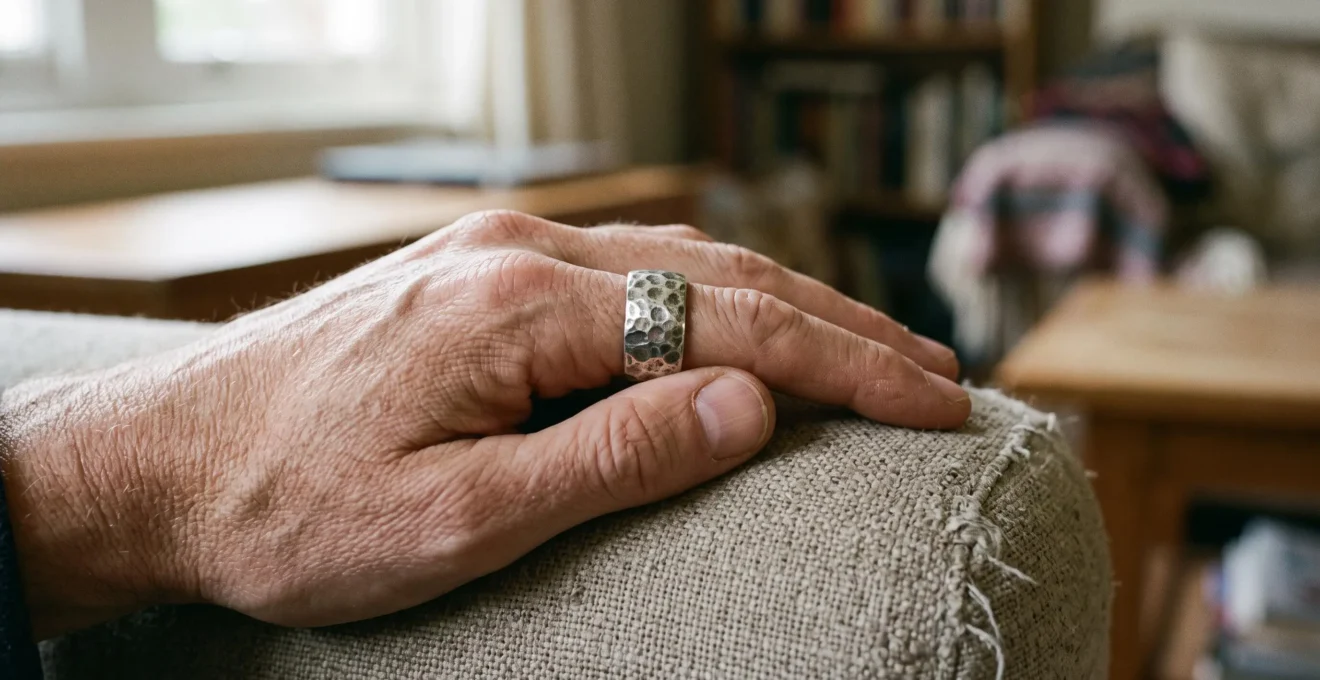
A silver ring can do more than catch the light. Its ridges may guide a thumb, its curved surface may settle comfortably against a finger, and a rotating band may offer a small, repeatable movement. These sensations create a relationship with jewelry that cannot be fully understood through photographs or visual styling alone.
Tactile jewelry design considers how a piece feels during ordinary wear: when the wearer adjusts it, rests a hand on a desk, pulls on a sweater or unconsciously explores its surface. Texture, temperature, weight, movement and contact pressure all influence that experience.
For designers, the challenge is to make those sensations intentional without introducing scratchy edges, excessive friction or difficult maintenance. For buyers, it is to distinguish a visually interesting surface from one that remains pleasant after several hours.
Silver offers a particularly useful material for exploring these decisions. Hammering, granulation, forming and matte finishing can create substantially different interactions between the same metal, the wearer’s skin and surrounding fabrics.
What matters most in tactile silver jewelry
- Touch-friendly surfaces depend on rounded edges, appropriate texture placement and comfortable contact pressure, not simply visible detail.
- Hammered, smooth, granulated and rotating designs create different experiences and require different maintenance and construction decisions.
- Long-term satisfaction depends on testing how a piece feels against skin, moves during daily activities and changes appearance with wear.
- Why Textured Silver Surfaces Create Subconscious Comfort During Wear
- Smooth vs Hammered vs Granulated: Comparing Tactile Experiences in Silver
- How Rotating Rings and Spinning Elements Create Tactile Engagement
- The Texture Choice That Irritates Skin and Catches Fabric Constantly
- How Hand-Contact Patina Develops Character on Tactile Silver Over Years
- How Metalsmiths Transform Flat Silver Sheets Into Three-Dimensional Sculptures
- Brushed vs Sandblasted vs Florentine Matte: How Each Texture Interacts With Fabric
- How Matte Silver Textures Create Understated Elegance in Minimalist Wardrobes
Why Textured Silver Surfaces Create Subconscious Comfort During Wear
Textured silver can provide a convenient surface for repetitive, sometimes unintentional finger movements. Rubbing a ridge, following a hammered facet or rolling a small element produces consistent tactile feedback. Some wearers may find these gestures pleasant or grounding, although the sensation varies individually and there is no established evidence that textured jewelry reliably reduces anxiety.
The distinction is between providing a touch opportunity and producing a proven psychological effect. A wearer may repeatedly explore a ring because the texture is interesting, easily accessible or associated with a familiar movement. That behavior does not automatically demonstrate therapeutic benefit.
Research on dedicated fidget devices illustrates why designers should be careful with stronger claims. A 2025 randomized study of fidget devices in adults with ADHD compared a fidget-ball group of participants in the fidget-ball group of 49 participants with a control group of participants in the control group of 24 participants during a laboratory stress experiment. Researchers reported no significant between-group differences in heart rate, heart rate variability or intrinsic fidgeting. The study did not investigate jewelry or establish whether textured accessories provide comfort.
Within that limitation, tactile design still offers a meaningful product experience. Some surfaces encourage exploration because fingertips can distinguish successive raised and recessed areas. Others appear highly textured under directional lighting but feel almost smooth when worn.
Consider three different intentions:
- Hammered facets: shallow changes in surface height that a thumb can trace repeatedly.
- Rounded ridges: a more defined path for sliding or following with the fingertips.
- Fine granulation: closely spaced raised points that create concentrated surface feedback when properly finished.
A design can fail to deliver its intended sensation if its most interesting texture faces away from the fingers, sits beneath the ring or becomes uncomfortable under pressure. Designers should therefore test tactile accessibility on the body rather than judging texture from magnified product photography.
Purchase positioning can reflect the experience without turning personal impressions into unsupported health claims. Descriptions such as « designed for repeated fingertip exploration » explain a feature. Claims such as « clinically proven to relieve stress » would require evidence that is not available here.
Once that distinction is clear, designers can choose surface geometries according to the sensations they actually produce, rather than how tactile they merely appear.
Smooth vs Hammered vs Granulated: Comparing Tactile Experiences in Silver
Smooth, hammered and granulated silver deliver three distinct kinds of tactile feedback. Smooth silver emphasizes continuous contact, temperature and weight. Hammered silver introduces alternating shallow facets that can guide repetitive finger movements. Granulated silver provides closely spaced raised features whose sensation depends on their height, spacing and finish. None is universally more comfortable.
A smooth ring presents an uninterrupted contact surface. Fingers slide without repeatedly encountering raised features, allowing the metal’s temperature and the pressure of its overall shape to become noticeable. This can suit jewelry intended for unobtrusive daily wear.
Hammered silver changes that experience. Broad, gently formed facets can create a recognizable sequence of subtle transitions under the thumb. The depth of each facet matters: shallow, rounded marks may feel inviting, while pronounced ridges can become distracting during sustained rubbing.
Granulation introduces another scale of detail. Individual rounded beads or clusters create many small contact points, which can remain noticeable even on relatively compact jewelry. However, high relief and closely spaced recesses can also retain residues that are harder to remove than deposits on a smooth surface.
| Design factor | Smooth silver | Hammered silver | Granulated silver |
|---|---|---|---|
| Primary sensation | Continuous contact and sliding | Changes in facet depth and contour | Multiple small raised contact points |
| Touch interaction | Gliding and holding | Tracing and rubbing | Pressing and exploring raised detail |
| Comfort consideration | Overall curvature and fit | Facet depth and edge finishing | Bead roundness and placement |
| Cleaning consideration | Generally accessible surfaces | Residue within deeper indentations | Deposits between closely spaced details |
| Potential design use | Low-distraction everyday jewelry | Frequently handled rings or pendants | Deliberately textured focal areas |
Hammering also changes the metal mechanically. Plastic deformation can work-harden silver, while annealing can restore workability during fabrication. However, a hammered finish alone does not guarantee greater dent resistance: alloy composition, thickness, forming history and subsequent heating also matter.
For pieces intended to be handled repeatedly, the designer should prioritize broad, accessible textures that remain comfortable after sustained contact. For predominantly visual pieces, more pronounced surface relief may be acceptable if it avoids skin-facing areas and likely fabric contact.
Cleaning requirements should enter the decision early. Intricate granulation can call for gentle, careful removal of residue from recesses, using methods compatible with the entire construction rather than aggressive polishing that alters the intended detail.
Surface texture is only one source of engagement. Mechanical movement adds another dimension, allowing the wearer to manipulate the object rather than merely explore its finish.
How Rotating Rings and Spinning Elements Create Tactile Engagement
Spinner rings create tactile engagement by allowing an outer band to rotate around a supporting inner band. The wearer applies light pressure with a finger to generate repeated movement. Successful construction balances sufficient clearance for rotation with enough control to prevent excessive wobble, friction or unwanted noise during ordinary activities.
A typical construction uses a wider base ring carrying a narrower movable component. The outer element must remain securely retained while still moving freely around the base. Its fit is influenced by the geometry of the two bands, surface finish, alignment and available clearance.
Clearance is especially important because an overly tight assembly can bind, while an overly loose component may rattle or tilt. The appropriate relationship is construction-specific; there is no single universal gap suitable for every alloy, ring width and spinner profile.
Movement-based tactility also differs from static surface texture. A hammered ring can be explored incidentally while the wearer is resting or adjusting a hand. A spinner requires more deliberate interaction, often involving a distinct finger movement.
This distinction matters when describing the product. A spinner can be presented as an interactive piece with a movable outer band, whereas a textured ring can be described through its surface sensation. Neither needs an unsupported claim about anxiety reduction.
Moving jewelry introduces maintenance challenges that static pieces do not have. Dirt, skin residues and tarnish products may accumulate around the interface between components, increasing friction or interfering with movement. Cleaning access therefore deserves consideration before the moving band is permanently retained.
Designers must also anticipate how movement sounds and feels outside the workshop. An outer band may produce a faint clicking or rattling noise if it contacts its retaining features. A prominent profile can also strike a desktop or keyboard during hand movements.
Construction details such as secure retaining shoulders or appropriately engineered stops can help keep the moving element in position. Where soldering is part of the assembly, the sequence must protect the movable component from accidental bonding or heat-related distortion.
A practical prototype test involves rotating the component repeatedly, wearing the piece during routine desk activities and checking whether the movement remains comfortable after exposure to normal handling. Any binding, scraping or loosening warrants investigation rather than simply increasing the gap.
The same construction discipline applies to stationary textures: a pleasing feature only remains successful when its position and finish prevent uncomfortable contact with skin and clothing.
The Texture Choice That Irritates Skin and Catches Fabric Constantly
Raised, sharp or incompletely finished textures are among the most problematic choices for skin-facing and fabric-contact areas. Rough as-cast granules, pointed projections and unfinished inner bands can produce uncomfortable localized pressure or catch textile fibers. The main design problem is generally the geometry, placement and finishing of the detail rather than the presence of texture itself.
A pronounced granular surface may feel acceptable when touched briefly with a fingertip but become unpleasant when pressed against the neighboring finger throughout the day. Similarly, a hammered band can have an attractive exterior while its interior carries burrs or abrupt transitions that should have been removed.
Fabric presents a separate challenge. Open-knit garments, loosely woven linens and high-nap textiles offer loops and fibers that can engage protruding metal details. A small projection may pass unnoticed against tightly woven cotton but repeatedly catch a wool sleeve.
Rounded transitions and selectively smoothed contact zones are therefore more reliable starting points than uniform texturing across every surface.
Finishing options include controlled smoothing, selective polishing and suitable tumbling processes. Their effectiveness depends on the construction: tumbling may soften accessible edges, but it cannot be assumed to eliminate every concealed burr or protect delicate settings automatically.
These issues can become commercial problems as well as physical annoyances. A customer who avoids wearing a piece because it catches clothing receives little value from an otherwise attractive design. Preventing that outcome requires realistic wear testing, not merely inspecting the product under studio lighting.
Five checks before approving a tactile jewelry design
- Run a fingertip over all accessible edges and raised elements; produce a marked inspection sheet identifying any sharp or abrasive locations.
- Inspect the skin-facing interior and contact points under magnification; produce a list of burrs, rough joints or projections requiring finishing.
- Wear the prototype through an ordinary day of relevant activities; record contact pressure, irritation or repeated adjustments in a wear-test log.
- Pass the finished piece gently across representative knit and woven fabric samples; record each snag and identify the feature responsible.
- Repeat the touch and textile checks after corrective finishing; retain a signed prototype approval record documenting the final condition.
Wear testing should reflect the intended product. A smooth pendant may need particular attention at the chain connection and garment-contact surface, while a statement ring requires scrutiny around adjacent fingers and frequently handled relief.
Not every unpleasant skin reaction is mechanical. Metal sensitivities, moisture trapped beneath a band and unsuitable fit can also contribute to irritation. A polished surface cannot rule out those causes, and persistent irritation should prompt the wearer to stop using the piece and seek appropriate advice.
Comfort must also remain manageable as the metal ages, because accumulated residues and changing surface appearance can alter the experience long after the original inspection.
How Hand-Contact Patina Develops Character on Tactile Silver Over Years
Tactile silver develops a changing appearance through the combined effects of tarnishing, contact, cleaning and mechanical wear. Repeated handling may polish exposed high points, while protected recesses can retain darker deposits. The resulting contrast can emphasize the object’s relief, although individual contact patterns do not necessarily determine where tarnish forms first.
Silver tarnish is primarily associated with reactions involving sulfur-containing substances. The Canadian Conservation Institute guidance on silver care and tarnish removal explains that dark silver tarnish consists mainly of silver sulfide and that salts and oils from skin can also leave marks on silver surfaces.
These processes are related but distinct. Skin contact can deposit residues and mechanically alter the surface through handling, while sulfur-containing compounds drive the principal chemical tarnishing reaction. Environmental exposure, storage, cleaning habits and protective finishes also influence the outcome.
A hammered ring might gradually display brighter raised facets surrounded by darker indentations. A granulated pendant may develop more pronounced contrast around its individual beads. These are plausible wear patterns, not guaranteed chronological records of exactly where or how often someone touched a piece.
Some designers intentionally preserve this developing contrast. Others aim for a consistent bright finish, using maintenance recommendations or appropriate protective treatments where compatible with the design.
The distinction between attractive patina and neglected residue depends partly on cleanliness. Soap deposits, dirt and other contaminants should not be treated as desirable merely because they darken a textured surface.
For suitable uncoated silver jewelry without vulnerable stones, adhesives or incompatible components, gentle cleaning with an appropriate mild detergent and water may help remove surface residues. A very soft brush may help reach accessible recesses, but it should first be assessed for the piece’s finish and construction. Thorough rinsing and drying are important when wet cleaning is appropriate.
Avoid assuming that aggressive polishing is harmless. The Canadian Conservation Institute notes that abrasive tarnish removal also removes a small amount of underlying silver. Repeated polishing can gradually affect fine surface detail, particularly on delicate or intentionally textured designs.
Designers can support informed purchases by specifying whether the intended appearance is bright silver, developing natural tarnish or a deliberately darkened finish. Buyers should also know that dark marks or occasional gray residue can occur, but their presence and intensity vary with the piece and wearing conditions.
The next design decision begins much earlier, at the workbench, where forming methods establish the ridges, curves and contact surfaces that will eventually wear in these different ways.
How Metalsmiths Transform Flat Silver Sheets Into Three-Dimensional Sculptures
Metalsmiths create three-dimensional silver forms by progressively deforming prepared sheet metal with hammers, stakes, punches and forming tools. Techniques such as sinking, dapping and fold-forming establish different curves and ridges, while annealing restores workability after sufficient work-hardening. The sequence determines both the finished silhouette and the tactile qualities of its surfaces.
Flat silver sheet initially offers limited dimensional variation. The metalsmith introduces volume by carefully moving the material into new shapes rather than simply adding decorative texture at the end.
During annealing, controlled heating softens work-hardened silver so it can undergo further deformation with less risk of cracking. After suitable preparation, the maker uses tools and repeated forming operations to develop the intended shape.
Several forming methods produce different tactile possibilities:
- Dapping: shaping sheet or blanks with rounded punches and matching depressions to create curved or domed forms.
- Sinking: hammering sheet into an appropriate support to develop concave volume and raised walls.
- Fold-forming: creating folds and then manipulating or opening the metal to generate ridges and sculptural contours.
- Planishing: refining a formed surface with controlled hammer blows to adjust its shape, evenness and visible facet pattern.
Annealing should be timed to the metal’s condition and the demands of the next operation. It is not necessary to re-anneal after every individual hammer strike or every pass. Excessive work-hardening can increase cracking risk, while unnecessary heating can complicate the process or alter the intended metallurgical condition.
A practical demonstration in the Ganoksin sterling-silver cuff forging demonstration shows how hammering, annealing and finishing contribute to the production of a forged wearable silver form. The demonstrated sequence illustrates the relationship between shaping operations and the final object without establishing a universal procedure for every sculptural technique.
Each forming choice affects the finished touch experience. A shallow dome distributes contact across a broad curved surface. A pronounced folded ridge presents a narrow feature that fingers can follow. Carefully retained hammer facets introduce smaller changes in relief across a larger form.
These characteristics can be deliberately preserved or reduced during finishing. Extensive planishing may diminish the visual and tactile distinction between earlier hammer marks. Conversely, preserving every tool impression can leave an irregular surface that requires additional work before it is comfortable to wear.
The process also involves possible failures. Uneven sinking can produce unwanted asymmetry, excessive localized deformation can tear the sheet, and poorly controlled forming may create thin or sharply bent areas. Such outcomes should be corrected or rejected when they compromise intended construction or comfort.
Visible evidence of hand-forming need not imply poor workmanship. Small variations can communicate the forming method, provided the finished object meets the intended standards for shape, fit and safe contact.
Once the form is established, the final surface treatment determines how that geometry meets clothing, reflects light and responds to everyday abrasion.
Brushed vs Sandblasted vs Florentine Matte: How Each Texture Interacts With Fabric
Brushed, sandblasted and Florentine silver finishes differ in how they scatter light and present microscopic surface relief. Brushing produces directional marks, sandblasting creates a distributed fine texture, and Florentine tooling generates closely spaced engraved lines. Their effects on fabric depend on abrasive depth, edge condition, garment structure and the placement of the finished surface.
A brushed finish is generally created by applying a controlled directional abrasion pattern. Fine, shallow marks can produce a satin appearance while leaving the jewelry relatively smooth to the touch. Movement along or across the grain may feel different when the texture is sufficiently pronounced, but directional brushing does not guarantee a friction-free surface.
Sandblasting changes the surface through abrasive impact, generating a more dispersed microscopic texture. Depending on the medium and processing conditions, the result can appear softly matte and feel finely textured. Coarser or more aggressive treatment may produce a noticeably rougher finish.
Florentine finishing creates repeated engraved marks through controlled tool work. The pattern may be cross-hatched or otherwise arranged to produce a rich, directional texture. Tool geometry, depth and finishing determine whether the surface feels subtle or noticeably ridged.
Fabric interaction becomes especially important for pendants, bracelets and rings that regularly touch clothing. Fine, well-finished textures may slide over many textiles without difficulty, while deep tool marks or protruding edges can interact with loose fibers.
High-nap wool, mohair and loosely knitted garments deserve particular testing. Contact may polish or abrade certain surface regions over time, although the rate and extent depend on the materials and actual wearing conditions.
Brushed finishes commonly develop shinier contact areas through progressive burnishing. They may sometimes be refreshed using suitable controlled abrasion, but attempting this at home can change the grain, remove detail or create an inconsistent appearance.
Sandblasted surfaces are often harder to reproduce uniformly without appropriate equipment. Localized polishing can create visible shiny patches, while complete refinishing may require workshop treatment. Florentine detail can also be difficult to restore accurately because the original tool marks must be reproduced without damaging adjacent surfaces.
Finish selection should therefore consider future repair and maintenance, not only initial appearance. A highly specialized finish may offer a distinctive texture but be less convenient to restore after visible abrasion.
The final decision should also reflect the buyer’s wardrobe, because the same metal finish can appear restrained against one fabric and unexpectedly prominent against another.
Key takeaways for choosing a wearable silver finish
- Choose surface texture in relation to the shape and intended contact areas, not from an isolated finish sample.
- Assess finish contrast under realistic lighting and against the fabrics the wearer actually uses.
- Include gradual burnishing, tarnish and refinishing requirements in product selection rather than treating the initial appearance as permanent.
How Matte Silver Textures Create Understated Elegance in Minimalist Wardrobes
Matte silver can complement minimalist wardrobes because its diffuse reflections reduce the prominence of sharp highlights. Instead of depending on mirror-like sparkle, a matte piece communicates through shape, proportion, surface direction and subtle tonal contrast. Its success depends on the particular finish, surrounding materials and the wearer’s preferred level of visual emphasis.
Consider a simple silver cuff worn with an oatmeal linen shirt. A polished surface may create distinct reflections as the arm moves. A satin or finely matte surface can produce a softer visual transition between the metal and the surrounding fabric.
That effect is not inherently superior. It provides a different visual relationship, one that can suit understated outfits without requiring the jewelry itself to disappear.
Matte finishes are especially interesting in tactile collections because they make sculpture more important. When bright highlights are reduced, subtle changes in curvature, silhouette and relief can become the principal design features.
This creates opportunities for architectural forms: broad cuff profiles, softly domed pendants, shallow ridges and gently faceted rings. Such pieces do not necessarily need to be heavier, although designers may choose more substantial proportions to communicate shape and physical presence.
The term « matte silver » also covers markedly different appearances. A pale brushed surface retains a light metallic character; a finely sandblasted finish may diffuse reflections more uniformly; and intentionally oxidized silver can introduce much darker tones. Oxidation and matte finishing are different treatments, however, and a dark surface is not automatically matte.
Choosing among these options requires looking at contrast rather than relying on broad labels. A finish that looks subtle against gray wool may become the most noticeable element against black cotton. Similarly, its contrast against skin depends on individual skin coloration, undertones, lighting and surrounding clothing.
A practical comparison can use three complementary criteria:
- Contrast against skin: observe whether the metal appears softly integrated or visually distinct under natural and indoor lighting.
- Contrast against garments: compare the same sample against frequently worn light, dark, smooth and textured fabrics.
- Touch and maintenance: assess whether the chosen finish feels pleasant in contact areas and whether gradual polishing or tarnishing fits the desired appearance.
For a versatile minimalist collection, designers can offer intentional differences rather than assuming a single matte treatment suits everyone. One piece might emphasize pale satin silver and broad curves, while another uses deeper tonal contrast and carefully controlled surface relief.
Whatever the appearance, tactile accessibility should remain compatible with wearability. An interesting finish hidden on an inaccessible surface contributes little to fingertip engagement, while abrasive relief placed against a cuff or collar can undermine the understated experience the design is meant to deliver.
Before finalizing a tactile jewelry collection or purchase, compare physical samples against real skin and everyday fabrics, document the results of a full-day wear test, and select the combination of form, finish and maintenance expectations that remains comfortable beyond the first impression.
Can tactile silver jewelry help with stress or anxiety?
Some wearers may find repetitive touch or spinning movements pleasant, familiar or grounding. However, evidence that tactile silver jewelry reliably reduces stress or anxiety is lacking. Research involving other fidget devices cannot be assumed to establish therapeutic benefits for jewelry. Such pieces are best described as offering opportunities for tactile interaction rather than as proven treatments.
Which silver finish is most suitable for someone with sensitive skin?
A smooth, carefully rounded surface may help reduce mechanical rubbing or pressure caused by raised texture. Nevertheless, a surface finish cannot prevent reactions to metal components, trapped moisture or unsuitable fit. People with known metal allergies should consider the actual alloy and their individual sensitivity, not simply whether the jewelry looks polished or matte.
Can a spinner ring be repaired if the outer band stops moving?
Repair may be possible, depending on the construction and cause of the problem. Accumulated residue, deformation, damaged retaining features or misalignment can interfere with movement. A qualified jeweler can assess whether cleaning, adjustment or component repair is appropriate. Forcing a jammed band may worsen the damage.
Should textured sterling silver be polished whenever it darkens?
Not necessarily. Some designs intentionally retain darker recesses to emphasize their relief. Repeated abrasive polishing also removes a small amount of silver and may gradually alter fine details. Maintenance should respect the intended appearance and the complete construction, including stones, coatings, soldered elements and moving parts.
How can buyers evaluate tactile jewelry when shopping online?
Look for close-up images showing texture depth, side views revealing projecting elements, and descriptions of the skin-facing surfaces. For moving jewelry, a demonstration of actual movement can be more informative than a still photograph. Ask about finishing, metal composition, maintenance and return conditions when these details are not provided. Physical handling remains the most reliable way to judge individual tactile comfort.