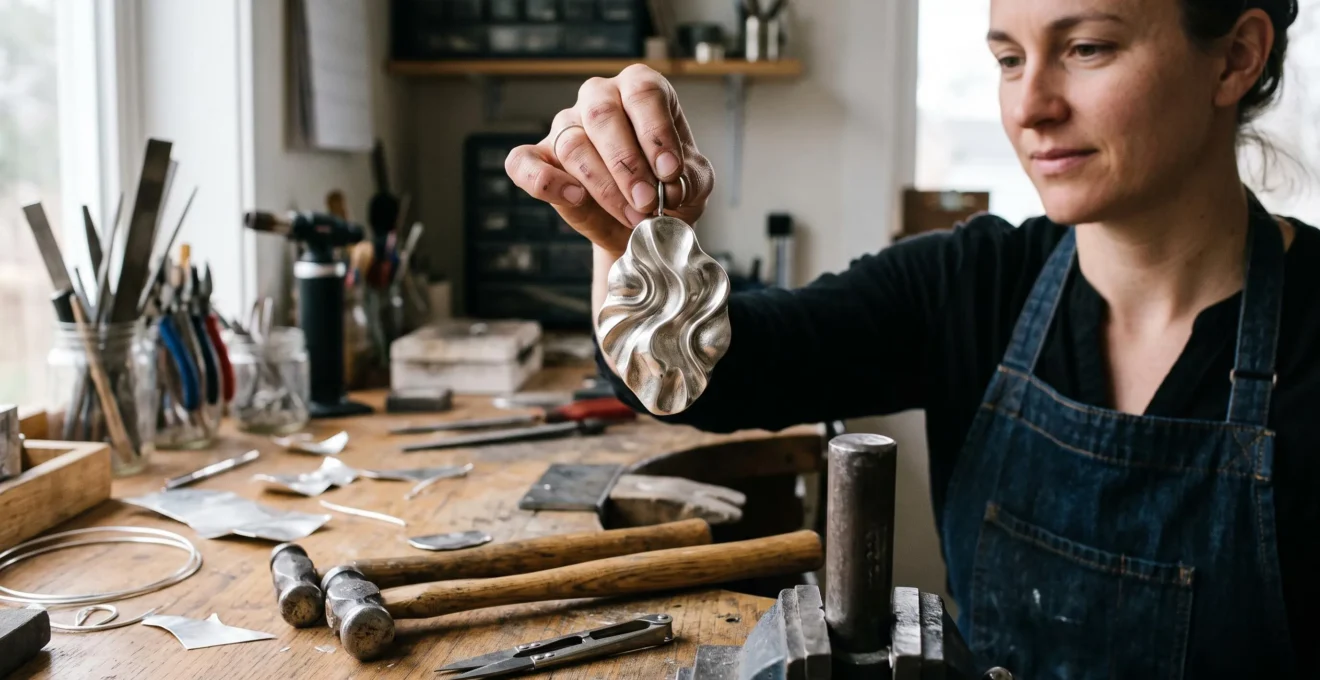
A silver pendant can be an ornament, a miniature sculpture, or both. The distinction emerges when a metalsmith treats the material as a three-dimensional medium, shaping volume, tension, negative space and movement rather than simply decorating a surface.
Sculptural silver jewelry transforms metal into wearable art through its geometry, craftsmanship and relationship with the human body. Raising, repoussé, anticlastic forming and carefully engineered articulation allow silver to occupy space in ways that conventional flat jewelry rarely attempts. The resulting object may carry the artistic identity of its maker, respond to bodily movement and reward close examination from multiple angles.
For collectors, this distinction raises questions beyond appearance. What justifies a gallery price? Which forming techniques signal accomplished metalwork? When does sculptural ambition compromise comfort? And how should a buyer distinguish an artwork intended for frequent wear from one better suited to occasional exhibition?
The answers lie where technical construction, artistic authorship and the physical experience of wearing silver intersect.
Sculptural Silver Jewelry: Essential Insights
- Sculptural silver acquires artistic significance through original form, skilled metalworking, documented authorship and its relationship with the body—not through silver content alone.
- Raising, anticlastic forming and repoussé create distinct kinds of volume and relief, while weight distribution, proportions and projecting elements determine practical wearability.
- Collectors should evaluate provenance, construction, fit, condition and artistic intention before choosing between an existing gallery work and a bespoke commission.
- Why Sculptural Silver Pieces Command Gallery Prices Far Higher Than Conventional Jewelry
- How Metalsmiths Transform Flat Silver Sheets Into Three-Dimensional Sculptures
- How Repoussé Techniques Create 3D Relief From Flat Silver Sheets
- Sculptural Forms vs Conventional Designs: Wearability Trade-Offs for Daily Life
- The Proportion Blunder That Makes Sculptural Jewelry Overwhelm Rather Than Enhance
- When to Commission Custom Sculptural Silver Versus Purchasing Gallery Works
- How Rotating Rings and Spinning Elements Create Tactile Engagement
- How Tactile Jewelry Design Engages the Senses Beyond Visual Appeal
Why Sculptural Silver Pieces Command Gallery Prices Far Higher Than Conventional Jewelry
Gallery-quality sculptural silver can command substantially higher prices than conventional silver jewelry because the buyer is acquiring an artist’s original conception and its demanding execution, not merely precious-metal content. Authorship, technical complexity, rarity, provenance and institutional recognition can all influence valuation. However, neither a five-to-tenfold premium nor future appreciation should be assumed without comparable market evidence.
Conventional silver jewelry often competes within identifiable product categories: chains, earrings, bands and pendants with relatively standardized construction. Its price may reflect metal weight, manufacture, branding, distribution and retail positioning. A unique sculptural brooch or forged neckpiece introduces a different valuation framework.
The object may represent an extended investigation into form, completed with specialized stakes, handmade tools, repeated annealing and painstaking surface refinement. Even when the silver itself is inexpensive relative to the selling price, the finished work embodies substantial artistic and technical labor.
The Smithsonian American Art Museum’s Ornament as Art exhibition provides an institutional illustration of this distinction. The exhibition presented jewelry alongside artists’ drawings, sketchbooks and sculptural constructions, positioning contemporary jewelry within wider artistic movements rather than treating it solely as personal ornament.
275 jewelry pieces
The Smithsonian exhibition included 275 pieces of jewelry within a presentation of 300 objects, with works dating from 1963 to 2006. This documents museum recognition of artist-made jewelry, not an average price premium or investment return.
Smithsonian American Art Museum, Ornament as Art: Avant-Garde Jewelry from the Helen Williams Drutt Collection.
For a prospective acquisition, artistic provenance and quality of execution deserve separate scrutiny. A well-documented object is not necessarily masterfully made, while an exceptional work by an emerging metalsmith may have little auction or exhibition history.
A reasoned appraisal considers several dimensions:
- Authorship: Is the maker identifiable, and can the work be attributed confidently?
- Originality: Is the sculpture unique, part of a numbered edition, or a repeatable studio design?
- Technical execution: Are forming, soldering, surface transitions and structural details accomplished?
- Documentation: Are invoices, artist statements, certificates or exhibition records available?
- Market context: Are there meaningful sales comparisons involving the same artist, medium and period?
The often-invoked proposition that sculptural silver costs five to ten times more than conventional jewelry is therefore best treated as a possible comparison, not an established market rule. A well-known artist’s unique, technically elaborate sculpture and a modest studio-made pendant occupy different markets. Edition size, reputation, scale and fabrication difficulty may affect the asking price, but no single multiplier captures those variables.
Collectibility also differs from liquidity. Documented work by a recognized metalsmith may attract curatorial and collector interest, yet recognition does not guarantee profitable resale. Selling costs, demand, condition and the availability of comparable works all remain relevant.
The strongest purchasing rationale combines sustained admiration for the work with confidence in its authorship and construction. Understanding how its sculptural form was made provides the next layer of evidence.
How Metalsmiths Transform Flat Silver Sheets Into Three-Dimensional Sculptures
Metalsmiths create three-dimensional silver sculptures by progressively deforming, folding, curving or joining sheet metal. Raising and sinking generate volume through repeated hammering; anticlastic and synclastic forming produce contrasting curvatures; fold forming introduces structured creases; and fabrication joins separately shaped components. Each technique leaves different visual and structural clues that collectors can learn to recognize.
The transformation begins with a deceptively simple material: silver sheet. Its ductility allows a metalsmith to redistribute its shape through controlled mechanical force. But deformation introduces work hardening, making further shaping increasingly difficult until appropriate annealing restores workability.
In raising, the metalsmith gradually brings metal upward and inward through successive courses of hammer blows against a suitable stake. Sinking, by contrast, works metal into a concave support to establish a depression or vessel-like contour.
Both processes can create sculptural volume, although their working methods, resulting thickness distribution and surface characteristics differ.
Anticlastic forming produces surfaces curving in opposite directions along different axes, often giving silver an open, ribbon-like or saddle-shaped geometry. Synclastic forms curve in the same general direction, creating rounded, bowl-like structures.
As explained in Ganoksin‘s Anticlastic Forming Techniques article, anticlastic shaping can support relatively large, lightweight jewelry forms through geometry rather than bulk. Its effectiveness depends on the actual design, sheet thickness and alloy.
Fold forming offers another vocabulary. Metal is folded, worked and opened, allowing creases and spreading contours to determine a final shape. Fabrication instead assembles distinct components, providing greater freedom to construct intersecting planes, hollow chambers and complex spatial arrangements.
These methods involve different compromises. Raising a form from one sheet may reduce the need for joints but require many progressive shaping operations. Fabrication can achieve a geometry that would be difficult to raise as a single piece, yet introduces seams whose alignment and finishing must withstand scrutiny.
The hidden decisions are as important as the visible ones. Excessive stretching can create vulnerable thin areas. Poorly positioned solder seams may undermine visual continuity or structural reliability. A projecting form must preserve enough strength to resist unintended bending without becoming unnecessarily heavy.
Hand-forged surface variation can give a piece a distinctive character, although mechanized processes can also create sophisticated textures. A collector should evaluate the result and the maker’s declared process rather than assume a particular appearance proves hand manufacture.
What appears to be a free-flowing silver gesture is often the result of rigorous material planning. Repoussé takes this relationship between force, surface and depth in a different direction, creating relief without necessarily constructing a freestanding volume.
How Repoussé Techniques Create 3D Relief From Flat Silver Sheets
Repoussé creates three-dimensional relief by pushing and shaping metal from its reverse, while chasing refines contours and surface details from the front. Together, these techniques transform flat silver into a landscape of raised and recessed forms. Their expressive depth depends on controlled deformation, suitable support, repeated working and careful management of the metal’s changing hardness.
Unlike hollow fabrication, where separate sheets can enclose space, repoussé builds dimensional detail within a continuous metal surface. The original sheet remains the foundation of the image or ornament, even as parts of it rise beyond the surrounding plane.
A traditional workflow begins with preparing and annealing the silver. A design may be transferred to the sheet and initial contours established with punches. The metal is supported in a material such as pitch, which holds it while allowing controlled movement under hammer blows.
The metalsmith works the reverse to develop the raised masses. The sheet can then be turned over and supported again while chasing tools sharpen edges, establish transitions and refine detailed lines.
The instructional account in Ganoksin’s Goldsmithing: Repoussé and Chasing article describes this combination of pitch support, reverse-side forming, front-side refinement and intermediate annealing. It also documents the application of both techniques to a silver brooch.
Repeated work can harden the metal, requiring the metalsmith to remove it from its support, clean it as appropriate, anneal it and resume shaping. This extended dialogue between tools and material helps explain why deep, intricate relief can require substantial labor.
For connoisseurs, the transition between high and low relief is particularly revealing. Well-resolved forms usually show deliberate contour changes rather than accidental distortion. Chased lines should appear integrated with the underlying volume instead of functioning as superficial decoration.
Examine the deepest areas for visible weakness, unintended tearing or excessively thin edges. Consider whether the ornament reads coherently under oblique lighting and whether details retain their clarity across the full surface.
These observations help assess craftsmanship but cannot definitively establish manufacturing technique. Pressing, casting and other reproduction methods can produce convincing relief. Reliable attribution may require examining the reverse, reviewing process documentation or consulting the maker.
Repoussé and chasing also connect contemporary jewelry with longstanding metalworking traditions. Related relief techniques appear across multiple historical cultures, including ancient Greek, Indian and Levantine metalwork. Those traditions encompass different materials, purposes and workshop practices, so they should not be treated as one continuous, identical method.
Yet dimensional refinement alone does not determine a jewel’s success. A relief brooch may be visually remarkable on a stand while proving impractical against clothing, bringing the body back into the evaluation.
Sculptural Forms vs Conventional Designs: Wearability Trade-Offs for Daily Life
Sculptural silver jewelry can be comfortable for daily wear, but its three-dimensional geometry introduces considerations that flat or compact jewelry may avoid. Projecting edges can snag fabric, concentrated weight can strain attachment points, and broad forms can interfere with ordinary movement. Hollow construction, thoughtful suspension and smooth contact surfaces can reduce these problems without sacrificing artistic presence.
The decisive issue is not simply the object’s weight. It is how that weight acts on the body. A heavy pendant hanging close to the chest may feel more stable than a lighter projection that repeatedly pivots or catches against clothing.
Similarly, a large hollow-form earring may contain relatively little silver yet exert leverage if its mass extends far from the piercing. A compact solid earring of comparable weight may behave differently because its centre of mass lies closer to the attachment point.
The following comparison provides a practical starting point for evaluating different forms.
| Design characteristic | Potential advantage | Practical concern |
|---|---|---|
| Deep repoussé relief | Expressive depth without a fully separate structure | Crevices can collect residue; raised edges may catch fabric |
| Projecting planes | Strong spatial presence and changing reflections | Possible interference with sleeves, bags or hand movements |
| Hollow-formed volume | Visual scale with less material than a comparable solid form | Thin areas may be susceptible to denting |
| Solid sculptural mass | Compact, substantial tactile presence | Concentrated weight may cause fatigue or discomfort |
| Articulated components | Movement that responds to the wearer | Joints and contact surfaces may require maintenance |
These are design-dependent considerations, not universal performance ratings. A carefully finished projecting edge may be less troublesome than a poorly positioned flat clasp.
For collectors, it is useful to distinguish three practical categories. Daily-wearable sculpture accommodates movement, clothing and routine activity. Statement sculpture suits controlled occasions where the wearer accepts greater spatial presence. Cabinet-oriented jewelry prioritizes artistic display and may be worn only briefly, if at all.
Maintenance also changes with geometry. Deep recesses may retain oils or cleaning compounds. Matte and brushed finishes can develop local polishing through contact; oxidized surfaces may change selectively with abrasion. High points on polished forms can reveal scratches more readily than protected recesses.
A collector should ask whether the maker recommends professional cleaning, whether delicate sections can tolerate routine handling and how the intended finish is expected to evolve. Aggressive polishing can remove deliberate texture or alter a carefully controlled patina.
Successful wearable sculpture needs neither to disappear nor to surrender its expressive character. It must establish an intentional relationship with the person who wears it—a relationship that begins with proportion.
The Proportion Blunder That Makes Sculptural Jewelry Overwhelm Rather Than Enhance
The central proportion mistake in sculptural jewelry is evaluating the object only on a display stand rather than on the body. A form may have beautiful internal balance yet project awkwardly, dominate the wearer’s silhouette or shift out of position during movement. Successful scale depends on placement, visual mass, negative space and the body’s changing geometry.
Consider a sculptural pendant composed of broad, overlapping silver planes. On a gallery plinth, the structure may appear light and carefully balanced. Against a neck and upper chest, those same planes could crowd the collar line or conceal the very negative spaces that give the sculpture its distinction.
The error is not necessarily that the pendant is too large. It is that its dimensions were judged independently of its wearing surface.
Artist Albert Paley provides a historically documented alternative. The Smithsonian American Art Museum‘s account of his jewelry describes wearable sculptures that engage with bodily structure and movement. His work demonstrates how sculptural design can treat the body as part of the artistic composition rather than merely as a support.
That principle becomes especially useful when evaluating earrings, necklaces, cuffs and rings. Each occupies a different anatomical and visual environment.
- Necklaces: Examine how the principal form relates to the neckline, collarbone and upper chest, including its movement when the wearer turns.
- Earrings: Check the distance between the sculpture, jaw and shoulder, along with how its silhouette changes in profile.
- Rings: Evaluate finger clearance, neighbouring fingers and the ability to grip ordinary objects without interference.
- Cuffs and bracelets: Assess wrist articulation, arm position and potential contact with hard surfaces.
Personal proportions influence the visual effect, but there is no universal rule requiring a particular face shape, hand size or neck length to wear a prescribed silhouette. The meaningful test is whether the intended relationship between object and body remains legible.
Viewing distance matters, too. A dramatic brooch may succeed as an exhibition object examined at close range but become visually confusing when seen across a room. Conversely, an open structure that initially seems oversized may appear balanced once its negative spaces are read against clothing.
A useful practical method is the stand-versus-body test: examine the jewelry independently, then assess it on the wearer from the front, side and usual conversational distance. Include natural movements rather than relying on a fixed pose.
Five Checks Before Acquiring Sculptural Silver Jewelry
- Photograph the piece on its display support from the front and side; retain two reference images showing its intended geometry.
- Try the piece on the intended wearer and photograph it from comparable angles; create a visual record of its relationship with the body.
- Perform ordinary movements appropriate to the jewelry, including turning, reaching or gently handling an object; write a brief comfort and clearance note.
- Inspect exposed edges, joints, hollow areas and attachment points under good lighting; produce a condition checklist identifying any areas requiring clarification.
- Request available maker identification, materials information, provenance and care guidance; assemble an acquisition record before deciding.
These checks help separate artistic intention from preventable fit problems. They can also reveal that an existing work is conceptually compelling but unsuitable for a particular wearer—an important distinction when considering a custom commission.
When a work’s proportions are inseparable from personal fit, collaborating with the artist may provide possibilities that a completed gallery object cannot.
When to Commission Custom Sculptural Silver Versus Purchasing Gallery Works
Commission custom sculptural silver when fit, bodily proportions, a specific occasion or a meaningful personal concept is central to the artwork. Purchase an existing gallery piece when the artist’s completed creative vision already resonates and the object meets your wearing requirements. The distinction is between collaborating in artistic development and acquiring a resolved work on its own terms.
Commissioning should not be confused with directing an artisan to reproduce a predetermined product. In contemporary studio jewelry, the maker’s artistic judgment is part of the value being acquired. A productive commission establishes the collector’s needs while giving the artist room to interpret them through an established sculptural language.
Buying from a gallery offers a different experience. The work already exists, allowing direct examination of its surface, scale, finish and spatial presence. Depending on the gallery’s arrangements, the buyer may also receive documentation about the artist, materials, exhibition history or previous ownership.
Commissioning introduces stages of development. These may include an initial conversation, preliminary drawings, physical maquettes, metal samples and agreed approval points before fabrication. The precise sequence varies between artists and projects.
A wax model or sculptural maquette can reveal volume more effectively than a drawing. However, a model cannot reproduce every characteristic of the finished silver object, particularly reflections, tactile texture and the exact behaviour of articulated elements.
Pricing requires equally careful discussion. Bespoke work may involve additional consultation, design iterations, prototype construction and fitting. These stages can increase costs relative to an available gallery object, but no consistent percentage premium applies across artists or techniques.
The greatest practical risks concern expectations. A drawing may communicate a compelling idea while leaving room for differing interpretations of scale, finish or movement. Final approval and revision rights can become contentious if they were never established.
Written commissioning terms should therefore identify the intended dimensions, metal specification, design-approval stages, anticipated completion arrangements, payment schedule, permitted changes and any applicable cancellation or return conditions. These are points to negotiate, not standardized legal protections across English-speaking countries.
Before commissioning, inspect the maker’s portfolio for technical consistency. An artist known for anticlastic folds is not automatically the most suitable choice for elaborate chased relief, and an accomplished sculptor may still need specific experience with comfortable attachment systems.
Useful questions concern the relationship between technique and practical outcome: Can the artist demonstrate related completed works? Are intermediate models available? How will weight and balance be assessed? What finishing and maintenance decisions will require approval?
Whether newly commissioned or purchased from a gallery, the result may be more than a stationary form. Some metalsmiths extend sculpture into movement itself, adding a kinetic relationship between silver and its wearer.
How Rotating Rings and Spinning Elements Create Tactile Engagement
Rotating rings and articulated silver elements turn jewelry into kinetic sculpture by allowing controlled movement within the finished object. Channels, pivots and retained components create the necessary motion, while accurate fitting prevents excessive friction or unintended looseness. As the wearer manipulates the jewelry, its sculptural form changes over time, making touch and movement part of the artwork.
A spinner ring typically consists of a primary band and a separately moving outer element. The outer section must remain securely captured while retaining enough clearance to rotate without binding.
The engineering challenge lies in balancing freedom and stability. Too little clearance can produce friction or sticking. Excessive clearance may introduce rattling, uneven movement or undesirable wear. The appropriate fit depends on the particular design, materials, finishing and construction.
Articulated pendants and earrings introduce related considerations. Pins, hinges or other connecting structures allow components to move relative to one another. A successful assembly must account for the direction of movement, possible collisions and stresses encountered during ordinary wear.
Kinetic silver also changes how collectors experience composition. A static form is examined from several viewpoints, but a moving form generates new relationships between planes, openings and reflections as the wearer interacts with it.
The tactile attraction of these pieces is significant. A wearer may rotate a band habitually, touch a moving pendant or explore the resistance of an articulated component. Such actions can become personally satisfying rituals, although claims that spinner jewelry reliably reduces anxiety or produces therapeutic benefits require evidence beyond its mechanical design.
Movement also introduces additional maintenance considerations. Sliding contact surfaces can accumulate debris, and repeated operation may gradually alter clearances. Fine particles can interfere with motion, while deformation can make a previously smooth mechanism difficult to operate.
Collectors should establish whether the moving component is designed for continuous manipulation or only occasional movement. They should also ask whether the assembly can be cleaned, inspected or repaired without damaging the finished surface.
A mechanism that feels pleasant during a brief gallery demonstration may behave differently after extended use. Serviceability and the maker’s aftercare arrangements are therefore legitimate aspects of quality, not incidental practical concerns.
Rotating elements make explicit something present in all sculptural jewelry: the wearer does not merely look at the object but experiences it through several senses simultaneously.
Key Takeaways for Collectors
- Judge an artist-made silver object through its relationship with the body as well as its independent sculptural quality.
- Recognize that texture, weight, movement and surface finish contribute to the work’s identity and may change through handling.
- Consider whether personal wear marks will enrich the relationship with the object or conflict with its intended condition and conservation needs.
How Tactile Jewelry Design Engages the Senses Beyond Visual Appeal
Tactile jewelry design expands sculptural silver beyond visual ornament through weight, temperature, texture, movement and sometimes sound. The wearer encounters these properties directly against the skin, while changing light reveals new aspects of the form during movement. This multisensory relationship gives sculptural jewelry an experiential dimension that cannot be fully captured in photographs or static gallery displays.
Silver is particularly expressive in this context because its reflective surface responds vividly to changing illumination. A smooth polished plane can register sharp highlights, while a brushed or matte surface scatters light more softly. Chased grooves and hammered depressions create alternating regions of brightness and shadow as the object moves.
These effects are not merely decorative finishes added after construction. Surface texture functions as a sculptural language, influencing how the form is interpreted.
Hammered marks may emphasize the process of hand forming. Fine chasing can direct attention toward relief and contour. Matte surfaces may foreground shape without strong reflections, while localized polishing can accentuate edges or raised areas.
The sensations against the skin add another layer. Silver conducts heat readily, so an object may initially feel cool before approaching skin temperature. Its perceived weight depends not only on total mass but also on contact area, attachment and movement.
Articulated components may produce subtle sounds when they touch, although unwanted rattling can equally reveal mechanical shortcomings. The quality of the sensory experience depends on whether these effects are deliberate and appropriate to the piece.
Personal handling gradually changes some surfaces. A ring repeatedly turned between fingers may develop brighter contact zones. Recessed areas can retain darker patination, and the high points of textured silver may become smoother through repeated friction.
For the wearer, such changes can record a lived relationship with the artwork. For a collector concerned with conservation, however, they introduce a different question: should the object preserve its initial finish, or is evolving surface character consistent with the artist’s intention?
There is no universal answer. A naturally developing patina may suit one work, while abrasion could compromise another’s carefully constructed finish. Documentation of original condition, handling advice and the artist’s position on restoration help distinguish acceptable change from deterioration.
The deeper significance of sculptural silver therefore lies in an unusual dual identity. It can be collected and studied as an autonomous artwork, yet its intended encounter may occur through being worn, warmed, touched and moved.
This helps explain why contemporary art jewelry occupies a space between sculpture, design and personal adornment. Its artistic standing does not depend solely on precious materials or technical difficulty, but on the expressive coherence between form, craftsmanship and human experience.
Before acquiring a piece, examine it in changing light, consider its presence against the body, explore its intended tactile qualities where handling is permitted, and request documentation of the artist’s process. The most revealing question is not simply whether the jewelry resembles sculpture, but whether its form creates an experience worth returning to.
Does museum recognition make sculptural silver jewelry a good investment?
Not necessarily. Museum exhibitions establish artistic and historical recognition, but they do not guarantee resale demand or financial appreciation. Evaluate individual authorship, provenance, condition and relevant market comparisons. A museum-recognized practice and a liquid investment market are different things.
Can a collector identify handmade silver sculpture solely from hammer marks?
No. Visible surface variation may be consistent with hand forming, but it is not conclusive evidence. Similar effects can arise through different manufacturing processes. Examine construction details and, where attribution matters, request the artist’s process documentation or a qualified technical assessment.
Is sterling silver suitable for large hollow sculptural jewelry?
Sterling silver can be used for hollow sculptural forms, but suitability depends on geometry, wall thickness, fabrication, load distribution and intended use. Hollow construction can reduce material mass, while poorly supported thin sections may be vulnerable to deformation. The maker should assess structural adequacy for the particular design.
What documentation should accompany a collectible silver artwork?
Useful documentation includes the artist’s name, work title where applicable, materials, approximate dimensions, date of creation, invoice and any available provenance or exhibition history. Edition information should be recorded when relevant. An artist statement, care instructions and condition photographs can also support future identification and responsible stewardship.
Should collectors polish the patina from sculptural silver?
Not automatically. Patina may be an intentional element of the artwork, and abrasive polishing can alter surface textures, remove oxidation from recessed details or change the artist’s original finish. Establish whether the appearance is deliberate before cleaning, and consult the maker or an appropriate conservation professional for sensitive works.