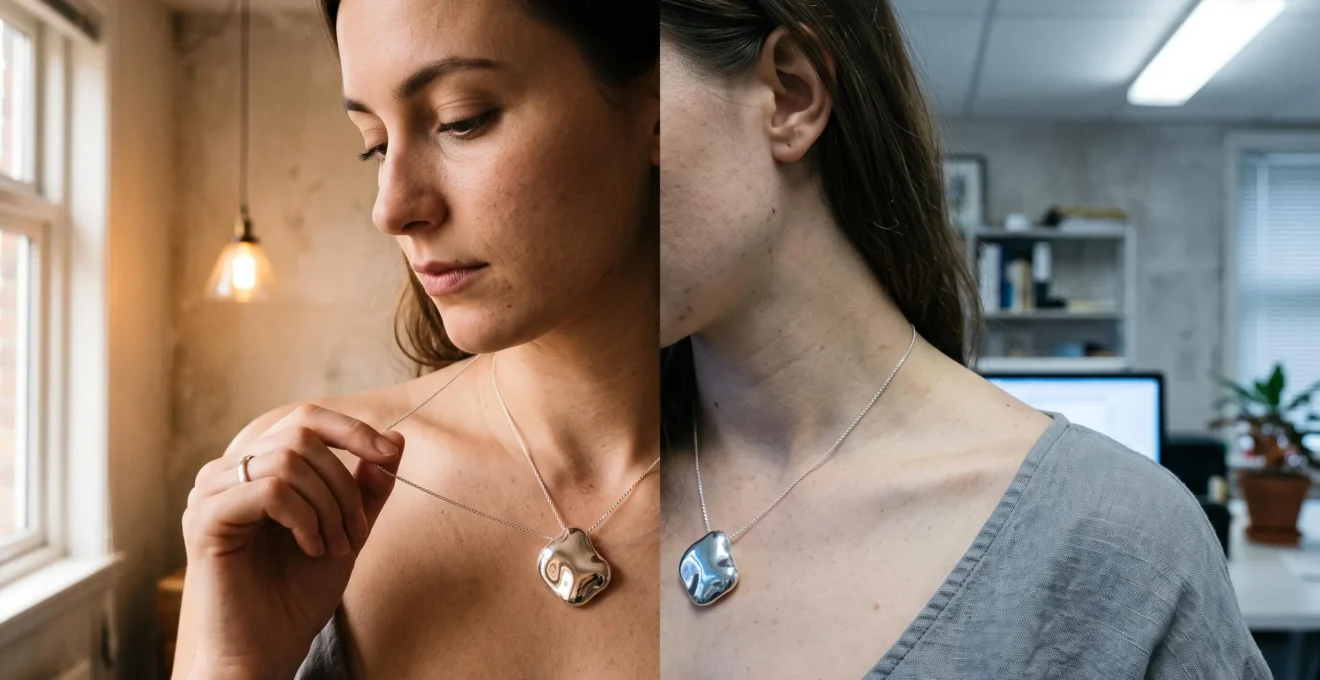
A silver necklace can sparkle beautifully beside a sunny window, appear almost white beneath office lighting, and look surprisingly understated at dinner. The metal has not changed. The light reaching its surface, the surrounding reflections, and the viewing angle have.
Choosing silver jewelry that looks beautiful in person and photographs well requires more than finding the shiniest finish. The most versatile pieces balance controlled reflections, visible surface detail, and enough contrast to remain interesting when lighting changes. Mirror-polished silver delivers striking highlights in favorable conditions, while brushed, satin, hammered, and mixed finishes distribute light differently.
The right choice depends on where the jewelry will actually be worn. Someone moving between an office, outdoor daylight, and evening events may benefit from a different finish than someone choosing a statement piece primarily for photographs. Understanding these differences makes it easier to recognize lasting visual appeal rather than relying on a particularly flattering display light.
Choosing silver jewelry that works across lighting conditions
- For maximum versatility: Consider satin, finely brushed, softly hammered, or mixed-finish silver rather than relying exclusively on a mirror polish.
- For reliable appearance: Compare jewelry in daylight, ordinary indoor lighting, and warmer evening light before committing to a purchase.
- For photographs and real life: Look for pieces whose shape and surface details remain visible even when dramatic highlights disappear.
- Why High-Polish Silver Looks Washed Out Under Fluorescent Office Lights
- Reflective vs Textured Finishes: Which Flatters Warm vs Cool Lighting?
- How to Test Silver Jewelry Appearance Under Different Light Sources Before Buying
- How Mixed-Finish Silver Pieces Maintain Visual Interest in Any Lighting
- The Finish Choice That Photographs Brilliantly But Looks Dull in Person
- High Polish vs Brushed Finish: Which Flatters Cool vs Warm Skin Tones?
- Brushed vs Matte vs Hammered: Which Catches Light Without Creating Glare?
- Which Silver Finishes Provide Subtle Shimmer Without Distracting Glare?
Why High-Polish Silver Looks Washed Out Under Fluorescent Office Lights
High-polish silver can look washed out under fluorescent office lighting when broad, relatively uniform illumination produces pale reflections with little visible contrast. Unlike textured silver, which breaks reflections into smaller variations, a mirror-like surface depends heavily on its surroundings. This effect is possible under fluorescent lighting, but it is not inevitable: fixture design, lighting direction, and nearby objects all influence the result.
A polished silver pendant behaves differently from a painted or matte surface. Rather than scattering incoming light broadly, its smooth surface reflects much of the surrounding environment in specific directions. Under a directional lamp, that behavior may create a bright highlight next to a darker reflection, making the pendant appear exceptionally shiny.
Move the same pendant into a workspace illuminated by large overhead fixtures, and the reflected environment changes. If the metal primarily reflects broad, pale ceiling surfaces and bright fixtures, its details may become harder to distinguish. A curved pendant can appear less dimensional even though its physical polish is unchanged.
This distinction comes from two optical behaviors:
- Specular reflection: Smooth, highly polished surfaces produce direction-dependent reflections resembling those of a mirror.
- Diffuse reflection: Microscopically irregular surfaces redirect light across a wider range of directions, producing softer, more distributed brightness.
The < itemprop="name">OpenStax explanation of specular and diffuse reflection describes the underlying physics. Its principles explain why surface texture and observation angle matter, although it does not establish that every polished silver design performs poorly under fluorescent lighting.
Consider a hypothetical example: a smooth silver collar necklace looks dramatic beneath a small, warm pendant lamp at home because it reflects bright and dark areas distinctly. In an evenly illuminated office, the same necklace reflects a more uniform environment and loses some of that apparent depth.
It is also important not to treat every artificial light source as interchangeable. Fluorescent fixtures can differ in their spectrum, color temperature, and distribution of light. Modern LED installations vary just as widely.
The U.S. Department of Energy identifies 2700 K and 3000 K as examples of warm-looking light. These kelvin values describe correlated color temperature, not brightness. A warm-white LED can produce very different reflections from a cool-white office fixture, but color temperature alone cannot predict how brilliant a particular necklace will appear.
Before selecting an everyday silver piece, identify the environments where it will spend the most time. An office with broad overhead panels presents different visual conditions from a desk beside a window or a room with directional spotlights.
A finish that appears understated under one fixture is not necessarily inferior. The more useful question is whether its shape and craftsmanship remain attractive when strong highlights are absent.
Reflective vs Textured Finishes: Which Flatters Warm vs Cool Lighting?
Mirror-polished silver is often appealing under directional daylight or warm accent lighting, where distinct reflections create contrast. Brushed, satin, and hammered finishes can maintain a more distributed appearance under broad or indirect lighting. However, warm versus cool color temperature does not determine the best finish on its own; the direction, size, and intensity of the light sources are equally important.
Reflective finishes depend heavily on what they mirror. A polished silver bangle near a window may show beautiful transitions between bright sky reflections and darker surroundings. Under a small evening spotlight, it may produce a concentrated flash as the wrist moves.
Textured surfaces create different visual patterns. Fine brushing produces directional microscopic grooves, satin finishing softens reflections, and hammering introduces multiple facets with distinct orientations. These irregularities redistribute reflected light, making the appearance less dependent on one continuous mirror-like highlight.
The following comparison provides practical tendencies rather than universal performance rankings.
| Finish | Warm or directional light | Cool or broadly diffused light |
|---|---|---|
| Mirror-polished | Can create dramatic highlights and strong reflected contrast | May reflect large pale areas and appear visually flatter |
| Brushed | Offers restrained sheen with directional texture | Can preserve visible surface texture without intense reflections |
| Satin | Creates a softer, more continuous glow | Often maintains an understated, relatively even appearance |
| Hammered | Produces changing highlights across individual facets | Can retain visible variation as different facets reflect the surroundings |
Imagine choosing between two silver bracelets. One has a completely smooth, reflective exterior. The other has a fine hammered finish. Under a small restaurant spotlight, the smooth bracelet may catch the eye immediately. As the wearer moves into softer illumination, the hammered bracelet may retain more visible detail because its differently angled facets reflect different parts of the room.
Texture can create useful local contrast, but it does not manufacture light. A hammered surface can still appear subdued under extremely low illumination, while a polished surface may remain attractive through reflected dark-and-light gradients.
Maintenance introduces another consideration. Fine scratches and fingerprints may be less immediately noticeable on certain textured designs, although this depends on their pattern and depth. Highly reflective surfaces tend to make some marks more conspicuous because interruptions to a uniform reflection are easier to notice.
Rather than selecting by lighting color alone, match the finish to your typical surroundings:
- For offices and evenly lit interiors, examine brushed, satin, and softly hammered finishes.
- For events with directional lighting, consider polished surfaces when pronounced highlights are desirable.
- For changing indoor and outdoor environments, compare moderately reflective and mixed-finish designs.
The decisive test is not whether a finish looks best under warm or cool light in isolation. It is whether the piece maintains the visual character you want across the environments in which you will wear it.
How to Test Silver Jewelry Appearance Under Different Light Sources Before Buying
The most reliable way to evaluate silver jewelry before buying is to view the same piece under several realistic lighting conditions without changing its finish or cleaning it between observations. Compare diffuse daylight, the shop’s display lighting, and ordinary ambient lighting. Look for consistent visibility of shape, texture, and detail rather than expecting identical brightness in every setting.
Jewelry display lighting is designed to make merchandise visually appealing. Spotlights, controlled reflections, and carefully chosen backgrounds can emphasize brilliance that may be less prominent in everyday environments.
That does not make the presentation deceptive. It simply means the display is one lighting scenario among many.
In a physical store, ask whether the salesperson can show the piece near a window or in an area away from concentrated display lighting. Keep the jewelry secure and within the retailer’s permitted viewing area while making the comparison.
First, examine the jewelry under the brighter display lighting. Notice which areas shine, where shadows appear, and whether engraving or surface details remain legible.
Next, observe it near a window receiving indirect daylight. This removes some of the influence of concentrated showroom reflections. Finally, inspect it under relatively ordinary indoor lighting, ideally resembling a workplace or living area.
Change your viewing position as well as the light source. Move slightly to either side of the piece or change your head position while the jewelry remains stationary. Then observe it while worn. These changes reveal how reflections behave as the relative positions of the light, metal, and viewer shift.
A finish does not need to maintain identical highlights at every angle to be well made. Even excellent mirror-polished jewelry produces strong direction-dependent reflections. The objective is to check whether its intended design remains attractive between those highlights.
For online purchases, review the seller’s return conditions before ordering. Where the return policy permits, a home comparison can reveal qualities that product photography does not communicate.
Five checks to complete before keeping a silver piece
- Record your typical environments: Write down the three lighting settings in which you expect to wear the jewelry most often.
- Make a daylight reference: Observe or photograph the piece beside a window in indirect daylight, noting whether its details remain visible.
- Compare indoor illumination: Examine it under your usual office or desk lighting and record any change in perceived contrast.
- Check evening appearance: Inspect it under a warm household lamp or similarly relevant event lighting and note any distracting glare.
- Make a keep-or-return decision: Create a short comparison of the three observations and verify that the chosen action complies with the retailer’s return conditions.
If photographing the tests, keep the background, camera angle, and exposure settings as consistent as practical. Automatic camera adjustments can otherwise conceal differences between lighting conditions.
A candlelit or warm-lamp check is useful when buying jewelry for evening events, but there is no need to expose the piece to flame or heat. Use a safe, ordinary lighting arrangement that reproduces the atmosphere you expect.
Once the piece has passed these checks, consider whether combining surface finishes would make its appearance even more adaptable.
How Mixed-Finish Silver Pieces Maintain Visual Interest in Any Lighting
Mixed-finish silver jewelry combines reflective and textured areas to create contrast within the piece itself. Polished details can provide bright accents, while brushed, satin, hammered, or intentionally darkened sections establish quieter visual backgrounds. As lighting changes, these areas respond differently, helping the design retain depth even when one type of reflection becomes less prominent.
A ring with polished edges surrounding a satin center illustrates the principle. Under directional light, the borders may catch bright highlights. In softer illumination, the central texture remains visibly different from the smoother edges, preserving the distinction between the design elements.
This is a form of internal visual hierarchy. Instead of depending on one uniform surface, the jewelry offers multiple reflection patterns.
Consider a hypothetical silver pendant with a polished raised motif and a finely brushed background. In evening lighting, the raised motif can produce a distinct highlight. Under broad office lighting, the brushed background may preserve tonal and textural separation from the motif even when the highlight becomes less dramatic.
The advantage is adaptability, not guaranteed brilliance. A mixed-finish piece can still look subdued under poor lighting, particularly when both finishes are very similar or the design lacks sufficient contrast.
When assessing the workmanship, inspect the transition between finishes. A deliberate polished border should have a clear relationship to the surrounding texture. Unintended scratches, irregular boundaries, or uneven treatment may undermine the effect rather than enhance it.
The relative area of each finish matters too. A large mirror-polished face with a tiny brushed detail will still behave predominantly like reflective jewelry. A more balanced distribution can make the textural differences apparent across a wider range of environments.
Oxidized recesses introduce another approach. Some silver designs intentionally incorporate darkened engraving, recessed patterns, or filigree details. These areas create contrast through surface coloration as well as geometry.
However, the presence of darkened details does not prove that a piece will perform better under every light source. Their effectiveness depends on the design, depth of the recesses, surrounding finish, and viewing conditions.
Before purchasing mixed-finish jewelry, examine the piece both close up and at normal conversational distance. A contrast that is striking in a magnified product photograph may be barely noticeable when the jewelry is worn.
Also ask how the different surfaces should be cleaned. Polishing an intentionally satin or oxidized area as though it were mirror-finished silver may alter the original design.
When the goal is adaptability, a clearly executed combination of finishes may offer more consistent visual interest than uniform high polish. Photography, however, introduces another set of variables.
The Finish Choice That Photographs Brilliantly But Looks Dull in Person
Mirror-polished silver can look spectacular in a carefully lit product photograph yet appear comparatively subdued under ordinary household lighting. The difference usually comes from the reflected environment, lighting arrangement, background, and camera position rather than a defect in the finish. However, high polish is not inherently misleading, and professional photography can also use soft, diffused lighting to present reflective metal accurately.
A polished silver bracelet reflects its surroundings. When photographed with carefully positioned light sources and contrasting surfaces, it can display smooth gradients, well-defined highlights, and an impressive sense of depth.
Move that bracelet onto a table in a room with uniform ambient illumination, and the reflected environment changes. The dramatic transitions visible in the photograph may disappear, leaving the surface looking comparatively plain.
Flash photography can create prominent highlights, particularly when the flash, reflective surface, and camera are positioned favorably. Yet direct flash may also produce excessive glare that obscures detail.
The GIA‘s jewelry photography recommendations explain how lighting, backgrounds, and positioning affect photographic results. The Gemological Institute of America also notes that highly polished metals can be difficult to photograph under direct lighting and that diffused light can help reveal metalwork.
Consequently, the assumption that polished silver always photographs better than textured silver is too simplistic. Skilled photographers can make either finish appealing through suitable lighting and composition.
When shopping online, compare several types of images instead of treating the hero photograph as a complete representation of the jewelry.
- Studio photographs: Useful for evaluating design details, proportions, and the intended polished appearance, but strongly influenced by controlled lighting.
- Customer photographs: Potentially helpful for observing the piece in everyday settings, although camera processing and lighting may vary widely.
- Photographs worn on the body: Useful for understanding scale, fit, and how reflective surfaces interact with nearby clothing and skin.
- Short videos: Can reveal changing reflections as the piece moves, provided the lighting and editing are not excessively stylized.
Textured and satin finishes deserve particular attention. In a small online thumbnail, fine surface variations may not be visible. A softly brushed bracelet might therefore look less distinctive on a screen than it does when observed directly.
That possibility should not be treated as a universal advantage of textured silver. Product photography, image resolution, viewing device, and actual craftsmanship all influence perceived quality.
If a listing contains only dramatically lit photographs, ask for an additional image or video in ordinary daylight. It is also worth checking whether the finish description clearly distinguishes polished, satin, brushed, hammered, or intentionally oxidized surfaces.
The best evidence comes from seeing the same piece in varied conditions. Once the lighting is understood, the next consideration is how the silver interacts with the person wearing it.
High Polish vs Brushed Finish: Which Flatters Cool vs Warm Skin Tones?
High-polish silver tends to create sharper highlights and stronger reflections of nearby colors, while brushed silver produces a softer, more distributed sheen. Either finish can complement warm, cool, or neutral skin undertones. The most flattering choice depends on personal preference, the jewelry’s shape and placement, and the surrounding light; skin undertone alone is not a reliable rule for selecting a silver finish.
Two different influences are often confused when choosing jewelry: the color of the illumination and the coloring of the person wearing it.
Lighting determines what reaches the metal. The wearer’s skin, clothing, and surrounding environment influence what the metal can reflect. For jewelry worn close to the face, these interactions may be particularly noticeable.
A highly polished silver earring can pick up reflected colors from nearby skin, clothing, or objects. Its appearance may therefore shift subtly as the wearer moves. A brushed earring generally produces less distinct reflections, offering a more uniform surface appearance.
Neither behavior automatically makes a complexion appear warmer, cooler, healthier, or more radiant. The visual result depends on the surrounding colors, the intensity of the reflections, and individual aesthetic preferences.
Traditional styling advice sometimes suggests examining wrist veins to identify undertones. Bluish or purple-looking veins are often associated with cool undertones, while green-looking veins are associated with warm undertones.
However, vein color is not a dependable standalone diagnostic test. Perceived vein color can vary with skin characteristics and illumination. It is better to compare actual jewelry against the skin than to make the purchase depend on that shortcut.
For a practical comparison, hold two pieces of comparable size near the face under indirect daylight: one polished and one brushed. Observe them at the same distance and against similar clothing.
Notice whether the polished surface produces highlights you enjoy or reflections that draw attention away from the design. Then check whether the brushed finish offers the softness you prefer without losing too much visual definition.
Repeat the comparison under the artificial light most relevant to your daily routine. A finish that seems striking beside a window may interact differently with overhead indoor lighting.
A person with warm-looking skin may prefer mirror-polished silver for its crisp contrast or brushed silver for its softer appearance. Someone with cool-looking skin may make either choice for similar reasons. There is no need to assign one finish exclusively to one complexion category.
Silver itself is widely used across diverse personal styles and complexions. The finish, shape, scale, and styling of the jewelry often provide more actionable information than a rigid warm-versus-cool classification.
Once the preferred visual relationship with the skin is clear, consider how much sparkle the piece should produce without becoming distracting.
Brushed vs Matte vs Hammered: Which Catches Light Without Creating Glare?
Finely brushed silver is a practical option for controlled sheen, matte silver offers the most subdued appearance, and softly hammered silver creates shifting highlights across small facets. None is completely glare-free under every light source. The best choice depends on whether the wearer prefers consistent understated brightness, minimal reflection, or occasional flashes of light as the jewelry moves.
These three finishes are often grouped together as alternatives to mirror polish, but their optical behavior differs.
A brushed finish contains fine, generally directional marks. These microscopic grooves interrupt smooth reflection and can create a visible grain, particularly when light crosses the pattern at a favorable angle.
Matte silver has a surface that scatters reflections more broadly. Depending on the exact manufacturing method, it can appear softly luminous or quite subdued. It is appropriate for designs where shape and silhouette should remain more prominent than sparkle.
Hammered silver contains visible or subtle facets. Each facet has its own orientation, which means different areas can catch the surrounding light as the piece moves. Depending on facet size and polishing, hammered jewelry can range from gentle shimmer to surprisingly bright flashes.
Glare occurs when a reflection becomes sufficiently bright and concentrated to cause visual discomfort or obscure nearby details. A large, smooth reflective area can produce a prominent highlight under directional illumination.
Texturing changes the distribution of reflected light, but does not eliminate the possibility of bright reflections. A polished hammered facet can still produce a sharp highlight, especially under direct sun or a concentrated spotlight.
The most useful comparison is therefore based on the desired visual effect:
| Selection criterion | Brushed | Matte | Hammered |
|---|---|---|---|
| Typical visual character | Fine directional sheen | Soft, restrained brightness | Multiple changing highlights |
| Movement of reflections | Subtle changes along the grain | Usually understated | Distinct flashes across facets |
| Potential glare | Often reduced compared with broad mirror polish | Generally low for strongly diffuse surfaces | Depends on facet size and polish |
| Suitable aesthetic | Versatile and contemporary | Minimal and understated | Textural and expressive |
| Care consideration | Preserve the direction of the grain | Avoid altering the original surface texture | Clean carefully around recesses and facets |
For daily office wear, a finely brushed ring may offer an appealing balance between visibility and restraint. For a minimalist design intended to blend into a professional wardrobe, matte silver may be more suitable.
If the priority is a jewelry surface that looks animated as the wearer moves between indoor and outdoor settings, gently hammered silver deserves attention. Larger, highly polished facets may create stronger flashes than finely textured hammering.
Maintenance can influence the long-term result. Everyday contact may gradually change a surface’s original texture. A matte area can become smoother in frequently rubbed locations, and directional brushing can acquire crossing scratches.
These changes do not occur identically across all jewelry. Alloy, construction, finish depth, wear patterns, and cleaning practices all matter.
For someone seeking subtle shimmer rather than a static matte appearance or strong mirror-like glare, the most promising options often lie between these extremes.
Key takeaways before making your choice
- Look for a finish that remains visually interesting in your most frequent lighting environment, not only beneath flattering showroom spotlights.
- Evaluate sparkle by its pattern and movement: a few controlled highlights may be more versatile than continuous mirror-like reflections.
- Consider surface care before purchasing, since inappropriate polishing can change the texture that originally attracted you.
Which Silver Finishes Provide Subtle Shimmer Without Distracting Glare?
Fine satin, lightly brushed, and softly hammered silver are strong candidates for subtle shimmer without excessive glare. These finishes distribute reflections or break them into smaller highlights rather than depending on one broad mirror-like surface. A carefully balanced mixed-finish design can offer a similar effect, although actual glare depends on the light source, finish quality, and viewing angle.
Subtle shimmer is different from maximum reflectivity. A successful understated finish catches attention briefly as the wearer moves, then settles back into the overall design. It does not need to appear brilliantly reflective from every direction.
Consider silver finishes along a practical spectrum, from pronounced mirror-like reflections to a more consistently subdued surface:
- Mirror-polished silver: Best suited to pronounced highlights and a smooth reflective appearance.
- Polished hammered silver: Creates multiple potentially bright reflections across individual facets.
- Softly hammered silver: Provides changing points of light with a generally more restrained effect.
- Satin or finely brushed silver: Produces a controlled sheen that is often adaptable to everyday wear.
- Strongly matte silver: Emphasizes form and texture with relatively little concentrated sparkle.
This sequence describes typical visual tendencies, not a fixed scientific ranking. Two pieces sold as satin silver may differ substantially because of how their surfaces were prepared. A finely polished hammered design can be brighter than a smooth piece viewed under different lighting.
Mixed finishes occupy several positions on the spectrum depending on their proportions. A satin bracelet with narrow polished edges may deliver brief accents without making the entire piece highly reflective.
When choosing a versatile finish, balance four factors: the lighting environments you encounter, the appearance you prefer against your skin, the consistency between photographs and ordinary viewing, and the maintenance you are prepared to perform.
Maintenance is especially relevant to textured jewelry. The Canadian Conservation Institute advice on silver care and tarnish removal explains that abrasive polishing can remove tarnish while also creating fine scratches and removing small amounts of metal.
This matters because a brushing or satin pattern is an intentional surface treatment, not merely a temporary lack of shine. Aggressive polishing may smooth or alter it. Repeated treatment can also affect delicate decoration, while silver-plated pieces carry additional risks if their surface coating is worn away.
For jewelry containing gemstones, plated areas, intentional oxidation, or specialized finishes, follow the manufacturer’s care instructions or consult a qualified jeweler before using polishing products. Methods suitable for plain solid silver may be inappropriate for a finished jewelry assembly.
A visually adaptable piece is one whose finish, design, and care requirements match how it will actually be worn. High polish remains an excellent choice for people who enjoy pronounced reflections. For those seeking quieter sparkle across varied lighting, satin, fine brushing, and gentle hammering are sensible starting points.
For your next purchase, select two or three promising finishes and compare them under daylight, ordinary indoor lighting, and evening light. Choose the piece that still appeals to you when its most dramatic reflection disappears—not simply the one that shines brightest in the display.
Does sterling silver look different from fine silver under the same lighting?
Both can have a bright silvery appearance, but their exact visual characteristics depend on surface preparation, condition, and alloy composition. Finish and surrounding illumination usually provide a more practical basis for comparing individual pieces than metal designation alone. Examine the actual jewelry rather than assuming every sterling or fine silver item will reflect light identically.
Can tarnished silver still look attractive under warm lighting?
Yes. Some designs intentionally incorporate darkened areas to emphasize engraving, relief, or texture. Unintentional tarnish can also reduce surface luster, however, and should not be confused with a deliberately applied oxidized finish. Warm lighting may change how those details are perceived, but it cannot restore lost reflectivity or remove tarnish.
Should silver jewelry be photographed with flash or natural light?
Neither is universally superior. Indirect natural daylight is a useful reference for observing the jewelry’s ordinary appearance, while carefully controlled flash or studio lighting can emphasize specific details. Direct flash may cause distracting reflections on polished metal. When accuracy matters, compare photographs taken with consistent camera settings and avoid judging a piece from a single lighting arrangement.
Will silver-plated jewelry reflect light differently from solid silver jewelry?
If their exposed surfaces have similar silver finishes and conditions, silver-plated and solid silver pieces can appear similar under ordinary viewing. Differences in polish, coating condition, wear, and construction may be more noticeable than the underlying metal. Plated jewelry requires particular care because excessive abrasive polishing can damage or remove the silver layer.
Can a brushed or satin silver finish be restored after accidental polishing?
In some cases, a qualified jeweler can recreate the intended surface texture using appropriate finishing techniques. Whether restoration is practical depends on the piece’s construction, metal thickness, coatings, decorative details, and extent of alteration. Avoid attempting repeated abrasive treatments at home, particularly on plated, oxidized, or gemstone-set jewelry.