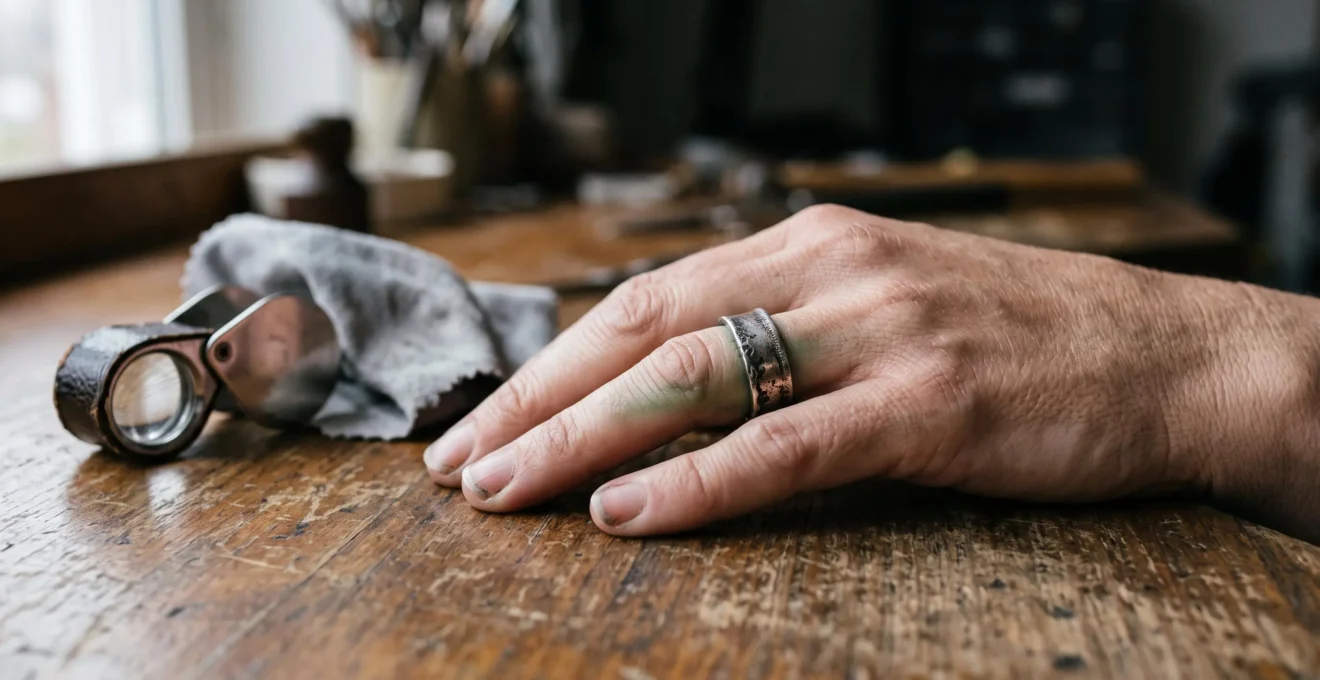
For sensitive skin, fine silver (999) and verified nickel-free silver alloys are generally preferable to jewellery with an unspecified metal composition. Argentium silver is another promising option because its germanium-containing formulation resists tarnish, although this does not establish that allergic reactions are impossible.
The important distinction is between a green stain and an actual allergy. Green discolouration usually reflects a chemical reaction involving metals such as copper, while itching, redness and blistering may indicate allergic contact dermatitis. A piece can produce one problem without causing the other.
Traditional sterling silver, Argentium, fine silver and plated jewellery each involve different compromises in durability, maintenance and potential metal exposure. Choosing between them requires more than checking a 925 hallmark or accepting a hypoallergenic label. Alloy specifications, joining materials, surface coatings and the location of skin contact all matter, especially for pierced ears or jewellery worn every day.
Silver alloy safety at a glance
- For confirmed nickel allergy: prioritise documented nickel-free composition, including posts, solder and clasps; consider fine silver where its softness is acceptable.
- For recurring green stains: reducing copper exposure through a suitable alloy or an intact protective coating may help.
- For long-term wear: Argentium offers improved tarnish resistance, but manufacturer claims do not replace individual allergy assessment or nickel-release evidence.
- Why Some People Develop Green Marks or Reactions When Wearing Sterling Silver
- Argentium vs Traditional Sterling: Which Is Safer for Nickel-Allergic Skin?
- How Germanium in Modern Silver Alloys Reduces Tarnish and Skin Irritation
- The « Nickel-Free » Label Loophole That Can Still Trigger Allergic Reactions
- How Barrier Coatings Prevent Skin Contact With Reactive Alloy Components
- 925 Sterling vs Argentium Silver: Which Resists Daily Scratches Better?
- Why Acidic Skin pH Accelerates Silver Tarnish — And What It Means for Sensitive Wearers
- How Alloy Composition Determines Whether Your Silver Jewelry Lasts 5 Years or 50 Years
Why Some People Develop Green Marks or Reactions When Wearing Sterling Silver
Sterling silver can leave green marks because its copper component reacts with moisture and substances encountered during wear. The resulting surface compounds may transfer onto skin without causing an allergy. By contrast, an itchy, inflamed rash suggests contact dermatitis, potentially involving nickel, cobalt or another substance in the jewellery.
Standard 925 sterling silver contains 92.5% silver, with the remaining 7.5% commonly consisting primarily of copper. This addition strengthens silver for practical jewellery applications, but copper-containing surfaces can react with sweat, moisture and environmental contaminants.
Some copper compounds formed during corrosion have green or blue-green colouring. Their transfer is particularly noticeable where a ring fits closely and moisture remains trapped against the skin. However, the precise compounds responsible cannot be identified from the stain’s colour alone.
Colour transfer and allergic inflammation require different responses. A green mark that washes away without discomfort is not, by itself, evidence of an immune reaction. Itching, persistent redness, scaling or blistering warrants greater attention, especially when symptoms recur in the same area.
According to DermNet’s information on jewellery allergy, nickel and cobalt are common causes of jewellery-related allergy. The same guidance distinguishes allergic dermatitis from irritation associated with friction, moisture, trapped soap and dirt.
Individual wearing conditions also influence staining. Consider whether marks appear after exercise, handwashing, applying cosmetics or wearing a particular ring for several hours. Record which pieces cause symptoms and whether the skin is merely coloured or genuinely inflamed.
A simple observation record can separate patterns of staining from more concerning reactions, but it cannot establish the responsible allergen. A dermatologist can use patch testing when metal allergy is suspected.
Fine silver is generally well tolerated and avoids the substantial copper addition used in conventional sterling. Nevertheless, persistent reactions should never automatically be blamed on copper or dismissed because a piece is described as pure silver. The complete jewellery item and its contact surfaces must be considered.
Argentium vs Traditional Sterling: Which Is Safer for Nickel-Allergic Skin?
For someone with nickel allergy, Argentium may be an attractive alternative to traditional sterling because it contains germanium and is designed to resist tarnish. However, neither an Argentium brand designation nor a 925 sterling hallmark independently guarantees freedom from nickel exposure. Verified composition and the materials used throughout the finished piece are more decisive.
Conventional sterling achieves its familiar balance of workability and strength through a silver-rich alloy, usually incorporating copper. Argentium modifies this approach by including germanium and increasing the nominal silver content in its documented modern grades.
Argentium’s official technical documentation identifies 940 and 960 alloy families, containing 94% and 96% silver respectively. The manufacturer promotes their tarnish resistance and suitability for sensitive skin, although the latter is a commercial claim rather than independent clinical proof.
The distinction matters because a higher silver percentage does not disclose every other ingredient, trace impurity or joining material. The jeweller should confirm the composition of the exact finished product rather than relying only on the principal alloy.
The following comparison helps match material properties to different wearing needs.
| Selection factor | Traditional 925 sterling | Argentium 940/960 |
|---|---|---|
| Nominal silver content | 92.5% | 94% or 96% |
| Principal alloy strategy | Typically silver and copper | Silver alloyed with germanium and other constituents |
| Tarnish behaviour | Requires regular cleaning according to exposure | Designed for improved tarnish resistance |
| Nickel-allergy assurance | Requires product-specific verification | Also requires product-specific verification |
| Suitable uses | Everyday jewellery when composition is verified and tolerated | Everyday jewellery where tarnish resistance and documented composition are priorities |
| Important limitation | 925 does not identify every constituent | Brand designation alone is not clinical allergy certification |
For pierced ears, verify the actual posts, backs and any soldered joints. These components may differ from the decorative silver portion. Someone with confirmed nickel allergy should not assume that a visually silver-coloured earring has a consistent composition throughout.
For bracelets and rings, prolonged contact, accumulated moisture and friction become particularly relevant. A documented nickel-free construction is preferable to relying solely on a manufacturer’s broad skin-sensitivity claim.
Argentium is a reasonable candidate when reduced tarnishing is also important, but the safest choice for nickel-sensitive skin remains a finished item whose contacting components and nickel exposure have been adequately verified.
How Germanium in Modern Silver Alloys Reduces Tarnish and Skin Irritation
Germanium-containing silver alloys form a protective surface oxide that helps resist tarnishing. This passivation can reduce surface reactions associated with discolouration, making Argentium appealing to people who experience staining with ordinary sterling. However, the protective layer has not been clinically demonstrated to prevent allergic contact dermatitis or eliminate exposure to every potentially reactive metal.
In ordinary sterling, copper-containing surfaces can undergo oxidation and corrosion during wear. Argentium incorporates germanium, which supports the formation of a germanium-oxide layer at the surface.
This thin surface layer helps protect the underlying material from environmental reactions. It is therefore relevant to maintaining appearance and reducing the tarnish that can transfer onto skin or jewellery-contacting materials.
The manufacturer identifies its alloys as tarnish resistant and firestain free in Argentium’s official alloy technical documentation. Its currently documented 940 and 960 grades should be distinguished from older or differently described compositions that may appear in retail listings.
Tarnish resistance is not equivalent to proven hypoallergenicity. A protective oxide can influence surface chemistry without establishing that every finished piece releases no nickel, copper or other substances. Surface imperfections, added components and individual sensitivity remain relevant.
Technical guidance from precious-metal supplier Palloys describes the protective germanium oxide as developing naturally and notes that appropriate professional processing can assist passivation. Certain aggressive cleaning procedures may remove or diminish this protection.
For normal home maintenance, gentle cleaning is preferable:
- Wipe the jewellery with a soft cloth after wear.
- Use warm soapy water when cleaning is necessary, then rinse and dry promptly.
- Avoid unsuitable dip polishes, electrolytic cleaning and steam cleaning where the alloy’s technical guidance advises against them.
- Remove jewellery when its surface may be exposed to harsh cleaning products or unnecessary abrasion.
Professional heat-passivation procedures should not be copied as home treatments. Finished pieces may contain gemstones, adhesives or other components that cannot safely undergo the same processing as an unassembled metal part.
Argentium is also a registered trademark, providing a way to identify the branded alloy family and request grade-specific documentation. That traceability is useful, although trademark status does not constitute independent medical certification.
When deciding between silver alloys, treat surface stability as one desirable property alongside verified nickel composition. For a sensitised wearer, less visible tarnish cannot substitute for evidence about the whole piece.
The « Nickel-Free » Label Loophole That Can Still Trigger Allergic Reactions
A jewellery item can satisfy a nickel-release regulation while still containing nickel. This is the central distinction between a composition claim such as « nickel-free » and a compliance claim based on measured nickel release. For highly sensitised people, regulatory compliance does not establish that exposure is entirely absent or that an individual reaction is impossible.
European Union REACH restrictions address nickel migration from specified jewellery and other skin-contact articles. They distinguish between components inserted into piercings and objects intended for direct, prolonged contact with skin.
The Court of Justice judgment quoting the EU nickel-release restrictions reproduces the following regulatory thresholds from the provision considered in that case.
0.2 and 0.5 µg/cm²/week
The quoted EU restriction specifies a nickel-release rate below 0.2 µg/cm²/week for relevant piercing post assemblies and a 0.5 µg/cm²/week threshold for covered articles intended for direct and prolonged skin contact. These are release measurements, not permitted nickel percentages or universal allergy-safe levels.
Court of Justice of the European Union, judgment dated 5 March 2024, quoting REACH Annex XVII, entry 27.
These EU provisions should not automatically be presented as the legal requirements of the United States, Canada, Australia, New Zealand or the United Kingdom. Applicable rules and recognised testing requirements must be checked for the relevant market. The cited judgment also does not establish the complete legal position as of October 2026.
Similarly, the term « hypoallergenic » should be treated cautiously rather than interpreted as a universal international certification. Ask what the seller means by it and what evidence supports the claim.
The European restriction also addresses covered articles with non-nickel coatings, requiring the applicable release limit to be maintained for at least two years of normal use under the quoted provision. That requirement does not mean every coating remains intact for exactly two years.
Product verification should include the metals used in soldered seams, clasps, earring backs and any substrate beneath plating. A reassuring alloy specification for the visible body of a ring does not necessarily describe the entire assembly.
Five checks before buying silver for nickel-sensitive skin
- Identify the complete material: request the alloy grade and constituent-metal information. Keep the manufacturer’s specification or a written seller confirmation.
- Check hidden contact components: ask what the posts, backs, clasps and solder joints contain. Record any components that have not been verified.
- Clarify nickel claims: determine whether « nickel-free » refers to composition or whether the product is merely compliant with a release limit. Keep the written explanation.
- Request testing evidence: where applicable, ask for documentation of nickel-release testing, such as relevant EN 1811 testing. Retain the report identification and the product it covers.
- Confirm purchase safeguards: review the return policy and any coating or repair disclosures. Save the agreed terms before purchase.
If the seller cannot identify the materials or explain its nickel-related claims, choosing another documented product is generally more prudent than assuming the silver colour or hallmark is protective.
How Barrier Coatings Prevent Skin Contact With Reactive Alloy Components
Rhodium plating and suitable protective coatings can separate skin from a reactive underlying silver alloy, reducing direct contact while the barrier remains intact. They are useful when replacing the jewellery is impractical, but they are not permanent allergy-proofing measures. Wear, scratching and incomplete coverage can expose the underlying metal again.
Rhodium is commonly used to give jewellery a bright, reflective finish. When properly applied, its coating forms a physical barrier between the wearer and the substrate.
Other surface treatments, including certain polymer coatings, e-coatings and protective waxes, may reduce contact with reactive metals. Their durability and suitability depend on the particular formulation, application quality and wearing conditions. They should not all be assumed to provide the same protection as professional rhodium plating.
Dermatological guidance recognises rhodium plating as a temporary way to isolate skin from potentially reactive jewellery components, while cautioning that plating wears over time.
Friction is especially relevant to rings and bracelets, which repeatedly contact neighbouring objects and surfaces. Earrings and pendants may experience less abrasion, although movement, cleaning and handling can still affect coatings.
There is no dependable universal schedule for reapplying rhodium. The appropriate interval depends on coating thickness, wear patterns, cleaning habits and the design of the piece. A professional should assess whether replating is needed.
Watch for uneven colour, exposed underlying metal, localised surface changes or the return of familiar staining. These observations may indicate deteriorating coverage, but visual inspection alone cannot determine how much nickel or another metal is being released.
For occasional wear, a professionally coated piece may be an acceptable maintenance-based solution. For daily wear with confirmed metal allergy, an appropriately verified alloy or other inherently suitable material can reduce dependence on a coating remaining intact.
If irritation starts or returns, discontinue wearing the item until its suitability has been assessed. Replating should not be treated as a substitute for investigating persistent dermatitis.
A barrier is most useful when its underlying material is known, its condition can be monitored and professional maintenance is available. For highly sensitive skin, dependable material selection is preferable to relying on an invisible coating indefinitely.
925 Sterling vs Argentium Silver: Which Resists Daily Scratches Better?
Neither 925 sterling nor Argentium is universally more scratch resistant in every finished form. Surface hardness depends on the specific alloy grade, manufacturing method, heat treatment and finishing. Argentium can be processed to improve its mechanical properties, but germanium-oxide tarnish resistance is not proof that its surface withstands abrasion better than every conventional sterling alloy.
The copper added to traditional sterling helps make silver more practical for jewellery than fine silver alone. However, silver content cannot independently predict scratch resistance: the remaining elements and the way the metal is processed matter considerably.
Argentium 940 and 960 contain different nominal silver proportions, and individual products may have different processing histories. A comparison of untreated samples would not necessarily predict the behaviour of finished pieces that have undergone hardening or other fabrication steps.
Tarnish resistance and scratch resistance measure different properties. The protective germanium-oxide surface contributes to chemical stability, but it does not justify assigning a numerical hardness advantage without a suitable test of the specific materials.
Argentium’s processing documentation includes alloy-specific technical information, while specialist guidance discusses how finishing and processing affect its surface. Neither establishes a universal scratch-resistance ranking against traditional sterling.
Scratches can nevertheless matter to a sensitive wearer. Surface irregularities may collect residues, and repeated abrasion can damage applied coatings. This is particularly important when the coating is the principal barrier between skin and a known reactive substrate.
For choosing by jewellery type, distinguish mechanical exposure from skin-contact requirements:
| Jewellery type | Mechanical priority | Sensitive-skin priority |
|---|---|---|
| Daily-wear rings | Verified hardness, finish and repairability | Known alloy and minimal reliance on worn coatings |
| Bracelets | Resistance to rubbing and clasp wear | Verified links, closures and joining materials |
| Earrings | Appropriate strength for posts and fittings | Verified post and backing materials |
| Pendants | Surface stability and appropriate strength | Known composition of skin-contacting surfaces and chains |
A harder finished surface may need less frequent cosmetic refinishing, but hardness alone does not establish lower allergy risk. Nickel release, coating integrity and personal tolerance remain separate considerations.
Before buying an expensive everyday ring, ask whether the jeweller can provide grade-specific hardness information and explain how the piece can be refinished if scratched.
The best everyday alloy is not necessarily the hardest one. It is the material that combines adequate mechanical performance with a clearly verified composition and manageable long-term maintenance.
Why Acidic Skin pH Accelerates Silver Tarnish — And What It Means for Sensitive Wearers
More acidic sweat can influence metal corrosion and the dissolution of alloy constituents, potentially contributing to faster surface changes in some wearing conditions. However, tarnishing also depends on moisture, salts, environmental chemicals and the jewellery’s composition. Skin acidity alone cannot reliably predict tarnish speed or diagnose a metal allergy.
Human sweat contains water, dissolved salts and other substances that can interact with metal surfaces. Its composition varies with activity and individual circumstances, so two people wearing similar jewellery may experience different results.
In copper-containing sterling, moisture and chemical exposure can encourage surface reactions that affect appearance or produce transferable residues. The process is more complex than a single relationship between acidity and tarnish.
No reliable universal fourfold tarnish-acceleration factor follows from the supplied evidence. Such a figure would require defined test conditions and appropriate comparative measurements.
Likewise, an individual cannot establish their skin pH from the speed with which a ring darkens. Cosmetics, cleaning residues, sweating, storage conditions and previous surface treatment can all change the outcome.
A practical approach is to document when and where the problem occurs:
- Does discolouration follow exercise, hot weather or extended wear?
- Does one ring stain while another verified silver item does not?
- Do marks wash away, or are they accompanied by persistent itching or inflammation?
- Does cleaning and thorough drying reduce recurrence?
Trying a suitably designed, verified fine-silver item may help illustrate differences between materials, but it is not a controlled diagnostic test and should not be attempted on irritated skin as a way of investigating suspected allergy.
For jewellery that frequently discolours, prioritise a known alloy composition, gentle cleaning and removal before activities involving prolonged sweat or harsh chemical exposure. Argentium’s surface passivation may be helpful for tarnish management, though it does not offer proven protection against allergic dermatitis.
Acidic environments may influence metal-ion release under particular conditions, but this does not establish that a person with more acidic sweat will necessarily react to a compliant jewellery item. Confirmed allergy requires its own precautions regardless of perceived skin acidity.
Frequent discoloration is a reason to review material choice and wearing habits. Persistent inflammatory symptoms are a reason to seek appropriate dermatological assessment rather than attempting to correct an assumed skin-pH problem.
Key takeaways before choosing a long-lasting alloy
- Prioritise verified composition: a hallmark or advertised purity does not identify every skin-contacting component.
- Consider lifetime maintenance: tarnish-resistant alloys and protective coatings age differently and require different care.
- Separate comfort from appearance: a bright finish, limited staining and low allergy risk are related purchasing concerns, not interchangeable guarantees.
How Alloy Composition Determines Whether Your Silver Jewelry Lasts 5 Years or 50 Years
Silver jewellery longevity depends on alloy chemistry, mechanical strength, design, manufacturing quality, wearing conditions and maintenance. Copper contributes to the strength of traditional sterling but also participates in surface corrosion. Germanium improves Argentium’s tarnish resistance. Neither composition guarantees a fixed lifespan of five or fifty years, particularly when coatings, fasteners and skin sensitivity affect continued use.
Fine silver, traditional sterling and Argentium each solve a different materials problem. Fine silver minimises the proportion of added metals but can be too soft for certain structural applications. Sterling improves practicality through alloying. Argentium provides an alternative balance of silver content, surface stability and fabrication properties.
Other alloying constituents, including zinc and silicon in formulations where they are used, may influence manufacturing behaviour and material characteristics. Their presence and proportions should not be assumed for a particular product without its technical specification.
Over time, conventional sterling may develop a visible patina requiring cleaning. Argentium is intended to resist this process, although wear and finishing conditions still matter. Plated jewellery adds another maintenance consideration because its barrier can deteriorate and expose the material beneath.
The decision should therefore account for what must remain safe and functional over repeated wear, rather than treating the maximum possible lifespan as the only measure of value.
| Material | Best reason to consider it | Main precaution |
|---|---|---|
| Fine silver (999) | Very high silver purity and minimal added alloy metals | Softness, construction details and other contacting components |
| Verified 925 sterling | Practical everyday construction with established finishing options | Potential copper staining and unspecified trace constituents |
| Argentium 940/960 | Improved tarnish resistance and identifiable alloy grades | Confirm exact composition and avoid interpreting brand claims as medical guarantees |
| Barrier-coated silver | Temporary isolation from the underlying metal | Coating wear, maintenance and unknown substrates |
For someone with confirmed nickel sensitivity who wants everyday earrings, verified contact materials should outweigh the difference between 925 and 940 silver content. For someone primarily concerned with green marks from a ring, a documented low-staining alloy or an appropriate protective finish may offer a more direct solution.
A piece that begins producing new skin symptoms after prolonged uneventful wear deserves renewed inspection. Changes in coatings, cleaning products, trapped residues or components may be relevant, but an allergic cause cannot be established from its appearance alone.
At purchase, inspect the hallmark and maker’s identification where applicable. Marks such as 925 indicate silver fineness rather than comprehensive nickel testing. Hallmarking practices also differ by jurisdiction, including the United Kingdom’s formal precious-metal hallmarking framework.
Request written confirmation of the alloy grade, relevant contacting materials, any plating and the return or repair terms. These records are particularly valuable if an item requires future refinishing or if its composition becomes relevant to a dermatological assessment.
Before committing to a piece for daily wear, choose the option whose complete composition can be verified, whose mechanical properties suit its purpose and whose maintenance requirements are acceptable. If jewellery repeatedly causes an inflamed rash, discontinue wear and discuss patch testing with a dermatologist before selecting a replacement.
Can someone be allergic to silver itself?
Silver itself is generally well tolerated, and jewellery-related allergies are more commonly associated with metals such as nickel or cobalt. However, it is not accurate to declare silver allergy impossible. A dermatologist can investigate persistent suspected allergic contact dermatitis with appropriate patch testing.
Does a 925 stamp guarantee that jewellery contains no nickel?
No. The 925 designation identifies the nominal silver fineness of an alloy, not the identity of every remaining constituent or the composition of attached fittings. Ask the manufacturer for the complete material specification and relevant nickel-release documentation.
Is fine silver suitable for sensitive pierced ears?
Fine silver offers high purity, but softness may limit its suitability for certain earring posts and constructions. Piercing suitability also depends on the design, finish, cleanliness and all contacting components. For new or healing piercings, seek advice from a qualified piercing professional about suitable materials rather than assuming silver is appropriate.
Can a home nickel test prove a silver ring is allergy-safe?
A consumer nickel-detection test may provide useful screening information, but a negative result does not certify a jewellery item as nickel-free or demonstrate compliance with a standardised release test. It also cannot identify other allergens or replace dermatological patch testing.
Should silver jewellery be replaced when its coating starts wearing off?
Not necessarily. A jeweller may be able to inspect, clean and replate an otherwise sound piece. However, someone with confirmed metal allergy should avoid continued contact with an exposed reactive substrate. If the underlying material is unsuitable or unknown, choosing a verified alternative may be more dependable than repeated recoating.