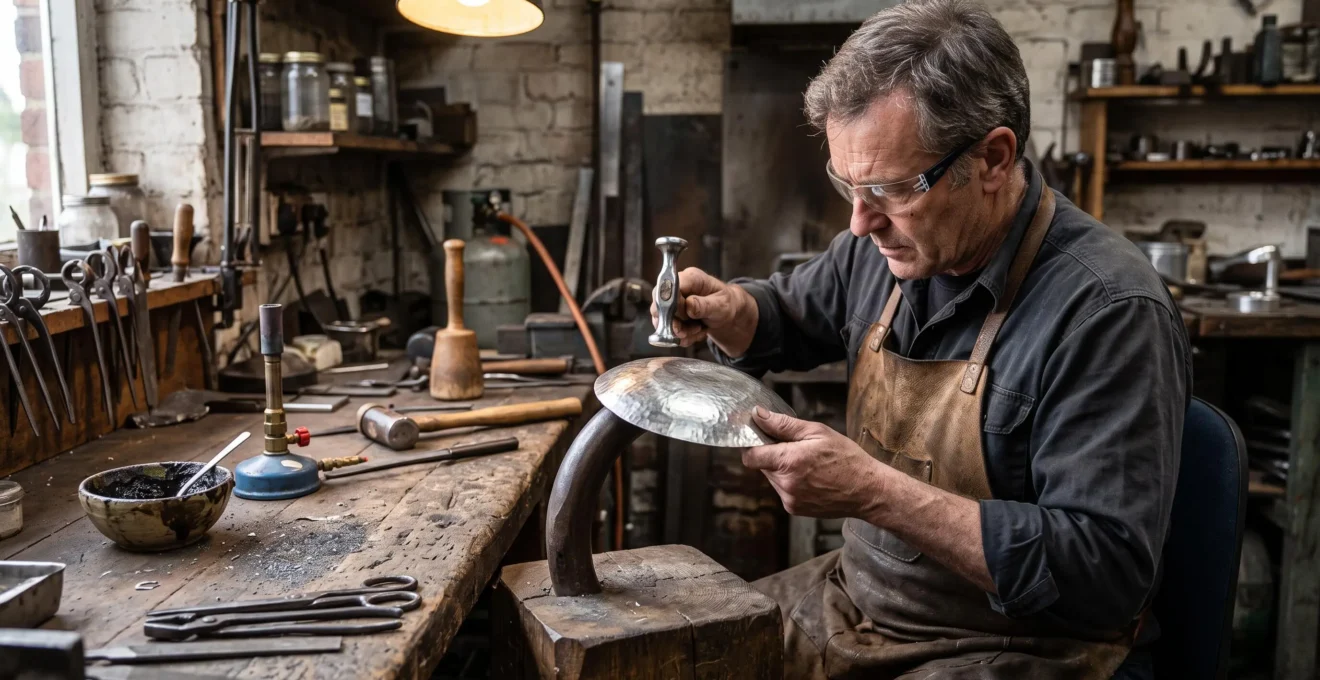
The value of silver jewelry extends beyond precious-metal content, decorative appeal and the reputation of its maker. Metalworking techniques determine how an object is formed, how its components withstand wear and how much specialised craftsmanship its production requires. For collectors, understanding those techniques provides a more reliable basis for evaluating workmanship than surface appearance alone.
Hand raising, forging, casting, wire drawing, filigree and repoussé involve different combinations of labour, tooling and artistic control. Yet traditional methods are not automatically superior: a precisely fabricated contemporary piece may demonstrate greater technical accomplishment than a poorly executed handmade example.
The central collecting question is therefore not simply whether an object was handmade, but which operations were performed, how successfully they were executed and whether their contribution is supported by evidence. Close examination, manufacturing records and informed comparisons can reveal craftsmanship that silver weight and decorative complexity cannot explain.
Understanding Silver Craftsmanship and Value
- Technique influences value through workmanship: labour, difficulty, artistic distinction and documented provenance matter more than the manufacturing label alone.
- Surface appearance is not conclusive: cast textures can imitate hammering, while polishing can erase evidence of genuine handwork.
- Collect strategically: prioritise demonstrable technical achievement, appropriate structural construction and credible workshop documentation.
- Why Hand-Raised Silver Vessels Cost More Than Spun Alternatives
- Hand-Hammered vs Cast Silver: Which Telltale Signs Reveal the Difference?
- How Master Artisans Draw Silver Into Threads Thinner Than Human Hair
- How to Spot Genuine Hand-Drawn Silver Threads in Filigree Jewelry
- How Repoussé Techniques Create 3D Relief From Flat Silver Sheets
- Forging vs Fabrication: Which Creates Stronger Silver Jewelry Structures?
- The Technique Fraud Where Machine Work Is Sold as Handmade
- When to Commission Traditional Techniques vs Modern Methods for Custom Work
Why Hand-Raised Silver Vessels Cost More Than Spun Alternatives
Hand-raised silver vessels can command higher prices than spun alternatives because their manufacture requires repeated manual forming, annealing and surface refinement. The premium may reflect specialist expertise, individual artistic decisions and limited production capacity. However, no universal price multiplier applies: complexity, scale, maker reputation and the quality of execution determine whether a particular difference is justified.
Hand raising starts with a relatively flat piece of metal, commonly a disc. The silversmith works it against suitably shaped stakes, progressively changing its form through controlled hammer blows. As the metal becomes work-hardened, annealing restores sufficient ductility for further shaping. Numerous forming and finishing stages may be required before the intended profile emerges.
Metal spinning follows a different production logic. A metal blank is rotated on a lathe and shaped progressively against a form, often called a mandrel. This approach is particularly effective for repeatable rotational shapes, although skilled manual control can remain central to the process.
The distinction is not simply hand versus machine. Raising allows the maker to develop shapes without depending on a rotational forming template, while spinning can offer a disciplined and highly accomplished form of craftsmanship.
| Evaluation criterion | Hand raising | Metal spinning |
|---|---|---|
| Forming principle | Progressive hammering against stakes | Rotating metal shaped against a form |
| Specialist demands | Hammer control, shaping judgment and annealing | Lathe control, material behaviour and tooling |
| Design flexibility | Especially suited to individually developed sculptural forms | Particularly suitable for rotational forms |
| Repeatability | Individual variation is inherent | Repeated profiles can be produced efficiently |
| Collecting significance | May offer distinctive evidence of individual workmanship | May represent sophisticated technical and design achievement |
The cost of raising depends on the number and difficulty of forming stages, potential corrections, material behaviour and the expertise required. Spinning also involves equipment, setup, tooling and skilled finishing. Neither method carries a fixed labour-cost or scrap-rate advantage across every design.
Collectors should examine variations in profile, wall thickness and finishing, while recognising that these features are indications rather than proof. The Crafts Council‘s catalogue record of Chris Knight‘s hybrid-fabricated teapot documents an accomplished object combining spinning, machining, soldering and hand fabrication. Its maker also described how polishing could remove visible traces of handwork.
Collection example: Chris Knight’s 2004 teapot
The Crafts Council records a teapot made in Sheffield using silver and anodised, dyed aluminium. Its documented processes include spinning, piercing, filing, soldering, machining and hand-finishing.
The example demonstrates that a collectible metalwork object can combine traditional and machine-assisted methods without reducing its craftsmanship to a single production category. It does not establish a general price comparison between raising and spinning.
A higher price becomes more persuasive when the maker can explain the forming sequence, its technical demands and the choices that distinguish the finished object. Documentation is particularly valuable when surface finishing conceals the manufacturing process.
Hand-Hammered vs Cast Silver: Which Telltale Signs Reveal the Difference?
Hand-hammered and cast silver can sometimes be distinguished through construction details, repeated patterns, surface marks and evidence of moulding. Hammer marks alone are insufficient because cast pieces may reproduce hammered textures or receive additional hammer finishing. Reliable identification combines close inspection with knowledge of the object’s manufacturing history, especially when assessing a premium for structural handwork.
Casting generally involves introducing molten silver into a mould and allowing it to solidify. Hand hammering instead alters the shape or surface of existing metal through mechanical deformation. A piece may undergo both processes, so the distinction is not necessarily exclusive.
For preliminary examination, use magnification and compare features across the entire object:
- Seams and sprue remnants: possible indicators of casting, although they may be removed during finishing.
- Repeated identical details: potentially consistent with mould replication or mechanised production, but not independently conclusive.
- Directional planishing marks: possible evidence of progressive hammer working, particularly when their orientation relates to the underlying form.
- Slight asymmetry: potentially associated with individual forming, although handmade work can be highly regular.
- Construction boundaries: solder joins, applied decorations and separately manufactured parts can reveal a hybrid production sequence.
Mechanical processing can also change the metal’s internal structure. Hammering causes plastic deformation and work-hardening, which can increase hardness while reducing ductility until subsequent annealing changes those properties. Casting produces a solidified structure whose soundness depends on alloy composition and process control; defects such as porosity may occur, but are not inevitable.
Consequently, hammered does not automatically mean stronger. Durability also depends on geometry, alloy, heat treatment, solder joints and the service conditions of the finished piece. Resonance, apparent density and sound are not dependable standalone identification tests.
The distinction between surface decoration and structural forming is especially important. The GIA‘s overview of traditional jewelry metalworking techniques describes hammered finishes alongside other jewellery techniques. Such a finish does not establish that the full structure was raised or forged by hand.
For an expensive acquisition, ask whether the underlying blank was cast, wrought or assembled, and which hammering operations actually shaped it. Process photographs, workshop records and the maker’s explanation can be more informative than texture alone.
Collectors should assign greater value to verified technical accomplishment than to an attractive but ambiguous surface. When the production sequence remains uncertain, that uncertainty belongs in both the object record and the purchase decision.
How Master Artisans Draw Silver Into Threads Thinner Than Human Hair
Master silversmiths produce exceptionally fine wire by progressively pulling silver through smaller openings in a drawplate, with annealing when needed to manage work-hardening. Achieving very small diameters requires carefully prepared material, appropriate tools and consistent control. A comparison with human-hair thickness is descriptive, not proof of a particular wire diameter or historical manufacturing method.
Wire drawing begins with a suitable silver rod or prepared strip. The maker reduces and tapers one end so it can enter the drawplate opening. Drawing tongs or a suitable pulling mechanism then draw the material through the die, reducing its cross-section and extending its length.
The operation is repeated through progressively smaller openings until the required diameter is reached. Each reduction must remain compatible with the metal’s condition and the available equipment.
- Prepare the starting material: establish a workable rod or strip with suitable dimensions and condition.
- Taper the leading end: make it narrow enough to pass through the chosen drawplate hole.
- Draw the wire: pull the silver through the die under controlled tension.
- Manage work-hardening: assess whether annealing is needed before further reduction.
- Repeat and inspect: continue through smaller dies, checking continuity, surface quality and diameter.
The principal technical challenge arises from the relationship between deformation and ductility. Drawing produces work-hardening, which can make additional reduction more difficult and increase the risk of failure when the metal is overstressed. Annealing changes the material’s condition so that further deformation becomes possible.
Fine silver and sterling silver do not behave identically because their compositions differ. Their response to working and heat treatment must be considered rather than assuming that the same drawing schedule suits every alloy.
The relationship between wire fineness and collector value is more nuanced than diameter alone. Extremely delicate threads may demonstrate exceptional control, but consistency, intended use, joining quality and decorative composition are equally important.
Very fine wire may also be manufactured with specialised modern equipment. Therefore, a small diameter does not prove hand drawing, nor does apparent regularity establish mechanised production.
Historical filigree techniques deserve attention for their workshop traditions and accumulated expertise. Nevertheless, claims that particular historical threads are impossible to reproduce today require evidence specific to the object and manufacturing method.
For a collector, the strongest evidence combines documented workshop practice, examination of the wire and an understanding of the completed ornament. Its collectible significance arises from the achievement as a whole, not a presumed number of drawing passes.
How to Spot Genuine Hand-Drawn Silver Threads in Filigree Jewelry
Authentic constructed silver filigree can be identified by examining how individual wires form patterns and connect to the supporting structure. However, visible variations cannot reliably prove that wire was hand-drawn rather than commercially manufactured. The most meaningful distinction is often between genuinely assembled wirework and ornament cast to imitate it, supported wherever possible by workshop documentation.
Traditional filigree uses fine metal wires arranged into decorative forms and joined, commonly by soldering. Plain, twisted and curled wires may form delicate openwork or be attached to a supporting surface. Granulation is a related but distinct technique involving small metal particles.
Start by examining the object’s edges, reverse and points where decorative elements meet. Constructed filigree may reveal separate wire contours, identifiable junctions and spaces between elements. A cast imitation may instead present an integrated mass with softened or continuous connecting areas.
These observations require caution. Skilled casting can reproduce fine detail, while solder and finishing can make genuinely assembled wires appear continuous.
A loupe helps establish whether components appear individually formed and joined. Compare several similar spirals, their curvature, wire cross-sections and points of attachment. Minor inconsistencies may support an interpretation of individual assembly, but do not distinguish hand-drawn wire conclusively from machine-drawn wire.
Equally, perfectly regular wire should not automatically be dismissed. Skilled hand drawing and careful assembly may produce remarkably consistent results.
Five Checks Before Acquiring Silver Filigree
- Inspect the construction: record close-up photographs of the front, reverse and decorative junctions.
- Compare repeated elements: prepare a short observation sheet identifying similarities, variations and possible casting evidence.
- Identify the materials: request a documented silver-fineness statement and record any visible marks without assuming they certify the technique.
- Question the workshop: obtain a written description stating whether the wires were drawn in-house, purchased, twisted, soldered or cast.
- Document the attribution: retain images, seller representations and supporting records in the collection file.
Regional filigree traditions may favour different silver alloys, wire treatments and decorative conventions. A 925 fineness designation concerns the alloy’s silver content, not whether the construction was performed by hand. Higher-fineness materials likewise provide no automatic proof of traditional craftsmanship.
The most useful seller questions concern the actual sequence of manufacture: were separate wires joined, where were those wires produced, how were decorative elements attached and which parts were cast?
A collectible filigree jewel merits a premium when its design, precision, craftsmanship and provenance justify one. Claims about the exact origin of its wire should remain qualified unless independent evidence establishes them.
How Repoussé Techniques Create 3D Relief From Flat Silver Sheets
Repoussé creates raised decoration by working metal from its reverse, while chasing refines forms and details from the front. Together, these techniques allow silversmiths to develop complex relief in sheet metal. Their collecting significance depends on the quality, complexity and documentation of the work, not simply on how far the decoration projects from the surface.
The silversmith begins with a sheet of metal and a planned design. A pitch support or another suitable holding arrangement stabilises the work while punches and hammers progressively deform the metal.
Working from the reverse pushes portions of the design outward. The piece may then be repositioned so that chasing tools can refine outlines, surface transitions and decorative details from the front.
Alternating forming, refinement and appropriate annealing allows the maker to develop relief while managing stresses in the sheet. Excessive deformation or unsuitable metal condition can produce unwanted thinning, distortion or cracking.
Collectors can assess relief through the relationship between depth, line definition and overall form. Controlled transitions, coherent contours and well-resolved details may demonstrate accomplished execution. Irregular depth is not necessarily a defect, since artistic intention may require substantial variation.
Stamped or mechanically embossed decoration can resemble repoussé. Repeated motifs, tool access, reverse-side characteristics and evidence of die forming may help guide examination, but neither depth nor irregularity independently authenticates a manual process.
Historical example: Royal silver kettledrums
The Metropolitan Museum of Art documents ceremonial silver kettledrums made by Franz Peter Bunsen, with heraldic decoration formed through repoussé from the inside and subsequently refined by chasing and engraving.
The example illustrates how multiple decorative metalworking operations can combine within a substantial historical object. Its royal context does not establish a general price premium for contemporary repoussé jewelry.
The Metropolitan Museum of Art‘s examination of repoussé silver kettledrums provides historical context for the combination of reverse-side forming and subsequent decorative refinement.
For valuation, determine whether repoussé is central to the object’s design or represents a limited decorative operation. A carefully resolved, shallow relief may display greater technical refinement than a deeper but poorly controlled example.
The most desirable examples unite artistic intention with convincing execution. Attribution, conservation condition and documented technique should inform the premium rather than relief depth alone.
Forging vs Fabrication: Which Creates Stronger Silver Jewelry Structures?
Neither forging nor fabrication guarantees stronger silver jewelry. Forging can create structural continuity and work-hardening in appropriately formed components, while fabrication allows complex assemblies whose reliability depends on design and joint quality. The stronger choice depends on alloy condition, geometry, soldering or fastening methods and the stresses encountered during wear.
Forging shapes metal through mechanical force. In silver, deformation changes the metal’s internal structure and can increase hardness until annealing alters its condition. The resulting mechanical properties depend on the full working and heat-treatment history, rather than simply on whether a hammer was used.
Fabrication constructs a piece from prepared components such as sheet, wire and formed elements. These may be joined by soldering, riveting or other appropriate techniques. Fabrication provides considerable flexibility for combining different shapes and decorative elements.
Its potential weak points include poorly executed joints, unsuitable component thicknesses and areas where forces concentrate during normal use. Forged components are not immune to failure, particularly where the design introduces sharp transitions or where the material has been overworked.
When inspecting a bracelet, examine the areas exposed to repeated bending, opening or impact. For fabricated necklaces and pendants, inspect connecting elements, solder joints and the points where weight is transferred through the structure.
| Application | Forging considerations | Fabrication considerations |
|---|---|---|
| Cuffs and bangles | Useful for developing continuous forms and controlled material condition | Suitable when assembled elements and joins are appropriately designed |
| Complex pendants | May shape individual structural or decorative elements | Allows separately prepared components and intricate construction |
| Findings and connectors | Mechanical properties can be tailored through working and annealing | Joint placement and attachment quality require attention |
| Multi-element designs | Useful for selected formed components | Offers flexibility in combining distinct shapes and materials |
The term stronger also requires a clear definition. Resistance to permanent deformation, fatigue under repeated movement and resistance to accidental fracture are not identical properties. A construction suited to one type of loading may perform less well under another.
Where a piece is intended for frequent wear, request information about structural repairs, previous deformation and any known vulnerable components. An expert examination may be appropriate for rare or expensive examples.
For a collector balancing preservation with occasional wear, sound engineering may be more valuable than a preferred manufacturing label. A carefully fabricated jewel can be both technically accomplished and structurally appropriate.
The Technique Fraud Where Machine Work Is Sold as Handmade
Misrepresentation occurs when the manufacturing story attached to silver jewelry exceeds what was actually done. A machine-produced object may be advertised as fully handmade, or a cast piece may be described as hand-forged despite receiving only manual finishing. Establishing whether a claim is misleading requires examining its precise wording, production evidence and applicable advertising standards.
Descriptions such as handmade, hand-finished, hand-forged and hand-engraved do not necessarily mean the same thing. Each refers to a different scope of activity, and the distinction can materially affect a collector’s valuation.
Potentially misleading descriptions include:
- Describing a predominantly machine-produced object as entirely handmade without a justified basis.
- Presenting a cast component as hand-forged because its surface resembles hammerwork.
- Calling an integrated cast ornament hand-assembled filigree when separate wire elements were not assembled.
- Using hand-finished to imply that all shaping, forming and construction operations were performed manually.
- Claiming an exclusively traditional manufacturing process while omitting material machine-assisted stages.
Modern tools do not, in themselves, indicate deception. Casting, CAD design, machining and laser welding can be legitimate parts of contemporary jewellery manufacture. The issue is whether the seller’s representation accurately describes their contribution.
In the United States, the Federal Trade Commission‘s Jewelry Guides address potentially deceptive representations concerning handmade products and specific hand-performed operations. The US jewelry advertising guidance on handmade claims in 16 CFR § 23.2 distinguishes broad handmade descriptions from narrower statements about individual operations.
This US guidance should not be assumed to govern marketing in the United Kingdom, Canada, Australia or other English-speaking markets. Local consumer protection rules and the wording of the particular claim require separate consideration.
Hallmarks and assay marks perform a different function. Where applicable, they provide information concerning precious-metal standards or testing systems; they do not independently establish whether a piece was cast, forged or entirely handmade.
Before an important purchase, compare the physical object with the seller’s description and request process photographs, workshop information or a signed statement identifying the operations performed. A production video may be informative, but it should be connected convincingly to the actual object under consideration.
Price is supporting context rather than decisive evidence. Affordable work is not necessarily misrepresented, and an expensive label does not guarantee authenticity.
When descriptions remain inconsistent, record the disputed statements, preserve advertisements and correspondence, and seek an independent specialist assessment where the potential loss warrants it. Any consumer remedy depends on the relevant jurisdiction and transaction circumstances.
Reliable provenance protects both the collector and the integrity of the object record. The objective is not to reject modern technology, but to ensure that the price reflects craftsmanship actually performed.
Key Takeaways Before Commissioning
- Specify which manufacturing operations matter to the collection rather than requesting handmade work without defining the term.
- Allocate the craftsmanship budget to technically or artistically significant components, supported by a clear design brief.
- Require a production record that distinguishes manual, machine-assisted and outsourced processes before agreeing to the commission.
When to Commission Traditional Techniques vs Modern Methods for Custom Work
Traditional techniques are particularly appropriate when a commission prioritises individual workmanship, historical continuity or sculptural expression. Modern methods may be preferable where dimensional precision, repeatability or design iteration are central requirements. A hybrid commission often provides the most effective balance, concentrating demanding handwork where it contributes meaningfully to the finished object’s character and value.
For a museum-oriented collection, a traditional process may be important because the making method is part of the work’s cultural significance. In that context, the commission should document not only the finished object but also the artisan’s training, workshop practice and decisions during production.
A private collector may place different emphasis on wearability, distinctive design, budget and future conservation. These priorities should influence the choice of process from the outset.
| Primary objective | Traditional approach | Modern or hybrid approach |
|---|---|---|
| Individual sculptural character | Hand raising, forging or repoussé | Digital planning followed by selected manual forming |
| Repeatable dimensions | Manual production guided by detailed templates | CAD, casting or precision fabrication |
| Intricate decorative detail | Constructed filigree and chasing | Digitally prepared components with documented hand assembly |
| Historical process documentation | Traditional workshop methods with production records | Hybrid production with clearly identified modern stages |
| Controlled design revisions | Sketches and physical prototypes | Digital models and prototypes before final manufacture |
The practical trade-offs extend beyond workmanship. A commission involving scarce specialist skills may depend on artisan availability, sequential forming stages and approval of physical prototypes. Digital workflows may simplify design revisions, but their actual scheduling and cost advantages depend on the chosen project.
Deposits, revision conditions, material specifications and completion milestones should be established in writing. Neither traditional nor digital production automatically guarantees a particular delivery schedule.
A hybrid project might combine a hand-raised silver body with separately cast fittings. Another could use CAD to develop proportions before a jeweller completes selected components through manual fabrication and surface refinement.
Such combinations should be evaluated according to their contribution to the design, not a hierarchy that automatically places one process above another.
A particularly effective commissioning brief identifies the intended use, desired visual qualities, acceptable manufacturing methods, verification requirements and the significance of any historical references. The final records should identify which stages were performed by the named maker and which involved other workshops or equipment.
Collectors should also plan for future attribution. Retained sketches, manufacturing photographs, material descriptions and signed invoices may establish a clearer production history than an undocumented verbal assurance.
Prepare a concise commissioning brief that lists the desired techniques, acceptable modern interventions and evidence required at delivery. Use it to compare makers on demonstrated ability and transparency, allowing the completed piece to enter the collection with a defensible account of its manufacture.
Does a 925 silver hallmark prove that jewelry is handmade?
No. A 925 designation indicates a stated sterling-silver fineness of 925 parts silver per thousand, not the manufacturing method. Applicable hallmarking and assay systems concern precious-metal identification or verification. Establishing hand production requires separate evidence concerning the object’s manufacture.
Can polishing remove evidence of traditional silversmithing?
Yes. Finishing can diminish or remove visible tool marks, making visual identification more difficult. Documented contemporary metalwork in the Crafts Council collection provides an example of a maker describing how polishing removed visible traces of handwork. The absence of hammer marks therefore does not prove machine manufacture.
Is antique silver filigree necessarily more valuable than contemporary filigree?
No. Age may contribute historical significance, but collectible value also depends on attribution, condition, technical execution, artistic distinction and provenance. An accomplished contemporary piece may have greater collecting relevance than an older example of uncertain manufacture or inferior workmanship.
Can a cast silver jewel qualify as an important collectible?
Yes. Casting is a legitimate production technique and does not exclude artistic or collectible importance. Design quality, the identity of the maker, originality, finishing, condition and documented history may all contribute. Casting becomes problematic when a seller inaccurately describes the object as having been manufactured through another process.
What evidence should accompany an expensive handmade silver commission?
Useful documentation includes a signed description of manufacturing operations, design drawings, photographs of relevant production stages, material specifications and a final invoice identifying the maker. Records should distinguish hand forming, machine-assisted work, casting, assembly and finishing wherever those distinctions materially affect the commission.