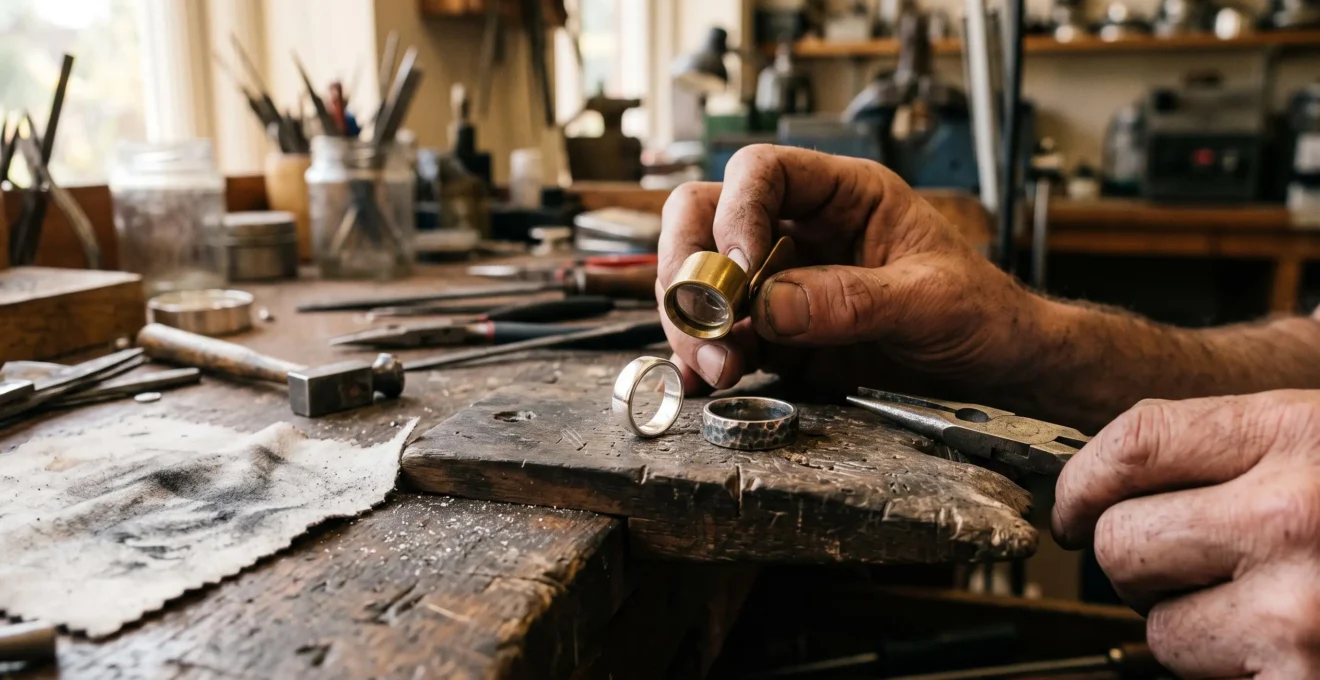
A pendant made from 99.9% pure silver sounds inherently superior to one made from 92.5% sterling silver. It contains more precious metal, has fewer alloying ingredients and offers the appeal of near-pure silver. Yet that extra purity can become a disadvantage when a design must withstand daily knocks, repeated bending or pressure on gemstone settings.
Fine silver is often an excellent choice for pendants, decorative elements and carefully handled pieces. Sterling silver generally offers a more forgiving balance of strength, fabrication options and repairability for frequently worn rings, bracelets and mechanically demanding designs.
The distinction becomes more interesting when tarnishing, skin sensitivity and newer alloy technologies enter the picture. A higher silver percentage does not automatically mean better corrosion resistance in every setting, fewer skin reactions or a longer-lasting piece.
For a custom pendant, the most useful question is therefore not simply how pure the silver is. It is whether its composition, construction and expected wear match the intended design.
Fine silver versus sterling: the essential decisions
- Choose 999 for suitable low-stress designs: pendants, decorative components and carefully protected pieces can benefit from high purity.
- Prefer 925 for structural demands: rings, hinges, substantial chains and thin gemstone settings often benefit from a stronger alloy and appropriate hardening.
- Evaluate more than purity: tarnish resistance, allergies, construction quality and repair options depend on the complete material and design.
- Why Pure Silver Can Tarnish Faster Than Sterling Alloys (and When the Reverse Is True)
- Fine Silver vs Sterling Silver: Matching Purity to Rings, Pendants, and Earrings
- How Jewellers Decide on Optimal Silver Purity for Structural Requirements
- The Everyday Handling Mistakes That Damage Pure Silver Pieces Within Weeks
- When Choosing 99.9% Purity Is Worth the Extra Maintenance
- How Germanium and Other Additions Create Tarnish-Resistant Hypoallergenic Alloys
- 925 vs 958 vs 999 Silver: Which Purity Grade Suits Which Jewelry Type?
- How Alloy Composition Determines Whether Silver Jewelry Lasts 5 Years or 50
Why Pure Silver Can Tarnish Faster Than Sterling Alloys (and When the Reverse Is True)
Pure silver can develop visible tarnish when exposed to sulfur-containing gases, humidity and environmental pollutants. However, conventional copper-containing sterling silver generally tarnishes faster than pure silver under comparable conditions because copper contributes additional reactive material. Differences in jewellery finishes, exposure and maintenance can reverse their apparent appearance without establishing that pure silver is intrinsically more reactive.
Silver tarnishing is a surface chemical reaction rather than ordinary dirt accumulation. Atmospheric sulfur compounds react with silver to form silver sulfide, Ag2S, producing a film that changes the metal’s colour.
In sterling silver, the usual silver content of sterling silver 92.5% and copper content of sterling silver 7.5% composition introduces another reaction pathway. Copper can participate in tarnishing reactions, contributing copper sulfide and altering the appearance of the resulting surface layer.
The Canadian Conservation Institute‘s explanation of silver tarnishing specifically describes sterling silver tarnishing faster than pure silver in its comparative demonstration.
92.5% silver + 7.5% copper
The conventional sterling silver composition. Its copper content contributes to alloy behaviour and can increase susceptibility to tarnishing compared with pure silver.
Canadian Conservation Institute, Government of Canada.
Environmental conditions still matter considerably. Higher relative humidity increases tarnishing at a given hydrogen sulfide concentration. Polluted air and sulfur-emitting materials can also influence exposure. A coastal environment may combine several potentially relevant factors, but proximity to the sea alone cannot predict which particular piece will discolour fastest.
Colour is not a reliable shortcut for identifying alloy performance. Early silver tarnish may appear yellow before progressing through other colours towards black as the film develops. A yellow pendant and a darker sterling tag may simply have different film thicknesses or exposure histories.
A practical, informal comparison involves observing two similarly finished pieces under comparable conditions for two weeks. Photograph both at the beginning and end, keep cleaning consistent and note visible changes. Such an observation can reveal differences between those specific objects, but it cannot establish a universal tarnishing rate or identify skin chemistry as the cause.
Tarnish resistance is therefore one consideration, not the deciding factor. The structural demands of the design often matter more than subtle differences in surface colour.
Fine Silver vs Sterling Silver: Matching Purity to Rings, Pendants, and Earrings
Fine silver generally suits jewellery exposed to limited mechanical stress, particularly substantial pendants, decorative charms and selected earring components. Sterling silver is typically more suitable for everyday rings, rigid bracelets, clasps and thin gemstone settings because alloying improves resistance to deformation. Actual performance still depends on geometry, fabrication and whether the metal has been hardened or annealed.
The difference starts with how pure silver behaves under force. Its relative softness makes it highly workable, but it also allows delicate elements to bend or acquire dents more readily than stronger silver alloys of comparable design.
Consider two custom pieces: a thick pendant with a broad decorative surface and a thin ring supporting a raised gemstone. The pendant mainly supports its own weight. The ring experiences repeated pressure from gripping objects, accidental knocks and ordinary hand movements.
For the pendant, fine silver may provide excellent functional performance. For the ring, a comparable fine-silver setting may deform more easily, particularly if the band or prongs are thin.
| Jewellery type | 999 fine silver | 925 sterling silver |
|---|---|---|
| Pendant | Suitable for well-supported designs | Suitable, especially for delicate connecting components |
| Everyday ring | Greater deformation risk in thin designs | Generally more practical |
| Stud earrings | Possible for decorative components | Often preferable for posts and secure fittings |
| Bangle | Requires careful design and protection | Generally better for frequent handling |
| Gemstone setting | Useful for suitably designed bezels | Often preferable for thin prongs and supporting structures |
| Decorative charm | Suitable if adequately thick | More resistant to repeated knocks |
Geometry can outweigh the nominal purity difference. A generously proportioned 999 pendant may be more robust than a poorly constructed, exceptionally thin sterling pendant. Conversely, a fragile fine-silver bail can compromise an otherwise substantial piece.
Skin tolerance adds another consideration. A person reacting to an alloying ingredient may tolerate a higher-purity composition better. However, green skin discolouration from copper compounds is not itself proof of an allergy, and nickel-free sterling is not automatically unsuitable for sensitive skin.
For earrings, the composition of posts and backs may matter more to skin contact than the decorative silver element. Buyers with confirmed metal allergies should identify all contact materials and seek appropriate medical advice where needed.
A mixed-material construction can sometimes provide a better outcome than insisting on one purity throughout the entire piece.
How Jewellers Decide on Optimal Silver Purity for Structural Requirements
Jewellers choose silver purity by evaluating the forces acting on each component, the manufacturing process, the required flexibility and anticipated repairs. High-purity silver may be appropriate for decorative surfaces or bezels, while stronger alloys support load-bearing structures. Professional selection also considers work-hardening, annealing and component geometry rather than treating purity as a universal measure of quality.
The first engineering question concerns load. A pendant plate, a chain link, a clasp spring and a ring shank perform very different jobs, even when they belong to the same jewellery design.
A pendant plate needs to retain its appearance and resist occasional contact. A chain link must tolerate repeated movement and pulling. A clasp needs reliable mechanical engagement, while a gemstone setting must retain its stone despite normal movement and impacts.
These different functions explain why the ideal alloy may change from one component to another.
- Cast components: assess alloy-specific casting behaviour, section thickness, porosity and finishing requirements.
- Forged or formed parts: consider how working the metal affects hardness, shape retention and internal stress.
- Wire structures: evaluate wire thickness, bending cycles and the condition of the metal after fabrication.
- Stone settings: balance the ability to shape metal securely around a stone with resistance to subsequent deformation.
Two workshop processes are particularly important. Work-hardening occurs when plastic deformation increases resistance to further deformation. Annealing involves controlled heating that changes the metal’s worked condition, restoring workability when appropriately performed.
A jeweller can therefore alter a component’s mechanical behaviour without changing its silver percentage. Nevertheless, hardening does not make fine silver equivalent to every harder sterling alloy, and subsequent heating may reduce previously developed hardness.
Hybrid construction offers another option. A fine-silver bezel can surround a stone while a sterling-silver body provides stronger structural support. Decorative granulation or fine-silver surface elements can similarly be combined with an alloyed foundation when the joining technique and design permit.
Such construction requires appropriate compatibility between components, joining materials and finishing operations. A fine-silver contact surface also cannot guarantee that the entire piece is suitable for someone with a metal allergy.
For a commissioned pendant, ask the maker to identify its body alloy, bail composition, chain specification and any particularly delicate attachment points. These details reveal more about practical longevity than a simple purity label.
Even a carefully engineered piece can suffer avoidable damage when daily handling fails to account for the metal’s condition and construction.
The Everyday Handling Mistakes That Damage Pure Silver Pieces Within Weeks
Fine-silver jewellery can develop scratches, dents or deformation relatively quickly when stored against harder objects, subjected to repeated pressure or cleaned aggressively. Damage within weeks is possible under unfavourable conditions, although there is no universal failure timeline. Separate padded storage, removal during high-contact activities and material-appropriate cleaning reduce these avoidable risks.
Loose storage is particularly easy to underestimate. A fine-silver chain placed against a rigid bangle or a heavily textured metal pendant can experience repeated contact whenever the jewellery box moves.
The result may be fine scratches, compressed details or damage to delicate connecting elements. This is mechanical wear, distinct from the chemical tarnish that produces surface discolouration.
The GIA‘s recommendations for jewellery care and storage advise using individual pouches or padded compartments rather than leaving pieces loose together. The guidance also addresses chemical exposure, gemstone precautions and periodic professional inspection.
Repeated bending is another risk. Sleeping while wearing delicate chains, gripping heavy equipment with rings on or allowing a pendant to catch beneath a bag strap may expose jewellery to unnecessary mechanical loads.
Not every such incident causes damage, but repeated deformation can compromise thin sections and connecting components. Removing jewellery before exercise, heavy manual work or activities involving snagging is a reasonable preventive measure.
Cleaning requires similar restraint. Abrasive polishing removes surface material and can soften fine details over repeated treatments. Chemical dips may be unsuitable for gemstones, patinated finishes, coatings or particular constructions. It would be inaccurate to assume that every dip removes 999 silver faster than sterling without considering its chemistry and application.
For simple, uncoated silver pieces without sensitive stones, gentle cleaning with an appropriate soft cloth is generally preferable to unnecessary abrasive polishing. For complex jewellery, follow the maker’s instructions.
When careful handling fits the owner’s habits, choosing a higher-purity material becomes a more reasonable proposition.
When Choosing 99.9% Purity Is Worth the Extra Maintenance
Choosing 99.9% silver makes sense when high precious-metal content, reduced exposure to alloying ingredients or a specific artistic technique matters more than maximum deformation resistance. It is particularly attractive for low-contact pendants, decorative jewellery and occasional wear. Buyers should accept gentler handling and verify construction, metal composition and available repair services before purchasing.
A custom pendant offers a good example. Its decorative front may benefit from fine silver’s workability and high purity, while careful sizing and a suitable bail can address the main mechanical concerns.
Purity may also matter to someone trying to avoid a particular alloying metal. Fine silver contains fewer intentionally added ingredients than conventional sterling, but the precise composition of solder, findings, coatings and chains remains relevant. Higher purity is not a medical guarantee of hypoallergenicity.
For buyers interested in silver content as part of the item’s identity, a clearly documented fineness can provide additional reassurance. This does not mean a 999 pendant automatically achieves a higher resale price than a well-designed sterling piece. Craftsmanship, condition, market demand and the actual precious-metal weight all influence commercial value.
Maintenance expectations should be explicit. Fine-silver pieces may need individual storage, care during physical activities and attention to thin decorative features. They can still tarnish, and that tarnish should not be mistaken for proof that the metal is impure.
Five checks before commissioning a 999 silver pendant
- Define expected use. Write down whether the pendant will be worn daily, occasionally or during physical activities. Deliverable: a one-sentence wear profile.
- Inspect the design’s weak points. Identify thin sections, openwork, the bail and any gemstone setting. Deliverable: an annotated sketch or product photograph.
- Confirm component materials. Ask which parts are 999, which use other alloys and whether joining materials or coatings are present. Deliverable: a written material specification.
- Agree on a care routine. Confirm storage, cleaning precautions and when the piece should be removed. Deliverable: a short care instruction sheet.
- Check future servicing. Ask whether the maker can repair the bail, replace a fitting or restore the finish. Deliverable: written confirmation of available services and limitations.
The servicing question deserves attention before purchase. A maker accustomed to a particular fine-silver technique may be better equipped to repair the resulting piece than a workshop primarily handling conventional sterling components. Availability varies and should not be presumed.
There is also a third option worth considering: an engineered silver alloy developed to improve selected properties without requiring maximum purity.
How Germanium and Other Additions Create Tarnish-Resistant Hypoallergenic Alloys
Germanium-containing silver alloys can resist tarnishing better than conventional sterling silver by promoting formation of a protective surface oxide under suitable processing conditions. These alloys offer an alternative to choosing between traditional sterling and fine silver. However, tarnish resistance varies with composition and treatment, while allergy tolerance depends on every ingredient in the finished jewellery.
Traditional sterling uses copper as its principal alloying addition. Modified silver alloys introduce other elements to influence manufacturing behaviour, appearance or surface chemistry.
Germanium is particularly interesting because of its role in surface passivation. Under suitable conditions, a germanium-containing alloy can develop an oxide-rich protective surface layer that limits subsequent sulfur-related reactions.
An experimental study of germanium-containing silver alloys published in the Journal of Materials Research and Technology in 2024 investigated silver-copper-zinc-germanium compositions using experimental preparation, passivation treatments and accelerated tarnishing tests.
Materials research: improving resistance to sulfur tarnishing
Researchers studied the behaviour of silver alloys containing copper, zinc and germanium, including the effects of a passivation heat treatment designed to produce a stable surface oxide layer.
The investigation supports the potential of germanium-containing alloy development to improve tarnish resistance. Its findings apply to the studied formulations and processing conditions; they do not establish immunity to tarnish or identical performance across all commercial jewellery products.
Argentium is a commercial example associated with germanium-containing silver alloy technology. Nevertheless, the trade name alone does not tell a buyer everything about the specific item’s silver fineness, fabrication condition or contact materials.
Modified alloys can be attractive for jewellery intended to remain visually bright with less frequent tarnish removal. Yet claims such as « hypoallergenic » and « tarnish-proof » deserve careful scrutiny.
Reduced copper content, where present, may be relevant to a wearer sensitive to a particular constituent. It does not prove that every germanium-containing alloy suits every person with metal allergies. Likewise, improved tarnish performance in laboratory testing does not establish a fixed number of maintenance-free years.
The sensible purchasing approach is to request the complete alloy designation, available ingredient information and appropriate care instructions. For a mechanically demanding item, ask about its hardness and fabrication condition rather than assuming germanium always makes the metal stronger.
Understanding those specialised alloys becomes easier when the conventional purity grades are compared on the same practical criteria.
925 vs 958 vs 999 Silver: Which Purity Grade Suits Which Jewelry Type?
Silver marked 925 contains 92.5% silver and is a practical default for many everyday jewellery designs. The 958 grade contains approximately 95.8% silver and offers an intermediate composition, while 999 contains approximately 99.9% silver and is comparatively soft. None is universally best: construction, alloy ingredients, mechanical condition and intended wear determine suitability.
The numerical grade expresses precious-metal fineness, generally in parts per thousand. It does not specify every remaining ingredient, the metal’s fabrication history or the structural quality of the jewellery.
For example, 958 silver is traditionally associated with Britannia silver in the United Kingdom. Its higher silver content generally means a softer conventional silver-copper alloy than standard sterling in comparable metallurgical conditions. However, describing 958 as inherently brittle would be misleading: softness and ductility are not the same as brittleness.
In practical terms, higher-purity silver may bend more readily without necessarily fracturing more readily. This matters when evaluating rings, raised settings and thin decorative details.
| Criterion | 925 sterling | 958 Britannia | 999 fine silver |
|---|---|---|---|
| Silver content | 92.5% | 95.8% | 99.9% |
| Mechanical behaviour | Generally more resistant to deformation than higher-purity conventional grades | Intermediate, depending on processing | Relatively soft and readily formable |
| Tarnishing | Copper can contribute to faster tarnishing | Depends on remaining alloy ingredients and environment | Can tarnish through silver sulfide formation |
| Skin considerations | Full alloy and findings matter | Full alloy and findings matter | Lower intentional alloy content, but no universal allergy guarantee |
| Typical design suitability | Everyday rings, chains and fittings | Decorative and appropriately engineered jewellery | Pendants, bezels and low-stress decorative features |
| Repair considerations | Confirm standard workshop capabilities | Confirm access to suitable materials and expertise | Confirm experience with fine-silver construction |
Identification deserves separate attention. In the United Kingdom, the Sheffield Assay Office‘s explanation of UK hallmarks identifies traditional symbols associated with 925 and 958 silver, including the lion passant and Britannia mark respectively.
The official UK hallmark framework distinguishes compulsory elements such as the sponsor’s mark, fineness mark and assay office mark from voluntary traditional symbols. Hallmarking rules differ between countries, so UK conventions should not automatically be applied to jewellery sold elsewhere.
More importantly, a fineness mark documents metal content within its applicable marking system. It does not certify scratch resistance, gemstone security or predicted service life.
For a buyer choosing between two pendants, a well-built 925 design may be more practical than a delicate 999 alternative. A substantial 999 pendant may conversely be entirely suitable when its greater purity has personal or artistic value.
The final consideration is how these material decisions influence ageing over the years, both visually and structurally.
Key takeaways before judging silver jewellery longevity
- Visible tarnish is not equivalent to structural failure: a darkened sterling item may remain mechanically sound.
- A higher silver percentage can increase intrinsic metal content without improving resistance to bending or impact.
- Reliable longevity depends on design geometry, processing, protective finishes and access to appropriate repair services.
How Alloy Composition Determines Whether Silver Jewelry Lasts 5 Years or 50
Silver jewellery longevity depends on more than its alloy percentage. Composition influences tarnishing and mechanical behaviour, while forming, hardening, component thickness, finishing and maintenance determine how the piece performs over time. A well-designed sterling item may remain usable for decades; a poorly supported fine-silver component can deform much sooner. Neither a five-year nor a fifty-year lifetime follows automatically from purity.
Three separate forms of ageing deserve attention: changes in surface appearance, changes in structural integrity and deterioration of individual functional components.
Surface ageing includes tarnishing, gradual polishing wear and changes in plating or decorative oxidation. These affect appearance but do not necessarily mean that a ring, pendant or chain has lost its structural function.
Structural ageing involves bending, wear at contact points, weakened joints or deformation of settings. Such changes matter because they can affect safety and usability even when the metal remains bright.
Component ageing concerns clasps, connecting rings, moving hinges and other parts that may require repair or replacement independently of the main jewellery body.
Alloy ingredients can influence these processes. Copper in conventional sterling contributes to tarnishing behaviour and mechanical characteristics. The degree of work-hardening and subsequent thermal treatment further affects how the metal resists deformation.
Finishes introduce additional variables. A plated surface may initially change how an item looks and wears, but the coating itself can degrade. An intentionally oxidised finish may also change under polishing or contact, even while the underlying silver remains serviceable.
For buyers, it is more useful to inspect tangible construction features than to accept a broad durability promise.
- Composition: identify fineness, alloy information and any different materials used in findings.
- Geometry: inspect ring shanks, pendant bails, prongs and connecting links for adequate thickness and support.
- Processing: ask whether the jewellery has been formed, cast, hardened or annealed, where relevant.
- Surface finish: confirm plating, intentional oxidation and any maintenance restrictions.
- Serviceability: establish whether the maker can inspect, repair or replace critical components.
Consider an explicitly hypothetical comparison: one owner keeps a substantial sterling pendant in separate padded storage and arranges repairs when needed. Another wears a thin fine-silver ring during heavy manual activities. The pendant could remain serviceable much longer, despite containing less silver. This illustrates a mechanical possibility, not a measured prediction of either item’s lifespan.
For a commissioned pendant, the strongest purchasing decision combines the desired appearance and purity with a construction that tolerates its expected use. Written material specifications and clear aftercare guidance make that decision easier to evaluate.
Choose the purity only after reviewing the design, wear conditions and repair plan. A well-matched 999 pendant can be an excellent purchase, but the quality of the finished jewellery is determined by how intelligently the metal is used, not by its fineness alone.
Is 999 silver always more valuable than 925 silver?
999 silver contains a greater proportion of silver by weight, but the value of a finished jewellery item also depends on total weight, craftsmanship, design, condition and demand. Higher purity alone does not establish a higher resale price or a better purchase.
Can a sterling silver chain be used with a fine silver pendant?
Yes. Combining a 999 pendant with a suitably designed 925 chain can be practical. The chain, clasp and pendant bail should all be proportioned for the pendant’s weight and expected movement. Buyers with a confirmed sensitivity to a particular alloy ingredient should also consider the materials that contact their skin.
Does tarnish mean that silver jewellery is losing its purity?
No. Tarnish is a surface reaction involving compounds such as silver sulfide. It does not mean that the underlying jewellery has changed from 999 to 925 silver. However, repeated abrasive tarnish removal can gradually remove material from the surface.
Can a jeweller repair a bent 999 silver pendant?
Some fine-silver deformation can be corrected by a suitably experienced jeweller, but repairability depends on the thickness, construction, previous work and any gemstones or finishes. Attempting to straighten delicate components at home may create additional damage. Request an assessment from the maker or a qualified repair specialist.
Is fine silver better for sensitive skin?
Fine silver contains fewer intentionally added alloying elements than conventional sterling, which may help someone who needs to avoid a specific ingredient. Nevertheless, allergic reactions depend on individual sensitivities and all materials present, including solder, chains, clasps and coatings. A higher purity mark is not a substitute for identifying the relevant allergen.