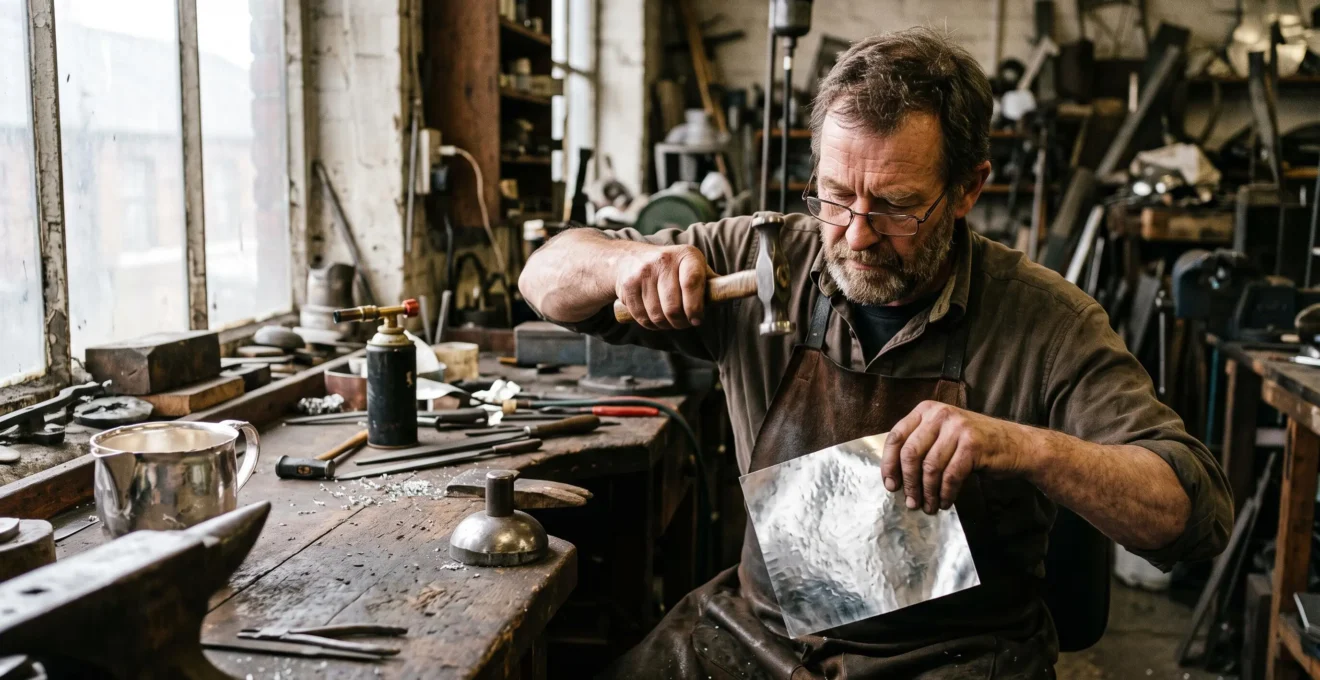
A silver cuff can look beautifully hammered yet have been cast in a mould. Another may appear perfectly smooth despite having been shaped through hours of hand forging. The difference matters when a seller asks a substantial premium for traditional craftsmanship.
Recognising valuable hand-forged silver requires more than examining its surface. The metal’s working history, construction, hallmarking, maker attribution and quality of finish must tell a consistent story. A distinctive hammer texture is useful evidence, but it is neither proof of hand fabrication nor a guarantee of future resale value.
For collectors, the strongest purchases combine verifiable material authenticity with demonstrable technical skill and an identifiable maker. Understanding how silver responds to hammering, heating, casting and surface decoration makes it possible to distinguish meaningful craftsmanship from attractive marketing—and to decide when a higher price genuinely makes sense.
Hand-Forged Silver: The Essential Buying Principles
- Authentic hand-forged silver is best assessed through consistent construction details, tool marks and maker documentation—not hammer texture alone.
- Forging can strengthen silver through work hardening, but alloy, annealing and final construction determine practical durability.
- A hallmark verifies precious-metal fineness under the applicable system; it does not independently prove handmade origin, authorship or investment value.
- Why Hand-Forged Silver Pieces Cost 5× More Than Cast Alternatives
- How Master Smiths Transform Molten Silver Into Wearable Sculptures
- Hand-Hammered vs Cast Silver: Which Telltale Signs Reveal the Difference?
- The Authentication Blunder That Costs Silver Collectors Over £2,000
- When Should You Commission Custom Silver Work Instead of Buying Ready-Made?
- How to Build a 5-Piece Silver Capsule Covering 20+ Outfit Combinations
- How Repoussé Techniques Create 3D Relief From Flat Silver Sheets
- How Different Metalworking Techniques Determine Silver Jewelry Value
Why Hand-Forged Silver Pieces Cost 5× More Than Cast Alternatives
Hand-forged silver can cost several times more than comparable cast jewellery because its price reflects individual workshop labour, specialist forming skills and limited production capacity. A fivefold difference is possible in a particular comparison, but it is not an established industry-wide multiplier. The additional expense is justified only when craftsmanship, design and documentation support it.
In casting, molten silver fills a prepared mould. Once a repeatable production process exists, multiple similar pieces can be manufactured with relatively little individual forming work. Hand forging typically requires a craftsperson to reshape metal progressively, correcting thickness, curvature and surface tension throughout fabrication.
The cost difference involves several components:
- Workshop hours: repeated forming, annealing, fitting and finishing require direct attention.
- Technical expertise: accurately controlling hammer force and deformation takes considerable practice.
- Tools and preparation: stakes, hammers, forming blocks and specialised fixtures must suit the intended shape.
- Material management: trimming, filing and unsuccessful components can increase material requirements, although many silver offcuts remain recyclable.
- Production volume: one-off pieces cannot spread design and setup costs across large manufacturing runs.
Consider a hypothetical comparison between a £180 cast cuff and a £900 individually forged cuff. The latter costs five times as much, but that figure alone reveals nothing about whether the premium is reasonable. A buyer needs to establish how much additional work occurred, whether the design is distinctive and whether the maker’s reputation has demonstrable market relevance.
Forging also changes the metal’s physical condition. Cold working introduces deformation that can increase hardness, improving shape retention in appropriately designed components. However, hammering does not automatically make a finished piece denser, stronger in every respect or less porous than every casting.
A properly cast and finished sterling silver ring may provide excellent everyday service. Conversely, a forged piece weakened by excessive working or inadequate annealing can develop cracks.
For acquisition decisions, compare the finished quality, thickness, construction, documentation and asking price rather than treating manufacturing technique as a ranking by itself.
Hand forging becomes particularly compelling when exceptional shaping, artistic individuality and traceable authorship matter more than obtaining the lowest price for a similar appearance. Understanding the fabrication process makes those differences easier to recognise.
How Master Smiths Transform Molten Silver Into Wearable Sculptures
A silversmith turns silver into sculptural jewellery by controlling its shape through successive stages of melting or material preparation, forming, annealing, cold working and finishing. Each operation changes the metal’s condition. The distinctive skill lies in knowing when to deform it, when to restore its workability and how to preserve the intended final geometry.
A piece does not necessarily begin with molten metal inside the artisan’s workshop. Many smiths buy commercially prepared sterling silver sheet, rod or wire. Others melt suitable silver stock and cast a starting ingot before rolling or forging it into usable material.
For a hand-raised pendant or sculptural cuff, a typical sequence may involve:
- Material preparation: selecting the required alloy and producing or acquiring suitable stock.
- Initial forming: rolling, cutting, bending or hammering the metal towards the intended profile.
- Annealing: heating the worked silver under appropriate controlled conditions to restore ductility.
- Progressive forging: refining curvature, section thickness and structural transitions through repeated tool work.
- Assembly and finishing: completing joints where needed, refining edges, applying surface texture and preparing the final finish.
The Victoria and Albert Museum‘s guide to metalworking techniques distinguishes raising, casting, stamping, repoussé and other processes by how metal is shaped. These distinctions are especially useful when evaluating claims that an object was made entirely by hand.
One critical workshop principle is the relationship between work hardening and annealing. Hammering and bending can make silver progressively harder to deform. Continued work without suitable heat treatment may eventually produce cracking, particularly around heavily stretched sections.
Annealing restores workability, allowing further shaping. A skilled maker judges the appropriate sequence according to the alloy, component thickness and desired final condition. An exceptionally polished object can conceal the visible evidence of these operations.
Two cuffs with the same outer silhouette may therefore have different internal constructions. One might have been raised and formed from sheet, while another was cast and subsequently polished. Weight, cross-sectional transitions, joints and subtle tooling can help establish which explanation is plausible.
During fabrication, a maker may also apply a personal identification stamp. In the United Kingdom, the registered sponsor’s mark used for hallmarking is a separate concept and does not necessarily identify the person who physically made the item.
Workshop records, preparatory sketches and photographs of intermediate stages can therefore be valuable supporting evidence, especially for commissioned work.
The final object is only the visible result of that sequence. Buyers must then examine whether its surviving physical clues support the claimed method of manufacture.
Hand-Hammered vs Cast Silver: Which Telltale Signs Reveal the Difference?
Hand-hammered silver often displays variations in tool impressions, carefully controlled thickness transitions and evidence of progressive forming. Cast silver may reveal mould seams, casting texture or small surface pores. None of these signs provides certainty alone: cast surfaces can imitate hammering, while genuinely forged silver can be polished until its tool marks disappear.
Begin with the whole object rather than concentrating exclusively on its decorative face. Examine the underside, internal surfaces, edges and the points where different components meet.
A manually raised cuff may show subtle relationships between hammer placement and changes in curvature. A cast piece may reproduce an apparently identical texture across several examples, particularly when all originate from the same model.
Useful preliminary observations include:
- Surface variation: check whether impressions change naturally with the object’s geometry or repeat in an unusually consistent pattern.
- Edges and transitions: inspect whether thickness and curvature reflect progressive shaping or a moulded form.
- Unfinished recesses: look for possible mould-parting traces, granular casting texture or finishing marks.
- Construction: identify soldered elements, formed sheet sections and separately attached decorative components.
- Weight: compare actual mass with documented dimensions and construction, without assuming that a heavier or lighter result proves a particular technique.
A pocket scale can help establish whether an object matches the seller’s description. It cannot reliably diagnose casting porosity from weight alone because differences in wall thickness, alloy and hollow construction may explain the measurement.
A 10× jeweller’s loupe provides a closer view of tool impressions, tiny pits, scratches and possible parting lines. Rotate the object under directional light rather than judging a single reflection.
Small irregularities may support a hand-worked explanation, but they are not conclusive. A cast object can reproduce the texture of an originally hand-hammered master. Mechanical planishing can also produce surface marks resembling manual work.
For this reason, authentication should use cross-consistency: does the surface agree with the construction, manufacturing claim and documentary history?
The distinction becomes particularly important when the asking price reflects a named artisan’s labour rather than the silver content alone. For an expensive or disputed piece, seek an independent jewellery specialist or qualified metalwork appraiser. A UK assay office can provide relevant metal testing and hallmarking services, but hallmarking itself does not certify the manufacturing technique.
Once the manufacturing claim appears plausible, attention should shift to the more financially consequential issue: whether the object, its hallmark and its claimed identity genuinely belong together.
The Authentication Blunder That Costs Silver Collectors Over £2,000
The most costly authentication mistake is accepting a hallmark as proof of an object’s maker, age and artistic authenticity. A genuine hallmark principally establishes precious-metal fineness under the applicable hallmarking system. It does not guarantee hand forging or provenance. On a high-value purchase, confusing these claims can expose a collector to losses exceeding £2,000.
That amount illustrates a possible individual loss, not a documented average for silver collectors. Consider a hypothetical £3,000 acquisition attributed to a sought-after maker. If subsequent investigation shows that the attribution is unsupported and the object is worth substantially less, the financial difference could easily exceed £2,000.
The underlying failure is to treat several separate questions as though they had a single answer:
- Is the object made from the stated silver alloy?
- Does its hallmark correspond to a legitimate assay system?
- Is the piece consistent with its claimed period and manufacturing process?
- Can the seller support the attribution to a particular craftsperson?
- Does the available market evidence support the asking price?
Under the UK system, the UK government’s practical hallmarking guidance identifies three compulsory components of a standard hallmark: a registered sponsor’s mark, a metal fineness mark and an assay office mark. The date letter is optional.
The four UK assay offices are Birmingham, Edinburgh, London and Sheffield. The sponsor’s mark identifies the registered individual or organisation responsible for submitting the article, not necessarily the artisan who fabricated it.
For qualifying UK silver articles, the exemption threshold is 7.78 grams. This is a UK-specific provision rather than a global rule. A piece below the relevant threshold may legitimately lack a hallmark, so absence of one is not automatically evidence of counterfeiting.
7.78 g
UK silver hallmarking exemption threshold, subject to the applicable legal conditions. This threshold does not establish the object’s craftsmanship, age or value.
British Hallmarking Council guidance published through GOV.UK.
Historical attribution requires further caution. Marks may have been copied, misread, altered or associated with components from different periods. Even a legitimate date letter records a hallmarking date rather than necessarily proving when every part of an object was made.
Before transferring funds, inspect clear photographs of the full hallmark, construction, underside and any maker signatures. Compare the identification against relevant official reference material and seek specialist advice if the sequence appears inconsistent.
Five Checks to Complete Before Buying Valuable Silver
- Request photographs of the complete object and all visible marks; save a dated image record.
- Check the metal fineness, sponsor’s mark and relevant assay office details; write down each identification and any uncertainty.
- Compare the declared dimensions and weight with the supplied photographs or an inspection; produce a short measurement record.
- Request evidence supporting the maker attribution, manufacturing process and ownership history; retain copies of the documents.
- Obtain an itemised invoice specifying the description, claims, price and applicable return terms; confirm unresolved questions before payment.
Online purchases create additional uncertainty because lighting, image editing and selective photography can conceal important details. Auction terms and return rights also differ from ordinary retail arrangements; applicable consumer protections depend on the jurisdiction, seller and transaction.
Reliable documentation reduces avoidable uncertainty, though it cannot eliminate it. This is one reason commissioning directly from a reputable silversmith can appeal to collectors seeking a more complete creation record.
When Should You Commission Custom Silver Work Instead of Buying Ready-Made?
Commission custom silver jewellery when fit, symbolism, unusual design requirements or verifiable maker involvement matter more than immediate availability. Ready-made work is generally more practical when an existing piece already meets the brief. A commission is worth considering if direct contact with the craftsperson and documentation of the making process add meaningful personal or collecting value.
Custom work is particularly useful for jewellery that must accommodate unusual proportions. A wide silver cuff, for example, may need a carefully balanced profile rather than simply a larger circumference.
Other compelling situations include transforming inherited silver into a contemporary design, creating a matching piece for an existing collection or commissioning relief decoration unavailable in commercially produced jewellery.
However, using inherited material introduces questions about alloy identification, contamination, sentimental value and whether the original metal is suitable for the intended fabrication process. A responsible maker should explain what can be reused and what may require substitution.
A professional commission usually develops through an agreed design brief, sketches or models, a quotation, fabrication and final inspection. The process may require revisions before production begins.
Lead times depend on the maker’s workload, technical complexity and any external hallmarking arrangements. A very short deadline is not automatically suspicious, but it deserves clarification when the proposed design involves extensive hand forming or intricate relief work.
Before paying a deposit, establish the following in writing:
- The approved design, measurements and intended surface finish.
- The silver alloy, including whether the piece will use sterling silver (925) or fine silver (999).
- Which manufacturing operations will be performed manually and whether any components will be cast or commercially sourced.
- The proposed hallmarking arrangements and any applicable exemptions.
- The agreed price, payment stages, design revision terms and estimated completion period.
- How disagreements, defects, cancellations and alterations will be handled.
These are prudent contractual arrangements, not universal legal obligations. Consumer rights and hallmarking requirements vary across English-speaking markets.
Custom fabrication also offers an opportunity to request dated workshop photographs, a signed description and documentation of the metal’s origin. Such records may support later attribution, particularly if the maker becomes recognised among collectors.
They do not guarantee financial appreciation. The resale market may place less value on a highly personalised design than the original purchaser does.
For jewellery intended to be worn regularly, however, a successful commission can combine excellent fit with a documented artistic identity. That principle becomes useful when building a small collection designed to work together.
How to Build a 5-Piece Silver Capsule Covering 20+ Outfit Combinations
A five-piece silver capsule can support more than 20 jewellery combinations by selecting complementary pieces that work independently, in pairs and in layered groups. The aim is not simply to accumulate accessories. Each item should contribute a distinct silhouette, scale or function while remaining compatible with the collection’s dominant finish and visual character.
A practical foundation includes five jewellery categories:
| Piece | Collection role | Craftsmanship to prioritise |
|---|---|---|
| Statement cuff or bracelet | Primary sculptural feature | Controlled forming, comfortable edges and balanced thickness |
| Everyday earrings | Discreet daily accessory | Reliable components, appropriate hardness and secure construction |
| Silver necklace | Flexible focal point | Quality joining, dependable clasp and well-finished details |
| Hand-forged ring | Small sculptural accent | Consistent profile, comfortable interior and suitable sizing |
| Decorative brooch | Adaptable clothing accent | Secure fastening and stable decorative construction |
A shared finish creates cohesion. Mirror-polished silver offers a more reflective appearance, while satin hammering or carefully controlled oxidation can produce quieter, more textural combinations.
Consistency need not mean identical surfaces. A pronounced hammered cuff may work effectively with understated polished earrings if the relative proportions remain balanced.
The number of possible combinations can be calculated rather than guessed. Five distinct pieces produce 10 unique pairs, 10 three-piece groups, five four-piece groups and one five-piece group. Including the five individual options gives 31 non-empty combinations.
This is a mathematical count of possible selections, not a guarantee of 31 aesthetically successful outfits. Physical compatibility, appropriateness for the occasion and personal styling preferences will reduce the practical total.
To test whether a collection genuinely provides 20 useful arrangements, photograph each piece individually and trial combinations with everyday, professional and evening clothing. Record the arrangements that feel comfortable and visually coherent.
From a collecting perspective, favour recognisable craftsmanship and timeless proportions over fleeting surface fashions. An identifiable maker and documented manufacturing method can provide useful historical context even when the jewellery is purchased principally for personal wear.
There is also value in avoiding redundancy. Two almost identical bracelets may offer less versatility than a bracelet and a brooch, despite requiring similar expenditure.
A carefully chosen capsule demonstrates how collecting and wearing can reinforce each other. More elaborate techniques, including hand-worked relief, can then be introduced selectively rather than purchased for complexity alone.
How Repoussé Techniques Create 3D Relief From Flat Silver Sheets
Repoussé creates raised decoration by working a metal sheet from its reverse, using shaped punches to displace the material into relief. The front may then be refined through chasing. Unlike engraving, which cuts material away, these techniques primarily reshape the existing metal. Their value lies in the quality, complexity and control of the finished form.
Traditional repoussé work commonly begins by securing a metal sheet in a supportive material such as pitch. This backing allows the sheet to deform while offering resistance against the punch.
The artisan develops the relief progressively, changing tools and working positions according to the desired depth and detail. Once the main form is established, the metal may be turned over and refined from the front through chasing.
Chasing tools sharpen contours, articulate textures and define transitions. Their purpose is different from engraving tools, which remove small amounts of metal to create incised lines.
The principal technical challenge is controlling material displacement. Excessive stretching or thinning can weaken a raised section, particularly near steep contours. The maker must anticipate how the metal will move and whether further annealing is necessary.
Hand-worked relief may exhibit subtle tool transitions and organic variation. However, apparently individual decoration can also be produced through pressing, die stamping or other repeatable processes.
A raised design is therefore not conclusive proof of traditional manual repoussé. Check the reverse, borders and consistency of repeated details, and ask the seller whether the relief was punched individually or formed mechanically.
Repoussé has a long history in European decorative metalwork. The Victoria and Albert Museum documents a Venetian silver bowl dated 1500–1520 as an example of historical embossing. Such objects demonstrate the technique’s established artistic heritage without proving that a contemporary piece has any particular age or provenance.
Care requirements also deserve consideration. Deep recesses collect dirt and cleaning residues more readily than simple polished surfaces.
Gentle cleaning with appropriate silver-care materials is preferable to aggressive abrasion. Avoid trapping polishing compounds inside relief details, particularly where oxidised finishes or delicate adjoining components are present.
The technique can add considerable artistic interest, but its contribution to value depends on execution and attribution. A convincing assessment must consider how repoussé compares with other methods and how different techniques interact within one object.
What Matters Before Valuing a Silver Piece
- Separate the silver’s material identity from the claimed manufacturing technique and maker attribution.
- Assess whether specialised methods genuinely improve the object’s design and workmanship rather than merely increasing decorative complexity.
- Match the evidence and price to the intended purpose: frequent wear, artistic collecting or long-term family ownership.
How Different Metalworking Techniques Determine Silver Jewelry Value
Silver jewellery value depends on how successfully its manufacturing techniques contribute to design, structural quality, artistic individuality and verifiable authorship. Hand forging, casting, filigree, engraving, repoussé and enamelling involve different skills, but none automatically guarantees a premium. A worthwhile acquisition must justify its price through workmanship, documentation and suitability for the buyer’s purpose.
Understanding the principal techniques provides a more reliable basis for comparison than generic descriptions such as artisan-made, handcrafted or luxury silver.
| Technique | Skill and labour considerations | Durability considerations |
|---|---|---|
| Hand forging | Requires controlled deformation, tool selection and forming skill; labour varies with complexity | Cold working can increase hardness, but excessive deformation may cause cracks |
| Casting | Requires model preparation, mould control, casting and finishing; especially suited to repeatable or complex forms | Sound casting and suitable design can provide durable jewellery; defects or porosity may compromise quality |
| Filigree | Requires accurate arrangement and joining of fine metal elements | Fine wires and joints can be vulnerable to snagging or impact |
| Engraving | Demands precise cutting and design control when performed manually | Deep cuts may affect thin sections; surface decoration can wear over time |
| Repoussé and chasing | Require controlled relief forming and detailed punch work | Raised areas need sufficient thickness and suitable protection |
| Enamelling | Requires preparation, temperature control and careful application of glass-based decoration | Glass enamel may chip or crack under impact |
The techniques also combine. A forged pendant might incorporate individually worked repoussé, engraved details and carefully fitted decorative elements. Such a piece can involve greater labour than a simpler object, but additional steps only justify a premium when they are executed competently.
For instance, uneven soldering, sharp unfinished edges or structurally vulnerable relief can undermine an otherwise intricate design. Conversely, a relatively restrained cast ring may display excellent proportions, precise finishing and thoughtful engineering.
The Ganoksin explanation of silver work hardening and annealing illustrates why the final condition of the metal depends on its processing history. Hardness alone does not establish that a piece was hand-forged or that its overall construction is superior.
When reading a sales description, distinguish statements that can be verified from language that merely suggests craftsmanship.
- Material claim: Is the silver content stated clearly, and what supports it?
- Process claim: Which operations were performed manually, and which used machinery or pre-made components?
- Attribution claim: Can the named maker be linked to the specific object?
- Condition claim: Are repairs, alterations, worn details and structural weaknesses disclosed?
- Value claim: Does the seller distinguish material worth, artistic merit and potential resale price?
Marketing expressions such as hand-finished or artisan-inspired should not be treated as interchangeable with fully hand-forged. Hand finishing may be genuine and skilful, but it does not explain how the main form was produced.
For significant purchases, request an itemised description identifying techniques and materials, together with relevant workshop documentation. Compare examples from the same maker where available and consider independent valuation when the asking price depends heavily on attribution or rarity.
The final judgement should reflect the purpose of ownership. For frequent wear, comfort, sound construction and maintainability may take precedence. For collecting, artistic distinction, documented provenance and maker recognition may carry more weight. For family transmission, a combination of durability, personal meaning and reliable records may be most important.
Choose the piece whose silver content, workmanship and identity can be explained and substantiated—and whose price remains sensible for the intended use. Preserve photographs, invoices and maker records after purchase. Treat any expectation of financial appreciation as uncertain rather than an automatic consequence of hand fabrication.
Can sterling silver be genuinely handmade without a hallmark?
Yes. Hallmarking requirements differ between jurisdictions, and exemptions may apply. In the United Kingdom, the relevant silver weight exemption is 7.78 grams, subject to the applicable rules. An absent hallmark does not automatically establish that an item is counterfeit or machine-made. Material testing and credible maker documentation may help assess an unmarked piece.
Does a 925 stamp prove that silver jewellery was hand-forged?
No. The number 925 indicates a claimed silver fineness of 925 parts per thousand, commonly associated with sterling silver. A standalone 925 stamp does not prove independent assay verification, handmade manufacture or authorship. The buyer should distinguish a simple fineness stamp from a recognised hallmark and obtain separate evidence of craftsmanship.
Can a professional polish remove evidence of hand forging?
Yes. Grinding, filing and polishing can reduce or eliminate visible hammer marks. A smoothly finished piece may still have been forged by hand. Its construction, thickness transitions, assembly details and maker records may be more informative than the appearance of the polished surface.
Is fine silver or sterling silver better for everyday jewellery?
Neither is universally better. Fine silver contains a higher proportion of silver and is generally softer than common sterling alloys in comparable conditions. Sterling silver is frequently preferred for components requiring greater resistance to deformation. The appropriate choice depends on the design, working history and intended use rather than purity alone.
Will collectible hand-forged silver jewellery increase in value?
Appreciation is possible but cannot be assumed. Resale value depends on maker recognition, artistic quality, condition, documentation, collector demand and prevailing market conditions. Original workshop records and credible provenance may strengthen an attribution, but they do not guarantee a buyer or a profitable resale. Collectors should distinguish personal and artistic value from expected financial returns.