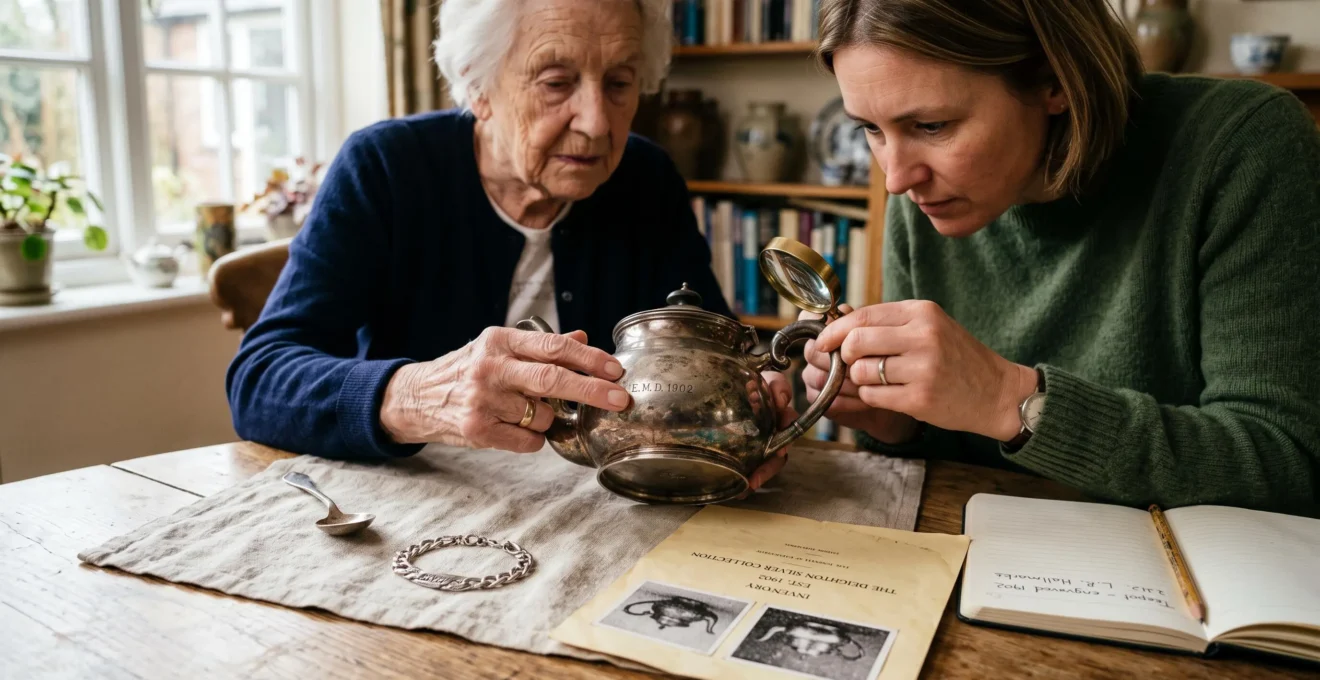
A silver bracelet passed down by a grandmother may have little significance to a stranger but represent decades of family history to its inheritor. Without a record of who wore it, when it was acquired, or why it mattered, much of that significance can disappear within a generation.
Transforming family silver into transmitted heritage means preserving more than the object. It requires documenting its history, understanding its craftsmanship, protecting its physical condition, and giving future generations a meaningful reason to keep it. The process also involves making thoughtful decisions about ownership, use, and inheritance.
Whether a collection contains engraved jewelry, silver tableware, commemorative gifts, or antique decorative objects, the most useful starting point is a reliable record connecting each piece to the people and events behind it. That record can guide conservation, support identification, clarify inheritance intentions, and preserve memories that might otherwise be lost.
Preserving family silver as a living inheritance
- Document each piece with photographs, identifying marks, family testimony, and supporting records before memories disappear.
- Balance monetary value, sentimental attachment, conservation needs, and applicable inheritance rules when deciding who receives or uses an heirloom.
- Teach the next generation what the silver represents, using careful handling and shared stories to maintain a connection with its history.
- Why Documented Provenance May Increase Heirloom Silver Value
- How to Research and Document Family Silver History Before Stories Are Lost
- Equal Division vs Meaning-Based Distribution: How to Divide Heirloom Silver
- The Documentation Gap That Creates Family Conflict Over Silver Inheritance
- When to Wear Fragile Heirloom Silver Versus Preserving It Unworn
- How to Photograph and Research Silver Hallmarks Using Online Databases
- Why Millgrain Beading Instantly Identifies Edwardian and Art Deco Jewelry
- How Millgrain Beading Reveals Historical Period and Craftsmanship Quality
Why Documented Provenance May Increase Heirloom Silver Value
Documented provenance may increase the value of inherited silver when it helps establish authenticity, historical significance, or a connection to a noteworthy maker or owner. The effect depends on the object, the strength of the evidence, and the market. A family story alone does not guarantee a higher appraisal or resale price.
Provenance is the documented history of an object’s ownership. It allows an inheritor, appraiser, or prospective buyer to distinguish established facts from family tradition. According to the Smithsonian Institution‘s provenance research resource, examining ownership history can help clarify an object’s authenticity, ownership, and historical significance.
For family silver, three types of evidence contribute different kinds of information:
- Maker and date identification: hallmarks, maker’s marks, inscriptions, and manufacturing characteristics help identify when and where an object may have been produced.
- Ownership history: correspondence, dated photographs, receipts, inventories, and wills may connect the piece to identifiable individuals.
- Personal significance: recorded memories explain whether the silver commemorated a marriage, marked a personal achievement, or belonged to someone important to the family.
These evidence categories are not interchangeable. A hallmark may support the identification of a silversmith without proving that a particular ancestor owned the object. Conversely, an old family photograph may establish possession without confirming the item’s maker or precious-metal content.
The commercial distinction matters. Where an object has recognizable craftsmanship, desirable design, or demonstrable historical associations, stronger documentation may help an appraiser assess it more confidently. Ordinary silver objects without collectible demand may still be valued primarily for their material content. It would therefore be misleading to assume that documentation creates a fixed percentage increase in value.
A practical way to test the significance of provenance is to request an appraisal that considers both the object itself and its supporting records. Ask the appraiser which documents affect the assessment, which facts remain uncertain, and whether the value reflects metal content, collectibility, historical association, or a combination.
Even where documentation does not change the monetary valuation, it preserves something equally important to a family: the distinction between an anonymous silver object and an identifiable part of its history.
How to Research and Document Family Silver History Before Stories Are Lost
Research family silver by interviewing relatives, examining household records, photographing each object, and checking identifying marks against reliable references. Preserve the findings in a separate record for every piece. Prioritize objects associated with elderly relatives or undocumented events, because some firsthand memories cannot be recovered once their witnesses are gone.
Begin with a conversation about one physical object rather than asking for a general account of the family’s silver collection. Place the piece where the relative can examine it safely, and ask questions connected to dates, people, and places.
- Who owned the object before it entered the current household?
- Was it purchased, inherited, or presented as a gift?
- What occasion was associated with its arrival?
- Where was it kept, and when was it used or worn?
- Does anyone remember an earlier photograph, receipt, or written reference to it?
Record answers accurately, identifying who supplied each account and when. Distinguish a firsthand recollection from a story repeated across generations. If two relatives disagree, preserve both accounts as attributed memories rather than silently choosing one.
Search for corroborating evidence in wedding gift lists, family letters, household inventories, insurance schedules, wills, dated photographs, and engraved inscriptions. A picture showing a distinctive brooch worn at a family celebration may help connect it to a person and occasion, although the photograph alone may not establish its complete ownership history.
Organize these findings into a one-page provenance record. Include a unique inventory number, an overall photograph, close-ups of marks and inscriptions, physical characteristics, known owners, approximate dates, associated events, and references to supporting documents. Add a separate note identifying uncertain information that still needs investigation.
Keep digital copies of photographs and interviews alongside the record, with a second backup stored separately. Preserve original letters and photographs appropriately rather than relying exclusively on scanned versions.
Five actions to create a transferable silver heritage record
- Inventory every piece: assign each object a unique reference number and produce a numbered collection list.
- Photograph distinguishing features: capture an overall view, hallmarks, inscriptions, and visible damage; save the images under the object’s reference number.
- Interview knowledgeable relatives: record their names, interview dates, specific recollections, and any conflicting accounts in a dated interview note.
- Collect supporting documents: identify photographs, correspondence, receipts, or inventories and create a source list distinguishing evidence from recollection.
- Complete and duplicate the record: produce one provenance sheet per object, with clearly labeled uncertainties and a backed-up digital copy.
Once these records exist, future inheritors can continue the research rather than reconstructing it from scratch. The same information becomes especially useful when the collection must eventually be divided.
Equal Division vs Meaning-Based Distribution: How to Divide Heirloom Silver
Dividing family silver fairly requires considering both financial value and emotional attachment. Equal-value division aims to give heirs comparable economic shares, while meaning-based distribution prioritizes personal connections to individual pieces. A hybrid arrangement can accommodate both goals, provided everyone understands the valuations, allocation reasoning, and applicable legal requirements.
The difficulty is that family silver can have two very different kinds of value. An expensive silver service may be emotionally unimportant to one heir, while a modest pendant worn daily by a grandparent may carry exceptional significance for another.
Purely financial division treats heirlooms as assets. Meaning-based allocation treats them as connections to family history. Neither approach automatically guarantees fairness.
The following comparison helps identify the trade-offs before anyone receives a particular object.
| Consideration | Equal-value division | Meaning-based division |
|---|---|---|
| Main objective | Comparable financial value for heirs | Preserving personal and historical connections |
| Primary evidence | Valuations and asset inventories | Documented memories and individual preferences |
| Principal weakness | May overlook sentimental attachment | May produce unequal economic outcomes |
| Most useful when | Heirs prioritize financial equality | Pieces have different personal significance to different heirs |
| Possible compromise | Adjust allocations with other assets | Consider valuations alongside preferences |
Consider a hypothetical family in which one heir wants a grandmother’s engraved silver bracelet, while another prefers a silver tea service. Their choices may align naturally, even if the objects have different values. If all heirs agree that financial equality matters, the family can explore balancing the allocations through other assets or an agreed adjustment.
This arrangement still requires attention to the estate’s governing documents and applicable inheritance law. A private understanding between relatives does not necessarily override legally established rights or the responsibilities of an estate representative.
Before making decisions, establish a shared inventory and record each person’s preferences separately. An independent valuation may be appropriate when objects have significant financial value or family members disagree about their worth.
Document the reasons for allocation, not merely the recipients. A descendant who later reads that a particular ring was given to someone because they shared a longstanding family tradition receives context that an unexplained distribution list cannot provide.
A durable inheritance arrangement should leave recipients with both clarity about ownership and an understanding of why particular pieces were entrusted to them.
The Documentation Gap That Creates Family Conflict Over Silver Inheritance
Missing documentation creates inheritance conflict when relatives cannot establish who owned an object, whether it was gifted, or who was intended to receive it. Competing recollections can then become competing claims. A dated inventory, consistent estate documents, and clearly recorded intentions reduce uncertainty, although informal family records do not necessarily determine legal ownership.
Imagine an inherited silver necklace that one relative says was promised to them during a private conversation. Another remembers the deceased describing it as an heirloom intended for the eldest grandchild. Without contemporary records, neither account may be independently verifiable.
The dispute is no longer simply about a necklace. It becomes a disagreement over memory, trust, and the interpretation of a relative’s wishes.
A particularly difficult situation occurs when a family member takes possession of an object before the estate is formally administered. Others may be unable to establish whether it was a lifetime gift, temporarily held for safekeeping, or removed without the appropriate authority.
Preventive records can provide important clarification:
- A dated inventory identifies each piece, its distinguishing features, and its recorded location.
- A custody acknowledgement identifies who is holding an object without necessarily transferring ownership.
- Contemporaneous gift documentation records what was transferred and the circumstances of the transfer.
- Consistent estate-planning instructions explain intended recipients and reduce reliance on unrecorded conversations.
These documents serve different purposes and should not be treated as legally interchangeable. A signed inventory can help establish what was recorded at a particular time, but it does not automatically prove title or prevent a legal challenge.
In some US states, wills may refer to separate memoranda identifying recipients of tangible personal property, including jewelry. The American Bar Association‘s introduction to wills discusses this approach and the formal requirements associated with wills and codicils.
However, inheritance rules differ by jurisdiction. A family letter, personal memorandum, or handwritten amendment that has legal significance in one place may be ineffective elsewhere. Before relying on any document to determine ownership after death, obtain advice appropriate to the relevant legal system.
The practical goal is to prevent survivors from having to guess about decisions that could have been recorded clearly. Disputes may involve legal expenses, but they can also damage relationships without ever reaching a courtroom.
Clear records protect more than property: they help preserve trust between the people who will become responsible for carrying the family’s heritage forward.
When to Wear Fragile Heirloom Silver Versus Preserving It Unworn
Whether to wear inherited silver depends on its condition, construction, decorative materials, and historical significance rather than its age alone. Robust pieces may tolerate careful occasional use, while fragile solder joints, thinning metal, loose settings, or vulnerable surface decoration can make wearing inappropriate. When condition is uncertain, professional assessment is safer than experimentation.
The emotional argument for wearing heirloom silver is compelling. A bracelet worn during significant family occasions can remain part of a living tradition, while an object permanently stored out of sight may become unfamiliar to younger generations.
But preservation requires recognizing how different objects respond to handling.
Solid silver flatware, hollow silver vessels, and assembled jewelry have different vulnerabilities. Hollow components may trap moisture, soldered sections can be structurally sensitive, and jewelry may contain gemstones, adhesives, pearls, or enamel requiring precautions beyond those used for plain silver.
Before deciding whether a piece can be worn or used, examine it for:
- Cracks or separation around solder joints and attachments.
- Thin, distorted, or visibly weakened metal.
- Loose clasps, chains, hinges, pins, or stone settings.
- Flaking enamel, damaged gilding, or delicate applied decoration.
- Previous repairs whose stability is uncertain.
The Canadian Conservation Institute guidance on silver care and tarnish removal emphasizes examining objects for vulnerable construction and details before cleaning. It also explains that polishing and some tarnish-removal methods can remove metal or damage surfaces.
A bright polish is not necessarily evidence of good preservation. Historical surface finishes, delicate relief, and identifying marks can be affected by inappropriate treatment.
For jewelry assessed as structurally sound, occasional wear may offer a practical compromise. Avoid unnecessary exposure to water, cosmetics, cleaning chemicals, and impacts. After use, inspect the object, handle it carefully, and return it to suitable storage that minimizes friction and tarnish-promoting exposure.
Pieces incorporating sensitive materials or showing structural deterioration should be assessed by an appropriately qualified conservator or specialist before cleaning or wearing. Do not attempt to test a weakened clasp by repeatedly opening it.
A family can also preserve emotional engagement without physical use. Share the object’s history, display photographs, explain an inscription, or associate the piece with an important family gathering while keeping the original safely stored.
Whatever the decision, record how the piece is handled and maintained. Conservation notes become another part of its history and can help future custodians avoid repeating harmful treatments.
How to Photograph and Research Silver Hallmarks Using Online Databases
To research a silver hallmark, photograph the complete object and each mark under clear, angled lighting, then compare the symbols with references appropriate to its likely country and period. Identify the metal standard, assay authority where applicable, sponsor or maker, and any date mark. Verify the complete combination rather than relying on one symbol.
Hallmarks can provide an independent check on a family narrative. If relatives believe a piece was acquired during a particular period, its marks may help assess whether the proposed chronology is plausible.
Start by locating marks on the underside, back, clasp, rim, or other accessible surfaces without dismantling the object. Use a phone’s macro capability or a suitable close-focusing camera. Stabilize the camera and photograph marks from several angles.
For shallow or worn impressions, move a lamp to produce raking light across the surface. Angled illumination can make raised and recessed details easier to distinguish than flat overhead lighting.
Include a small scale reference beside the object when possible, taking care not to scratch it. Preserve the original photographs rather than editing away surface details that might be important for identification.
Once the marks are legible, identify the relevant hallmarking tradition before interpreting individual symbols. Different countries and historical periods use different systems, and a mark that resembles a familiar British symbol may have another explanation.
For British silver, a useful interpretation sequence is:
- Identify the fineness mark: determine whether the marking corresponds to a recognized precious-metal standard.
- Examine the assay office mark: where present, use it to help identify the relevant assay authority.
- Interpret the sponsor’s mark: compare its initials and surrounding shape with appropriate records, remembering that the sponsor is not necessarily the person who physically made the piece.
- Check any date letter: compare its letterform, case, and shield shape with the correct historical series.
- Cross-check the complete attribution: assess whether the combination of marks, construction, and family chronology is internally consistent.
The Sheffield Assay Office‘s official reference explains that modern UK hallmark components include compulsory sponsor, fineness, and assay office marks, while a date letter is optional. Historical practices and letter cycles also require careful interpretation.
Free research can begin with official assay office guidance, publicly accessible hallmark reference collections, and specialist identification projects. Collector forums may help generate alternative readings, but an unattributed forum interpretation should not be treated as authoritative verification.
Whenever possible, compare findings with at least two independent references relevant to the object’s origin. Be alert to reproductions, pseudo-hallmarks, worn impressions, and marks that are only partially visible.
Finally, add the photographs, transcription, proposed identification, consulted references, and remaining uncertainties to the piece’s provenance record. A hallmark can support information about manufacture or assay, but it does not independently establish the entire chain of family ownership.
That evidence becomes particularly useful when historical design details suggest a period of manufacture but cannot establish a date on their own.
Why Millgrain Beading Instantly Identifies Edwardian and Art Deco Jewelry
Millgrain beading is a decorative border of tiny raised metal beads commonly associated with refined early twentieth-century jewelry, including Edwardian and Art Deco designs. It can offer a useful stylistic clue, but it cannot instantly or conclusively date a piece. Later jewelry frequently imitates historical details, so marks, materials, construction, and provenance must also be considered.
Also written as milgrain, the technique produces a fine beaded finish along the edges of metal settings, borders, or decorative elements. The beads catch light subtly and can visually soften a sharply defined metal edge.
In many examples of Edwardian jewelry, delicate beaded borders complement intricate openwork and pale metal settings. Art Deco designs may incorporate similar finishing into more geometric compositions.
However, the presence of millgrain does not establish that an object belongs to either period. The technique existed beyond those stylistic categories and is used in contemporary jewelry inspired by antique designs.
Look at the entire piece rather than treating an individual detail as a date stamp. Examine:
- The relationship between millgrain borders and the overall setting design.
- Whether the metalwork has delicate, flowing forms or a more geometric arrangement.
- The shape, spacing, and condition of the beads.
- Evidence of repairs, replacement settings, or altered components.
- Identifying marks that may offer independent chronological information.
Crisp, consistent beading may indicate careful finishing, while flattened or interrupted borders can suggest wear, later alteration, or differences in manufacture. Neither observation, considered alone, reliably establishes the age or quality of an entire piece.
Absence of millgrain is equally inconclusive. Not all authentic Edwardian or Art Deco jewelry used the technique, and its omission cannot be considered evidence that a period attribution is false.
For inherited silver jewelry, millgrain becomes most useful when it supports other findings. A family photograph showing the piece in an identifiable historical context, compatible metalwork, and consistent markings collectively provide stronger evidence than decorative style alone.
The next step is to evaluate how the technique was executed and how it fits into the broader craftsmanship and construction of the inherited piece.
What to establish before attributing an heirloom’s period
- Decorative millgrain can support a historical interpretation, but it cannot authenticate or date jewelry by itself.
- Inspect bead spacing, edge sharpness, and surrounding construction to distinguish observable workmanship from assumptions about age.
- Compare style with hallmarks and documented ownership history, recording disagreements between these sources rather than forcing a single conclusion.
How Millgrain Beading Reveals Historical Period and Craftsmanship Quality
Millgrain beading offers clues about jewelry design and finishing quality through its size, regularity, placement, and relationship to surrounding metalwork. Fine borders may be consistent with Edwardian or Art Deco aesthetics, while modern pieces can reproduce similar effects. A credible assessment combines detailed visual examination with hallmark evidence, construction analysis, and documented history.
Understanding its chronology helps avoid an overly simple attribution. Precision finishing and decorative beading became prominent features of many early twentieth-century designs, but the technique did not disappear permanently when jewelry fashions changed. It has also been revived in later and contemporary production.
This means an inherited silver ring with millgrain may be an original period piece, a later design inspired by that period, or an older piece that underwent modification. The beaded border alone cannot distinguish these possibilities.
A comparative examination provides more useful evidence than simply identifying the technique.
| Feature | What to examine | Interpretive limitation |
|---|---|---|
| Bead density | Whether beads are fine, closely spaced, and consistent | Fine beading can occur in both historical and modern jewelry |
| Border placement | How beading frames stones, edges, or decorative metalwork | Placement supports stylistic interpretation, not a precise date |
| Surface condition | Flattened, interrupted, or worn beads | Wear may obscure the original workmanship |
| Finishing consistency | Variations around curves, corners, and junctions | Regularity alone cannot establish whether finishing was performed by hand |
| Surrounding construction | Settings, joints, metal structure, and possible repairs | Components may originate from different periods |
Well-executed millgrain can reflect considerable attention to finishing. Yet identifying individual raised beads does not establish how much manual work was involved, who performed it, or how the market should value the piece.
Craftsmanship quality and historical authenticity are separate assessments. A carefully finished modern reproduction may demonstrate excellent workmanship, while an authentic antique may display uneven or degraded beading following decades of wear.
When examining an heirloom, document the border using close-up photographs taken from different angles. Note whether the beading appears consistent with adjacent decorative features and whether any section shows signs of replacement or repair.
Compare these observations with available hallmarks and the family’s provenance file. If a relative’s memory suggests an early twentieth-century origin but other identifying evidence points to a later setting, preserve that discrepancy for specialist evaluation.
The strongest heritage record is not necessarily the one that assigns every object a confident historical label. It is the one that distinguishes verified information, reasonable stylistic interpretations, and unanswered questions.
Choose one inherited piece, complete its documentation, and share the resulting record with its intended future custodian. That small, repeatable act connects the object’s physical survival with the preservation of the people and stories that give it meaning.
What should be done first after inheriting a collection of family silver?
Start with a photographic inventory that records each piece, its identifying marks, visible condition, and current location. Preserve associated paperwork and avoid unnecessary cleaning or repairs until the objects have been assessed. If ownership or estate administration remains unresolved, do not assume that physical possession establishes the right to distribute or sell an item.
Can family silver have heritage value even without an identifiable maker?
Yes. An unmarked or unidentified piece can retain considerable personal significance when connected to documented family events or individuals. Its financial value may remain uncertain, but photographs, letters, and recorded testimony can preserve historical context independently of a maker attribution.
Should original inscriptions be polished or repaired before silver is passed down?
Do not polish or alter inscriptions simply to make an heirloom appear newer. Abrasive treatment can remove metal and diminish fine details. Photograph inscriptions before any intervention and seek specialist conservation advice when their legibility or surrounding surfaces are at risk.
How can families preserve heirloom stories for children who are not yet interested in silver?
Connect each object to a specific person, event, or photograph rather than presenting it only as a valuable possession. Short recorded conversations, family albums, and clearly labeled provenance sheets allow younger relatives to discover the stories later, even if their interest develops gradually.
Can a digital inventory replace original family documents?
A digital inventory is useful for organizing and sharing information, but original letters, dated photographs, receipts, and estate documents may contain evidence that scans do not fully preserve. Keep originals safely, maintain backed-up digital copies, and identify where important physical records are stored.