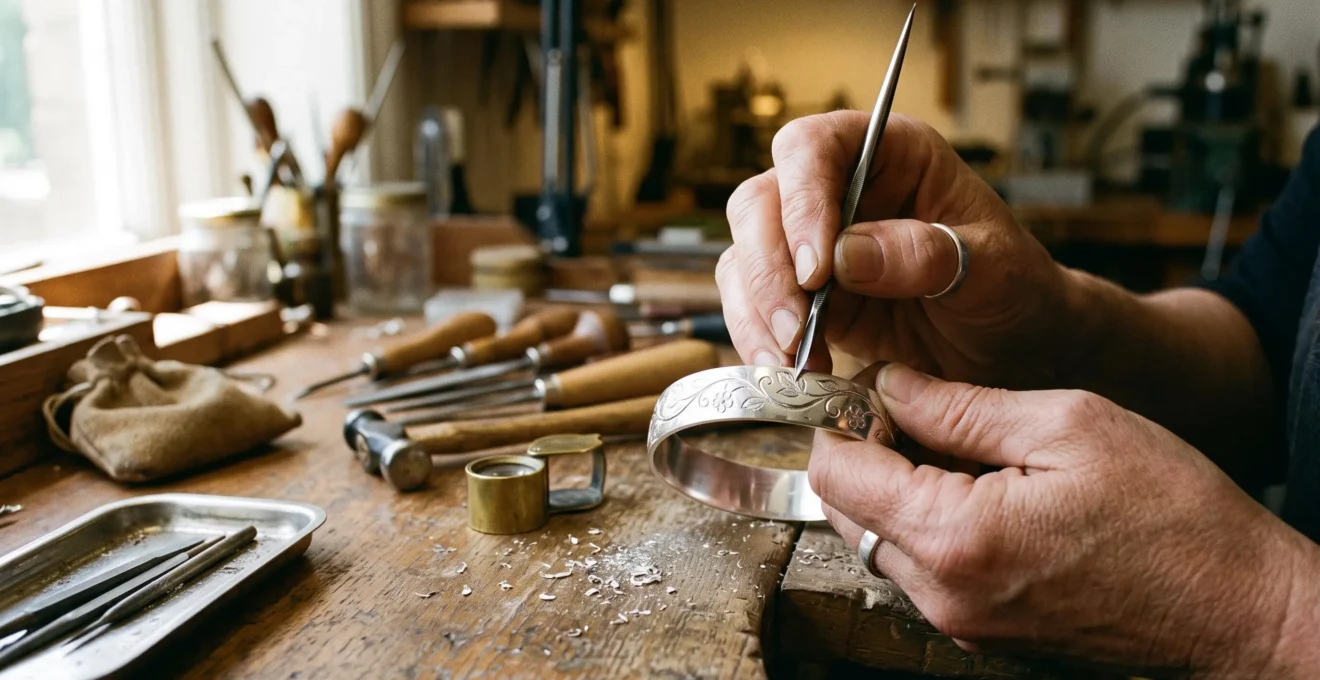
Winding vine motifs in silver jewelry commonly evoke growth, enduring relationships, renewal and the continuity of life. Their symbolism emerges from the way living plants climb, branch, intertwine and regenerate. Yet a grapevine engraved on a historical ornament does not necessarily carry the same meaning as ivy on a contemporary wedding bracelet.
The distinction matters when choosing jewelry to commemorate a relationship, graduation, birth or personal transformation. Botanical details can suggest different messages, while the period, cultural setting and intentions of the maker determine whether those interpretations are historically grounded or simply personal.
Silver provides a particularly expressive surface for engraved stems, leaves and tendrils. Its visual contrast can make delicate botanical patterns easy to appreciate, although the metal itself does not establish one universal interpretation.
Understanding vine symbolism therefore requires looking beyond the general idea of nature-inspired jewelry. The plant represented, its historical associations, its arrangement and the circumstances in which the piece was made all contribute to its meaning.
Vine symbolism in silver jewelry: essential meanings
- Intertwining vines often suggest growth and connection, but historically documented meanings vary between cultures and periods.
- Ivy, grapevines and abstract scrolls communicate different associations; identifying the botanical details is the first step towards interpreting a design.
- For meaningful gifts, choose a motif that reflects the recipient’s milestone and confirm its intended symbolism rather than relying on a product label.
- Why Vine Motifs Represent Growth and Connection Across 12 Cultural Traditions
- Ivy vs Grapevine vs Abstract Vines: What Each Botanical Detail Symbolises
- Ascending vs Descending Vines: How Direction Alters Symbolic Meaning
- The Vine Motif That Carries Negative Symbolism in Mediterranean Cultures
- When to Gift Vine-Motif Silver Jewelry for Maximum Symbolic Resonance
- Trinity vs Lover’s vs Eternity Knots: Which Symbolises What Commitment?
- Graduation vs Marriage vs Parenthood: Which Symbolic Elements Suit Each Milestone?
- How to Commission Silver Jewelry That Authentically Commemorates Life Milestones
Why Vine Motifs Represent Growth and Connection Across 12 Cultural Traditions
Vine motifs lend themselves to meanings of growth and connection because vines extend, intertwine, bear fruit and sometimes return after seasonal dormancy. These characteristics make them effective visual metaphors for relationships, renewal and continuity. However, their meanings are not identical across twelve cultural traditions, and a decorative vine cannot automatically be interpreted as a sacred or protective symbol.
The underlying symbolism begins with observable botanical behaviour. A climbing stem depends on a supporting structure; its tendrils reach outward; its branches can become intertwined. Such features make the vine suitable for expressing both individual development and relationships sustained over time.
Annual growth and fruit production add another interpretive dimension. A vine that survives seasonal change can suggest renewal, while a fruit-bearing branch can evoke abundance or the results of sustained effort. These are plausible symbolic readings, not proof of what every historical artisan intended.
Historical context is more reliable than visual resemblance alone. Consider the following twelve cultural and historical contexts, which differ substantially in how securely a particular vine meaning can be established.
| Context | Interpretive relevance | Important distinction |
|---|---|---|
| Ancient Greek religious imagery | Grapevines are associated with Dionysos and wine. | Religious iconography is not interchangeable with jewelry symbolism. |
| Roman funerary art | Grape imagery could evoke a blessed afterlife. | A funerary setting does not make the vine inherently ominous. |
| Early Christianity | The vine acquired explicitly Christian interpretations. | Meaning depends on religious context. |
| Later Christian devotional traditions | Vine imagery can refer to spiritual belonging and fruitfulness. | Not every decorative scroll has devotional meaning. |
| Jewish biblical tradition | Vineyards, vines and fruit can evoke agricultural blessing and Israel. | Scriptural imagery must not be automatically assigned to an unidentified ornament. |
| Byzantine decorative traditions | Botanical and vine designs occur within wider religious and ornamental vocabularies. | Decoration and theological significance require separate evaluation. |
| Islamic decorative traditions | Vegetal scrolls participate in extensive traditions of ornament. | A stylised scroll does not necessarily identify a particular plant. |
| Iranian metalworking traditions | Vegetal designs form part of ornamental craftsmanship. | The specific symbolism of a vine requires object-level evidence. |
| Central Asian silver ornament | Historical jewelry documents the use of vine and floral patterns. | The presence of a motif does not establish its meaning. |
| Caucasian metalworking traditions | Botanical ornament offers a relevant field of comparison. | Regional attribution and individual motifs need verification. |
| Eastern European folk ornament | Floral and climbing-plant designs may appear in traditional decorative arts. | Shared appearance does not demonstrate shared symbolism. |
| Victorian European jewelry | Natural forms became prominent in nineteenth-century jewelry design. | Romantic, fashionable and mourning contexts should be distinguished. |
These twelve contexts are interpretive categories rather than proof of twelve independent traditions assigning an identical meaning to vines. Historical sources support some associations directly; others require examination of particular objects, places and periods.
A particularly informative example comes from the Metropolitan Museum of Art‘s Roman grapevine sarcophagus. Its catalogue connects grape-harvesting imagery with Dionysos and the prospect of a blessed afterlife. The museum also explains how Christians adopted grapevine imagery in connection with John 15:5 and the Eucharist.
This example demonstrates how the same plant could acquire different religious interpretations without changing its essential appearance.
Silver jewelry introduces a separate question: how botanical imagery was physically realised. An early twentieth-century collar ornament attributed to Iran or Central Asia provides a documented example. Its embossed vine and floral patterns show that such ornamentation was incorporated into silver accessories associated with Turkmen dress.
That evidence does not establish that silver was systematically preferred to gold for delicate vines in Central Asia, the Caucasus or Eastern Europe. Nor does it prove that artisans chose silver because of its reflective qualities. These remain claims requiring additional comparative evidence.
Trade and cultural exchange create further complications. A design may travel through craftsmanship, commerce or changing fashion without retaining the interpretation associated with its earlier setting. Botanical resemblance alone cannot establish a continuous symbolic tradition.
The most useful distinction is between a meaning documented within a tradition and one that a present-day wearer deliberately gives a piece. Both can matter, but identifying the plant itself is the next essential step.
Ivy vs Grapevine vs Abstract Vines: What Each Botanical Detail Symbolises
Ivy commonly suggests fidelity, persistence and attachment; grapevines may evoke abundance, celebration, fertility or religious imagery; and abstract winding vines provide a flexible metaphor for continuity. Their interpretations depend on context, however. Recognising leaves, grapes, tendrils and repeated scrolls helps distinguish a specifically botanical design from ornament that has no documented symbolic intention.
Ivy is an evergreen climber, making its persistent foliage a natural metaphor for lasting attachment. In a contemporary gift, an ivy motif can communicate loyalty through changing circumstances. Yet such an interpretation should not be projected onto every historical ivy ornament without supporting evidence.
Grapevines have a different visual vocabulary. Recognisable grape clusters, broad lobed leaves and curling tendrils can connect a piece to ideas of harvest, abundance and celebration. Specific religious interpretations are possible when an object’s provenance and accompanying iconography justify them.
Abstract vines often retain only the curving rhythm of stems and spirals. Such patterns can represent an unbroken relationship for a contemporary wearer, but their generic appearance makes historical attribution particularly uncertain.
| Motif | Visual identification | Possible symbolic reading |
|---|---|---|
| Ivy | Pointed, often lobed leaves; climbing or trailing stems | Fidelity, endurance, persistent attachment |
| Grapevine | Broad lobed leaves, tendrils and sometimes grape clusters | Fruitfulness, abundance, celebration |
| Abstract vine | Curving stems, repeated spirals or non-specific leaves | Continuity, interconnectedness or decoration |
Jewelry-making can blur these distinctions. A narrow bracelet may leave insufficient room for characteristic leaves, while shallow engraving can make a grape cluster resemble a flower or ornamental dot. A jeweler might intentionally simplify the design for balance rather than botanical accuracy.
When a listing describes a design as ivy or grapevine, ask the seller which botanical features support that identification. A maker’s original sketch, a close-up image or an explanation of the chosen plant is more informative than an unsupported product title.
Combined motifs deserve equal attention. A vine intertwined with flowers may communicate a personal idea of flourishing, while a vine accompanied by a bird can suggest movement or freedom. Neither combination has one automatic interpretation across cultures. The associated element modifies the potential message, provided the maker or recipient intends that reading.
Once the plant has been identified, consider how it travels across the jewelry. Direction can help build a personal narrative, though its historical significance is much less certain than many product descriptions imply.
Ascending vs Descending Vines: How Direction Alters Symbolic Meaning
An ascending vine can be interpreted as aspiration, development and new opportunities, while a descending vine can suggest ancestry, inherited connections or roots extending through generations. These are useful contemporary design interpretations rather than universal historical codes. The direction matters most when the maker intentionally incorporates it and the jewelry has a clearly identifiable orientation.
On a pendant, a stem rising towards the suspension loop might suit a graduation gift because its movement can visually suggest progress. A branch extending downward from a central family symbol might instead represent descendants or the passing of knowledge between generations.
Neither interpretation should be treated as an established convention without evidence from the specific culture or artisan.
A silver ring introduces an important complication. When a continuous vine wraps around the entire band, there may be no fixed beginning, end, top or bottom. A wearer can rotate the ring, changing the apparent orientation. In that configuration, continuity may be a more convincing personal interpretation than direction.
Examining the end of the motif offers a more practical way to develop an intentional design. A bud can suggest possibilities yet to unfold, while fruit can represent achievement or maturity. A root-like termination might be chosen to express remembrance or family origins.
These associations are interpretive suggestions, not a reliable method of reconstructing an unknown historical maker’s intentions.
Direction may also result from technical or compositional decisions. The jeweler may orient the design to accommodate the available surface, avoid an awkward junction or preserve visual balance. A particular direction should not automatically be attributed to the movement of the engraving tool: that technical relationship would require evidence about the original production process.
For a new commission, request a drawing showing the actual wearing position. Mark the starting point, branches and terminal detail on the sketch. This makes the intended symbolism understandable independently of the jewelry’s sales description.
Direction can enrich a symbolic gift when deliberately chosen, but appearance alone is not enough to establish historical meaning. That caution becomes especially important when interpreting motifs associated with mourning or religious imagery.
The Vine Motif That Carries Negative Symbolism in Mediterranean Cultures
No single winding vine motif is reliably established as a universally negative symbol across Mediterranean cultures. Grapevines can appear in funerary art without representing misfortune, while ivy and other climbing plants may acquire melancholy associations in particular contexts. The strongest interpretation comes from an object’s date, provenance, accompanying imagery and intended use, not from assuming that a particular leaf or vine direction signals danger.
One common misunderstanding concerns climbing plants that appear to overwhelm their supports. This image can be interpreted metaphorically as possessiveness or destructive attachment. However, a modern association between an invasive plant and unhealthy dependence is not evidence of an established Mediterranean jewelry tradition.
Similarly, describing ivy as a plant that necessarily kills its host oversimplifies its biology and provides no secure basis for assigning historical meaning to a silver ornament.
Grapevines offer a more clearly documented contrast. The Metropolitan Museum of Art identifies grape-harvesting imagery on late Roman sarcophagi with Dionysian ideas of a blessed afterlife and explains its subsequent Christian religious significance.
Thus, funerary use does not automatically equal negative symbolism. A vine depicted on a tomb may communicate hope, spiritual belonging or continuity rather than betrayal or suffering.
The association between Noah’s vineyard and intoxication provides another possible cultural reference, but it does not establish that grapevine jewelry generally signifies drunkenness, punishment or moral failure. Interpreting a particular ornament in those terms requires stronger contextual evidence.
Victorian mourning jewelry illustrates why materials and historical setting matter. The V&A’s historical gemstone and jewelry collection discusses mourning practices involving Whitby jet, including differences in finish associated with stages of mourning.
The same museum documents nineteenth-century French jewelry decorated with grape motifs as part of the period’s enthusiasm for natural forms. Those examples should not be conflated: botanical ornamentation and mourning practices existed within overlapping historical periods without every botanical jewel being funerary.
Documented case: grapevines in Roman funerary art
A third- to fourth-century Roman marble sarcophagus fragment in the Metropolitan Museum of Art collection depicts children harvesting grapes among vines.
The museum connects this imagery to Dionysian afterlife beliefs and describes its later Christian adoption. The documented example demonstrates that funerary and hopeful religious meanings can coexist, but does not establish a negative meaning for grapevine silver jewelry.
For antique or inherited jewelry, begin by checking any maker’s marks, metal hallmarks, documented provenance and period attribution. Examine whether the vine appears alongside portrait miniatures, memorial inscriptions, hairwork, black mourning materials or explicitly funerary imagery.
No single clue proves an object’s original purpose. A hallmark may help establish a material or production context where properly identified, while expert assessment may be necessary for ambiguous pieces.
Before gifting an antique vine ornament to someone from a Mediterranean background, avoid presuming that their culture assigns one specific meaning to it. A conversation about the recipient’s family associations may be more reliable than broad cultural generalisations.
A well-supported provenance and an appropriately chosen personal message are more valuable than an invented warning about a botanical pattern. Those considerations also help determine which occasions are suitable for vine-motif jewelry.
When to Gift Vine-Motif Silver Jewelry for Maximum Symbolic Resonance
Vine-motif silver jewelry is particularly meaningful when its botanical details reflect the occasion: an unbroken vine for an enduring relationship, a developing shoot for a new beginning, or branching stems for expanding family connections. These associations work best as deliberately chosen personal messages. They should be explained rather than presented as fixed traditions shared by every culture.
The occasion provides the starting point, but the recipient’s relationship with the symbol determines whether it will resonate. Someone drawn to gardening may appreciate a recognisable plant, while another person might prefer a subtle abstract design that can be worn without an obvious narrative.
For anniversaries, an intertwined or continuous vine may communicate the development of a relationship through successive life stages. A wedding gift could combine botanical growth with a clearly designed commitment symbol.
For a birth or a new family chapter, buds and branches offer an accessible visual metaphor for new life. A vine with fruit might instead be chosen to celebrate an achievement or a family tradition, provided the imagery feels appropriate to the recipient.
| Occasion | Suggested motif | Personal message |
|---|---|---|
| Wedding anniversary | Continuous or intertwined vine | A relationship that continues to grow |
| Birth or adoption | New shoot or branching stem | A new chapter and expanding connection |
| Graduation | Ascending vine with a bud | Growth and possibilities ahead |
| Coming of age | Developing vine or unfolding leaves | Independence and personal development |
| Memorial tribute | Continuous vine with personal engraving | Remembrance and enduring bonds |
| Personal recovery or renewal | Fresh shoot or unfurling tendril | Resilience and a new beginning |
Silver can add another layer of meaning. Purity and protection are associated with silver in certain cultural and historical beliefs, but these are not universal properties of the metal or established explanations for every botanical silver jewel.
Its practical advantages for the design are more readily observable. Contrasting polished and recessed surfaces can make fine engraving visible, while a restrained metallic appearance may allow the motif itself to carry the message.
Consider possible misinterpretations before purchasing. An antique piece with memorial inscriptions or mourning associations may be unsuitable for a celebratory gift unless its history is understood and welcomed. By contrast, an intentionally descending vine is not inherently inappropriate for a wedding or birth.
Personalisation can make the meaning unmistakable. A name, date or brief inscription placed near a flowing stem can connect the botanical motif to a particular occasion. Whether the stem is the best engraving location depends on its width, the available surface and the technique; it is not universally more suitable than a leaf or separate inscription panel.
A thoughtfully chosen motif becomes more personal when its details and occasion agree. Additional symbols, particularly knots, can clarify whether the underlying message concerns romantic partnership, spiritual commitment or lasting family ties.
Trinity vs Lover’s vs Eternity Knots: Which Symbolises What Commitment?
A trinity knot commonly expresses threefold unity and can carry spiritual associations; a lover’s knot represents the joining of relationships through intertwined strands; and an eternity knot suggests an unbroken bond through continuous geometry. These categories are useful when selecting jewelry, but terminology varies between makers and traditions. The structure and documented cultural context are more dependable than the commercial name alone.
The familiar triquetra, often called a trinity knot, has a three-cornered interlaced form. In some Christian interpretations it represents the Trinity, while other contemporary interpretations emphasise interconnected dimensions of life. Its historical meaning cannot be reduced to a universal promise between three people.
A lover’s knot generally focuses on the joining of strands. There is no single geometry used by all jewelers under this label. Two interlinked elements may suit romantic commitment, but the same general design can express friendship, partnership or familial affection.
An eternity knot is typically understood through continuity. Depending on the design, its lines may form an endless loop or an interlacing structure intended to evoke something without a beginning or end. Such continuity need not imply romantic exclusivity.
| Motif | Visual clue | Suggested commitment |
|---|---|---|
| Trinity knot | Threefold interlacing, often a triquetra | Spiritual unity or a personally defined threefold bond |
| Lover’s knot | Intertwined or linked strands | Partnership, affection or mutual commitment |
| Eternity knot | Continuous, apparently endless line | Endurance and uninterrupted connection |
Combining a knot with a vine creates opportunities for a more specific message. A lover’s knot surrounded by branching vines might symbolise a relationship that continues to develop. A continuous vine flowing into an eternity knot could express continuity through change.
These combined readings are most convincing when the design was intentionally composed to communicate them. An elaborate ornament that happens to contain knots and scrolls does not necessarily encode a historical statement about commitment.
When evaluating a product, examine the actual strands. Count the principal loops, identify whether the line is continuous and ask whether the jeweler has followed a recognised design or created a new interpretation.
Do not rely on interchangeable marketing labels. A photograph, technical sketch and explanation of the design’s origin can establish far more than the words « eternity, » « Celtic » or « love » in a listing.
The most appropriate knot depends on whom the piece honours and what kind of promise it represents. For milestone jewelry, matching the combined symbols to the life event creates a more coherent design.
Graduation vs Marriage vs Parenthood: Which Symbolic Elements Suit Each Milestone?
Graduation jewelry can emphasise development through an ascending vine or emerging bud; marriage jewelry can express partnership through intertwined stems or a lover’s knot; and parenthood jewelry can represent expanding family connections through branches, shoots or fruit. These are design recommendations rather than universal symbolic rules. The strongest choice reflects what the milestone means to the individual recipient.
A graduation marks achievement as well as transition. An emerging bud can express opportunities ahead without suggesting that the graduate’s existing accomplishments are incomplete. Pairing it with a personal date or educational milestone can balance past achievement with future development.
Marriage involves a different narrative. Intertwined vines can suggest that two individuals develop alongside one another while remaining distinct. A continuous band or clearly identified commitment knot can strengthen the idea of an enduring relationship.
Parenthood introduces themes of responsibility, continuity and changing family relationships. Branching stems offer a flexible visual structure for celebrating children or other significant members of a family. New shoots can be added to a design as circumstances evolve, provided the jewelry permits modification.
These distinctions are especially useful when one person experiences multiple milestones. Rather than purchasing unrelated pieces, a family might choose a pendant with space for successive engraved dates, or a charm bracelet whose botanical theme remains consistent as new elements are added.
For example, a hypothetical pendant could begin with a small ascending vine to commemorate graduation. A later commission might introduce an intertwined section for marriage and additional branches for new family members. The resulting design would form a personal narrative created over time, not reproduce a documented historical symbolic system.
The feasibility of successive modifications should be discussed before fabrication. Available space, the construction of the original piece and future repairs may limit what can be added.
Gift-giving also requires attention to individual circumstances. Not everyone associates marriage with permanence or parenthood with biological inheritance; a symbol can be adapted to chosen family, adoption or other meaningful relationships.
The greatest weakness of a generic botanical gift is not that it lacks beauty, but that its intended message may be unclear. A precise association between motif, occasion and recipient makes the symbolism easier to appreciate.
Once the message is settled, an individually commissioned piece can integrate plant type, movement, knot structure and personal engraving into a coherent design.
Key takeaways before commissioning
- Define the personal message first, then choose botanical features that make it understandable.
- Separate documented historical associations from newly created symbolism, particularly when adapting culturally significant motifs.
- Approve the final design at actual scale, including orientation, botanical details and any space reserved for later personalisation.
How to Commission Silver Jewelry That Authentically Commemorates Life Milestones
Commissioning meaningful vine-motif silver jewelry starts with defining the milestone and the message it should communicate. The next steps are selecting identifiable botanical elements, agreeing on the metalworking technique, approving a detailed sketch and inspecting the finished piece against that approval. Authenticity depends on communicating the intended symbolism clearly, not claiming an undocumented ancient meaning for a modern design.
The initial brief should describe the relationship or event being commemorated. Rather than requesting a « meaningful nature-inspired necklace, » specify whether the piece should evoke personal growth, family continuity, loyalty or an enduring promise.
Then establish the visual vocabulary. A grapevine with fruit communicates something different from abstract spirals; an ascending shoot suggests another narrative from a continuous vine encircling a ring. If a knot is included, describe its geometry rather than providing only a commercial label.
A reference sketch helps resolve ambiguity before fabrication. It should show the intended wearing orientation and distinguish essential features from optional decoration. For example, a bud at the upper end of a pendant may be central to the design while the number of small background leaves may not matter.
Technical discussions are equally important. The GIA’s explanation of jewelry metalworking techniques describes engraving, filigree, repoussé and chasing as distinct methods for creating decorative effects.
Engraving cuts details into the surface; filigree uses arranged metal wires; repoussé raises forms from the reverse, while chasing shapes surface relief through indentation. Their different physical effects can change how a botanical motif appears, even when the underlying design is similar.
Discuss hand engraving and machine-assisted options where available. Neither should automatically be considered more symbolically authentic. What matters is whether the selected method can preserve the intended leaves, terminal details and intersections at the chosen scale.
The maker should also explain any simplification required. If a grape cluster becomes indistinguishable from a flower, or a threefold knot loses its recognisable structure, the design may no longer communicate what was agreed.
Five steps for commissioning and checking symbolic silver jewelry
- Write a one-sentence symbolic brief. Record the milestone, intended message and recipient in a short description that can be shared with the jeweler.
- Create an annotated motif reference. Identify the plant, vine direction, terminal detail and any knot, using a labelled sketch or reference image.
- Agree on a production specification. Obtain written confirmation of the metal, dimensions, decorative technique, engraving text and any accepted design simplifications.
- Approve the final-scale drawing. Keep a dated copy showing the complete design in its intended orientation before fabrication begins.
- Inspect and document the finished piece. Compare the delivered jewelry with the approved specification and retain photographs and written correspondence describing any discrepancies.
If the finished ornament differs materially from the approved design, document the differences and contact the maker with the original specification. Available remedies depend on the agreement and applicable consumer law; customisation alone does not justify assuming that every purchase carries identical return or cancellation rights across English-speaking countries.
Historical inspiration requires similar care. If a design is described as derived from a particular tradition, request the basis for that attribution. Otherwise, it is more accurate to describe it as a contemporary piece inspired by botanical ornamentation.
That distinction does not diminish its personal significance. A modern vine motif designed to commemorate a life event can be meaningful without claiming to reproduce a fixed symbolic message from antiquity.
Before approving the commission, write a brief explanation of why the chosen vine, arrangement and inscription belong together. Sharing that explanation with the jeweler—and eventually with the recipient—can turn an attractive silver ornament into a clearly understood personal keepsake.
Does a winding vine symbol always represent eternal love?
No. A winding vine can be interpreted as enduring love, particularly when it forms a continuous or intertwined design. Historical grapevine imagery also has religious, funerary and decorative associations. Eternal love is therefore one possible personal interpretation rather than a universal historical meaning.
Can an antique silver vine motif be identified without knowing its maker?
The plant may be identifiable from leaves, tendrils and fruit, but establishing the intended symbolism is more difficult. Hallmarks, provenance, associated imagery and the likely production period can help narrow the context. A confident interpretation may remain impossible without further documentary evidence.
Does sterling silver change the meaning of an engraved vine?
Sterling silver identifies a metal alloy rather than a specific symbolic tradition. Silver can carry cultural associations in particular settings, but it does not automatically transform a grapevine into a protective symbol or ivy into a promise of fidelity. The plant, design and cultural context remain essential.
Is a vine motif appropriate for someone who does not follow a religion?
Yes. Botanical vines can communicate entirely personal ideas, such as resilience, friendship or growth. A contemporary abstract vine may be especially suitable when the giver wants to avoid specific religious associations. Recognisable grapevine iconography should be considered more carefully if those associations are important to the recipient.
How can a buyer tell whether a vine engraving is likely to remain readable?
Ask to see the design at its finished size and inspect sample work produced with the intended technique. Check whether leaves, grapes, buds and knot intersections remain distinguishable without excessive magnification. Long-term appearance also depends on surface wear, cleaning, craftsmanship and the piece’s construction.