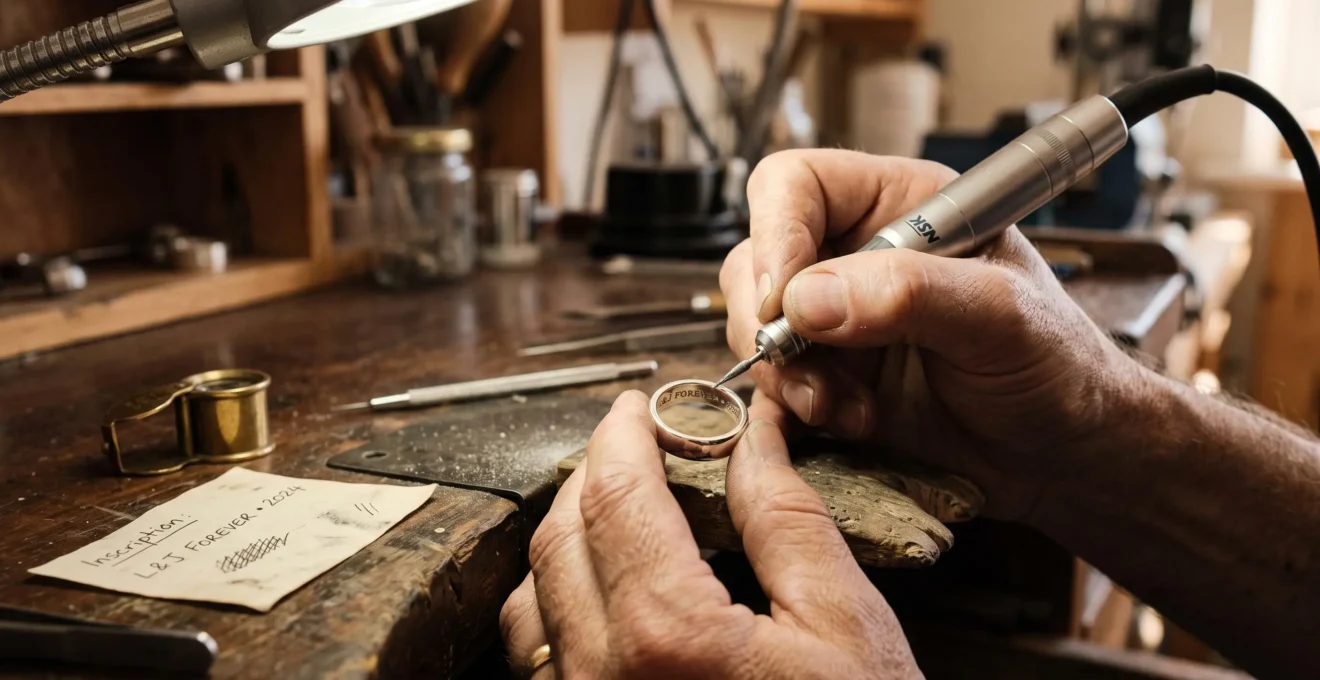
The most meaningful silver jewelry engraving is rarely the longest or most elaborate. A carefully chosen word, discreet symbol, meaningful location or brief personal dedication can express a connection that remains recognizable decades after the occasion that inspired it.
Choosing the inscription involves more than finding the right sentiment. The message must fit the available metal surface, remain legible through ordinary wear and suit the person who will eventually own the piece. A romantic inscription that feels perfect today may become uncomfortable later, while a private family reference may gain significance as the jewelry passes between generations.
Start with the meaning you want to preserve, then decide how explicitly to express it. Consider whether the engraving belongs on a visible surface or somewhere intimate, whether it can survive future resizing or polishing, and whether another person could understand its significance without knowing the original story. Those choices determine whether personalization becomes a temporary reminder or a lasting part of the jewelry’s identity.
Choosing a Silver Engraving That Lasts
- Favor values, short meaningful phrases, personal symbols or carefully chosen initials over unnecessarily detailed inscriptions.
- Match wording and placement to the available surface, expected wear and possible future repairs.
- Preserve the story behind the inscription in writing, particularly when the jewelry may become a family heirloom.
- Why Specific Dates and Full Names Often Lead to Regret
- Visible vs Hidden Engravings: Which Placement Suits Different Message Types?
- How Engraving Size Determines Legibility and Practical Character Limits
- The Engraving Wording Error That Creates Unintended Negative Meaning
- When to Add Engravings to Multi-Piece Collections for Coherent Narrative
- Graduation vs Marriage vs Parenthood: Which Symbolic Elements Suit Each Milestone?
- Why Documented Provenance Increases Heirloom Silver Value by 200-400%
- How to Transform Family Silver Into Transmitted Heritage Across Generations
Why Specific Dates and Full Names Often Lead to Regret
Engraving a complete name or exact date can make jewelry feel uniquely personal, but it also fixes information and emotions to an object that may outlast their original context. The problem is not that names and dates are inherently poor choices. It is that permanent personalization requires thinking beyond the present occasion.
A full name or birth date displayed on a bracelet plate can reveal more personal information than the wearer intends. Unlike a letter stored privately, visible jewelry travels into workplaces, public spaces and photographs. Initials, a discreet date format or a private inscription can retain personal meaning with less exposure.
Relationship-specific wording introduces a different vulnerability. A ring engraved with a partner’s full name and a romantic promise may become difficult to wear if the relationship ends. This does not mean avoiding romantic engravings altogether. A shared symbol, a meaningful location or a short expression of values may remain emotionally useful across changing circumstances.
Before approving the design, apply a simple longevity test:
- Ten-year test: Would the message still reflect something important if the wearer’s circumstances changed?
- Twenty-five-year test: Could the wearer explain its significance without feeling obliged to defend an outdated choice?
- Privacy test: Would it be comfortable for strangers to read the engraving?
- Inheritance test: Would a future recipient understand why the inscription mattered?
Distinguish factual mistakes from emotional regret. A misspelled name or incorrect anniversary can sometimes be corrected through professional refinishing, depending on the metal and engraving depth, but correction may leave traces or remove material. Emotional regret is less easily solved: even perfectly executed lettering can carry a message its owner no longer welcomes.
For example, a hypothetical bracelet engraved with the word “Courage” might remain meaningful through career changes, relocation and family milestones. A bracelet displaying an exact professional title may no longer describe the wearer a few years later. Neither choice is universally right; their usefulness depends on the intended purpose.
Once the words have passed that test, their placement becomes equally important: a message can be emotionally timeless yet physically vulnerable if engraved in the wrong location.
Visible vs Hidden Engravings: Which Placement Suits Different Message Types?
Visible engravings are best for messages the wearer wants to share, while hidden engravings suit private dedications, intimate memories and personal identifiers. Neither placement is automatically more durable. The lasting quality of an inscription depends on how frequently its surface encounters friction, whether it may be altered during repairs and how much space remains around the lettering.
An outer bracelet plate can display a family motto or a single meaningful word. The reverse of a pendant can hold a personal dedication, while the inner surface of a ring may carry initials, a short promise or a date intended primarily for the wearer.
The distinction is therefore as much about audience as aesthetics. A visible inscription communicates outwardly; a hidden one can remain meaningful without inviting explanation.
The following comparison connects common message types with suitable locations and practical limitations.
| Placement | Suitable messages | Main consideration |
|---|---|---|
| Outer ring band | Symbols, initials, short words | Exposed to contact and visible wear |
| Inner ring band | Private dedications, brief dates | Possible friction and resizing conflicts |
| Front of pendant | Timeless words, monograms | Public visibility and design balance |
| Back of locket | Names, short personal messages | Available space and surface contact |
| Bracelet plate | Family mottos, coordinates | Potential rubbing against desks or clothing |
| Protected pendant interior | Intimate references, memorial wording | Accessibility and available engraving area |
Private placement should not be mistaken for guaranteed preservation. An inscription inside a ring can gradually lose definition through wear and polishing, even though no one else sees it. Similarly, a bracelet underside may experience repeated contact with hard surfaces.
Repairs introduce another consideration. Resizing a ring can require cutting, adding or removing metal, potentially affecting lettering near the work area. Ask the jeweler whether the planned inscription can survive foreseeable alterations before finalizing its position.
One effective approach is to divide meaning across two surfaces. The visible side might display “Always,” while the reverse contains a private dedication identifying the person or event. The main design remains broadly meaningful, while the hidden inscription preserves context.
This arrangement is particularly useful for jewelry intended to move between generations. A future owner can appreciate the visible design without needing to display every personal detail attached to its history.
With the location selected, the next question is whether the chosen words can be engraved at a size that remains comfortably readable.
How Engraving Size Determines Legibility and Practical Character Limits
Engraving capacity is determined by usable surface dimensions, character height, spacing, lettering style and the engraving process. There is no universal character limit for silver jewelry. A narrow ring band may accommodate only initials or a few words, while a broad bracelet plate or locket can offer room for a longer dedication without sacrificing clarity.
Ring width and finger size affect the available engraving area. Existing hallmarks and purity marks can further restrict where lettering belongs. As explained in Whiteflash‘s article on jewelry and ring engraving, the usable surface is a practical constraint that must be assessed for each piece.
A jeweler may be able to engrave a phrase technically without making it comfortably legible. Fine script with tightly spaced loops can become difficult to distinguish on a small reflective surface. Cleaner block lettering or a simple sans-serif style is often worth considering when space is limited.
Instead of choosing a universal minimum letter height, ask the engraver to recommend a readable size for the actual piece and technique. The same height may look different depending on the font, engraving contrast and viewing conditions.
Compare these hypothetical inscriptions for a narrow band:
- “Always” — short, visually flexible and easy to position.
- “A + J” — compact and suitable for a personal reference.
- “Wherever life takes us, our hearts remain together” — emotionally expressive, but potentially difficult to accommodate without compromising readability.
The longer message is not necessarily more meaningful. Reducing it to “Together, wherever” might preserve its essential sentiment while allowing a clearer inscription.
Layout deserves as much attention as character count. Letter spacing, alignment and line breaks affect the visual rhythm and sometimes the interpretation of a phrase. A dedication divided in the wrong place may emphasize an unintended word or separate two ideas meant to be read together.
Request a proof at the proposed scale. Examine it at a natural viewing distance rather than relying solely on an enlarged digital preview. Check that the engraving does not intrude on existing marks and that decorative elements leave enough space for the words to remain distinct.
A readable inscription solves the physical design problem, but its precise wording still needs careful review before any permanent work begins.
The Engraving Wording Error That Creates Unintended Negative Meaning
The most overlooked wording mistake is adding an inscription without considering the words already present on the jewelry. A new dedication can conflict with an earlier message, change its emotional tone or create an unintended interpretation when both are read together. This is especially relevant to inherited, secondhand or repeatedly personalized pieces.
Imagine a hypothetical inherited pendant bearing “Forever Remembered.” Adding a celebratory phrase immediately beside it may produce an awkward combination, even if both inscriptions are appropriate individually. Their proximity creates a new message that neither owner intended.
Before adding text to an existing item, photograph every inscription and read the complete wording as one composition. Consider whether each phrase refers to the same person, occasion or period, and whether the physical separation is sufficient to distinguish their purposes.
Ambiguity can also arise on newly commissioned jewelry. Punctuation, capitalization, apostrophes and translation all influence meaning. A short phrase in an unfamiliar language may sound elegant but carry an unintended nuance. Have a fluent native speaker review the final wording rather than relying exclusively on an automated translation.
Fonts can introduce problems of their own. An ornate letter may resemble another character, particularly when names are engraved at small sizes. A correct spelling in a typed document is not enough if the engraved design makes it hard to read.
Five Checks Before Authorizing a Silver Engraving
- Finalize the message: Write the exact inscription, including punctuation and capitalization, in one approved text document.
- Verify personal details: Check names and dates against an authoritative personal record or confirmation from the relevant person, producing a verified wording sheet.
- Review existing inscriptions: Photograph the jewelry’s current text and compare it with the proposed addition, producing a combined message review.
- Approve the visual layout: Obtain a proof showing the chosen font, spacing, line breaks and actual placement, and retain the approved version.
- Confirm correction possibilities: Ask the jeweler in writing what corrections are feasible, whether they would remove metal and what risks remain before authorizing the work.
Read the final wording aloud and character by character. If the engraving combines multiple languages, review them both individually and together. For a gift, discreetly verifying a name or date with the recipient or someone close to them can prevent an irreversible surprise.
Once individual inscriptions are coherent, the same principle can help organize multiple pieces into a connected collection rather than an assortment of unrelated messages.
When to Add Engravings to Multi-Piece Collections for Coherent Narrative
A collection of engraved silver jewelry becomes more meaningful when its inscriptions follow a deliberate structure. Rather than personalizing every piece independently, decide whether the collection should express one shared story or record a sequence of milestones. This distinction helps preserve coherence as new rings, pendants or bracelets are added over time.
A shared-story collection might use the same small symbol on every piece. The symbol could represent a family value, meaningful location or personal connection, while each item has a different wearer or purpose.
A milestone collection follows a chronological structure. One piece records graduation, another marriage and a later item the arrival of a child. Each engraving has its own identity, but consistent lettering, dates and placement conventions allow the collection to read as a sequence.
The two strategies can coexist if their roles are clearly defined. For example, a recurring symbol might provide continuity while individual words describe successive life chapters. Problems arise when dates, quotations, initials and unrelated motifs accumulate without any organizing principle.
Timing is another important decision. Engraving an entire collection at once fixes a narrative before future events happen. A staged approach allows the collection to grow naturally, provided each piece has sufficient space for the intended additions.
Before reserving blank surfaces, discuss future engraving with the jeweler. Adding inscriptions may require handling or refinishing older pieces, and later polishing could affect existing details. Not every surface can accommodate unlimited expansion.
Consistent typography also matters. A ring, pendant and bracelet need not contain identical messages, but compatible lettering styles and capitalization make them feel related. The same placement principle can be adapted to different shapes: a visible motif on the front and contextual wording on the reverse, for instance.
Maintain a simple collection register recording each piece, its exact inscription, font, location, owner and date of personalization. Include photographs showing the lettering before resizing or repair. This record makes it easier to continue the narrative even when pieces move between wearers.
Choosing the symbolic language of the collection becomes easier when each major life event has a clear role within the broader story.
Graduation vs Marriage vs Parenthood: Which Symbolic Elements Suit Each Milestone?
Graduation engravings work well with values, initials or concise references to achievement; marriage engravings suit shared promises and personal symbols; parenthood engravings often carry family names, birth details or a child’s own words. The strongest choice is not necessarily the most specific one, but the inscription that continues to reflect why the occasion mattered after circumstances have changed.
Graduation celebrates achievement and transition. Initials identifying an institution, the graduation year or a word such as “Persevere” can preserve the significance of the accomplishment. A future job title or career ambition is usually less adaptable because professional paths often change.
Marriage invites a more intimate approach. Initials and a wedding date remain familiar conventions, while a short phrase drawn from personal vows or the coordinates of a meaningful place can express a shared history without explaining it publicly. For a visible inscription, a simple symbol may be more comfortable than a complete private promise.
Parenthood offers several distinct possibilities. A child’s name or birth date can create a lasting connection, particularly on jewelry worn by a parent. An older child’s handwritten word or signature can become another deeply personal option, provided its reproduction is feasible at the available size.
These recommendations can be compared through their relationship to identity and changing circumstances.
| Milestone | Potentially lasting choices | Choices requiring extra thought |
|---|---|---|
| Graduation | Year, institution initials, personal value | Predicted career, future title, temporary ambition |
| Marriage | Shared symbol, initials, short vow, meaningful location | Highly public intimate wording or long romantic promises |
| Parenthood | Child’s name, birth date, meaningful word or signature | Very long inscriptions or details intended to remain private |
A useful distinction is between a role and a circumstance. Becoming a graduate or parent generally remains part of a person’s biography, even as daily circumstances change. A particular employer, address or anticipated future may not. Marriage-related roles and wording deserve personal consideration because relationships and identities can evolve.
Gift-givers should be particularly careful with factual details. An inscription may be commissioned as a surprise, but the surprise should concern the gift rather than an unverified spelling or date. Ask a trusted contact for confirmation where possible.
For jewelry intended to become an heirloom, consider whether descendants will recognize the occasion. A short note explaining the graduation, marriage or family event may eventually carry more historical meaning than adding extra words to a small metal surface.
When the piece eventually becomes collectible or inherited silver, the context behind those symbols may also affect how its history and significance are assessed.
Why Documented Provenance Increases Heirloom Silver Value by 200-400%
Documented provenance can strengthen the credibility and potential market appeal of inherited silver jewelry, but there is no established universal increase of 200–400 %. That percentage should be treated as an unverified proposition rather than an expected return. The actual influence of ownership records depends on the object’s identity, condition, maker, historical significance and the quality of the supporting evidence.
Provenance means the documented history of ownership. For silver jewelry, it can help explain who owned the piece, when it changed hands, how an inscription originated and whether a claimed historical association is credible.
According to Christie’s explanation of provenance and its role in auctions, ownership history may influence an object’s value and support authentication research. However, it does not establish a fixed financial premium for ordinary engraved silver jewelry.
A documented history may be especially relevant when a piece is associated with a recognized maker, historically significant owner or identifiable period. For an otherwise ordinary contemporary bracelet, family records might substantially increase sentimental significance without producing a comparable increase in resale value.
Useful evidence can include:
- Hallmarks and sponsor’s marks: clear photographs of all identifying metal marks, alongside any professional identification.
- Historical photographs: dated images showing the jewelry in identifiable family use.
- Transaction records: original receipts, invoices, auction records or relevant appraisals.
- Correspondence: letters or other documents connecting the item to a person or occasion.
- Ownership history: a written sequence of custodians, supported wherever possible by independent records.
- Engraving records: documentation of who added an inscription, when it was made and why.
Marks must be interpreted carefully. The Sheffield Assay Office‘s hallmark identification information explains that a sponsor’s mark identifies the registered party responsible for submitting an item for hallmarking, not necessarily the manufacturer. A hallmark can support identification without independently proving ownership.
Similarly, an engraved name is not automatically evidence that the named person owned the piece. It may refer to a recipient, a deceased relative or another person important to the original owner.
Before assigning historical or monetary significance, photograph the item and preserve its existing condition. If the piece may be valuable, consult an appropriately qualified appraiser and request a written assessment explaining the basis of any attribution.
Do not attempt aggressive cleaning before that examination. Heavy polishing can affect original finishes, hallmarks and delicate inscriptions, potentially removing evidence that a specialist needs to evaluate.
For families, that traceability serves another purpose: it allows the story attached to an engraved object to survive after the people who originally understood it are gone.
Key Takeaways for Future Heirlooms
- An engraving identifies a memory, but supporting records explain its significance to someone who did not witness the original event.
- Preserving existing marks and inscriptions can be more important than restoring a piece to a newly polished appearance.
- Deciding who will inherit meaningful jewelry is part of preserving its story, not merely distributing possessions.
How to Transform Family Silver Into Transmitted Heritage Across Generations
Transforming engraved silver into family heritage requires preserving both the object and the story attached to it. Record what each inscription means, document who owned the jewelry and arrange how it will pass to future custodians. A physically well-preserved piece can still lose much of its personal significance if later generations cannot explain the names, symbols or dates it carries.
Begin by creating a short record for every important item. Describe the jewelry, photograph its visible and hidden engravings, identify the person who gave or wore it, and explain the event or relationship behind its personalization.
Where information comes from family recollection rather than documents, identify it as such. A note stating that a grandmother believed a bracelet was given at a particular anniversary is more reliable than presenting an uncertain date as an established historical fact.
Keep one copy of the record with the jewelry when appropriate and another in a separate digital archive. Include images of the hallmarks and any existing condition issues. Store digital copies in a format accessible to family members who may later assume responsibility for the collection.
The practical importance of preservation extends beyond the inscription itself. The Canadian Conservation Institute‘s guidelines for caring for metal objects explain how abrasive polishing can remove silver and wear away fine decorative details, including delicate engravings.
For historically important or fragile silver jewelry, prioritize suitable storage, stable environmental conditions and professional conservation advice rather than repeated polishing. Ordinary wearable pieces may have different maintenance needs, but excessive abrasion should still be avoided.
Inheritance arrangements also deserve attention. Discuss intended recipients while the current owner can explain personal preferences and family connections. A written allocation or suitable estate-planning document may reduce confusion, although its legal effect depends on the applicable jurisdiction and inheritance rules.
Where several relatives have emotional connections to the same piece, a photograph and written account can help preserve the shared story even if the physical jewelry passes to only one person.
A family heirloom need not remain unchanged forever. A new custodian might add a small inscription, commission a related piece or simply contribute a dated photograph and personal reflection to the accompanying record. Each addition can extend the object’s history without compromising its original character.
Any physical alteration should be considered carefully, particularly for antique or historically significant jewelry. A new inscription may affect collectibility, surface condition or the interpretation of older markings. When preservation is more important than further personalization, adding to the documentary record is the safer choice.
The most sustainable approach combines responsible use, minimal unnecessary intervention and careful documentation. The jewelry remains an object that can be worn and appreciated, while its records protect the personal history that wear alone cannot communicate.
Choose one important silver piece and create its first heritage record today: photograph the engraving, write down its story and identify where that information will be kept. This small action can protect meaning that no amount of additional lettering could preserve on its own.
Can an engraving be removed from sterling silver jewelry?
Some engravings can be reduced or removed through professional refinishing, but the process may require removing metal and can alter the jewelry’s surface, thickness or original details. Feasibility depends on engraving depth, construction and the available material. Historically significant pieces should be assessed by a specialist before any alteration.
Are symbols more meaningful than words on engraved jewelry?
Neither is inherently more meaningful. Symbols can communicate privately and remain visually simple, while words can preserve a specific sentiment. A symbol is especially useful when engraving space is limited, but its meaning should be recorded if future generations may not recognize its significance.
Can a jeweler reproduce someone’s handwriting on silver?
Some engraving services can reproduce handwriting from a suitable image or digital file. The result depends on the available equipment, the quality of the original sample and the dimensions of the jewelry. Fine handwritten details may need adaptation, so request a proof before authorizing the engraving.
Should an antique silver heirloom receive a new engraving?
Adding an inscription to antique silver should be approached cautiously because it permanently changes the object and may affect its historical interpretation or market appeal. Seek specialist advice when the piece has potential heritage or collectible significance. A written family record can preserve a new memory without altering the original metal.
What information should accompany engraved jewelry given as a family gift?
Include the exact wording and meaning of the engraving, the identity of the giver and recipient, the occasion, and the date when known. Photographs, purchase records and details of any later repairs provide additional context. Keep the record separately as well as with the jewelry so its history is less likely to disappear.