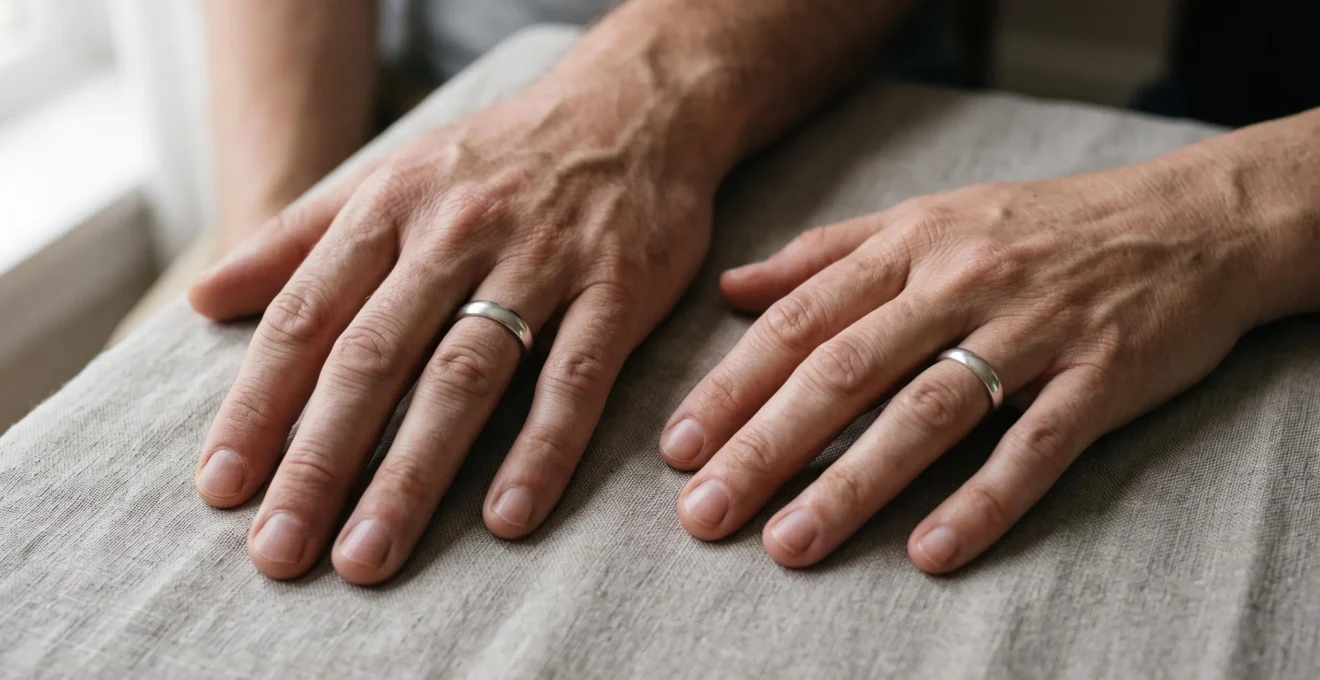
A silver ring on the fourth finger of the left hand might suggest engagement or marriage in Britain. Move that same ring to the right hand, however, and its meaning may change considerably depending on where it is worn. In some European and Orthodox Christian traditions, right-hand wedding rings are customary. Elsewhere, a right-hand silver ring may simply reflect personal style.
Ring symbolism depends on three interacting factors: finger position, cultural context and the ring itself. The hand provides a possible social signal, while the design, materials and circumstances of wearing help determine how that signal is interpreted. None offers a reliable way to establish someone’s relationship status without asking.
Silver introduces another layer of flexibility. It can carry the same commitment symbolism as a gold band, but it is also widely used for decorative, heritage-inspired and personally meaningful jewellery. A Celtic knot ring, for instance, may communicate family identity on one finger and romantic commitment on another.
Understanding these distinctions makes it easier to select a meaningful ring position, interpret unfamiliar customs and avoid assumptions when travelling or navigating relationships across cultures.
Silver Ring Symbolism at a Glance
- Culture changes the meaning: Left-hand engagement and wedding customs are familiar in the UK and US, while right-hand wedding traditions are established in several other countries.
- Placement is not proof: A fourth-finger ring can suggest commitment, but personal choice, religion, family tradition and fashion complicate interpretation.
- Design adds context: Stacking order, silver band proportions and Celtic knot motifs contribute meanings that cannot be determined from finger position alone.
- Why the Ring Finger Means Engagement in the UK but Something Different Elsewhere
- Left vs Right Hand Ring Symbolism: What Different Cultures Read Into Each
- How Ring Stacking Order Communicates Relationship Timeline and Status
- The Ring Position That Signals Marriage Availability When You’re Not
- When to Follow Tradition vs Intentionally Subvert Ring Symbolism
- Vertical Detailing vs Horizontal Bands: Which Design Elongates Short Fingers?
- Trinity vs Lover’s vs Eternity Knots: Which Commitment Does Each Symbolise?
- What Do Different Celtic Knot Patterns Actually Symbolise in Silver Jewelry?
Why the Ring Finger Means Engagement in the UK but Something Different Elsewhere
In the UK, a ring on the fourth finger of the left hand commonly signifies engagement or marriage, depending on its design and the wearer’s circumstances. In countries such as Germany and Russia, wedding rings are often worn on the right hand instead. The difference reflects cultural and religious traditions rather than a universal meaning assigned to either hand.
The familiar British convention has a historical explanation: the vena amoris, or « vein of love ». An ancient belief associated the fourth finger of the left hand with a direct connection to the heart. Although frequently attributed to Roman traditions, the story should not be confused with established anatomy. There is no exclusive vein connecting that finger to the heart.
The significance of the tradition is therefore symbolic, not biological. Nor does the origin story fully explain why different societies later developed contrasting customs. A shared historical association with marriage can coexist with very different contemporary choices about which hand carries the ring.
According to GIA’s guidance on engagement and wedding ring placement, left-hand engagement and wedding rings are traditional in the United States and other countries following that convention. Right-hand wedding-ring traditions are also common in Germany, Russia, Poland, Greece and India.
In India, practices vary by community, religion and personal preference. Explanations sometimes connect right-hand preferences to cultural distinctions between hands, including concepts of ritual cleanliness, but the available evidence does not support treating hygiene as a universal explanation for Indian ring placement.
Orthodox Christian customs provide another important example. The right hand traditionally has particular significance in wedding-ring practices, although individuals may adapt these customs within different national or family settings.
For someone interpreting a silver ring, a useful sequence is:
- Identify the finger: The fourth finger is the strongest conventional clue to relationship symbolism in many Western and European contexts.
- Check the hand: A right-hand wedding ring may be entirely conventional in the wearer’s cultural background.
- Examine the design: A plain band might suggest marriage, while a prominent gemstone may suggest engagement, but neither distinction is conclusive.
- Consider the occasion: A ring exchanged during a wedding, engagement or family ceremony can carry a meaning invisible to an observer.
A common mistake among UK observers is to equate every fourth-finger ring with engagement. In reality, such jewellery may represent marriage, a former relationship, remembrance, family identity or an entirely personal choice.
Once the fourth finger has been identified as a potential relationship signal, the distinction between left and right hands becomes more useful—but also more complicated.
Left vs Right Hand Ring Symbolism: What Different Cultures Read Into Each
The left and right hands have no universally fixed meanings in ring symbolism. Their interpretations emerge from religious customs, practical wearing preferences and modern social conventions. In some communities, the right hand communicates marriage; in others, it carries no particular relationship message. A silver ring’s meaning therefore depends more on the wearer’s cultural setting than on handedness alone.
Three different mechanisms help explain why rings appear on opposite hands.
Religious tradition can establish a preferred position independently of contemporary fashion. The Orthodox Church in America’s explanation of wedding-band customs confirms that Orthodox Christians traditionally wear wedding rings on their right hands. It also recognises that some Orthodox Christians in America wear them on the left, showing how religious convention and everyday practice can diverge.
Practical comfort offers a second explanation. People frequently consider which hand performs more demanding tasks, whether a ring catches on equipment and how easily it can be damaged. Someone who works extensively with their dominant hand might prefer jewellery on the other. This is an individual decision, not an established cultural code.
Modern social signalling introduces a third possibility. The commercially promoted idea of a « right-hand ring » associates jewellery with independence, self-purchase and personal achievement. These meanings can be attractive to wearers, but they should not be mistaken for universally recognised traditions.
Silver adds another interpretive complication. A contemporary sterling silver ring may be purchased as fashion jewellery, a sentimental gift or a wedding band. Although observers might associate certain precious-metal styles with marriage, metal colour alone does not establish relationship status.
Consider a hypothetical example: a British traveller notices a simple silver band on the right ring finger of someone living in Germany. The traveller might regard it as decorative jewellery because it is not on the left hand. In the local context, however, a wedding interpretation may be more likely.
For multicultural couples, the practical solution is to decide which audience matters most when wearing rings. Partners may follow a religious ceremony’s convention, a shared family custom or the convention most easily understood where they live.
The meaning conveyed by a ring’s hand placement is only one consideration. When several rings share the same finger, their order introduces a separate form of symbolism.
How Ring Stacking Order Communicates Relationship Timeline and Status
In a conventional Western bridal stack, the wedding band sits at the base of the fourth finger, nearest the palm, while the engagement ring rests above it. This arrangement is often explained through the symbolic idea of keeping the wedding ring closest to the heart. Anniversary and eternity rings can be added later, although stacking order remains a personal choice.
Ring stacking can communicate a relationship timeline without words. Each piece may represent a distinct milestone: an engagement, a wedding, an anniversary or another important moment. However, the order in which those milestones are displayed does not always match the chronology in which the rings were received.
For example, someone might receive an engagement ring first but place the wedding band beneath it after the ceremony. Another wearer might reverse the order to reflect the original sequence of gifts. Both arrangements can carry deliberate meaning.
For an unconventional silver stack, begin by selecting an anchor ring: the piece representing the most important personal commitment or memory. Position that ring first, then arrange the remaining pieces according to either chronological order or visual balance.
If there is no engagement ring, an eternity band or another meaningful silver ring can serve as the anchor. Nevertheless, the intended story will usually be understandable only to someone familiar with the wearer’s choices.
The symbolic arrangement must also work physically. High gemstone settings can press against adjacent bands, while rings with incompatible profiles may rub against one another. A gap between settings, repeated movement or poor alignment can contribute to wear.
Sterling silver deserves particular consideration because its susceptibility to scratches and dents affects how stacked pieces age. Gold alloys also vary in hardness, so it would be misleading to assume that silver always wears faster than every gold alternative.
Before finalising a stack, check whether the rings sit comfortably together, whether any stone setting presses against another surface and whether each piece can be removed without force. Rings with delicate details may be better worn separately.
When symbolic order conflicts with protection of the jewellery, preserving the rings is a reasonable priority. Their meaning does not disappear because their position changes.
Unlike stacking order, which may hold a largely private meaning, a single ring on the fourth finger can prompt immediate public assumptions—even when those assumptions are wrong.
The Ring Position That Signals Marriage Availability When You’re Not
A ring on the fourth finger is more likely than one on the index, middle or thumb to be interpreted as a relationship signal in many Anglophone and European settings. If you are single and want to minimise assumptions that you are engaged or married, another finger may be a clearer choice. No position, however, guarantees a particular interpretation.
In the UK, a plain silver band on the left ring finger can resemble a wedding ring. A gemstone ring in the same position may be associated with engagement. On the right fourth finger, a similar piece may be interpreted differently by people familiar with German, Russian or Orthodox wedding traditions.
Other fingers generally offer more flexibility, although their traditional associations vary considerably.
| Finger | Commonly suggested meaning | Important limitation |
|---|---|---|
| Thumb | Individuality, confidence or unconventional style | Some communities and historical settings attach more specific meanings to thumb rings. |
| Index finger | Authority, identity or status | Family, signet and affiliation traditions may alter the interpretation. |
| Middle finger | Balance, prominence or personal expression | These associations are not universally established cultural rules. |
| Fourth finger | Engagement, marriage or relationship commitment | The relevant hand and the meaning of the ring differ across cultures. |
| Little finger | Decorative style, family identity or signet-ring tradition | Interpretations depend on the design and social context. |
These meanings are best understood as interpretive possibilities rather than a fixed international vocabulary. Contemporary fashion frequently overrides traditional associations.
The reverse problem matters too. Someone who is married or engaged might remove a ring before manual work, exercise or an activity where jewellery presents a safety concern. An absent ring does not indicate that the person is single or available.
When wearing a ring on the finger is impractical, some people place it on a necklace or keep it safely stored until they can wear it again. A pendant may preserve personal significance, but observers will not necessarily recognise it as a relationship symbol. Jewellery worn around the neck must also be removed when workplace or physical-activity safety requirements demand it.
Historical signet customs and symbolic codes within particular communities further complicate interpretation. A ring position used for self-expression by one person may have a more specific association for another. Such associations should not be used to infer someone’s sexuality, affiliations or personal circumstances.
The most reliable way to prevent misunderstanding is not to search for a universally neutral finger, but to understand the local convention and decide whether communicating—or challenging—it matters.
When to Follow Tradition vs Intentionally Subvert Ring Symbolism
Follow traditional ring placement when a recognisable social signal is useful, such as communicating marriage within a community that shares the convention. Choose an unconventional position when comfort, identity or personal meaning matters more. When neither interpretation is important, a neutral approach based on fit and design is often sufficient. Intentional symbolism works only when others recognise the convention being challenged.
A ring can function as personal jewellery, a public signal or both. The distinction matters because wearers and observers do not always assign the same meaning to an object.
For someone attending a formal family event, conventional placement may reduce unnecessary questions about engagement or marriage. A person whose work makes a traditional position uncomfortable may reasonably choose another finger. Someone who rejects prescribed relationship symbolism might deliberately wear a prominent ring in an unexpected location.
These choices can be organised around the consequences of being understood—or misunderstood.
| Situation | Suggested approach | Reason |
|---|---|---|
| Communicating marriage at a family or religious occasion | Follow the relevant community’s convention | Shared expectations make the intended message easier to recognise. |
| Ring position creates discomfort or practical difficulty | Adapt the placement or remove the ring when necessary | Safety and comfort outweigh symbolic consistency. |
| Expressing independence or rejecting prescribed customs | Choose a deliberate non-traditional position | The choice may become personally meaningful even if others do not recognise it. |
| Wearing decorative silver jewellery without a social message | Prioritise fit, proportions and personal preference | Not every ring needs a symbolic explanation. |
Intentional subversion depends on shared knowledge. A British wearer might deliberately place a wedding-style ring on an unconventional finger, expecting friends to notice the departure from tradition. That gesture may become invisible when travelling somewhere with different customs.
Conversely, a silver band worn on the right fourth finger as an aesthetic choice could prompt marriage-related assumptions in a German or Russian setting. What feels unconventional to the wearer might be entirely conventional to an observer.
The following checklist turns this cultural awareness into a practical placement decision.
Five Steps to Choose a Silver Ring Position
- Identify the main audience. Write down the country, community or social setting where the ring will usually be seen; the result is one clearly defined cultural context.
- Clarify the intended message. Select commitment, heritage, personal expression or decoration; record one primary meaning.
- Check the expected convention. Identify whether that audience associates a particular finger and hand with your chosen meaning; note the likely interpretation.
- Test the physical placement. Try the ring during ordinary hand movements and check for discomfort, rubbing or interference; record a comfortable position.
- Make a deliberate final choice. Compare your intended meaning with the likely public interpretation, then choose a finger and hand with a one-sentence explanation you would be comfortable giving.
This method does not eliminate ambiguity. It makes that ambiguity visible before it becomes an awkward social interaction.
Once symbolism has been considered, the ring itself deserves equal attention. Finger shape, band width and decorative direction influence how a silver ring looks in its chosen position.
Vertical Detailing vs Horizontal Bands: Which Design Elongates Short Fingers?
Vertical detailing generally creates a stronger impression of finger length than a broad horizontal band. Elongated gemstones, lengthwise engravings and narrow silver settings guide the eye along the finger, whereas wide bands emphasise its width. The visual result also depends on ring proportions, finger shape and placement, so vertical designs are a styling option rather than an absolute rule.
The difference comes from how the eye follows edges and proportions. A long, narrow centrepiece encourages a lengthwise reading, while a broad band creates a prominent line across the finger. When a ring occupies a large proportion of the visible finger, the surrounding skin can appear shorter.
Oval, marquise and elongated emerald-cut gemstones can support a lengthening effect when oriented along the finger. Likewise, a narrow band with an elongated decorative motif may create a more continuous visual line.
Silver’s reflective surface can make these design features conspicuous, particularly where polished edges contrast with skin. However, the strength of that contrast varies with lighting, finish and complexion. There is no basis for assuming that silver always creates a stronger visual effect than yellow gold.
Placement can change the balance. A wide silver band that appears oversized on a little finger may look proportionate on a middle finger. Similarly, a tall setting suitable for a longer ring finger might dominate a shorter index finger.
When comparing styles, examine the ring on the intended finger rather than evaluating it in isolation. The width of the band relative to the visible finger length is often more useful than a general rule about horizontal and vertical details.
The jewellery material creates a second decision: appearance versus maintenance.
As discussed in GIA’s comparison of ring materials for everyday wear, sterling silver is relatively affordable and versatile, but it is susceptible to scratching, denting and tarnish. Its composition and the demands of daily wear should influence design selection.
Fine engraving, openwork and textured surfaces can also require more attentive cleaning because recessed areas may be harder to reach. This is a maintenance consideration, not evidence that vertical designs intrinsically tarnish faster.
Silver’s affordability may make experimenting with different ring proportions more accessible, although it does not establish that elaborate designs are more common or that their prices always compare favourably with every alternative metal.
For a lengthening effect with manageable upkeep, a relatively slim band with a smooth elongated centrepiece offers a straightforward starting point. The best fit remains the design that feels comfortable and preserves enough structural strength for its intended use.
Beyond its visual proportions, a silver ring can carry a distinctive decorative message. Celtic knot patterns are a useful example, provided their modern interpretations are not confused with historically proven meanings.
Trinity vs Lover’s vs Eternity Knots: Which Commitment Does Each Symbolise?
The Trinity knot, Lover’s Knot and eternity knot express different ideas in contemporary jewellery symbolism. The Trinity knot is associated with threefold concepts such as spiritual unity or the Christian Trinity. Lover’s Knot designs typically suggest two connected lives, while eternity patterns emphasise continuity. These are common modern interpretations, not universally documented ancient meanings for every design bearing those names.
One reason Celtic-inspired rings are frequently chosen as gifts is that their interlaced patterns can represent connections without relying on gemstones or conventional wedding-band styling. The exact message, however, depends on the motif and the meaning assigned to it.
The Trinity knot, also called the triquetra, is distinguished by a three-part form. It may be interpreted through Christian religious symbolism, threefold relationships or ideas such as past, present and future. These different readings should not automatically be attributed to the same historical period.
A Trinity knot silver ring may suit someone who wants to acknowledge faith, family connections or a meaningful threefold concept rather than exclusively romantic commitment.
The Lover’s Knot is a broader term, and its precise geometry varies between designs. In contemporary jewellery, interlaced loops or intertwined strands commonly represent the joining of two lives. The symbolic appeal is relational: two individual elements are understood as connected.
This makes a Lover’s Knot a natural contemporary choice for a romantic gift, although the label alone does not establish a single historically standardised Celtic pattern.
Eternity knot designs emphasise continuity through an unbroken or repeating form. In a romantic context, they are frequently used to suggest an enduring bond. Their visual continuity can make them appealing for anniversaries and established commitments.
However, an eternity knot should not be confused automatically with an eternity ring set with gemstones. One describes a decorative motif, while the other refers to a jewellery style commonly associated with significant relationship milestones.
The distinctions can guide a gift decision.
| Pattern | Common contemporary interpretation | Potential gifting context |
|---|---|---|
| Trinity knot | Threefold unity, faith or connected stages of life | Spiritual occasions, family gifts or personal milestones |
| Lover’s Knot | Connection between two people | Romantic gifts or relationship celebrations |
| Eternity knot | Continuity and enduring commitment | Anniversaries or commemorations of lasting bonds |
The important historical qualification is that a continuous line does not automatically prove an ancient association with eternal romantic love. Medieval interlace was a substantial artistic tradition, but specific emotional meanings promoted for modern rings are not necessarily documented in medieval evidence.
For an evolving relationship, a design with a personally defined meaning may be more appropriate than one explicitly presented as a promise of permanence. The recipient’s preferences and understanding should guide the selection.
These three designs belong to a wider decorative tradition. Understanding the broader vocabulary of Celtic-inspired patterns makes it easier to distinguish recognised historical motifs from contemporary jewellery symbolism.
Key Takeaways Before Choosing a Celtic Silver Ring
- Separate history from interpretation: The historical existence of a knot pattern does not prove that its modern romantic or spiritual meaning is ancient.
- Match the motif to the message: Choose a pattern for the relationship, heritage or personal value it should represent, rather than for its name alone.
- Combine design with placement: A Celtic motif may suggest heritage on one finger and commitment on another, depending on the surrounding cultural context.
What Do Different Celtic Knot Patterns Actually Symbolise in Silver Jewelry?
Celtic-inspired silver jewellery uses spirals, interlaced lines, crosses and geometric motifs to express ideas such as heritage, faith, connection and continuity. Some designs have documented historical origins, while many specific meanings used in contemporary jewellery descriptions are modern interpretations. Understanding that distinction allows wearers to choose a meaningful pattern without attributing unsupported symbolism to ancient Celtic cultures.
Historical context matters because the category « Celtic knot » encompasses several forms with different origins and artistic functions. Early medieval Insular art provides particularly important evidence for elaborate interlace decoration.
Trinity College Dublin’s research on Insular manuscript art identifies spirals, interlacing knotwork and repeating geometric forms in manuscripts such as the Book of Kells and Book of Durrow. The research examines how these decorative patterns were constructed and repeated, rather than assigning a fixed emotional meaning to each modern jewellery motif.
This provides a sound basis for recognising the artistic tradition, but not for claiming that every contemporary named knot preserves a precisely documented ancient message.
The following distinctions are useful when examining silver rings.
| Pattern | Commonly cited meaning | Historical qualification |
|---|---|---|
| Triquetra (Trinity knot) | Threefold unity, spiritual connection or the Christian Trinity | The motif has a historical decorative presence, but specific interpretations depend on context and cannot be universally applied. |
| Celtic cross | Christian faith, heritage and spiritual identity | Historical Irish and Insular Christian cross traditions are established; individual decorative elements do not all have independently proven symbolic meanings. |
| Dara knot | Strength, resilience and connections resembling tree roots | The interpretation is widely circulated in contemporary jewellery descriptions, but its status as a precisely defined ancient symbolic motif is not established by the supplied historical research. |
| Serch Bythol | Enduring love and the joining of two people | This is a popular contemporary attribution; the supplied evidence does not establish an ancient origin for the named design. |
| Single spiral | Growth, movement, transformation or life’s journey | Spiral decoration is historically attested, but a universal symbolic translation of a single spiral is not demonstrated. |
| Shield knot | Protection, security and defence against harm | The protective interpretation is commonly repeated, but the supplied sources do not establish one historically fixed shield-knot design or meaning. |
The table highlights a crucial difference between a historically attested artistic form and the meaning assigned to a modern product. A triquetra can be associated with historically recognisable interlace, for example, without every interpretation of its three points being historically authenticated.
Silver is a practical material for many of these designs because it can be worked into engraved, cast and openwork jewellery. Its comparatively accessible price also makes it an attractive choice for people experimenting with heritage-inspired rings.
Associations between silver, moon imagery and femininity appear in various symbolic traditions and contemporary jewellery narratives. However, the available evidence does not establish those associations as a universal historical explanation for Celtic knotwork being made in silver.
Likewise, the popularity of silver Celtic rings should not be presented as proof that silver was always the default metal for Celtic jewellery. Historical artistic traditions and modern commercial preferences are separate subjects.
A Celtic knot ring’s social meaning also changes with placement. On the right index finger, it might be noticed primarily as heritage-inspired or decorative jewellery. On the fourth finger, the same design could invite questions about a relationship or marriage, especially if its form resembles a wedding band.
Neither interpretation is guaranteed. The knot contributes one layer of meaning, the finger another and the hand a third. Cultural background and the wearer’s own explanation ultimately determine how these layers fit together.
A useful interpretation therefore asks three questions: What does the pattern commonly represent? Is that interpretation historically supported or primarily contemporary? What additional association might the chosen finger and hand create?
Before choosing a silver Celtic ring, identify the message you want the design to carry, assess whether its meaning is historically established or personally assigned, and try it on the intended finger. That combination offers a more considered choice than relying on the knot’s name or the ring’s appearance alone.
Does a silver ring have the same relationship meaning as a gold ring?
A silver ring can represent engagement or marriage just as a gold ring can. The relationship meaning usually comes from the ring’s purpose, the circumstances in which it was exchanged and the relevant cultural convention, rather than from its metal alone. Silver is also commonly used for decorative jewellery, so its presence on a ring finger does not independently confirm relationship status.
Can you wear a wedding ring on a different finger if it no longer fits?
Yes. Although wedding-ring positions follow established conventions in many communities, individuals may adapt placement for comfort, fit or practical reasons. An alternative finger does not invalidate the personal meaning of the ring. If the ring has become too tight or loose, a qualified jeweller can assess whether resizing is suitable for its construction and material.
Do men and women follow different rules for silver ring placement?
Ring customs can differ according to gender, family tradition, religion and local practice, but there is no universal rule assigning separate symbolic meanings to each finger for men and women. Contemporary wearers may choose silver rings according to style or personal significance regardless of traditional gender associations.
Is an open-ended Celtic knot ring less meaningful than a continuous knot?
No. A continuous knot is often interpreted in modern jewellery as representing an enduring connection, but this does not mean that an open-ended design has less significance. Some wearers may associate an open form with change, personal growth or an evolving relationship. Those are personal interpretations unless supported by specific historical or cultural evidence.
How can you check whether a Celtic knot’s advertised meaning is historically authentic?
Look for a clearly identified historical example, its approximate period, the context in which it appeared and a credible scholarly or museum-based explanation. A modern seller’s description may establish how a motif is marketed today, but it does not independently prove ancient symbolism. Distinguishing the age of a pattern from the age of its attributed meaning is the most important step.