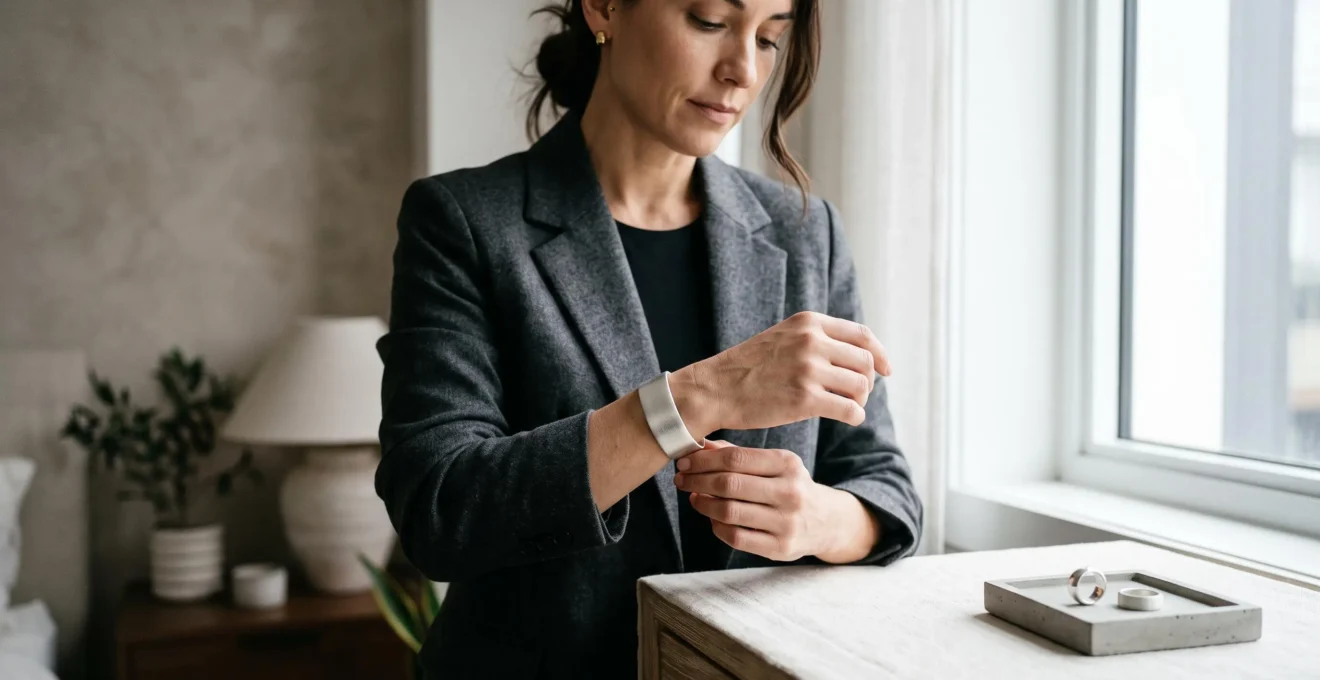
A minimalist wardrobe depends on thoughtful proportions, restrained colours and carefully chosen details. Jewellery should contribute to that balance rather than interrupt it. Matte silver offers an appealing solution: its textured surface softens reflected light, allowing metal to remain visually distinctive without the strong highlights associated with mirror polishing.
The difference is more than decorative. Brushed, sandblasted and engraved finishes interact with light and clothing in different ways. A satin silver ring may appear quietly luminous against wool, while a frosted cuff can introduce texture to a crisp cotton shirt without dominating the silhouette.
Choosing the right finish also involves practical considerations. Surface treatments affect how fingerprints, scratches and cleaning methods influence appearance over time. Understanding these distinctions makes it easier to select a piece that suits daily routines, professional settings and the fabrics already in a wardrobe.
Matte silver in minimalist dressing: the essentials
- Matte textures scatter reflected light, producing softer-looking highlights than highly polished surfaces under comparable conditions.
- Brushed satin, sandblasted and Florentine finishes offer different degrees of visual texture and should be selected alongside clothing fabrics.
- Gentle cleaning helps preserve textured finishes; abrasive polishing can alter the surface and create unwanted shiny areas.
- Why Matte Silver Finishes Suit Corporate Environments Better Than High Polish
- Matte vs Polished Finishes: Maintenance Frequency and Effort Comparison
- Brushed vs Sandblasted vs Florentine Matte: How Each Texture Interacts With Fabric
- The Cleaning Mistake That Accidentally Polishes Away Matte Texture
- How Mixed Matte-Polish Finishes Create Subtle Dimensional Contrast
- Why Certain Silver Pieces Thrive in Boardrooms Whilst Others Distract
- Why Brushed Satin Finishes Balance Visibility With Professional Discretion
- Which Silver Finishes Provide Subtle Shimmer Without Distracting Glare?
Why Matte Silver Finishes Suit Corporate Environments Better Than High Polish
Under office lighting, jewellery with a mirror-polished surface can produce concentrated reflections. A smooth silver ring may catch an overhead fixture or window at a particular angle, creating a bright highlight that briefly draws the eye. Matte finishes distribute much of that reflected light across different directions, typically producing a quieter visual effect.
The underlying distinction is optical. As described in The Physics Classroom‘s explanation of specular and diffuse reflection, relatively smooth surfaces produce directional reflections, while microscopic surface irregularities scatter light. This principle helps explain the visual difference between mirror-polished and textured silver, although actual results depend on surface geometry and illumination.
For professional dressing, this difference can support a more composed appearance. A narrow brushed cuff alongside a tailored jacket introduces an intentional material detail without requiring the brightness of a polished bracelet. The jewellery remains visible, but its texture becomes the principal point of interest.
Light behaviour matters particularly during video calls. Camera position, nearby windows and directional lamps can make polished jewellery produce noticeable highlights. Matte silver generally offers a softer alternative, although no finish eliminates reflections under every lighting condition.
A practical styling check is to examine a piece beside a window, beneath ordinary room lighting and through a phone camera. Rotate it slowly and notice whether bright highlights appear at the angles most likely during everyday wear. This is a personal visual assessment, not a standardized glare test.
Textured surfaces may also make some fine scratches less visually conspicuous because small marks blend with the existing grain. This is not guaranteed: deeper scratches, flattened areas and directional damage can remain obvious, especially on uniform frosted finishes.
The best professional piece is not necessarily the least reflective one. Its size, placement and relationship with clothing are equally important, particularly when comparing how different finishes age through everyday use.
Matte vs Polished Finishes: Maintenance Frequency and Effort Comparison
Polished and matte silver require different kinds of attention. A mirror finish makes fingerprints and fine surface marks relatively easy to notice, potentially encouraging frequent wiping or polishing. Matte silver can appear more consistent between gentle cleanings, but restoring an altered texture may require specialist finishing rather than ordinary home care.
Lower apparent maintenance does not mean greater resistance to damage. Matte surfaces may disguise certain marks while remaining vulnerable to abrasion, handling and gradual smoothing. Polished jewellery can often be refreshed through appropriate polishing, although every abrasive treatment introduces its own material considerations.
The following comparison describes typical visual and care considerations, rather than measured cleaning intervals.
| Consideration | Matte silver | Polished silver |
|---|---|---|
| Fingerprints | Often less visually prominent on textured surfaces | Frequently noticeable on mirror-like surfaces |
| Fine scratches | Some may blend into the existing grain | May interrupt the smooth reflection |
| Routine cleaning | Gentle methods that protect the texture | Gentle cleaning, with suitable polishing when necessary |
| Abrasive treatment | Can smooth or alter the intended finish | Can restore shine but may remove surface material |
| Visible finish damage | May require professional retexturing | May require refinishing or repolishing |
| Suitable preference | Soft reflections and minimal cosmetic intervention | Mirror shine and willingness to maintain it |
The Canadian Conservation Institute guidance on silver care and tarnish removal explains that silver polishing products use abrasives and that mechanical polishing can remove some metal. Its conservation advice does not establish how frequently jewellery with different finishes must be cleaned, but it provides an important reason to avoid unnecessary abrasion.
For someone who prefers putting on jewellery without repeatedly restoring a mirror shine, a matte or satin surface may feel easier to live with. Someone who actively enjoys maintaining a bright finish may prefer polished silver instead.
Cleaning frequency also depends on wear, storage, exposure to substances that encourage tarnishing, and the presence of gemstones, coatings or other materials. Matte silver is not tarnish-proof, and surface texture should not be confused with a protective barrier.
Once the preferred care routine is clear, the next consideration is texture itself: directional, frosted and engraved finishes create noticeably different relationships with fabric.
Brushed vs Sandblasted vs Florentine Matte: How Each Texture Interacts With Fabric
Matte silver is not a single surface treatment. Brushed, sandblasted and Florentine finishes achieve visual softness through different textures, producing distinct effects when placed against smooth shirts, structured tailoring or textured knitwear.
A brushed surface has fine, often parallel marks that create a directional grain. Sandblasting produces a more uniformly frosted appearance through fine surface irregularities. Florentine finishing introduces deliberately engraved, intersecting lines that form a decorative pattern.
These distinctions matter because fabric provides the visual background against which the metal is perceived.
| Finish | Visual character | Styling suggestion |
|---|---|---|
| Brushed | Fine linear grain and restrained directional sheen | Wool tailoring, textured cotton and understated knitwear |
| Sandblasted | Soft, comparatively uniform frosted surface | Smooth poplin, plain cotton and fine-gauge garments |
| Florentine | Visible cross-hatched engraved pattern | Plain fabrics where the metal supplies the principal texture |
Brushed silver works particularly well when the fabric already has a subtle directional structure. Against woven wool or lightly textured cotton, fine metal lines can echo the garment’s grain without reproducing it exactly. The relationship feels cohesive because both materials reward close observation.
Sandblasted silver offers a different effect. Its frosted surface can create a gentle contrast against smooth poplin or a plain knitted top. Rather than following the fabric’s weave, the jewellery introduces an even, softly illuminated surface.
Florentine finishes are more visibly patterned. A contributor to the Ganoksin Orchid discussion of Florentine engraving techniques describes the use of line gravers to create cross-hatched patterns. This practitioner description explains the construction of the texture, although it does not establish particular fabric pairings.
In minimalist styling, Florentine engraving is often most effective as a deliberate contrast. A patterned silver ring against a plain dark sleeve provides fine detail without requiring an additional decorative element.
Visual compatibility is only half the consideration. Pronounced ridges, sharp corners or rough finishing can catch fibres, especially on silk, loose knits and fine merino. The risk depends on actual surface construction rather than the finish’s name alone.
Check a bracelet where it approaches the cuff, a pendant where it contacts a neckline, and a ring where it brushes against delicate clothing. A properly finished textured surface should feel comfortable and should not repeatedly pull threads.
A useful styling principle is to select finer, smoother textures for delicate fabrics and reserve more pronounced patterns for robust or closely woven garments. This is a practical aesthetic guideline, not a technical compatibility standard.
Whichever texture suits the wardrobe, retaining its original character requires avoiding one particularly common mistake during cleaning.
The Cleaning Mistake That Accidentally Polishes Away Matte Texture
The most consequential cleaning mistake is treating matte silver as though it were mirror-polished jewellery. Conventional polishing cloths, abrasive creams and vigorous rubbing can change the surface’s microscopic texture, creating shinier areas that interrupt its intended soft appearance.
Silver polishing cloths commonly contain abrasive material. Abrasive products are designed to remove tarnish and can also affect the underlying surface. What improves the appearance of a polished piece may therefore compromise the carefully produced grain of matte silver.
The effect can be uneven. Repeated rubbing may smooth exposed edges more than recessed areas, creating contrasts between newly brightened sections and those retaining the original finish.
Technical conservation work also illustrates the importance of surface preparation. The Canadian Conservation Institute technical note on silver plating and surface finishes explains how polishing, texturing and burnishing influence the appearance of silvered surfaces. Its observations concern particular conservation processes, not all commercial jewellery, but demonstrate how mechanical treatment can change reflectivity.
Accidental shine is not necessarily permanent. Depending on the metal, plating thickness, design and original treatment, a jeweller may be able to restore the texture. However, attempting corrective abrasion at home can make the inconsistency more pronounced.
For plain, uncoated silver pieces that are suitable for contact with water, gentle cleaning is generally preferable to polishing. Lukewarm water, a small amount of mild detergent and careful drying may remove ordinary surface dirt without intentionally changing the finish.
A very soft brush may help clean accessible recesses when the jeweller confirms that brushing is appropriate. Avoid scrubbing the surface grain. Pieces containing pearls, porous stones, glued settings, decorative coatings or deliberately oxidized details may require entirely different methods.
Five steps to protect a matte silver finish
- Identify the construction. Check whether the piece is solid silver, plated, coated or combined with sensitive materials. The deliverable is a confirmed care specification or jeweller’s guidance.
- Inspect the existing texture. Examine the surface under soft light and identify any scratches, shiny patches or darkened areas. The deliverable is a reference photograph before cleaning.
- Choose compatible cleaning materials. If water-based cleaning is approved, prepare lukewarm water, mild detergent and a soft lint-free cloth. The deliverable is a cleaning setup without abrasive polish.
- Clean gently and dry carefully. Remove ordinary dirt without rubbing aggressively, then dry the piece thoroughly using an appropriate method. The deliverable is a clean surface with its visible grain preserved.
- Review and store separately. Compare the finish with the original photograph and place the jewellery in a suitable individual compartment. The deliverable is a documented condition check and protected storage position.
When considering a commercial cleaning cloth, read its instructions rather than relying on its softness. A fabric that feels gentle may still contain polishing compounds. If the product is intended to restore shine, avoid using it on a matte finish without specific confirmation of compatibility.
Once the distinction between preserving and polishing a surface is understood, combining both finishes in a single design becomes easier to appreciate.
How Mixed Matte-Polish Finishes Create Subtle Dimensional Contrast
A jewellery piece does not have to be entirely matte to achieve understated elegance. Designs combining a softly textured body with carefully placed polished edges can introduce depth without relying on a uniformly reflective surface.
The visual effect comes from the contrast between two treatments. A matte plane distributes reflected light across a wider range of directions, while a smooth polished bevel can create a more concentrated highlight at a particular viewing angle.
Consider a broad silver ring with a brushed outer face and narrow polished borders. The brushed area provides visual stability, while the edges catch occasional points of light as the hand moves. The contrasting finishes make the shape more legible without adding stones, colour or elaborate ornament.
Placement determines whether contrast remains subtle. Polished accents positioned along narrow edges or small geometric details generally occupy less visible area than a broad mirror-finished centre. They can nevertheless create strong highlights when directly aligned with a light source.
This approach offers useful versatility in a limited wardrobe. Against matte wool, a polished detail provides a modest point of light. Beside satin or another reflective fabric, the larger brushed surface can create a calmer relationship with the clothing.
Mixed finishes also allow jewellery to bridge different settings. A slim pendant with a satin body and polished rim may complement both a plain daytime shirt and a more formal evening outfit, without requiring a complete change of accessories.
There is a maintenance consideration, however. Cleaning one section must not unintentionally change another. Polishing the bright edge of a ring can be difficult without touching the adjacent brushed surface, particularly on intricate designs.
When choosing such a piece, examine how clearly the finishes are separated and whether the construction permits appropriate cleaning or professional refinishing.
The same principle applies beyond surface design: a jewellery piece can have a discreet finish yet remain distracting if its proportions, movement or sound are poorly suited to the setting.
Why Certain Silver Pieces Thrive in Boardrooms Whilst Others Distract
Professional jewellery is shaped by more than formality. Its appearance changes as the wearer gestures, moves between lighting conditions or works at a desk. A compact textured ring may remain visually consistent, while a dangling or highly polished accessory can introduce more movement and intermittent reflections.
These effects do not make expressive jewellery inherently inappropriate. They simply help explain why restrained silhouettes often integrate more naturally with minimalist professional outfits.
Four practical considerations can guide the choice:
- Scale: A piece should feel proportionate to the wrist, hand, neckline or ear rather than overwhelm the surrounding clothing.
- Movement: Static forms usually produce fewer changing visual elements than dangling charms or loosely suspended components.
- Reflection: Mirror surfaces and faceted stones can create concentrated highlights, particularly under directional lighting.
- Sound: Multiple bracelets or loose metal elements may make contact with desks, keyboards or one another during movement.
Imagine two hypothetical accessories worn with the same charcoal suit. The first is a narrow brushed silver cuff that follows the wrist and remains relatively still. The second is a polished bracelet carrying several small charms.
Both may be aesthetically appealing, but their behaviour differs. The first presents a stable textured shape. The second adds movement, changing reflections and potentially audible contact between components.
In a video meeting, the distinction may become more noticeable when hands move near the camera. A polished accessory can briefly reflect a lamp or window; a matte accessory usually produces softer reflections under similar conditions.
It is worth considering comfort as well. A heavy signet ring may interfere with typing, and a wide cuff may rest awkwardly against a desk even when its surface is suitably restrained.
The best choice therefore combines finish, form and practical wearability. A piece that looks discreet in a jewellery display should also feel natural during the activities for which it is intended.
For anyone seeking a compromise between presence and discretion, brushed satin silver deserves particular attention because it occupies a useful position between fully frosted and highly polished finishes.
Why Brushed Satin Finishes Balance Visibility With Professional Discretion
Brushed satin silver occupies a visually useful middle ground. Its fine directional texture moderates the intensity of reflections without removing the characteristic brightness of silver. The result is a surface that remains recognizably metallic while appearing less mirror-like than a high-polish finish.
Unlike a heavily frosted treatment, satin retains a controlled sheen. Fine linear marks break up reflections, but smooth areas within the texture can still respond visibly to light.
This balance makes satin an appealing option for jewellery worn near the face. Small satin-finished earrings or a simple pendant can remain visible against neutral clothing without relying on large stones or highly reflective settings.
For video calls, brushed satin is worth testing because its moderate sheen may appear more distinct than a deeply matte finish while producing fewer intense highlights than mirror polishing. Actual performance depends on light position, camera exposure, surface orientation and design.
Satin works best when its texture remains visually coherent. Repeated aggressive polishing can soften directional marks and increase shine in selected areas. Conversely, accumulated dirt or tarnish may reduce the finish’s original luminosity.
Because satin depends on a particular balance of grain and sheen, appropriate routine cleaning is often more desirable than attempting to restore brightness through vigorous buffing. The safest care method should always reflect the item’s materials and manufacturer’s guidance.
A styling example is a pair of narrow satin silver earrings worn with an ivory shirt and dark tailored jacket. The earrings add a cool metallic note without creating the pronounced reflections of broad polished hoops.
Satin also combines naturally with matte fabrics. Its restrained luminosity creates a small material contrast against cotton, wool or linen, while its directional grain provides enough detail to reward closer inspection.
When comparing pieces, examine the fineness of the brushing, the evenness of the surface and the way highlights change as the jewellery rotates. Two products labelled satin can still differ considerably in grain and reflectivity.
That balance leads to the broader decision: how much shimmer is desirable, and which combination of finish, texture and silhouette will produce it most reliably?
What to keep in mind before choosing a finish
- Evaluate reflection in the lighting where the jewellery will actually be worn, rather than relying on product photographs alone.
- Consider texture and physical construction together: a refined surface should complement the fabric without catching or damaging fibres.
- Prefer an adaptable silhouette and a finish whose care requirements fit the wearer’s routine, rather than selecting by brightness alone.
Which Silver Finishes Provide Subtle Shimmer Without Distracting Glare?
Brushed satin and finely textured matte finishes are strong choices for subtle silver shimmer because they soften concentrated reflections while retaining visible metallic character. Sandblasted silver generally produces a more frosted appearance, whereas high-polish surfaces create stronger directional highlights. The most suitable finish depends on lighting, jewellery geometry and the desired level of visual contrast.
The relationship between finish and reflection is better understood as a qualitative spectrum than a precise ranking. Without comparable measurements on actual jewellery samples, no universal glare score can be assigned to each treatment.
The following guide describes their typical appearance under otherwise similar conditions.
| Finish | Typical visual effect | Styling application |
|---|---|---|
| High polish | Strong directional highlights and a mirror-like appearance | Small accents or occasions where visible shine is welcome |
| Brushed satin | Moderate sheen with softened, directional reflections | Versatile everyday pieces and restrained professional jewellery |
| Fine sandblasted matte | Frosted appearance with broadly scattered reflections | Quiet minimalist styling and smooth neutral fabrics |
| Oxidized matte | Darkened appearance where oxidation and texture affect the visible surface | Low-brightness accents and designs emphasizing shape or contrast |
Oxidized silver needs a distinction: oxidation changes surface colour and contrast, but does not automatically produce a non-reflective texture. An oxidized piece may still have polished raised sections or other reflective details.
Likewise, hammered silver cannot automatically be classified as low glare. Its individual facets can reflect light in different directions, sometimes creating a series of distinct highlights rather than the even glow of a finely sandblasted surface.
Lighting can change the perceived result considerably. Direct sunlight may reveal bright reflections from polished borders, while soft ambient lighting may make the same accessory appear restrained. Office ceiling lights, warm lamps and window illumination each interact with jewellery differently.
Stones and mixed materials complicate the picture further. A small stone set flush within a matte surface may offer controlled contrast, but a faceted stone can still produce bright flashes. Pavé settings, with multiple small reflective surfaces, are generally less suited to a deliberately quiet visual effect.
The most reliable selection method combines three questions: how much light should the finish reflect, how should its texture relate to the clothing, and how much will the piece move during wear?
For maximum discretion, a compact, static form with a fine matte or satin texture is a sensible starting point. For a slightly more expressive result, narrow polished details can introduce brightness while leaving the principal surface restrained.
Choose one frequently worn outfit, examine two or three silver finishes beside its fabric under everyday lighting, and select the piece that adds definition without competing with the overall silhouette. The right finish should feel intentional as part of the wardrobe, not demand attention apart from it.
Does matte silver tarnish more slowly than polished silver?
A matte finish does not inherently prevent tarnishing. Silver can react with sulfur-containing substances in its environment regardless of whether the visible surface is polished or textured. Surface roughness, storage conditions, coatings and exposure may influence how tarnish develops or appears, but there is no reliable universal cleaning interval based solely on finish.
Can scratched matte silver jewellery be refinished?
Refinishing may be possible, especially on suitable solid-silver pieces. A professional jeweller can assess whether the original brushing, frosting or engraving can be restored. Thin plating, coatings, detailed engraving and delicate settings may limit the available options, so avoid attempting aggressive home abrasion.
Is brushed silver the same as satin silver?
The terms overlap but are not completely interchangeable. Brushed describes a directional surface treatment, while satin generally describes a soft, moderate sheen. Brushing can create a satin appearance, but commercial naming varies, so examine the actual surface rather than relying on the product label alone.
Can matte silver jewellery be worn with polished accessories?
Yes. Combining a matte ring with a narrow polished bracelet, for example, can create controlled contrast. To maintain a minimalist appearance, keep the number of pieces limited, consider their relative proportions and allow one finish to remain visually dominant.
Which silver texture is safest to wear against delicate knitwear?
A smoothly finished piece with minimal surface relief, rounded edges and no projecting elements is a sensible choice. Fine satin textures may work well, but the actual construction matters more than the finish name. Check the jewellery for rough points that could catch silk, fine merino or loosely knitted fibres.