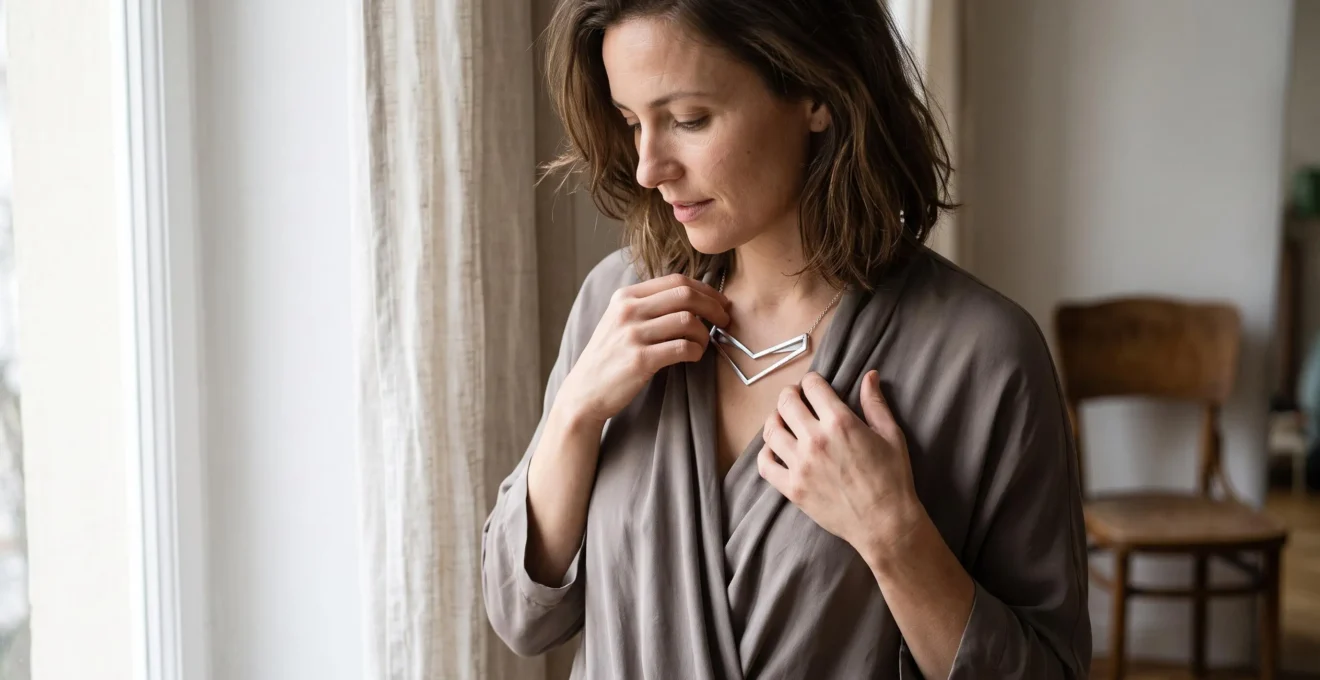
Angular silver jewelry and flowing contemporary clothing might seem like opposing design languages. One relies on defined edges, straight lines, and precise geometry; the other emphasizes movement, draping, and relaxed silhouettes. Yet that difference can become the defining feature of a balanced outfit.
The key is to use geometric silver jewelry as a deliberate structural accent rather than repeating sharp shapes across every accessory. A triangular pendant can frame a softly draped neckline, while a sculptural cuff can give definition to a loose sleeve. Neither needs a rigid garment to feel intentional.
Successful combinations depend on proportion, placement, fabric behavior, and surface finish. The goal is not to conceal the jewelry’s geometry but to let its architectural character coexist with the softness of contemporary fashion.
Whether styling a silk blouse, relaxed tailoring, or a minimalist dress, a few practical decisions can help angular accessories feel distinctive without making the overall look unnecessarily severe.
Angular Silver Jewelry Styling Essentials
- Choose one dominant geometric focal point and allow flowing fabrics or rounded accessories to provide contrast.
- Adjust jewelry size and placement to the garment’s drape, neckline, and existing structural details.
- Use mixed profiles and matte-polished finishes to introduce depth without multiplying competing sharp edges.
- Why Sharp Geometric Edges Create Striking Contrast Against Flowing Fabrics
- Sharp Angles vs Rounded Profiles: Which Flatters Different Face Shapes?
- How to Balance Angular Silver Jewelry With Soft Contemporary Styling
- How Mixed-Profile Layering Creates Visual Interest Without Geometric Harshness
- The Angular Overload That Creates Aggressive Rather Than Architectural Looks
- Statement Pieces vs Delicate Layers: Which Suits Your Work Environment?
- How Mixed Matte-Polish Finishes Create Subtle Dimensional Contrast
- How Matte Silver Textures Create Understated Elegance in Minimalist Wardrobes
Why Sharp Geometric Edges Create Striking Contrast Against Flowing Fabrics
Sharp geometric silver jewelry creates contrast against flowing fabrics because it introduces defined lines into a silhouette dominated by curves and movement. A single angular pendant or cuff can establish a visual focal point without changing the garment’s natural drape. The effect is strongest when the jewelry complements the fabric’s proportions rather than competing with several other structural details.
Consider a loose silk blouse with fabric gathering around the collarbone. Its folds create shifting curves, while a triangular silver pendant introduces a consistent outline. The pendant provides a point of visual stability as the fabric moves.
The relationship between geometry and fluidity has meaningful precedents in design history. The Met‘s collection record for Ed Wiener’s geometric necklace documents a 1948 sterling silver design incorporating alternating shapes, including triangles and a rhomboid. The work illustrates how angular forms can contribute to a coherent jewelry composition, although it does not prescribe contemporary styling rules.
Placement determines how the contrast reads. An angular pendant positioned above an uninterrupted area of draping can provide definition. Multiple geometric pieces scattered between the ears, neckline, wrists, and hands may instead divide the outfit into competing focal points.
Fabric behavior matters as much as jewelry shape. A lightweight poplin shirt or softly tailored crepe garment may visually accommodate a substantial cuff or pendant, while very fluid jersey or delicate silk can look more harmonious with lighter geometric pieces. These are styling judgments, not fixed material rules. Actual weight and physical contact also matter: heavy jewelry can distort delicate fabric if attached to it.
A simple visual test is to hold the jewelry against the garment before putting it on. Compare the longest visible line of the piece with the dominant direction of the fabric folds:
- Parallel lines: Often create continuity and a more integrated appearance.
- Perpendicular lines: Introduce a stronger interruption that can become an intentional focal point.
- Diagonal lines: Add directional energy but may compete with complex or asymmetrical draping.
This comparison is a practical styling experiment rather than a scientifically established rule. The same diagonal pendant might look coherent against a plain blouse but visually busy against a heavily pleated garment.
Once the garment provides an appropriate backdrop, the next consideration is how the jewelry’s shape interacts with the proportions of the wearer.
Sharp Angles vs Rounded Profiles: Which Flatters Different Face Shapes?
Sharp angular earrings can introduce visual definition around round or oval faces, while rounded jewelry may soften the appearance of square or rectangular jawlines. These are flexible styling tendencies rather than universal rules of attractiveness. Earring length, placement, personal preference, and the balance between earrings and necklaces can matter just as much as face shape.
The central distinction is between echoing existing facial lines and deliberately contrasting them. Geometric earrings can repeat the straight lines of an angular jaw, creating a striking architectural effect. Alternatively, curved hoops or rounded drops can introduce a softer counterpoint.
For rounder faces, elongated triangular earrings or narrow geometric drops may create a stronger vertical emphasis. For oval faces, a wide range of angular and rounded profiles can work, with scale and hairstyle often influencing the final impression more than the underlying face shape.
Use the following comparison as a starting point rather than a prescription.
| Face shape | Angular styling option | Softer alternative |
|---|---|---|
| Round | Elongated triangles or narrow geometric drops for visual definition | Oval drops for a gentler vertical line |
| Oval | Angular studs, asymmetric earrings, or geometric drops | Rounded hoops and curved sculptural forms |
| Square | Compact geometric studs to echo defined facial lines | Rounded hoops or curved drops to contrast with the jaw |
| Rectangular | Wider geometric profiles to emphasize horizontal balance | Shorter rounded earrings for a softer framing effect |
Proportion can override the apparent effect of shape. A long triangular earring ending below the jaw establishes a different silhouette from an equally angular stud positioned close to the earlobe. The angle’s relationship to the jawline and neck matters more than simply categorizing the earring as sharp.
Angular necklaces require a slightly different assessment. A pointed pendant can direct attention down the center of the torso, particularly when its position follows an open neckline. However, a sharply angled necklace sitting directly against a V-neck may repeat the neckline so closely that both elements compete.
When combining earrings and necklaces, consider making only one of them strongly geometric. Angular earrings paired with a curved chain, or a triangular pendant paired with soft hoops, can retain architectural interest without concentrating every sharp line around the face.
Face shape offers one useful reference, but clothing provides the larger visual context. A geometric piece that feels prominent near the face may become more balanced when the garment’s neckline, texture, and proportions are considered together.
How to Balance Angular Silver Jewelry With Soft Contemporary Styling
Balance angular silver jewelry with soft contemporary clothing by giving geometric structure one primary area of emphasis and keeping the surrounding elements relatively fluid. An angular pendant, for example, can complement relaxed tailoring and a draped blouse when the outfit avoids competing sharp accessories. Neutral colors, thoughtful proportions, and a single organic detail help maintain a modern appearance without making it feel rigid.
A practical approach is to divide an outfit into three visual zones: the upper body and neckline, the central garment silhouette, and the hands or wrists. Decide which zone should provide the strongest geometric statement, then allow the others to play supporting roles.
This is a three-zone styling heuristic, not a mandatory ratio. An asymmetric silver collar might be the dominant angular feature, supported by soft trousers and a relaxed handbag. Alternatively, a structured blazer can provide the geometry while a delicate silver chain maintains the connection to the overall aesthetic.
Color affects how readily jewelry lines stand out. Against ivory, charcoal, taupe, or muted grey, a silver piece often remains visually distinct without requiring additional accessories. Bright patterns or densely detailed fabrics can compete for attention, especially when a pendant overlaps the print.
Construction details also deserve attention. A sharply cut lapel, asymmetric neckline, pronounced shoulder, or diagonal slit already introduces direction into the silhouette. Rather than adding another unrelated angle, choose jewelry that echoes one existing line or contrasts with it in a clearly controlled way.
Historical clothing design offers a useful illustration of how fabric establishes its own visual architecture. The Met’s collection record of a draped Madame Grès evening dress describes a 1974–75 silk-crepe garment featuring cascading folds. Although the record does not address jewelry styling, it demonstrates how fabric selection and construction can generate a complex silhouette without rigid tailoring.
The opposite challenge arises when an outfit is excessively minimal. A white shirt, straight trousers, polished silver triangle earrings, and rigid accessories may create a deliberately severe effect. If that is not the desired direction, introduce one organic element: softly arranged hair, tactile knitwear, or a slouchy leather bag.
A Five-Step Angular Jewelry Styling Check
- Identify the focal point: Select one jewelry piece or structured garment detail and record which element should attract attention first.
- Inspect the fabric: Hold the jewelry next to the garment and identify whether its strongest line echoes or interrupts the dominant folds.
- Check competing angles: Review the neckline, shoulders, earrings, and wrist accessories; identify any sharp line that feels unnecessarily repeated.
- Add a soft counterpoint: Introduce one rounded accessory, textured garment, or relaxed detail and compare the appearance.
- Review the complete outfit: Take a full-length photograph and confirm that the intended focal point remains clear without distracting from the overall silhouette.
These five checks create a repeatable method for evaluating an outfit rather than relying on isolated rules about which garments supposedly belong with geometric jewelry.
Once the main focal point is established, layering becomes an opportunity to add subtle complexity instead of increasing visual competition.
How Mixed-Profile Layering Creates Visual Interest Without Geometric Harshness
Mixed-profile layering combines angular and rounded jewelry to create movement between distinct shapes. The arrangement works particularly well when pieces occupy different lengths or positions, allowing the eye to recognize each silhouette. A geometric pendant paired with a curved chain, for instance, introduces contrast without repeating sharp edges at every level of the neckline.
The most useful principle is gradual visual transition. Instead of combining several equally prominent geometric pendants, establish a sequence from one angular element toward softer profiles, or reverse the direction if a rounded piece is intended to dominate.
For example, a short rounded silver chain can sit above a medium-length geometric pendant, followed by a longer, uncomplicated necklace. The change in length provides separation, while the contrast between rounded and angular forms makes the arrangement feel intentional.
Exact necklace lengths are less important than how the pieces sit on the individual wearer. Neckline depth, pendant dimensions, torso proportions, and chain movement determine whether two necklaces remain visually distinct.
Contemporary fashion advice supports a flexible approach to accessory distribution. Vogue‘s editorial advice on layering jewelry discusses choosing focal areas, experimenting with necklace lengths, and mixing materials. Jewelry designer Jennifer Fisher describes favoring emphasis on either earrings or necklaces rather than making both equally dominant. These are editorial styling preferences, not universal restrictions.
To keep mixed-profile layering visually readable, try changing the length before changing another variable. Combining markedly different shapes at almost identical positions can create a crowded arrangement, especially when the chains overlap.
At the wrists and hands, a different approach may be more practical. Bracelets and rings move with gestures, so large angular profiles placed immediately next to rounded pieces can collide, rotate, or interrupt each other’s positioning.
Smaller mixed-profile rings or a restrained combination of one angular cuff and one curved bracelet may be easier to manage. Consider comfort, clearance between pieces, and whether corners catch on sleeves, particularly with delicate fabrics.
Layering should feel like a connected composition. When every piece demands equal attention, removing a secondary accessory can improve the arrangement more effectively than introducing another one.
The Angular Overload That Creates Aggressive Rather Than Architectural Looks
Angular jewelry can shift from architectural to visually aggressive when several large, sharply defined pieces compete across the face, neck, wrists, and hands. The distinction is subjective, but an architectural look generally benefits from controlled repetition and softer negative space. Reducing secondary angles, adjusting their direction, or introducing rounded elements can make the overall composition feel more balanced.
Architectural styling is not defined by how many geometric objects appear in an outfit. Its strength often comes from the relationship between a prominent structure and the space surrounding it.
A large silver triangular necklace worn against a fluid monochrome dress may communicate clarity and intention. Adding equally prominent triangular earrings, a pointed cuff, and several oversized geometric rings produces a different arrangement, with multiple objects competing to become the main statement.
Watch for several practical signs of angular overload:
- Large geometric earrings and an equally assertive geometric necklace compete near the face.
- Pointed cuffs or rings project outward and draw attention away from the clothing.
- Angular motifs repeat across several accessories without a clear focal hierarchy.
- The garment, bag, shoes, and jewelry all contribute strong structural lines with little visual softness.
Angle direction can influence the impression. A long pendant with a downward point often reinforces the vertical line of an outfit, while angular details projecting toward the cheeks or beyond the wrists can appear more expansive and assertive. Neither orientation is inherently wrong; the desired mood and surrounding silhouette determine whether it works.
When a look feels overcrowded, begin with the smaller repeated pieces rather than immediately removing the main statement necklace. Secondary geometric rings, additional earrings, or stacked cuffs can create repeated visual interruptions that are easy to overlook individually.
Remove one accessory, evaluate the silhouette, and repeat only if necessary. This gradual editing process preserves the intended geometric identity while clarifying its hierarchy.
Softness does not require replacing all sharp forms with curves. Even one visible draped sleeve, rounded handbag, or organic texture can offer enough contrast to change the overall impression.
The ideal degree of visual intensity also depends on where the outfit will be worn, particularly when personal style must coexist with professional expectations.
Statement Pieces vs Delicate Layers: Which Suits Your Work Environment?
Statement angular silver jewelry often suits creative or visually expressive workplaces, while smaller geometric accessories may be easier to incorporate into formal professional settings. The best choice depends on actual workplace culture, the frequency of face-to-face or video interactions, and the impression the wearer wants to create. Neither statement jewelry nor delicate layering is inherently more professional.
Three contextual questions provide a practical starting point: How often is the outfit seen on camera or in person? How formal is the organization’s everyday dress culture? And what kinds of accessories do colleagues actually wear?
These observations are more informative than relying exclusively on broad labels such as creative, corporate, or conservative. A design studio may favor expressive accessories, but a client-facing presentation can still call for a more restrained look. Conversely, a formal office may accommodate a striking sculptural ring when it is integrated thoughtfully into the overall outfit.
Visual framing is particularly important for video meetings. Earrings and necklaces remain visible within a typical head-and-shoulders composition, while bracelets may rarely appear. A pair of angular silver earrings can therefore establish a clearer signature than several understated rings.
For in-person settings where clothing and accessories are visible together, placement becomes more flexible. A sculptural cuff over a smooth sleeve, or a single geometric ring paired with soft tailoring, can express personal style without concentrating every detail near the face.
| Work context | Statement option | Delicate alternative |
|---|---|---|
| Creative studio | Oversized geometric pendant with relaxed clothing | Mixed-profile silver necklace layers |
| Video meetings | Angular earrings positioned within the camera frame | Fine geometric chain or compact silver studs |
| Formal office | One sculptural ring or restrained cuff | Small angular earrings with an understated necklace |
| Client-facing presentation | Single controlled geometric accent | Small, clearly defined angular jewelry with minimal movement |
Delicate geometric layers can offer a consistent style signature, while a single statement piece concentrates attention at a chosen moment. The decision is less about avoiding boldness than choosing how visible the accessory should be.
Very assertive angular designs may be interpreted differently across workplaces and cultures. Such impressions are contextual and should not be treated as evidence that particular shapes universally communicate authority, distance, or aggression.
Once size and placement are settled, finish offers another way to control visual prominence without changing the geometric design itself.
How Mixed Matte-Polish Finishes Create Subtle Dimensional Contrast
Combining matte and polished silver finishes adds visual depth to angular jewelry by varying how strongly different surfaces reflect light. Polished elements can emphasize selected edges, while matte surfaces create quieter areas within the composition. Used together, they allow similar geometric profiles to remain distinguishable without requiring additional colors or more elaborate shapes.
The distinction is particularly useful when working with minimalist wardrobes. A pair of angular earrings may already have enough geometric presence; changing the finish of a coordinating bracelet can introduce variation without repeating another prominent motif.
Polished silver tends to create more concentrated highlights, while matte, brushed, or satin-like surfaces scatter reflected light more broadly. The precise appearance depends on surface treatment, the surrounding light, and the piece’s condition.
One styling approach is to place the brighter finish near the face and use matte jewelry farther down the body. A polished geometric earring can become the main highlight, supported by a brushed silver cuff.
The reverse can also work. Under strong lighting, matte earrings may feel quieter, while one polished ring introduces a small reflective accent. Rather than applying a universal rule, test the finishes under the lighting in which the outfit will be worn.
Mixed finishes can also clarify layered jewelry. When two necklaces have similar silhouettes, subtle differences between polished and brushed surfaces may help distinguish their contours. Length separation remains useful, however, because finish contrast alone may not prevent overlapping chains from looking crowded.
Surface condition introduces a practical limitation. Sterling silver can accumulate scratches and tarnish with use. The Gemological Institute of America‘s educational guidance on everyday ring metals describes sterling silver as relatively susceptible to scratching and dents and explains that tarnish can develop over time.
Scratching and tarnishing are different processes. A scratched polished surface does not automatically become an intentional satin finish, and a tarnished matte surface should not be treated as equivalent to a deliberately brushed texture.
Check jewelry periodically for visible wear, particularly on corners, raised edges, and frequently contacted surfaces. Cleaning or refinishing should follow the manufacturer’s guidance because abrasive polishing can change an intentionally matte or brushed treatment.
Mixed finishes provide flexibility, but a predominantly matte approach can be especially effective when the wardrobe already relies on subtle textures and understated silhouettes.
Key Takeaways for a Refined Silver Jewelry Look
- Matte silver can make angular designs feel graphically defined without relying on strong reflective highlights.
- Matching jewelry finish to garment texture creates a coherent starting point, but intentional contrast can add depth.
- A single polished accent can keep an otherwise matte outfit from appearing visually flat.
How Matte Silver Textures Create Understated Elegance in Minimalist Wardrobes
Matte silver jewelry complements minimalist wardrobes by emphasizing form and texture rather than intense shine. On angular designs, the subdued surface treatment allows straight edges and sculptural outlines to remain visible without making reflection the dominant feature. Pairing matte silver with linen, washed cotton, or textured wool can create a cohesive look, while a small polished detail adds contrast when needed.
Minimalist styling depends on deliberate choices. When an outfit uses a limited palette, restrained detailing, and simple silhouettes, the surface of an accessory becomes more noticeable. A matte geometric cuff can contribute architectural definition without drawing attention through repeated flashes of reflected light.
This makes matte silver a useful option for larger geometric pieces. A broad angular cuff that might appear highly decorative in a mirror-polished finish can take on a quieter, more graphic character when its surface is brushed or satin-like.
Texture correspondence offers a practical way to coordinate jewelry and fabric. Matte silver beside washed linen, felted wool, or softly textured cotton creates a shared visual restraint. Polished silver beside silk or satin may echo the garment’s reflective character instead.
These combinations are aesthetic options, not material requirements. A polished geometric pendant against rough linen can provide an equally intentional contrast, just as matte jewelry can balance a glossy blouse.
The potential weakness of an entirely matte outfit is a lack of visible variation. Matte silver earrings, a brushed cuff, washed cotton, and flat-colored trousers can create a harmonious arrangement, but their surfaces may appear too similar under diffuse lighting.
One carefully selected highlight can restore depth. A polished silver ring, a subtly reflective earring edge, or a small satin detail near the neckline introduces a different light response without transforming the outfit into a highly decorative ensemble.
For an understated daytime outfit, consider a relaxed linen shirt, fluid charcoal trousers, and one medium-sized matte geometric pendant. Keep the remaining jewelry compact or rounded. If the composition feels visually flat, replace one small accessory with a polished piece rather than adding another oversized angular design.
Matte jewelry still requires care. Avoid assuming that every cleaning or polishing method is suitable for a textured surface. Follow finish-specific maintenance advice, especially if the piece combines brushed sections with deliberately polished edges.
Build a wearable combination by starting with one fluid garment and one angular silver piece. Assess their scale, texture, and placement together, then introduce only the accessories needed to complete the visual balance. The most effective result is not necessarily the simplest or boldest, but the one in which geometry and softness have distinct, complementary roles.
Can angular silver jewelry work with romantic or feminine clothing?
Yes. Angular silver jewelry can complement romantic clothing by introducing a defined counterpoint to ruffles, draping, and soft fabrics. A single geometric pendant with a fluid dress or angular earrings with a softly gathered blouse can create contrast while preserving the garment’s character. Keep competing accessories restrained if a balanced rather than dramatic result is preferred.
Should geometric silver jewelry match the shape of a neckline?
Not necessarily. Matching a pendant’s direction to a neckline can create continuity, while contrasting their outlines may produce a stronger focal point. Consider the space between the jewelry and the neckline: a pendant overlapping complicated draping can appear crowded, whereas one resting against a relatively open area often remains easier to distinguish.
Is sterling silver suitable for angular rings worn every day?
Sterling silver can be worn regularly, but it is relatively susceptible to scratching, dents, and tarnishing. Angular rings with exposed corners may also require particular attention to comfort and contact with clothing or other objects. Inspect high-contact areas and follow appropriate cleaning guidance to preserve both the metal and its surface finish.
Can matte and polished silver jewelry be combined without matching exactly?
Yes. Mixed finishes can make a silver jewelry arrangement more dimensional without requiring identical surfaces. A matte cuff can complement polished earrings, while a brushed pendant can sit alongside a reflective chain. Coordinate the pieces through shared proportions, compatible shapes, or a clear focal point rather than insisting on an exact finish match.
How can angular jewelry be styled without making an outfit feel too formal?
Combine one prominent angular accessory with relaxed fabrics, softer silhouettes, and organic textures. A sculptural silver pendant over a loose knit or draped blouse generally creates a different impression from the same pendant worn with sharply tailored clothing and several rigid accessories. Adjusting the surrounding pieces often changes the mood more effectively than replacing the geometric jewelry itself.