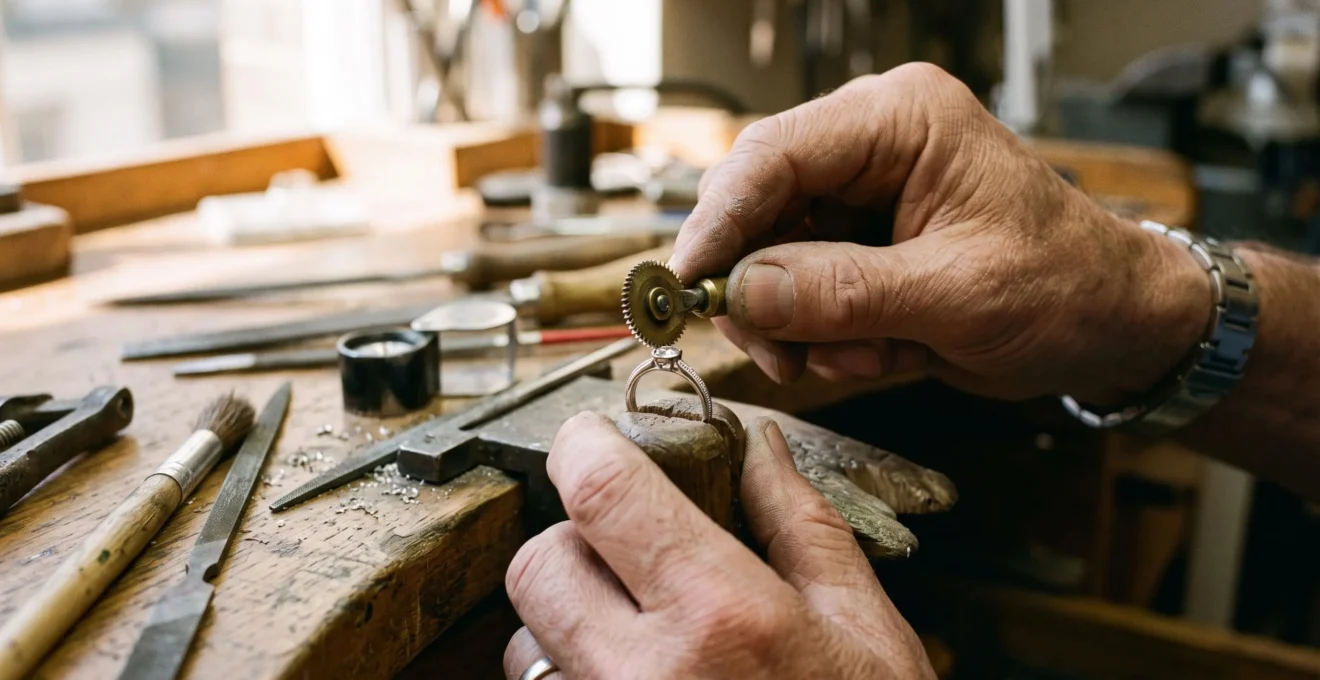
A border of tiny metal beads surrounding a diamond can reveal more about antique jewelry than its decorative appearance suggests. Known as millgrain or millegrain, this finishing technique became particularly associated with the delicate platinum settings of Edwardian jewelry and remained prominent in the geometric designs of the Art Deco period.
For collectors, the significance lies in how the beads were made, their relationship to the setting, and whether their execution agrees with the piece’s supposed age. Crisp impressions formed with a jeweler’s millgrain wheel can reveal skilled metalworking, while softer cast reproductions may suggest a different manufacturing process.
Yet millgrain alone cannot authenticate or precisely date a jewel. Later reproductions can reproduce historical patterns, and original pieces sometimes undergo repairs that change their decorative edges. Reliable assessment combines bead formation, design, metal composition, construction details, hallmarks, and evidence of restoration.
What Millgrain Reveals About Antique Jewelry
- Fine millgrain borders are characteristic of many Edwardian platinum designs, while Art Deco pieces frequently combine beading with more geometric settings.
- Under magnification, bead definition, spacing, surface texture, and interruptions can help distinguish hand finishing from cast decoration and possible repairs.
- Hallmarks and construction evidence are essential cross-checks; excessive polishing can permanently remove original details used in historical assessment.
- Why Millgrain Beading Instantly Identifies Edwardian and Art Deco Jewelry
- How Jewellers Create Precise Beaded Rims Using Millgrain Wheels
- Hand-Millgrained vs Cast Imitation Beading: How to Spot the Difference
- The Cleaning Error That Flattens Delicate Millgrain Beading Permanently
- How Millgrain Bead Density Reveals Craftsmanship Quality and Period Accuracy
- Why Hallmarks Reveal a Piece’s Age, Origin and Authenticity Instantly
- Why Precision-Cast Silver Captures Details Impossible to Hand-Carve
- How to Decode Silver Hallmarks to Authenticate and Date Antique Pieces
Why Millgrain Beading Instantly Identifies Edwardian and Art Deco Jewelry
Millgrain beading is a valuable stylistic clue when identifying Edwardian and Art Deco jewelry because it appears prominently in the fine metal borders of both periods. Edwardian designs often use delicate beading within flowing platinum settings, while Art Deco examples frequently integrate similar details into geometric compositions. The distinction is useful for preliminary dating, but neither style nor bead spacing provides conclusive proof of age.
During the Edwardian period, traditionally associated with the reign of Edward VII and extending stylistically into the years before the First World War, platinum enabled jewelers to create exceptionally delicate settings. Its strength allowed fine frameworks to support diamonds while leaving relatively little visible metal.
Millgrain complemented this approach by softening the visual boundaries between stones and settings. Tiny beads outlined bezels, pierced panels, and intricate arrangements inspired by lace, ribbons, flowers, and garlands.
As documented in Sotheby’s history of jewellery through the ages, platinum, filigree, and millegrain were characteristic features of Edwardian jewelry. This association is particularly useful when several design characteristics appear together.
Art Deco jewelry retained beaded edges but increasingly placed them alongside architectural forms, stepped arrangements, straight lines, and strongly contrasting gemstones. The appearance of millgrain therefore changed with the surrounding design language rather than through a universally defined change in bead dimensions.
| Feature | Edwardian tendencies | Art Deco tendencies |
|---|---|---|
| Design structure | Flowing, lace-like, garland-inspired | Angular, symmetrical, geometric |
| Millgrain placement | Fine borders following delicate curves | Beading outlining geometric settings and panels |
| Typical visual effect | Light, intricate, understated metalwork | Defined edges within structured compositions |
| Additional clues | Platinum, pierced ornament, floral motifs | Stepped designs, calibrated stones, contrasting materials |
These are stylistic tendencies, not exclusive manufacturing rules. A finely beaded geometric ring could be an original Art Deco piece, a later revival, or a contemporary reproduction made using traditional techniques.
Look beyond the millgrain to assess the metal, the back of the setting, the piercing technique, and the relationship between individual gemstones. Hand-cut openings, calibré-cut stones, and construction appropriate to the proposed period may strengthen an attribution, but each feature must be evaluated in context.
Once the broader period style appears plausible, the next question is whether the beaded edge was genuinely worked with a tool or reproduced as part of the metal casting.
How Jewellers Create Precise Beaded Rims Using Millgrain Wheels
Jewelers traditionally create millgrain by rolling a small patterned steel wheel along the edge of a metal setting. The wheel’s shaped teeth press into the surface, displacing metal into a succession of tiny rounded impressions. Precise results depend on the chosen tool, controlled pressure, suitable edge preparation, and the jeweler’s ability to maintain consistent contact through curves and corners.
A conventional millgrain tool has a handle and a small rotating wheel with a shaped working edge. Unlike casting, which forms a decorative pattern in a mold, traditional millgraining modifies an existing metal surface after the setting has been manufactured.
The jeweler first prepares the edge to receive the decoration. A narrow, accessible rim of sufficient metal must remain around the setting, whether surrounding a bezel or bordering a bright-cut surface. The exact geometry depends on the design and the metal being worked; a thin, work-hardened rim is not an absolute requirement for every application.
The wheel is then guided along the edge under carefully controlled pressure. Its repeated contact forms the visual rhythm of the beads. In restricted corners or difficult transitions, individual beading tools and hand gravers can help complete the pattern.
Leon Megé‘s technical overview of jewellery metal finishes describes both rolling tools and individual bead-forming methods. The workshop also describes millgrain sizes ranging from 0.1 mm to 1.5 mm, illustrating the substantial variation possible within the technique. These figures are not historical dating standards.
Tool control becomes especially visible where the direction changes. On a straight border, maintaining a regular sequence may be comparatively straightforward. Tight curves require adjustment of hand position and tool angle to avoid overlapping impressions or uneven contact.
A skilled craftsperson manages these transitions without visually disrupting the border. Slight variations may remain, even in carefully executed work, because the finishing is controlled by hand.
By contrast, pronounced gaps, crushed sections, unexpectedly flattened beads, or irregular overlaps can suggest poor execution, inappropriate tool selection, or subsequent damage. They are reasons for closer inspection rather than automatic evidence of inexperience.
Multiple careful adjustments may be needed to produce a satisfactory finish, although repeated passes over the same beads are not universally required and can themselves distort the pattern if poorly controlled.
Metal behavior also affects the result. Platinum, gold alloys, and silver respond differently to local pressure and finishing. The jeweler must adapt the technique to the material and the available edge rather than impose a single bead profile on every setting.
The finished surface can reveal tool marks and finishing decisions, but its appearance must still be distinguished from comparable decoration created by modern casting.
Hand-Millgrained vs Cast Imitation Beading: How to Spot the Difference
Hand-applied millgrain often displays sharply defined impressions, subtle variations in spacing, and surface features consistent with metal displacement. Cast millgrain may appear softer, rounder, and more integrated into the surrounding casting texture. A 10x jeweler’s loupe can reveal useful differences, although neither crispness nor casting porosity independently proves how a piece was made or when it was manufactured.
Begin by examining a clean, well-lit section of the border at approximately 10x magnification. Change the direction of the light rather than judging the beads from one fixed angle. Oblique illumination can make shallow depressions, wear, and variations in relief easier to see.
Hand-finished work may show a sequence of individual tool impressions, occasionally with minute irregularities where the jeweler repositioned the wheel. Look for how the beads merge with adjacent metal, particularly around curves and transitions.
In contrast, cast decoration can reproduce the entire beaded pattern at once. Depending on the quality of the model, mold, casting, and later finishing, its individual beads may appear more rounded or less distinctly separated.
Small pits between beads may be compatible with casting porosity, but isolated pits can also result from corrosion, wear, or other manufacturing processes. Likewise, an extremely consistent border is not inherently cast: skilled jewelers can produce remarkably uniform handwork.
| Inspection point | Hand-applied millgrain | Cast millgrain |
|---|---|---|
| Bead definition | Often crisp, individually impressed | May be softer or more rounded |
| Spacing | Can show subtle manual variations | May reproduce consistent modeled spacing |
| Edge transitions | May show changes in tool direction | Pattern formed within the modeled shape |
| Surface texture | Potential evidence of displaced and finished metal | Potential casting texture or porosity |
| Dating value | Supports manufacturing-method assessment | Supports manufacturing-method assessment |
Neither column establishes a manufacturing date. Modern jewelers still apply millgrain by hand, and cast settings can be refined manually after casting.
For collectors, the financial significance depends on the object’s identity and the claims made about it. A cast reproduction should not be valued as an original period jewel solely because the decorative pattern resembles historical handwork. Equally, hand-applied millgrain does not make a newly manufactured ring antique.
Restoration adds another layer of uncertainty. An antique setting may retain original beads along one section while displaying newly applied millgrain elsewhere. A repaired segment might have sharper impressions, a different bead size, or an abrupt change in spacing.
Such inconsistencies deserve documentation, particularly near resized shanks, replaced bezels, solder joints, and sections that have been rebuilt. They may indicate restoration, although variations can also arise during the original manufacturing process.
Five-Step Millgrain Authentication Inspection
- Photograph the complete jewel. Record clear front, side, and reverse views to establish its overall construction and decorative layout.
- Inspect the beaded edges at 10x. Capture close-up images of at least one straight section, one curved section, and any visibly irregular area.
- Compare bead formation. Note differences in sharpness, spacing, relief, and surrounding metal texture in a short observation record.
- Check possible repair locations. Mark any interrupted borders, abrupt changes, solder seams, or unusually fresh-looking details on the photographs.
- Cross-check the manufacturing evidence. Record visible hallmarks, metal information, and setting construction, then identify which findings require professional verification.
The result should be an evidence-based assessment with photographs and clearly separated observations, not a definitive authentication based on one decorative feature.
Preserving the surface in its current condition is equally important: aggressive cleaning may erase the very characteristics that make this comparison possible.
The Cleaning Error That Flattens Delicate Millgrain Beading Permanently
The most damaging cleaning mistake is aggressive polishing of raised millgrain borders. Abrasive compounds, forceful polishing cloths, and mechanical buffing can gradually remove the metal forming the beads. Once original material is worn away, its historical surface cannot be recovered. Reworking the edge may recreate a decorative pattern, but it cannot restore the original craftsmanship evidence.
Millgrain is especially vulnerable because its visual effect depends on very small differences in metal relief. Each bead stands above neighboring depressions, leaving exposed high points where polishing friction can concentrate.
Repeated abrasion gradually rounds those high points. A border that originally displayed clear individual impressions may become a continuous, softened ridge with only faint traces of its former pattern.
The Canadian Conservation Institute‘s guidance on caring for metal objects explains that polishing removes original surface material and can damage delicate decoration. Its advice concerns historical metal objects generally rather than a tested cleaning procedure for millgrain jewelry specifically.
“Polishing is abrasive in nature: some of the original surface is always removed.”
For antique jewelry, the safest approach is to determine what the piece can tolerate before applying moisture, pressure, or cleaning products.
Do not assume soaking is universally safe. Pearls, opals, certain treated gemstones, enamel, adhesives, unstable settings, and deteriorated components may make immersion inappropriate. Even apparently robust gemstone jewelry can contain concealed repairs.
A conservative maintenance approach is to keep the jewel in protective storage, minimize unnecessary handling, and remove loose surface dust only when the materials and condition permit a suitable non-abrasive method. Avoid scrubbing the millgrain rims directly.
Where cleaning is necessary, an experienced antique-jewelry specialist can examine stone security, surface condition, and previous repairs before selecting an appropriate method. Professional intervention does not automatically mean polishing: preserving the existing metal surface may be the preferable treatment.
The consequences extend beyond appearance. Over-polishing can obscure individual bead impressions, soften evidence of tool direction, and conceal differences between original and repaired areas.
For a collector seeking to date a piece, that loss reduces the amount of visible manufacturing evidence. Any effect on market value depends on the object’s rarity, condition, originality, and buyer expectations; there is no universal percentage reduction attributable to flattened millgrain.
Once the edge is preserved, bead density and consistency can be examined more reliably as potential indicators of workmanship.
How Millgrain Bead Density Reveals Craftsmanship Quality and Period Accuracy
Millgrain bead density describes how closely individual beads are positioned along a decorative metal edge. Fine, tightly spaced beads can demonstrate precise finishing and often complement the delicate appearance of Edwardian jewelry. Coarser beading may suit different designs or manufacturing choices. Density is most informative when assessed together with bead regularity, edge condition, original design, and possible repairs.
Collectors sometimes associate extremely fine millgrain with superior craftsmanship because the small impressions require careful tool selection and consistent execution. In intricate settings, closely spaced beads can also preserve the intended delicate appearance without visually overwhelming the gemstones.
However, finer does not automatically mean older or better. A larger bead may be an intentional design choice, and a densely beaded rim may be poorly finished if its impressions overlap, vary excessively in depth, or lose their definition at corners.
No universal bead-count threshold reliably distinguishes Edwardian, Art Deco, and modern jewelry. Tool sizes, workshop preferences, metals, design requirements, and later interventions all influence the final appearance.
A useful inspection therefore compares like with like: two opposite sides of the same bezel, repeating settings within one brooch, or equivalent decorative sections on a symmetrical ring.
Record whether the bead rhythm remains continuous and whether changes coincide with structural boundaries. A shift from fine, deep impressions to larger, shallow ones on an otherwise matching edge may suggest separate finishing sessions, localized wear, or restoration.
Hypothetical Example: A Beaded Art Deco-Style Ring
Consider a ring with geometric diamond settings and fine millgrain around most of its central bezel. One short section contains noticeably larger beads with sharper relief and a visible change near a solder joint.
The combination would justify investigating a possible rebuilt bezel section. It would not establish that the ring is genuinely Art Deco, that the sharper section is modern, or that the other beads are original. Those conclusions require additional construction and metal evidence.
The difference between workmanship quality and chronological accuracy matters particularly when comparing original antiques with historical reproductions. A contemporary jeweler can produce exquisitely fine, hand-applied millgrain consistent with an Edwardian aesthetic.
Conversely, an authentic older jewel may exhibit uneven beading because of wear, tool limitations, initial manufacturing choices, or later damage. Its imperfections should be interpreted rather than automatically penalized.
A sensible quality assessment considers bead definition, continuity around the entire setting, integration with the surrounding design, and consistency between comparable areas. Density strengthens that assessment but cannot replace it.
The next level of verification involves evidence independent of decorative style, particularly hallmarks that identify the metal and its marking history.
Why Hallmarks Reveal a Piece’s Age, Origin and Authenticity Instantly
Hallmarks can provide valuable evidence about jewelry’s metal fineness, responsible sponsor, and assay location, with date letters offering additional chronological information when present. They do not always reveal a precise manufacturing date or guarantee that every component is original. Their greatest value in millgrain assessment is providing an independent test of the period suggested by the decorative workmanship.
A hallmark is an official or legally defined marking associated with precious-metal identification under a particular jurisdiction’s system. Its meaning varies between countries and historical periods, so the first requirement is to identify which marking system applies.
In the United Kingdom, the current compulsory components are the sponsor’s mark, fineness mark, and assay office mark. The date letter became voluntary in 1999, which means its absence on later British hallmarked jewelry is not necessarily suspicious.
The Sheffield Assay Office‘s official guidance also explains that British date-letter interpretation depends on details such as letter form, case, and shield shape.
For a jewel displaying Edwardian-style millgrain, a credible period-appropriate hallmark can strengthen the broader attribution. A mark associated with a much later manufacturing or assay context may prompt further investigation into whether the piece is a reproduction or has undergone alteration.
Platinum marks require particular care. Platinum became important in early twentieth-century fine jewelry, but national hallmarking systems did not develop identically. British and French platinum marking practices must therefore be examined independently rather than assigned one shared introduction date.
When a British mark is suspected, a structured inspection prevents common interpretation errors:
- Identify the assay office. Establish which British office’s marking system and historical reference charts should be consulted.
- Read the fineness identification. Determine the indicated precious metal and standard, considering which marks were used in the relevant period.
- Examine any date letter. Match the letter, typeface, case, and shield shape to the appropriate historical series.
- Identify the sponsor or maker-related mark. Compare it with reliable registers where available, without assuming it necessarily identifies the individual craftsperson.
This is an analytical sequence rather than proof that every element on the jewel was made together. A genuine marked component may have been incorporated into a later assembly, and the mark itself must be assessed for authenticity.
Hallmarks also cannot establish whether a beaded border was finished by hand. That question requires direct examination of the metal surface and construction.
This distinction becomes especially important when modern precision casting reproduces intricate antique-style detail with considerable fidelity.
Why Precision-Cast Silver Captures Details Impossible to Hand-Carve
Modern precision casting allows jewelers to reproduce intricate textures, repetitive beading, and complex three-dimensional patterns directly from a model. It can reproduce arrangements that would be difficult, inefficient, or impractical to carve manually in the finished metal. However, precision casting does not make every hand-carved detail impossible, nor does intricate decoration prove that a piece was made by hand.
In lost-wax casting, a model is used to create a mold system from which a metal casting is produced. Contemporary modeling and casting processes can capture small decorative features, including patterns designed to resemble traditional millgrain.
This manufacturing capability changes how collectors should evaluate ornament. A dense arrangement of tiny beads, previously assumed by some buyers to demonstrate prolonged manual finishing, might instead reproduce a pattern already incorporated into the original model.
Silver is particularly relevant to this distinction because antique-style decorative objects and modern reproduction jewelry may both incorporate elaborate cast surfaces.
The resulting design can be highly detailed, but pattern complexity and manufacturing method are separate questions. A precision-cast piece may display intricate surface decoration without its beads having been individually formed on the finished metal.
Traditional millgraining leaves evidence associated with mechanical contact and metal displacement. Cast beading begins as part of the shaped metal surface, although subsequent finishing may modify its appearance.
Collectors can compare the definition of raised edges, transitions into adjacent surfaces, and the apparent direction of any finishing marks. A casting that was polished or hand-refined after production may present mixed characteristics.
It is also important not to exaggerate the limits of casting. A well-made cast border can be exceptionally crisp, and a worn original hand-finished border can appear comparatively soft. Neither sharpness nor visible metal texture supplies a definitive manufacturing test on its own.
When examining an antique-style reproduction, ask two separate questions: how accurately has the maker reproduced the historical design, and which manufacturing techniques were actually used?
A ring may be historically convincing without being manufactured by traditional methods. Another modern ring may be cast initially and then receive genuine hand-applied millgrain around its settings.
The presence or absence of hand finishing therefore describes a craft decision, not automatically a difference between authentic antiques and reproductions.
To determine whether the object itself belongs to the claimed period, manufacturing observations must ultimately be compared with hallmarks and component construction.
Key Takeaways Before Dating a Piece
- Start with a proposed period based on the complete design, then test that hypothesis against independently identifiable metal marks.
- Interpret British hallmark components within their historical system; the same visible letter or symbol may have different implications depending on its context.
- Investigate disagreements between the hallmark evidence, millgrain condition, and setting construction before treating the jewel as a fully original period example.
How to Decode Silver Hallmarks to Authenticate and Date Antique Pieces
Decoding antique British silver hallmarks involves identifying the metal-standard symbols, assay office, date letter where present, and sponsor’s mark within the correct historical system. Comparing those findings with millgrain style and construction helps test the proposed age of a jewel. A correctly interpreted hallmark documents aspects of the marked metal object, but cannot independently authenticate every component or decorative technique.
British silver provides a useful example because its hallmarking traditions incorporate recognizable symbols and historical date-letter sequences.
The lion passant is traditionally associated with sterling silver, corresponding to a silver fineness of 925 parts per thousand. It is now an optional additional mark under the current British system, and its historical use must be interpreted within the marking rules applicable to the object.
An assay office mark identifies the office responsible for the assay. A date letter, when included, can help determine the marking year once the correct office, series, letter form, and shield have been established.
Consider the following explicitly hypothetical example of an antique silver brooch with a beaded decorative rim.
Hypothetical Hallmark Decoding: An Antique Silver Brooch
An appraiser examines a brooch bearing a lion passant, a recognizable assay office symbol, a letter within a shaped shield, and a separate sponsor’s mark. The brooch has a delicate beaded border that resembles early twentieth-century millgrain.
First, the lion passant provides a clue to the silver standard. Next, the assay office symbol directs the appraiser to the relevant historical hallmark tables. The appraiser then compares the date letter’s shape, typography, and case with the appropriate series. Finally, the sponsor’s mark is checked against relevant records.
Because no specific letter design, shield, or fully identified mark sequence is supplied in this hypothetical case, no precise assay year can responsibly be assigned. The example illustrates the verification process rather than a documented identification.
Once a marking period is established, compare it with the design and construction. If the brooch appears to combine earlier silver metalwork with much later beaded settings, the mismatch should prompt examination of possible repairs, replacements, or assembly from components of different ages.
These composite objects are sometimes described as marriage pieces. Their existence does not necessarily indicate deliberate deception: historical jewelry has often been adapted, repaired, and repurposed.
Import marks and special historical marking conventions can complicate identification. Equally, later-added or counterfeit marks may imitate genuine assay symbols. Apparent familiarity with a mark is therefore not sufficient evidence of authenticity.
A genuine hallmark is not a certification that a decorative border was hand-finished or that every gemstone setting belongs to the original object.
For reliable assessment, compare the visible marks with authoritative historical references, document any conflicting construction evidence, and seek specialist examination where the proposed age materially affects a purchasing decision.
The practical next step is to document the piece’s hallmarks, beaded borders, structural joins, and gemstone settings in a single photographic record. Where uncertainty remains, request a qualified antique-jewelry assessment that distinguishes verified findings from stylistic attribution before buying, selling, or restoring the jewel.
Can genuine antique jewelry have uneven millgrain beading?
Yes. Hand-applied millgrain may display minor variations in spacing, depth, and tool alignment, especially around curves or difficult transitions. Wear and restoration can introduce further irregularities. Uneven beads should be interpreted alongside the construction and condition of the jewel, not treated as automatic evidence of either authenticity or poor workmanship.
Does platinum millgrain mean a ring is Edwardian?
No. Fine millgrain on platinum is strongly associated with many Edwardian designs, but the same materials and techniques appear in Art Deco jewelry and later reproductions. The date must be assessed using the overall design, setting construction, hallmarks where available, and evidence of subsequent alterations.
Can a modern reproduction feature authentic hand-applied millgrain?
Yes. Hand millgraining remains an available jewelry-finishing technique. A contemporary piece may use traditional tools and genuine manual craftsmanship while reproducing Edwardian or Art Deco styling. Authenticity of technique should not be confused with authenticity of historical period.
Should worn antique millgrain be re-cut to improve its appearance?
Not automatically. Re-cutting may improve the visible bead pattern but alters the existing surface and can remove or obscure evidence of the piece’s manufacturing and subsequent wear. A collector prioritizing historical originality should obtain an assessment from a specialist familiar with antique jewelry conservation before authorizing refinishing.
What should a buyer request when a seller claims a piece is original Art Deco jewelry?
Request detailed photographs of the front, reverse, millgrain borders, hallmarks, and any suspected repair locations, together with a clear statement of known restoration and available provenance. A specialist assessment should explain how the identified materials, construction, markings, and design support the proposed period, while acknowledging any unresolved uncertainty.