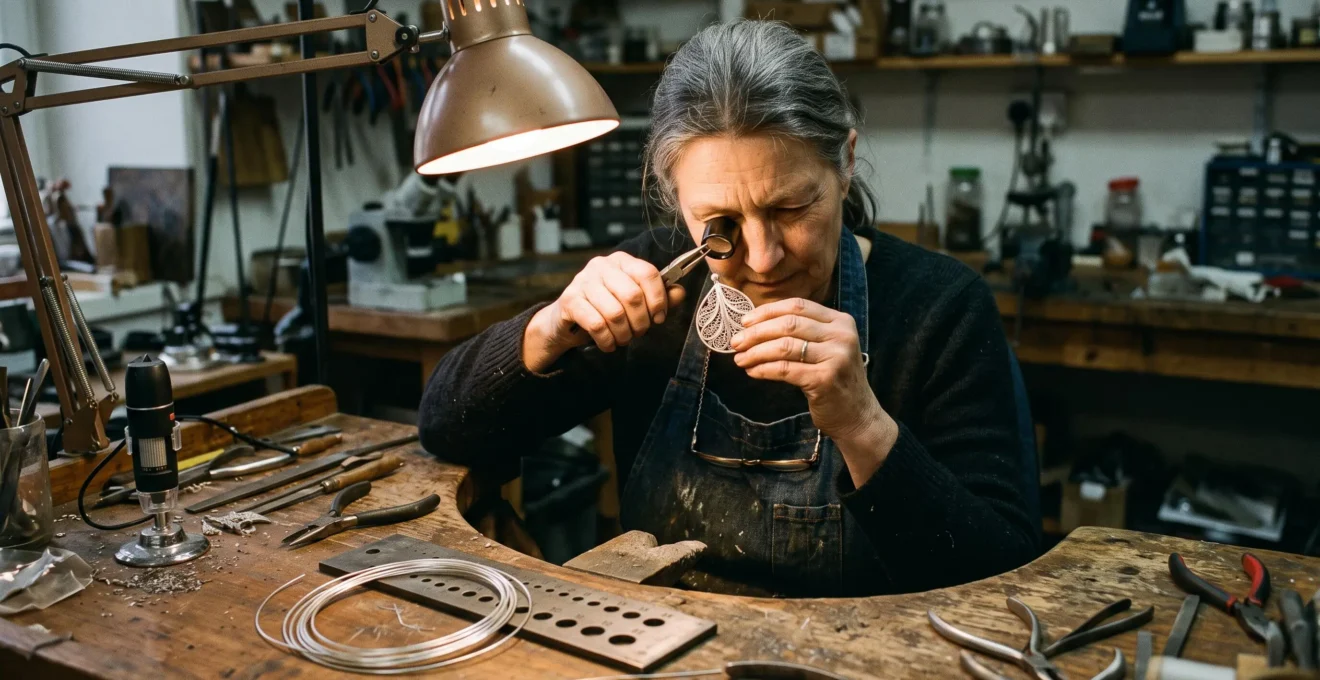
A silver filigree pendant can be entirely assembled by hand without its maker ever drawing the original silver wire. That distinction matters when a seller charges a premium specifically for hand-drawn threads, traditional wire preparation, or an unusually labor-intensive production process.
To assess such a claim, examine the construction under magnification, distinguish separate wires from cast imitations, question the maker about wire sourcing, and seek evidence of the drawing process. No single surface characteristic proves that a wire was drawn manually. Skilled artisans using hand-operated drawplates can produce exceptionally uniform wire, while machine-drawn stock can be transformed into authentic handmade filigree.
For collectors, the strongest assessment combines physical inspection with documented workmanship and transparent seller explanations. This approach helps establish what was actually made by hand, which claims remain unverified, and whether the asking price reflects craftsmanship rather than an attractive but unsupported production story.
Hand-Drawn Filigree: Essential Authentication Points
- Separate the operations: hand-drawing silver wire, hand-forming decorative filigree threads, and hand-assembling jewelry are different stages of production.
- Use magnification carefully: wire edges, twists, solder joints, and casting marks help identify construction methods but cannot independently prove manual wire drawing.
- Verify the premium: ask for wire-sourcing information, production photographs, and a written description of the work before paying for a specifically hand-drawn piece.
- Why « Handmade Filigree » Labels Often Describe Assembly, Not Wire Creation
- How Master Artisans Draw Silver Into Threads Thinner Than Human Hair
- Hand-Drawn vs Machine-Pulled Wire: What Microscopes Reveal
- The Filigree Fraud Using Factory Wire Sold at Artisan Prices
- When to Commission Custom Thread Work vs Purchase Ready-Made Filigree
- Why Precision-Cast Silver Captures Details Impossible to Hand-Carve
- Hand-Millgrained vs Cast Imitation Beading: How to Spot the Difference
- How to Spot Poor Casting Quality Before Buying Silver Jewelry
Why « Handmade Filigree » Labels Often Describe Assembly, Not Wire Creation
Authentic handmade filigree does not necessarily contain silver wire drawn by the artisan who made the jewelry. A craftsperson may purchase commercially drawn wire, twist or flatten it into decorative strands, bend those strands into patterns, and solder the components together entirely by hand. These operations represent genuine craftsmanship, but they do not demonstrate manual production of the starting wire.
The distinction becomes important when a listing uses broad expressions such as « traditional handmade filigree » to suggest a particular manufacturing process.
Three separate operations should be identified:
- Wire drawing: reducing silver stock through successive drawplate openings to produce wire of a specified diameter or profile.
- Decorative wire fabrication: twisting, flattening, shaping, or otherwise modifying wire to create filigree elements.
- Filigree assembly: positioning and joining decorative elements to form the finished jewelry.
A jeweler might perform the second and third operations personally while purchasing the starting wire. That is not inherently deceptive. Misrepresentation arises when the seller specifically claims a drawing process that did not occur or attributes work to a maker who did not perform it.
Etsy’s official Seller Policy requires accurate representation of how products are made and disclosure of relevant production partners. These platform-specific requirements do not establish that a jewelry maker personally drew the silver wire, nor do they create a universal legal definition of hand-drawn filigree.
Before purchasing, ask the seller three precise questions:
- Do you draw your own silver wire? Establish whether the maker operates a drawplate or purchases finished round wire.
- What is the source of your wire stock? Request an explanation of the material supplied and the transformations performed in the workshop.
- Can you show the wire before it is worked? Ask for photographs of starting stock and, where available, intermediate stages.
A seller who openly uses commercially supplied wire may be more trustworthy than one who describes every stage as handmade without explaining the process. Vague answers justify further investigation, but they do not independently establish dishonesty.
Production time can influence value. Personally drawing wire adds an operation, yet its financial significance depends on the actual labor, required equipment, design complexity, and other work performed. There is no defensible universal premium for hand-drawn versus commercially sourced wire.
Once the seller’s terminology is clear, understanding the drawing process makes it easier to request meaningful evidence rather than relying on the appearance of the finished pendant.
How Master Artisans Draw Silver Into Threads Thinner Than Human Hair
Traditional manual wire drawing uses a drawplate containing progressively smaller openings. The craftsperson prepares a wire end, pulls the metal through a selected opening, and repeats the operation as its cross-section decreases. Annealing between reductions restores workability when needed. This process can produce extremely fine silver wire, although the resulting diameter alone does not prove manual manufacture.
The starting material may be a cast ingot converted into suitable stock through preliminary metalworking, or commercially supplied wire that the artisan reduces further. A maker does not necessarily smelt or cast the original silver.
The essential sequence follows several operations:
- Prepare the stock: obtain silver of the desired composition and form it into a workable starting section.
- Prepare the leading end: taper the tip sufficiently to feed it through the selected drawplate opening.
- Draw the metal: grip the projecting end and pull it through the plate, decreasing the wire’s cross-sectional area.
- Repeat reductions: move through appropriate smaller openings rather than attempting an excessive reduction at once.
- Anneal when necessary: heat and appropriately cool the metal to restore workable properties before further drawing or forming.
The technical principles, including drawplate geometry, annealing, and manual versus automatic equipment, are described in Ganoksin‘s technical article on metal rolling and drawing, adapted from Erhard Brepohl‘s goldsmithing reference.
The drawing process can introduce small dimensional variations or surface marks, particularly when tools are worn or operating conditions fluctuate. However, irregularity is not a necessary signature of hand drawing. A well-maintained manual drawplate can produce accurately shaped, smooth wire, just as equipment defects can create irregularities in industrial stock.
The description « thinner than human hair » also needs care. Human hair varies in diameter, and visually delicate filigree may comprise multiple strands twisted together. Without an actual measurement of the component being discussed, its thickness should not be assumed from a seller’s comparison.
Traditional filigree is associated with regional jewelry practices in places including Sardinia, Goa, Oaxaca, and parts of the Caucasus. Such associations may provide useful cultural context, but regional origin does not prove that every silver strand was manually drawn. Historical craftsmanship encompasses multiple wire-making and decorative methods.
Likewise, an artisan may use self-drawn wire for selected decorative sections while relying on purchased material for structural frames or attachments. Provenance documentation should distinguish these components if the production method affects the purchase decision.
Knowledge of the process is valuable chiefly because it makes the seller’s account testable. The next challenge is deciding what the finished metal can reveal when the manufacturing stages were not documented.
Hand-Drawn vs Machine-Pulled Wire: What Microscopes Reveal
Magnification can reveal how filigree is constructed, whether separate wires are present, and where surface or joining defects occur. It cannot reliably establish whether a round silver wire passed through a hand-operated or motor-driven drawplate. Both methods can produce regular diameters and circular profiles; taper, ovality, and surface marks are supporting observations rather than validated proof of manual drawing.
Begin with a clean, well-lit specimen and a 10x jeweler’s loupe. A digital microscope may help record larger images, provided its magnification and image quality are adequate for the details being assessed.
Examine several accessible features rather than selecting one visually striking area:
- Wire profile: determine whether the element appears round, flattened, square, or otherwise shaped. Different profiles can result from different drawplate openings or subsequent deformation.
- Twisted strands: inspect whether the visible ornament consists of separate intertwined wires or a solid surface reproducing a twisted pattern.
- Wire ends: locate accessible terminations where genuine strands may be distinguished from a continuous cast imitation.
- Solder joints: examine how wires connect to neighboring elements or structural frames.
- Surface defects: record longitudinal scratches, flattened edges, discontinuities, or possible seams without immediately attributing them to one production method.
Rolled or cut strip stock may present straight edges or a rectangular cross-section. Extruded profiles can also have noncircular shapes. Neither characteristic alone proves deception: a designer may deliberately use strip or shaped metal in a legitimate handmade composition.
For useful documentation, photograph the entire object first, then capture close-ups of its twists, connections, accessible wire ends, underside, and any suspicious features. Keep the lighting and orientation reasonably consistent, and include a scale reference when practical.
The photographs should show actual observations rather than an interpretive label such as « machine-made. » A qualified jewelry specialist can then assess the visible construction alongside the maker’s statements and any supporting documentation.
| Observation | Reasonable interpretation | Important limitation |
|---|---|---|
| Highly uniform round wire | Consistent die-formed geometry | Manual drawing can produce the same result |
| Uneven diameter or ovality | Possible variation from tooling or deformation | Not a validated signature of hand drawing |
| Distinct twisted strands | Evidence supporting assembled wire construction | Does not reveal who drew the starting wire |
| Flat-sided metal elements | Possible strip, flattened wire, or shaped stock | May be an intentional traditional design choice |
| Continuous imitation wire relief | Possible casting or another replication method | Requires examination of joins and reverse surfaces |
Construction authentication and process attribution are different questions. A loupe may strongly support the conclusion that a motif consists of assembled metal strands while leaving the original drawing method unresolved.
When physical evidence is inconclusive, seller transparency, listing accuracy, and the commercial justification for the premium become increasingly important.
The Filigree Fraud Using Factory Wire Sold at Artisan Prices
Using factory-produced wire in handmade filigree is not fraud by itself. The problem arises when a seller represents the finished piece as containing personally hand-drawn wire, or claims a specific artisan production process, without that process having occurred. The distinction matters because buyers may pay for labor, provenance, or individual workmanship that the description does not accurately establish.
Commercially manufactured wire can reduce the number of fabrication steps required in a workshop. It does not eliminate the skill involved in twisting, shaping, arranging, and joining filigree elements.
The relevant pricing question is therefore not simply whether machine-made materials were used, but which operations the seller actually performed and which operations the asking price supposedly rewards.
Several situations deserve examination:
- Misattributed craftsmanship: a seller claims that an individual artisan created all components despite purchasing ready-made decorative assemblies.
- Unsupported heritage claims: a listing relies on descriptions of traditional village production without documenting where or how the specific object was made.
- Reproductions presented as unique: substantially identical pieces are marketed as individually created originals without explaining the use of common patterns, molds, or supplied components.
- Misleading photography: workshop imagery implies that the pictured artisan made the listed object when the actual production relationship is different.
None of these scenarios can be established solely by seeing multiple similar pendants. Craftspeople frequently repeat successful designs, and traditional techniques can produce consistent patterns.
A genuine warning sign is a discrepancy between the seller’s precise claim and the evidence supplied. For example, an insistence that every wire was personally drawn becomes difficult to substantiate when the seller cannot describe the stock, drawing tools, or relevant production stages. That inconsistency warrants further questions, not an automatic accusation.
Hypothetical purchase assessment: Two matching pendants
A collector finds two visually similar silver filigree pendants. Seller A describes one as entirely hand-drawn but supplies no information about its wire preparation. Seller B explicitly states that commercial fine silver wire was hand-shaped, twisted, and soldered into the design.
Seller B’s description provides greater process transparency, even if Seller A’s claim might ultimately be genuine. The collector should request further evidence from Seller A rather than assuming that either appearance or price proves the drawing method.
If a completed purchase turns out to have been materially misrepresented, preserve the original listing, messages, invoices, photographs, and any expert findings. Depending on the marketplace, payment method, jurisdiction, and circumstances, a buyer may be eligible for a dispute procedure, purchase protection, or a card-related remedy. Deadlines and evidentiary requirements vary; reimbursement is not guaranteed.
When verified wire origin matters more than immediate availability, commissioning directly from an artisan can make the required evidence part of the purchase agreement from the outset.
When to Commission Custom Thread Work vs Purchase Ready-Made Filigree
Commissioning custom hand-drawn filigree is most useful when the drawing method is a material part of the object’s value to the collector. A commission allows the buyer to specify who prepares the wire, which components must contain that wire, and how the process will be documented. Ready-made filigree may be preferable when cost, availability, or everyday wear matters more than detailed production provenance.
Neither buying method guarantees superior workmanship. A thoroughly documented ready-made piece may be more desirable than a poorly executed commission.
Four decision factors help determine which arrangement fits the intended purchase.
| Decision factor | Custom commission | Ready-made filigree |
|---|---|---|
| Budget | Allows a defined scope of additional handwork, potentially increasing cost | Allows comparison of completed pieces at known asking prices |
| Timeline | Requires an agreed production schedule with possible adjustments | Generally available without waiting for fabrication |
| Provenance | Documentation requirements can be included in the agreement | Depends on records already held by the seller or maker |
| Intended use | Suitable when specific heirloom characteristics justify the process | Often practical for occasional or regular wear, depending on construction |
For a commission, begin with a written brief describing the jewelry’s dimensions, design, silver composition, intended use, and precise production requirements. Specify whether the artisan must personally draw all starting wire or only the ornamental strands.
Next, ask the maker to identify the starting stock and describe the drawing, decorative forming, and assembly operations separately. Agree on which photographs will document these stages and whether the completed piece will include a signed description of materials and techniques.
Production timing should be based on the maker’s actual workload and methods, not an assumed universal schedule. Drawing delicate wire, producing matching decorative elements, and completing detailed soldering may require multiple stages and opportunities for correction.
Payment milestones can be negotiated around an initial deposit, an agreed progress stage, and final completion. The contract should explain approval criteria, changes, cancellation arrangements, and what happens if a documented manufacturing requirement cannot be met.
Five Steps to Document a Hand-Drawn Filigree Commission
- Define the requirement: create a written brief identifying exactly which components must use personally drawn silver wire.
- Verify the maker’s method: obtain a written explanation of wire sourcing, drawplate use, and subsequent decorative fabrication.
- Agree on evidence: prepare a photography checklist covering starting stock, drawing, shaping, and completed assembly.
- Set production checkpoints: obtain a milestone schedule recording approvals and associated payment conditions.
- Complete the provenance record: collect the final invoice, maker’s process statement, agreed photographs, and material description.
These records may assist future appraisal, insurance discussions, or resale by establishing the maker’s stated process. They do not guarantee a particular valuation, insurance acceptance, or financial return.
Commissioning is only one route to well-made jewelry. Ready-made and cast alternatives also deserve fair evaluation when their materials and techniques are accurately described.
Why Precision-Cast Silver Captures Details Impossible to Hand-Carve
Precision casting can reproduce intricate metal relief, repeated ornamentation, and fine surface features that would be difficult to produce consistently through direct hand-carving. Lost-wax and other casting processes create shapes from a prepared pattern or mold. This makes casting a legitimate jewelry technique, but a cast imitation of twisted filigree is structurally different from ornamentation assembled from individual silver wires.
True openwork filigree commonly relies on separately formed metal strands joined into decorative patterns. Cast filigree-look jewelry may reproduce similar visual geometry as a single cast structure, whether solid-backed or openwork.
Consequently, a decorative opening does not automatically prove that individual wires were assembled by hand, just as the presence of casting does not automatically indicate poor craftsmanship.
Weight can provide a preliminary clue when comparing objects of similar dimensions and silver composition. A solid-backed cast design may be heavier than an openwork wire construction. However, cast jewelry can itself be hollow or openwork, and differences in thickness, scale, and attached components can reverse the comparison.
Under magnification, inspect the boundaries of apparently separate strands. In assembled filigree, genuine wire edges, junctions, and joining material may be visible. In a cast imitation, the ornamental relief may merge continuously into its surrounding metal.
Potential casting indicators include:
- Small surface pits or cavities associated with porosity.
- Unfinished parting lines or remnants of the casting process.
- Softened decorative relief where the reproduced detail is insufficiently defined.
- Repeated surface features carried over from the same pattern.
These indicators are not conclusive in isolation. Casting can reproduce crisp details, finishing may remove visible traces, and a genuine filigree piece may contain cast structural elements such as settings or decorative attachments.
The better evaluation asks whether the seller accurately explains the construction. A carefully executed cast pendant can be an appropriate choice for a buyer seeking durable ornament at a particular budget, while a collector specifically seeking assembled wirework should require evidence of that method.
Surface ornament can introduce another identification problem: small decorative beads that resemble hand-applied finishing but were actually reproduced as part of a casting.
Hand-Millgrained vs Cast Imitation Beading: How to Spot the Difference
Hand millgraining creates a decorative line of small bead-like impressions using a textured tool or wheel against the metal. Cast imitation beading reproduces a similar appearance directly in the casting. Under magnification, tool-formed impressions, edge transitions, and repeated geometry may help distinguish the methods, although extremely consistent handwork and well-finished cast detail can appear similar.
Millgraining is a distinct finishing technique rather than evidence that an artisan drew the wire used elsewhere in the jewelry.
To evaluate a beaded border, observe how each bead joins the surrounding metal. Tool-applied millgraining may show local variations in pressure, alignment, and spacing, particularly where the artisan begins, turns a corner, or finishes a run.
Cast imitation beads may reproduce highly consistent decorative geometry, together with casting-related surface features if they remain after finishing. Yet uniformity alone is not decisive. A competent artisan using a well-made millgrain wheel can also form highly regular beading.
Look for relationships among the beads, adjacent wirework, and the metal beneath them. A bead line formed along a solid border should be assessed differently from a row of physically separate spheres attached to a filigree structure.
Granulation is a third technique. It involves attaching small metal granules to a surface, historically through specialized joining methods, rather than pressing a continuous series of bead impressions into an edge.
The Metropolitan Museum of Art’s record of historical filigree earrings documents objects combining gold wire, openwork filigree, sheet-metal construction, and fine granulation. The example demonstrates that several decorative metalworking techniques can coexist in one piece, without establishing how its original wire was drawn.
When evaluating historical or revival jewelry, this distinction prevents authentic granulation from being incorrectly dismissed as imitation millgraining. It also discourages treating all small metal beads as evidence of the same artisan process.
An inexpensive loupe can support both examinations in one session: first assess whether the filigree strands are separate, then inspect whether decorative beading appears tool-formed, attached, or integrally reproduced.
Once the decorative methods are distinguished, the remaining concern is workmanship quality, especially on cast sections that might conceal weaknesses beneath an attractive polished surface.
Key Takeaways Before the Final Inspection
- Inspect the entire object, including components that may have been cast separately from genuine wire filigree.
- Do not confuse uniform decoration with evidence of industrial manufacture, or irregularity with proof of handwork.
- Evaluate structural condition independently from the accuracy of the seller’s craftsmanship claims.
How to Spot Poor Casting Quality Before Buying Silver Jewelry
Poor casting quality can often be recognized through visible porosity, incomplete details, unfinished flash, or defects in thin structural sections. Examine the front and reverse of the jewelry, especially joints, settings, and clasps. A visible defect may be merely cosmetic, but cavities, inadequate metal fill, or weaknesses near stressed components deserve closer assessment before purchase.
Begin with the underside. Product photographs frequently emphasize the most attractive face of a piece, while less visible surfaces may show finishing inconsistencies or manufacturing marks.
In an in-person inspection, gently turn the jewelry over without forcing delicate elements. Look across the reverse surface under changing light angles and examine the areas surrounding attachment points.
Focus on four observable categories:
- Porosity: small pits, cavities, or clusters of holes that may indicate defects in the cast metal. Surface appearance alone cannot determine how far a cavity extends internally.
- Incomplete fill: missing or poorly formed areas where the casting did not reproduce the intended geometry.
- Unremoved flash or casting lines: raised ridges and remnants that may indicate incomplete finishing.
- Questionable proportions: unusually thin connecting sections or poorly supported elements relative to the intended design and use.
Where casting defects interrupt critical sections, they may reduce effective metal area or create locations where cracking becomes more likely under stress. A qualified jeweler should assess questionable structural areas rather than relying on appearance to predict failure.
Weight should be considered alongside construction, not used as an isolated authenticity test. A heavy item is not necessarily well cast, and a lightweight design is not necessarily weak.
Likewise, the underside test is a useful screening measure rather than a complete examination. Polished surfaces can conceal internal defects, and a visually clean reverse does not guarantee sound construction.
The most practical pre-purchase routine combines a few repeatable observations:
- Inspect the overall form and identify whether the design uses separate wire, cast sections, or both.
- Examine the underside, connections, clasp, and accessible structural details.
- Use a loupe to document wire construction and suspicious casting features.
- Compare visible evidence with the seller’s description of the production methods.
- Request clarification or an independent assessment before paying for an unverified artisan claim.
This routine works best when the buyer records observations separately from conclusions. A photograph showing a visible pit is evidence of that feature; a statement that the entire piece is structurally defective requires further evaluation.
Before paying an artisan premium, request a clear written description of the wire source, the processes performed by the maker, and any available production documentation. If the seller cannot substantiate a specific hand-drawn claim, value the piece according to the craftsmanship that can actually be established—or seek another example with stronger provenance.
Can authentic handmade filigree be made from commercially drawn silver wire?
Yes. A skilled artisan may purchase commercial silver wire and personally transform it into decorative filigree strands before assembling the finished piece. Hand-fabricating filigree and hand-drawing the starting wire are separate operations. Authenticity depends on the workmanship and the accuracy of the seller’s claims, not on a universal requirement that every wire must be manually drawn.
Can a jeweler prove hand-drawn wire using only a 10x loupe?
No. A loupe can reveal strand construction, twisting, joins, and visible surface features, but it cannot conclusively distinguish manual from machine-operated drawing. Both processes use drawing dies and can produce highly regular silver wire. Documented production stages and a credible maker’s account provide stronger evidence of how the starting wire was prepared.
Does a sterling silver hallmark verify that filigree was made by hand?
No. A fineness mark such as 925 relates to an indicated silver composition, not to the process used to produce or assemble the jewelry. Its interpretation and legal significance depend on the applicable hallmarking system. Even a properly verified silver composition does not establish whether the filigree wire was hand-drawn, commercially drawn, or reproduced through casting.
Should a collector pay more for filigree containing hand-drawn wire?
A higher price may be justified when the buyer values a documented manufacturing process and the piece demonstrates suitable design, workmanship, condition, and provenance. Hand-drawn wire alone does not establish a particular monetary premium. Compare the maker’s actual contribution, the quality of the finished work, and the strength of the accompanying documentation before deciding.
What evidence should accompany an expensive commissioned filigree piece?
Useful records include a written description of the silver stock, identification of which components were personally drawn, photographs showing agreed fabrication stages, the maker’s identity, a final invoice, and any relevant material specifications. Such documentation helps establish the claimed process, although it does not independently guarantee authenticity, appraisal value, insurability, or future resale performance.