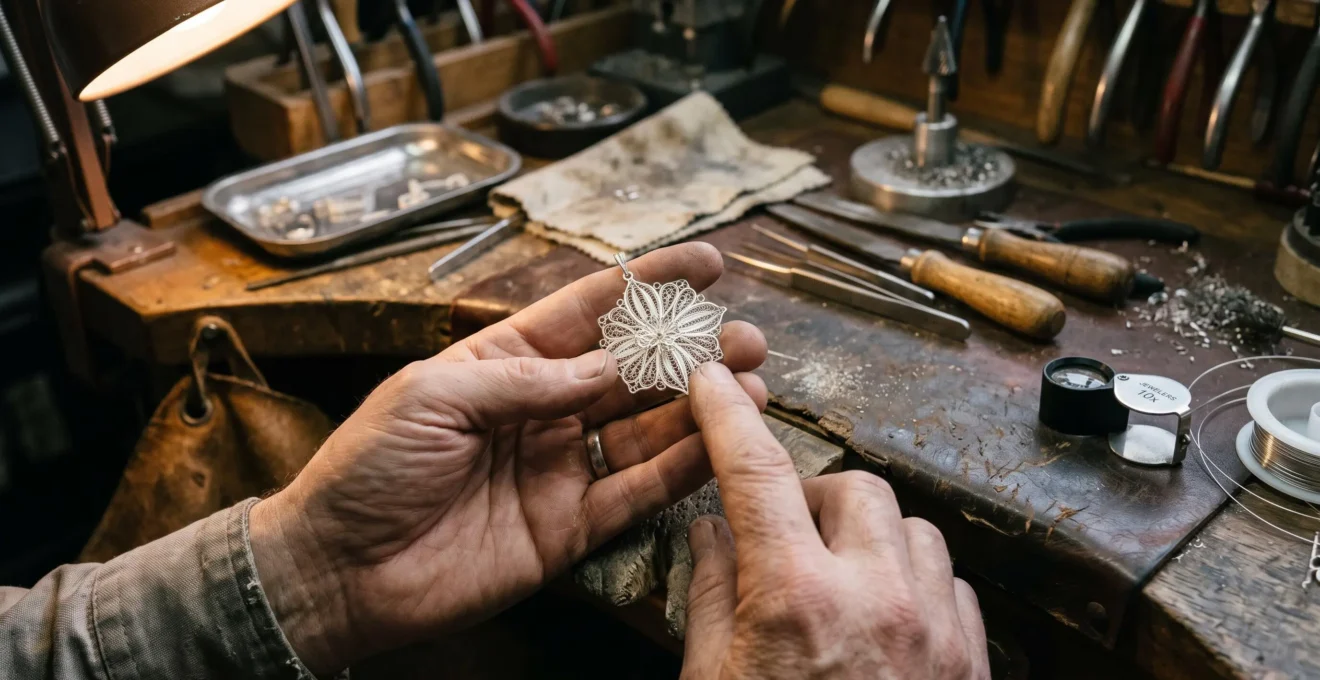
Hair-thin silver wire jewelry can be remarkably light and intricate, but its delicacy comes with practical limitations. Exposed strands can bend, snag, kink, or break under forces that sturdier jewelry would tolerate. Even careful cleaning may cause damage if a fine component is gripped, pulled, or polished too vigorously.
The distinction that matters is not simply whether a piece is thin. Its wire diameter, metal temper, manufacturing history, joint construction, and structural support all influence how well it withstands handling. A carefully made pendant with protected filigree may remain wearable for years, whereas a free-standing loop of similar wire may be vulnerable from its first outing.
For anyone considering ultra-fine silver jewelry, realistic ownership means choosing appropriate designs, limiting unnecessary movement, storing pieces separately, and recognizing when professional attention is safer than attempting a repair. The goal is to preserve the delicate appearance without expecting the metal to behave like a heavier everyday accessory.
Hair-Thin Silver Wire Jewelry: Essential Care Limits
- Extremely thin wire has very low bending stiffness, making unsupported sections especially vulnerable to distortion and snagging.
- Repeated plastic bending can work-harden silver and contribute to eventual cracking or breakage.
- Supported designs, low-contact cleaning, individual storage, and occasional wear can reduce avoidable damage without guaranteeing a particular lifespan.
- Why Silver Wires Under 0.3mm Diameter Break With Normal Handling
- Thread-Fine vs Standard Gauge Wire: Aesthetic Appeal vs Practical Durability
- How to Handle Delicate Wire Silver Pieces During Cleaning and Storage
- The Tangling Blunder That Permanently Kinks Fine Silver Wire
- How Protective Layering Extends Hair-Thin Wire Jewelry Lifespan by Years
- Why Silver Bands Thinner Than 1.5mm Bend Permanently After Minimal Pressure
- The Cleaning Error That Flattens Delicate Millgrain Beading Permanently
- Why Visually Beautiful Silver Jewelry Often Fails Structurally Within Months
Why Silver Wires Under 0.3mm Diameter Break With Normal Handling
Silver wire below 0.3 mm in diameter can be unusually vulnerable because its small cross-section provides little resistance to bending and limited capacity to withstand pulling forces. A snag, localized fold, or repeated movement at a stressed connection can cause deformation or eventual fracture. However, 0.3 mm is not a scientifically established universal breaking threshold: actual durability depends on the complete design and material condition.
The effect of diameter is substantial. For a solid circular wire, cross-sectional area varies with the square of its diameter, while its second moment of area varies with the fourth power. Under comparable elastic conditions, halving the diameter reduces the area by 75% and the geometric contribution to bending stiffness by 93.75 %.
93.75% less geometric bending stiffness
For an idealized solid circular wire with half the original diameter, assuming the same material, length, and elastic bending conditions. This is a mathematical comparison, not a measured jewelry failure rate or lifespan.
Derived from the circular-section relationships presented in the University of Illinois engineering formula sheet.
Two different damage mechanisms must be distinguished. Acute breakage occurs when one sufficiently strong pull, snag, or forced bend overloads a component. Progressive fatigue develops when repeated loading and deformation eventually produce cracking, potentially without one memorable accident.
Plastic deformation can also work-harden silver. A bend that permanently changes the wire’s shape alters its mechanical condition; repeated attempts to straighten and rebend the same section may make subsequent fracture more likely. Ordinary motion entirely within the elastic range should not be equated automatically with progressive work-hardening.
Before wearing the piece, examine the transition between thin and heavy sections, soldered attachments, clasp connections, and sharply formed curves. Under good light, look for an unexpected angle, a flattened segment, a visible gap, or a previously repaired area. These are useful inspection points, although they do not prove a joint is defective.
A freely suspended wire loop deserves particular caution because a passing sleeve or strand of hair can catch it. By contrast, a fine element resting inside a rigid frame is less likely to experience direct pulling, provided the frame does not itself place the wire under tension.
A wire’s appearance alone cannot reveal its remaining fatigue life. Treat visible kinks, loose connections, and repeated bending at one point as reasons to reduce wear and request inspection.
Thread-Fine vs Standard Gauge Wire: Aesthetic Appeal vs Practical Durability
Thread-fine silver wire offers an exceptionally airy appearance, often making a pendant or earring seem almost weightless. Standard-gauge construction generally provides more structural margin for everyday handling, although the comparison depends on metal temper, component geometry, and support. Neither thinness nor thickness alone determines whether a finished piece is well made.
Choosing between the two is primarily a question of how and where the jewelry will be worn. An occasional pendant that stays clear of clothing may suit ultra-fine decorative wire; a bracelet regularly exposed to desks, sleeves, and bags usually benefits from sturdier construction.
The practical differences are easier to assess side by side.
| Ownership factor | Hair-thin wire | Standard-gauge wire |
|---|---|---|
| Visual character | Airy, lace-like, nearly invisible strands | More visibly defined structure |
| Weight and comfort | Very light decorative elements | Potentially heavier, depending on design |
| Snag exposure | High for open or unsupported loops | Often more tolerant of incidental contact |
| Repair considerations | Small joints and distortion can complicate restoration | More material may provide easier access for conventional repairs |
| Typical wearing suitability | Protected designs or careful occasional wear | Often preferable for frequent handling |
Repairability is especially important. A broken heavier silver component may sometimes be soldered or replaced without substantially changing its appearance. A snapped ultra-fine strand can present a different challenge: applying heat near adjacent delicate elements, restoring the original curve, and preserving the finish may require specialist work or replacement of the whole section.
Nevertheless, it would be misleading to assume that every fine-wire break is irreparable. A skilled jeweler may have appropriate joining or reconstruction options, depending on the alloy, location, and design.
When evaluating a piece, look beyond the finest visible strand. Ask whether delicate wire is supported by an outer frame, grouped with other strands, or connected to a heavier structural element. These choices may reduce the mechanical load reaching an individual wire.
Thicker jewelry need not appear bulky. Mixed-gauge construction, closely arranged fine wires, and discreet backing can preserve a delicate visual character while allocating strength to less visible components.
Professional guidance on selecting wire according to gauge, temper, and application is discussed in Ganoksin‘s article on choosing silver jewelry wire. Its discussion supports considering the intended use rather than choosing dimensions for appearance alone.
The most elegant option is not necessarily the most fragile one. A well-supported design may deliver nearly the same visual refinement with fewer exposed stress points.
How to Handle Delicate Wire Silver Pieces During Cleaning and Storage
Delicate silver wire jewelry should be handled with minimal pulling, twisting, rubbing, or unsupported lifting. Cleaning methods must suit the entire piece, including gemstones, coatings, adhesives, and solder joints. Separate, padded storage prevents contact with heavier jewelry, while tarnish prevention helps limit the need for repeated polishing that removes some surface metal.
A common mistake is treating hair-thin jewelry like a solid silver bracelet. Firm rubbing with a polishing cloth may exert enough local pressure to bend unsupported loops. A brush can catch exposed wire, and mechanical tumbling may be inappropriate for fragile assembled components.
Silver polishing also involves a less obvious trade-off. The Canadian Conservation Institute guidance on silver care and tarnish removal explains that polishing can remove silver as well as tarnish. Chemical treatments can also affect surface details or present problems for complex constructions.
For routine care, begin with a visual inspection. If the piece is only dusty, avoid aggressive tarnish removal. If cleaning is necessary, select a method confirmed compatible with the metal, finish, and any incorporated materials. Do not immerse a fragile mixed-material piece or apply chemical dips without establishing their suitability.
Handling technique matters just as much as cleaning chemistry. Place the jewelry on a stable, clean surface. Where practical, slide a flat support beneath a delicate pendant before lifting it, rather than pinching an exposed loop. Hold substantial structural elements whenever they are available.
Storage should prevent movement, not merely conceal the jewelry. Individual padded compartments or well-fitted protective cases are preferable to allowing pieces to slide against clasps, rings, and chains. Fine wire should not carry the weight of attached components when stored or transported.
The GIA‘s jewelry care recommendations support using padded compartments, protective travel packaging, and anti-tarnish materials for sterling silver. They also emphasize adapting maintenance to the specific jewelry materials.
For particularly intricate pieces, laying the item flat may reduce unnecessary tension and movement. Hanging is not automatically unsafe for every design, but it should be avoided when delicate decorative wires would support weight or snag on adjacent objects.
A Five-Step Routine for Safer Fine-Wire Jewelry Care
- Inspect before handling: Check wire loops and connections under good light; identify any bent, loose, or damaged sections.
- Support the piece: Transfer it using a stable surface or stronger structural elements; confirm that no delicate strand is pulled taut.
- Choose compatible cleaning: Identify the metal finish and additional materials; decide whether gentle cleaning is appropriate or professional advice is needed.
- Secure individual storage: Place the item in a padded compartment where it cannot shift against other jewelry; verify that no decorative wire carries the piece’s weight.
- Limit tarnish exposure: Keep storage dry and use suitable anti-tarnish protection; periodically check that the piece remains clean and undistorted.
Preventive care preserves the original construction more reliably than repeatedly attempting to restore a bent or over-polished component.
The Tangling Blunder That Permanently Kinks Fine Silver Wire
The damaging mistake when untangling fine silver wire is pulling the ends apart to force a knot open. This can tighten loops, create sharp bends, and permanently distort the metal. Once a wire has been plastically kinked, bending it back may make it appear straighter but can introduce further deformation and weaken the damaged area.
Tangles often begin during storage or transport. An exposed filigree loop catches a nearby chain, the pieces move inside a loose pouch, and the chain passes through another opening. What initially looks like a simple knot may actually contain several interlocked elements.
The greatest danger comes from applying tension before understanding how the wires crossed. Pulling both ends typically makes a tight loop smaller, placing force directly onto the thinnest section. If that section folds sharply, the metal can develop a permanent crease.
Silver can deform plastically when stress exceeds its elastic limit. Straightening a kink imposes additional deformation, potentially increasing localized work-hardening. This does not mean every kink will break or that one corrective bend guarantees cracking; it means a visibly restored shape does not prove full mechanical integrity.
A cautious untangling attempt should begin on a flat, well-lit surface. First, identify which component passes through each loop. Allow slack to develop by moving the surrounding chain or strand in the reverse direction of the entanglement, rather than pulling an end away from the knot.
For a loose tangle, smooth, fine-pointed jewelry tools may help guide slack through an opening, provided their tips do not scrape or press against the silver. Improvised sharp tools can scratch, dent, or cut the metal, so they are not appropriate for resistant knots or unsupported filigree.
If a strand has already formed a sharp kink, do not repeatedly bend it straight. Stop if the wire resists movement, changes shape unexpectedly, or shows visible damage. A jeweler can assess whether controlled reshaping, component replacement, or leaving the section undisturbed is the better choice.
After a successful untangling, inspect the affected wire under good lighting. Look for an abrupt angle, a flattened surface, a loose joint, or an opening that no longer matches its original shape. Reduce exposure to snagging if any suspect area remains.
The safest recovery is the one that preserves the existing geometry. When resistance appears, professional examination is preferable to turning a manageable tangle into a permanent bend or fracture.
How Protective Layering Extends Hair-Thin Wire Jewelry Lifespan by Years
Protective layering can help hair-thin silver wire jewelry remain usable for longer by reducing snagging, bending, rubbing, and unintended loading. The greatest benefits come from shielding fragile decorative elements within the design, isolating them during storage, and adjusting how the jewelry is worn. These measures may support years of careful ownership, but no specific lifespan extension has been established for ultra-fine silver wire.
Structural sheltering begins with the piece itself. A delicate wire motif contained within a more substantial pendant frame may be less exposed to direct impacts than an equivalent free-standing loop. The frame should take the handling load, rather than transferring it through the fine wire.
Grouped wires and mixed-gauge construction offer another design approach. A heavier element can serve as the attachment point while finer strands provide visual detail. This may improve load distribution, although actual performance depends on joints, shape, and how the individual strands connect.
Layering also applies to storage and transportation. A soft, suitable lining can prevent abrasion, while a rigid or semi-rigid case limits external compression. Internal compartments need to hold the piece securely enough that ordinary movement does not cause delicate elements to collide.
For wearing, the goal is to keep the silver clear of clothing seams, loose scarves, long hair, and accessories likely to catch it. A protective position beneath clothing may work for certain pieces, but textured fabric can create friction and snags. Smooth contact surfaces and sufficient clearance are more useful than concealment alone.
The wear cycle deserves special attention. Dressing, undressing, sleeping, exercising, and handling bags all create opportunities for accidental contact. Putting delicate jewelry on after clothing and removing it before undressing can reduce those opportunities.
- During the day: Position vulnerable loops away from repeated clothing contact.
- Before physical activity: Remove pieces likely to experience impacts, pulling, or compression.
- Before sleep: Store exposed fine-wire jewelry separately rather than allowing it to catch on bedding.
- During travel: Use fitted protective compartments instead of a shared pouch with moving jewelry.
These practices reduce exposure to potentially damaging events; they do not change the wire’s intrinsic cross-section or eliminate manufacturing stresses. A protected strand can still fail if an attachment is defective or the piece receives an unexpected load.
Think of protection as managing the conditions in which the jewelry is used. The less frequently fragile elements must carry force, the better the opportunity to preserve their intended shape over time.
Why Silver Bands Thinner Than 1.5mm Bend Permanently After Minimal Pressure
Silver bands thinner than 1.5 mm can be susceptible to permanent distortion because small cross-sections provide less resistance to everyday bending loads. Gripping handles, carrying heavy objects, and pressing a ring against hard surfaces can deform a particularly slender band. However, 1.5 mm is not a universal failure threshold: band width, thickness, profile, alloy, and temper all affect resistance.
Unlike exposed fine wire, which may kink or fracture at a localized point, a thin ring often shows damage by gradually losing its round shape. A band may become slightly oval without developing an obvious crack or sharply folded section.
Ring geometry is particularly important. A narrow band with a substantial depth can behave differently from a band with similar visible width but an extremely thin wall. The distribution of metal around the cross-section influences stiffness, so judging durability only by the width seen from above can be misleading.
Pressure may accumulate through ordinary use. Consider a hypothetical wearer who regularly grips gym equipment while wearing a lightweight band. Even if no single incident is memorable, repeated contact can increase the opportunities for permanent distortion.
Owners may notice that a ring begins to sit at an unusual angle or rotate differently on the finger. A change in shape can sometimes be identified by placing the ring on a stable surface, although an accurate assessment and controlled reshaping are best left to a jeweler.
Repeatedly bending a distorted band back by hand is undesirable. Where permanent deformation occurs, repeated reshaping can work-harden the metal, potentially increasing the risk of cracking at stressed sections. Settings, solder seams, and decorative features may also be disturbed.
Before buying a slender silver ring, assess how often it will encounter pressure. Manual work, weightlifting, frequent carrying, and activities involving tightly gripped equipment make an extremely fine profile a less practical daily choice.
For everyday wear, a more substantial cross-section or protective design may offer greater tolerance. Very slender bands can remain attractive options for occasional or low-contact use, especially when the owner is prepared to remove them during demanding activities.
A well-fitting ring is not automatically a structurally suitable ring. Its construction must also match the pressures of the wearer’s routine.
The Cleaning Error That Flattens Delicate Millgrain Beading Permanently
Aggressive polishing can gradually flatten delicate millgrain detailing by wearing down the tiny raised metal beads that form its decorative border. Repeated pressure from abrasive cloths, brushes, or polishing compounds can reduce their definition. Once material has been removed, ordinary cleaning cannot restore the original relief, and specialized reworking may be needed.
Millgrain is a decorative edge treatment made up of closely spaced bead-like impressions or raised features. Traditional millgrain can be formed by pressing or rolling a patterned tool along a metal edge. Similar appearances may also be produced through other manufacturing methods.
This distinction matters because the finished decoration is a shallow surface feature rather than a deep structural element. Its visual effect depends on fine boundaries between individual beads. If those high points wear down, the border becomes less distinct.
Polishing is especially consequential because abrasive treatments remove material rather than merely displace tarnish. On a broad, plain surface, slight material loss may be difficult to notice. On a miniature beaded edge, the same process can visibly reduce the texture that defines the design.
For care, avoid concentrated rubbing directly across a millgrain border. If loose dust is present, use an appropriately gentle method that does not snag or abrade the decoration. Tarnish removal should be chosen according to the entire piece, including coatings, settings, and recessed details.
Do not assume that liquid silver dips provide a universally safer alternative. Some treatments may change the appearance of decorative surfaces or interact poorly with associated materials. Where the finish is valuable or the construction uncertain, professional guidance is preferable.
A useful warning sign is a loss of visibly distinct bead boundaries. Under good lighting and, if helpful, magnification, compare the border with less-exposed parts of the same piece. A change from clearly defined relief to smoother-looking edges suggests wear, although manufacturing variation should also be considered.
If the detailing has already been damaged, restoration may require specialized tools and sufficient remaining metal. Feasibility and cost vary with the construction; no universal repair price or outcome can be assumed.
Surface decoration and structural wire have different failure mechanisms, but they share one care principle: avoid repeated interventions that remove or permanently deform irreplaceable fine features.
Key Takeaways Before Choosing a Delicate Silver Piece
- Look for fine details that are supported by stronger structural elements instead of carrying loads independently.
- Evaluate the complete construction, including joins, surface detailing, and repair accessibility, rather than judging only the visible beauty.
- Match the piece to realistic wearing conditions; occasional use with careful storage is often more appropriate than unrestricted daily wear.
Why Visually Beautiful Silver Jewelry Often Fails Structurally Within Months
Intricate silver jewelry can experience structural problems relatively early because the design features creating its delicate appearance may also reduce its resistance to mechanical stress. Thin wires, narrow bands, and shallow decorative details leave less room for unintended deformation or abrasion. Failure within months is possible, but it is not inevitable or evidence that every lightweight piece is poorly manufactured.
The central issue is the relationship between visual refinement and structural exposure. An open filigree loop looks elegant partly because there is little material surrounding it. That same openness leaves it accessible to sleeves, hair, and objects that can catch or bend it.
A thin band creates a different problem: everyday pressure may change its shape. Raised millgrain introduces yet another vulnerability because repeated polishing can gradually remove the visible detail. These mechanisms should not be conflated, even though they may coexist within one piece.
Manufacturing quality determines how well a design manages these limitations. Properly finished joints, suitable wire temper, considered attachment positions, and adequate structural support can help delicate components withstand their intended use.
Before purchasing, evaluate the jewelry through four practical questions:
- How is it supported? Identify whether exposed fine sections are framed, backed, or left free-standing.
- Where does force travel? Check whether clasps, connecting rings, and heavier elements place tension on thin decorative wires.
- What is its intended wear pattern? Distinguish occasional decorative use from regular exposure to work, clothing, and physical activity.
- Can it be repaired? Ask whether broken fine elements can be rejoined or replaced and whether previous repairs could affect the finish.
These observations also help separate fragility by design from fragility caused by a defect. A beautifully executed fine-wire pendant may remain vulnerable to snags while still being appropriately made for careful occasional wear. Conversely, visible gaps at joins, poorly secured attachments, or unusual deformation before use deserve further investigation.
A seller’s care guidance can be informative, particularly when it identifies specific activities or cleaning methods to avoid. Broad statements such as « durable silver » are less useful than explanations of the actual construction and repair limitations.
There is no reliable universal service-life estimate for hair-thin silver jewelry. A piece may remain intact for years when protected from damaging contact, while another may break much sooner following an isolated snag or structural fault. Usage conditions and construction matter more than an assumed countdown to failure.
Before buying, inspect the piece closely, clarify its intended use, and ask a qualified jeweler about its most vulnerable components. Choosing jewelry that fits the actual wearing routine is the most practical way to enjoy its delicacy without expecting unrealistic robustness.
Can hair-thin silver wire jewelry be repaired after breaking?
Sometimes. Repair depends on the silver alloy, break location, existing joints, nearby materials, and accessibility of the component. A jeweler may be able to join or replace a damaged section, but extremely fine decorative wire can be difficult to restore without changing its appearance. An assessment is necessary before determining whether an invisible repair is realistic.
Does sterling silver resist bending better than fine silver?
Sterling silver is commonly chosen for jewelry because alloying can provide greater mechanical strength than pure silver. However, metal temper, manufacturing history, and geometry remain important. A very fine sterling wire can still be substantially less resistant to bending than a thicker component made from a softer silver material.
Should a slightly kinked silver wire pendant still be worn?
A visible kink indicates permanent deformation, but does not establish that the wire is about to break. Avoid repeatedly straightening it or exposing the affected section to pulling. If the kink is sharp, located near a joint, or accompanied by a visible crack or loose attachment, have the piece inspected before further wear.
Can anti-tarnish storage replace regular silver polishing?
Anti-tarnish storage can reduce exposure to substances that promote tarnishing and may decrease how often polishing is needed. It cannot eliminate all discoloration, mechanical damage, or the need for occasional cleaning. Storage materials should be suitable for the whole piece, and the jewelry should be clean and dry before being stored.
Is professional ultrasonic cleaning safe for ultra-fine silver wire jewelry?
Not automatically. Suitability depends on the component construction, joints, stones, treatments, and existing condition. Ultrasonic cleaning should not be assumed safe simply because a piece is made of silver. A professional should assess the complete jewelry item and select an appropriate cleaning method before treatment.