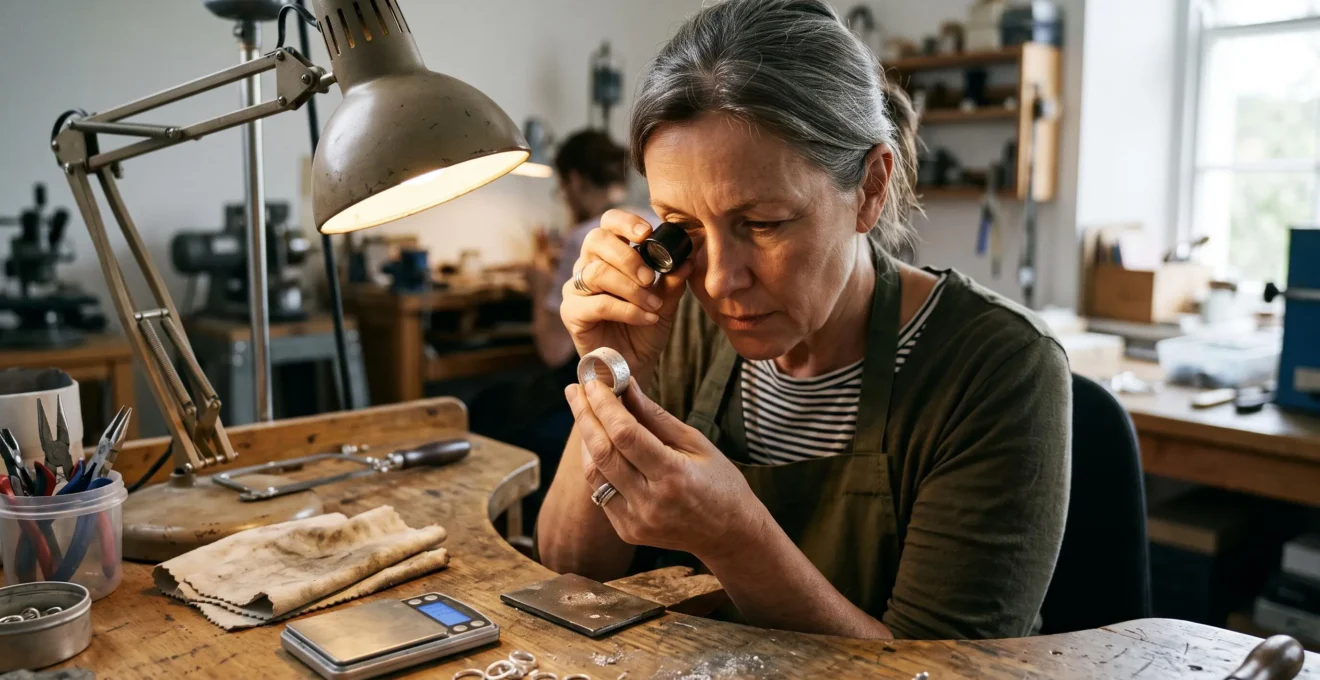
A cast silver ring can look flawless under showroom lighting while concealing rough recesses, poorly filled details or cavities that compromise its durability. Surface brightness is therefore a weak measure of manufacturing quality. The more revealing evidence lies in the relationship between edge definition, surface texture, component thickness and the condition of areas exposed to mechanical stress.
Before buying cast silver jewelry, examine decorative details under angled light, inspect concealed surfaces with a 10x jeweller’s loupe and look for clustered pits, fractures, incomplete fills and excessive corrective polishing. These observations help distinguish ordinary finishing marks from defects that justify further questions or professional assessment.
Good casting is not synonymous with perfect symmetry or mirror polishing. Hand finishing, decorative techniques and intentional textures affect what a well-made piece should look like. The practical objective is to determine whether the manufacturing process faithfully reproduced the design without leaving weaknesses in structurally important areas.
Silver Casting Quality: Essential Buying Checks
- Inspect the details: crisp edges, fully formed patterns and clean recesses are more informative than overall shine.
- Investigate porosity: clustered cavities, particularly near ring shanks and setting supports, deserve caution even when surrounding surfaces are polished.
- Judge craftsmanship separately: casting, wirework and millgrain finishing require different quality criteria; a premium finish does not establish sound internal construction.
- Why Precision-Cast Silver Captures Details Impossible to Hand-Carve
- How Lost-Wax Casting Creates Intricate Patterns With Microscopic Detail
- Centrifugal vs Vacuum Casting: What Determines Surface Perfection?
- The Casting Defect Hidden Beneath Polish That Weakens Jewelry by 40%
- How to Inspect Casting Quality Using a Jeweller’s Loupe
- Hand-Drawn vs Machine-Pulled Wire: What Microscopes Reveal
- Hand-Millgrained vs Cast Imitation Beading: How to Spot the Difference
- How Millgrain Beading Reveals Jewelry’s Historical Period and Craftsmanship Quality
Why Precision-Cast Silver Captures Details Impossible to Hand-Carve
Precision casting can reproduce intricate silver jewelry patterns with consistent geometry because a prepared mold transfers the original model’s shapes into metal. Repeated reliefs, complex recesses and interconnected decorative features can be replicated without individually cutting every element. However, casting does not automatically exceed the finest achievable detail of skilled hand engraving.
The distinction matters when evaluating expensive ornamental jewelry. Hand carving and engraving create details through controlled removal or displacement of material. Casting reproduces details already present in a model. Its advantage is repeatability and the ability to produce complicated forms, including shapes that would be difficult to access with a cutting tool.
A sharp original model cannot compensate for every later manufacturing problem. Investment quality, model production, metal flow and finishing can all affect the final definition. A design may begin with exceptionally fine contours yet emerge with rounded edges or incomplete recesses.
Under magnification, inspect three characteristics:
- Edge continuity: relief borders should remain defined along their intended length rather than disappearing at corners.
- Recess clarity: narrow grooves should retain their intended geometry without unexpected bridges or filled areas.
- Texture fidelity: deliberately repeated patterns should remain recognizably consistent without unexplained patches of softened detail.
A softened feature does not establish that a mold was worn. Low-resolution model production, incomplete metal filling and abrasive finishing can produce similar appearances. Compare several instances of the same motif, especially protected areas that have experienced little wear.
Detail reproduction also provides indirect evidence about process control. Well-defined features alongside clean surfaces are encouraging because both depend on competent manufacturing. Neither observation, however, rules out internal shrinkage voids.
The next inspection concerns the production stages behind those visible features: knowing how lost-wax casting works makes surface defects easier to interpret without attributing every imperfection to the wrong cause.
How Lost-Wax Casting Creates Intricate Patterns With Microscopic Detail
Lost-wax casting reproduces intricate jewelry by surrounding a wax or wax-like model with refractory investment, removing that model through burnout and filling the resulting cavity with molten metal. Detail quality depends on each stage: imperfections in the model, investment damage, incomplete mold filling and solidification defects can all survive into the finished silver piece.
The main sequence includes five operations:
- Model preparation: the wax pattern establishes the geometry and surface detail to be reproduced.
- Sprue assembly: channels are attached to direct metal into the mold cavity.
- Investment: refractory material surrounds the model and records its shape.
- Burnout: the pattern is removed, leaving a cavity that must remain intact and sufficiently clean.
- Metal filling and solidification: molten silver alloy occupies the cavity before cooling and contraction occur.
A buyer cannot observe these stages on a finished ring, but their consequences are sometimes visible. Missing portions of thin ornamentation can suggest incomplete filling. Unexpected protrusions may indicate mold damage. Cavities can arise from trapped gas, inadequate feeding or solidification behavior.
Normal shrinkage must be distinguished from defective formation. Both the model-making workflow and cooling metal can introduce dimensional changes. A consistent reduction relative to an original model is not equivalent to isolated distortion, cracks or an incompletely formed setting support.
Porosity is especially important because its appearance may provide clues about the underlying mechanism. Smooth, approximately round pits can be consistent with gas-related porosity. Irregular, interconnected or spongy cavities can suggest shrinkage-related defects. Appearance alone cannot conclusively establish the cause or severity.
Technical descriptions in Ganoksin‘s article on platinum casting defects distinguish surface-opening shrinkage cavities from internal voids and describe irregular, sometimes spongy morphology. The documented examples concern platinum; these mechanisms provide qualitative guidance rather than silver-specific defect measurements.
Pay particular attention to transitions between thick and thin sections. Local solidification and feeding conditions can make these geometries vulnerable to shrinkage-related defects. A cluster of pits near a narrow connection deserves more attention than an isolated mark on a broad decorative surface.
The appearance of a finished casting reflects multiple stages rather than one manufacturing decision. This becomes especially important when a seller describes vacuum or centrifugal casting as proof of superior quality.
Centrifugal vs Vacuum Casting: What Determines Surface Perfection?
Neither centrifugal nor vacuum-assisted casting guarantees a flawless silver jewelry surface. Centrifugal systems use rotational acceleration to drive molten metal into the mold, while vacuum-assisted systems use pressure differences to support filling. Both can reproduce fine detail successfully, but outcomes depend on mold preparation, alloy handling, component geometry and the workshop’s overall process control.
The difference is primarily how metal is encouraged to enter and occupy the mold cavity. It is not a simple choice between a process that creates porosity and one that eliminates it.
The following comparison focuses on manufacturing principles and what buyers can reasonably infer.
| Criterion | Centrifugal casting | Vacuum-assisted casting |
|---|---|---|
| Metal movement | Rotational acceleration assists filling. | Pressure differential assists filling. |
| Thin-section reproduction | Can fill intricate sections when the system is correctly configured. | Can fill intricate sections when equipment and mold conditions are appropriate. |
| Air and gas | Does not inherently prevent gas entrapment or shrinkage porosity. | May assist evacuation of mold air but does not guarantee pore-free metal. |
| Surface appearance | Depends on model, mold, pouring and finishing quality. | Depends on model, mold, pouring and finishing quality. |
| Buyer verdict | Assess the actual casting, not the method label. | Assess the actual casting, not the method label. |
A Ganoksin Orchid professional discussion comparing centrifugal and vacuum casting reports practitioner experience that sound results can be achieved with either approach. This is practical manufacturing commentary, not a controlled experiment demonstrating superiority for sterling silver.
Surface signatures require equally careful interpretation. Unevenly filled recesses, rounded edges or localized porosity can indicate manufacturing problems, but they do not reliably identify which casting system produced the piece. Similar flaws can arise through different combinations of temperature, gating, investment and finishing conditions.
Finishing further complicates the assessment. Extensive polishing may make two castings from different processes appear nearly identical. It can also soften intentional relief, remove evidence of surface cavities or introduce fresh marks.
For a purchase decision, ask about manufacturing quality control, repair work and the inspection performed after casting. Those answers are more useful than a claim that one casting machine produces universally better jewelry.
Even when the surface passes inspection, internal voids can remain. The next concern is the mechanical consequence of porosity that may be concealed beneath an attractive finish.
The Casting Defect Hidden Beneath Polish That Weakens Jewelry by 40%
Subsurface porosity can weaken cast silver jewelry by reducing the metal’s effective load-bearing area and concentrating stress around internal cavities. The 40% figure in this section’s title is not a verified universal strength reduction. Actual weakening depends on pore size, shape, distribution, location, alloy condition and the type of force applied to the piece.
Porosity is particularly concerning at structural stress points. A cavity beneath a decorative panel may have different consequences from an equivalent cavity at the base of a prong or within a narrow ring shank. Local geometry can determine whether ordinary wear places substantial stress around the defect.
During bending, resizing or accidental impact, stress may become concentrated around a cavity. A crack can initiate or propagate through an already weakened section, especially where several voids lie close together.
Polishing adds a second difficulty: the most visible surface is not necessarily representative of the underlying metal. Abrasive removal can eliminate shallow defects from view, while surface deformation or subsequent repair may make some imperfect regions less apparent. This does not mean every highly polished ring conceals porosity.
Real Inspection Case: Porosity Concealed by Repair
The Gemological Institute of America describes a jewelry-forensics case in which an appraiser observed extensive porosity in a ring and recommended replacement.
The ring was later presented again after porous regions had been filled with solder. This documented example shows why an improved surface appearance cannot, by itself, establish that underlying manufacturing concerns have been resolved. The account does not quantify any reduction in metal strength.
The case appears in GIA‘s jewelry-forensics article on workmanship and durability, which explains how manufacturing clues help trained inspectors evaluate longevity risks.
Before purchasing, look for warning signs that justify further examination:
- Clusters of pits in narrow or load-bearing sections.
- Cracks near a prong base, hinge or ring-shank transition.
- Areas that appear unusually rounded or heavily reworked compared with adjacent details.
- Surface pits returning after previous refinishing or repair.
- Visible solder filling or localized repairs whose purpose has not been explained.
Apparent low weight is a much less dependable indication. Hollow construction, deliberate design choices and alloy differences may explain it without any casting defect. Weight should not be used as a porosity test unless the piece’s construction and expected mass are known.
An ordinary loupe cannot reveal sealed internal cavities. A buyer concerned about a costly or structurally delicate piece should request a qualified jeweller’s assessment rather than treat a clean visible surface as conclusive proof.
The next step is to examine accessible surfaces systematically, concentrating on locations where poor filling, polishing corrections or early damage are most likely to affect the purchase decision.
How to Inspect Casting Quality Using a Jeweller’s Loupe
A 10x jeweller’s loupe is useful for screening cast silver jewelry before purchase because it reveals small pits, irregular relief, fine cracks and finishing marks that ordinary viewing can miss. Inspect the piece in a consistent order under direct and raking light. Magnification can identify visible concerns but cannot establish the absence of internal defects.
Begin with a clean, dry piece and a stable light source. Hold the loupe close to the eye and adjust the jewelry’s distance until the area becomes sharp. Rotate the piece rather than repeatedly changing the viewing distance.
Start with broad surfaces to understand the intended finish, then examine recesses, junctions and load-bearing features. Direct lighting helps reveal the overall contour. Raking light, directed almost parallel to the metal surface, exaggerates slight depressions, protrusions and changes in polish.
When assessing an imperfection, record both its appearance and location. The same small pit can justify different decisions depending on whether it lies in a decorative recess or at the base of a stone setting.
| Observation | Interpretation | Preliminary verdict |
|---|---|---|
| Uniform intended texture and complete relief | Encouraging surface workmanship | Pass visible check |
| Isolated shallow pinhole away from stressed areas | Possible localized surface defect | Ask questions |
| Clustered or interconnected pits | Possible casting porosity | Request assessment |
| Incomplete detail or unexplained flow-like mark | Possible filling or model reproduction issue | Ask questions |
| Fine raised line or seam | Potential manufacturing trace or unfinished joint | Inspect further |
| Deep sanding marks or visibly reduced relief | Possible excessive finishing correction | Ask questions |
| Crack at a prong base or narrow junction | Potential structural failure point | Do not buy without professional clearance |
Give particular attention to sprue-removal locations, internal ring surfaces, undersides of settings and junctions between components. These can show manufacturing evidence that is less obvious on outward-facing polished areas.
A sprue-removal mark does not automatically indicate a defective casting. Similarly, a visible seam may come from construction rather than poor mold filling. The important question is whether the feature interferes with finish quality, durability or intended function.
Five-Step Silver Casting Inspection Checklist
- Survey the overall finish: rotate the piece under normal light and identify any unexpected patches of roughness, discoloration or inconsistent texture. Record the affected locations.
- Check decorative reproduction: examine fine edges and repeated motifs at 10x magnification. Identify any incomplete or unexpectedly softened details.
- Screen for surface cavities: apply raking light to recesses and accessible flat surfaces. Record whether visible pits are isolated or clustered.
- Inspect structural junctions: examine prong bases, shank transitions, soldered attachments and other narrow connections. Identify any cracks, gaps or suspicious repairs.
- Make a documented decision: classify the piece as visually acceptable, requiring clarification or requiring professional inspection. Retain the photographs and seller’s responses before purchasing.
These five actions constitute a practical consumer screening procedure, not a certified industry inspection standard. A jeweller may need additional methods to assess questionable construction or hidden internal porosity.
A cast jewelry piece may also contain separately manufactured wire elements. Their quality and attachment introduce different inspection questions beyond the casting itself.
Hand-Drawn vs Machine-Pulled Wire: What Microscopes Reveal
Hand-drawn and machine-drawn silver wire can differ in dimensional consistency and visible tooling marks, but microscopy alone does not always identify the production method conclusively. Both methods pull metal through a die and can work-harden it. Structural quality depends more directly on alloy condition, reduction history, subsequent annealing and how the wire is incorporated into the jewelry.
Wirework matters when cast components are combined with filigree, decorative borders, bezels or other separately formed elements. A strong casting cannot compensate for a poorly fitted wire attachment that later becomes a failure point.
Traditional hand drawing may produce slight variations in tension and handling, potentially leaving subtle differences in straightness or surface appearance. Mechanically controlled drawing can offer consistent processing conditions and dimensional repeatability. Nevertheless, hand-drawn wire can also be highly uniform, while machine-produced wire may show defects.
Under magnification, examine the following features:
- Diameter consistency: unexplained abrupt changes can affect fit or mechanical behavior, regardless of production method.
- Longitudinal marks: die-related lines may occur with either manual or machine drawing.
- Surface cracking: fine splits or irregular openings can indicate damage requiring closer evaluation.
- Attachment quality: gaps, incomplete solder flow and poorly aligned joints can compromise assembly quality.
Tool marks and slight taper are not reliable proof of hand production. Wire can be straightened, polished, annealed or further worked after drawing, removing or altering earlier manufacturing traces.
The common assumption that hand drawing necessarily creates uneven hardening while machine drawing guarantees uniform properties is too simplistic. Both processes involve plastic deformation, and final hardness depends on the actual processing history.
For decorative wire, craftsmanship may be evident in controlled curves and neat connections. For a structural component, appropriate dimensions and sound attachment are more important than whether the wire was drawn manually.
This distinction also applies to beaded decorative borders, where a handcrafted appearance and the actual method of production are frequently confused.
Hand-Millgrained vs Cast Imitation Beading: How to Spot the Difference
Hand-applied millgrain is produced by mechanically forming a sequence of small beads along a metal edge, while cast imitation beading reproduces a bead pattern already incorporated into the model. Under magnification, compare bead profiles, spacing, border transitions and signs of tool contact. No single feature reliably proves that an edge was finished by hand.
Traditional millgraining uses a specialized tool to displace the surface metal and create a raised ornamental border. Cast beading derives its shape from the casting model, although it may subsequently be refined by hand.
This difference influences pricing because adding a decorative border individually requires a separate finishing operation. However, manufacturing method alone does not determine whether the result is durable or visually successful.
Look closely at bead definition. Hand-applied millgrain may display subtle changes in spacing or bead shape as the tool follows curved geometry. Cast patterns can be highly regular, but they can also contain variations inherited from the original model or introduced during casting and finishing.
The presence of minor irregularities is therefore supporting evidence, not authentication. Perfectly regular beads do not prove machine manufacture, just as uneven beads do not establish handwork.
Pay attention to the base of each bead. A clearly formed border with well-defined bead separation suggests careful execution. Flattened or merged features may indicate polishing wear, poor reproduction or inadequate finishing.
Hand-applied deformation can locally work-harden the affected surface. That does not establish that hand-millgrained borders possess universally higher density or structural strength than cast beads.
Manufacturing guidance in Ganoksin’s technical discussion of CAD/CAM jewelry production distinguishes model details from features that may require subsequent hand finishing. The described production equipment and its capabilities should not be treated as universal limits for all casting systems.
When considering a premium price, ask whether the millgrain was applied individually after the main piece was manufactured. A reputable seller should be able to distinguish hand finishing from decoration formed directly in the model.
The quality of the border is important even when its precise origin remains uncertain. Historical jewelry introduces an additional consideration: the decorative style may suggest an era, but wear, restoration and reproduction can complicate the interpretation.
Key Takeaways Before Evaluating Vintage Silver
- Judge bead definition, spacing and border continuity together; regularity alone is not proof of craftsmanship or age.
- Look for mismatches between ornate decoration and poorly finished or weakened supporting metal.
- Treat historical attribution as a separate question requiring construction evidence, not simply an attractive millgrain pattern.
How Millgrain Beading Reveals Jewelry’s Historical Period and Craftsmanship Quality
Millgrain beading can provide clues about a silver jewelry piece’s decorative style and manufacturing traditions, but it cannot reliably establish an exact historical period by itself. Bead size, spacing, border geometry and tool execution may support an assessment when considered alongside construction, hallmarks, wear and provenance. Modern makers can reproduce historical patterns convincingly.
Fine beaded edges appear in jewelry associated with several historical design traditions, including late nineteenth-century and early twentieth-century styles. The presence of millgrain does not establish that a piece was manufactured during those periods, particularly when contemporary workshops deliberately reproduce vintage designs.
Evaluate the execution before attempting to date the object. Well-made millgrain should follow the intended contours coherently, including curves and changes in direction. Beads should retain sufficient definition without unintended flattening or abrupt deterioration of the border.
Border quality also reveals something about the finishing standard of the workshop. A casting with sharp original relief but careless millgrain treatment may have received insufficient attention during its final decorative operations. Conversely, beautifully executed beading does not eliminate the possibility of porosity beneath the main structure.
For older jewelry, distinguish original wear from manufacturing defects. Rounded beads can result from prolonged contact, previous polishing or restoration. Deep pits in protected recesses may deserve greater scrutiny because they are less easily explained by ordinary surface abrasion.
Restoration complicates age assessment further. A vintage ring may combine original cast components with newer soldered repairs, replaced wirework or reapplied millgrain. Differences in finish, bead height or local geometry can suggest that several manufacturing episodes are represented in one object, although they do not independently establish when each operation occurred.
A credible evaluation therefore combines decorative workmanship with construction, the condition of high-stress regions and any available documentation. Price differences are most defensible when the seller can explain the materials, manufacturing methods, finishing work and condition rather than relying solely on a historical label.
For a prospective purchase, photograph the beadwork and recessed areas, request clarification about any repairs, and seek independent inspection when age, authenticity or structural integrity materially affects the asking price.
Can a silver ring have hidden casting defects even if it looks perfect?
Yes. Internal shrinkage cavities or other subsurface imperfections can remain invisible beneath an intact polished surface. A loupe can reveal surface-opening defects but cannot reliably establish the condition of the metal throughout the ring. Professional assessment is appropriate when important structural concerns remain.
Does a 925 hallmark guarantee good silver casting quality?
No. A 925 designation indicates a stated silver fineness of 925 parts per thousand, or 92.5%, but does not independently certify the absence of porosity, weak joints or inadequate finishing. Hallmark authenticity and manufacturing quality are separate matters.
Should jewelry with one visible pinhole always be rejected?
Not necessarily. An isolated shallow surface pit in a noncritical decorative location may be primarily a cosmetic concern. Its depth and relationship to any underlying cavities remain uncertain, however. Clusters of pits and defects near structurally loaded features justify more caution and further examination.
Can polishing permanently repair porous cast silver?
Polishing can remove some surface imperfections or make them less visible, but it does not reliably eliminate deeper casting porosity. Solder filling and other corrective work may change the visible surface without restoring the original metal structure. The suitability of any repair depends on the location and severity of the defect.
Is handmade silver jewelry necessarily stronger than cast jewelry?
No. Manufacturing technique alone cannot establish superior strength. Alloy condition, component thickness, work hardening, heat treatment, joint quality and workmanship all influence durability. A carefully produced casting can be suitable for demanding everyday use, while a poorly constructed handmade piece can still fail.