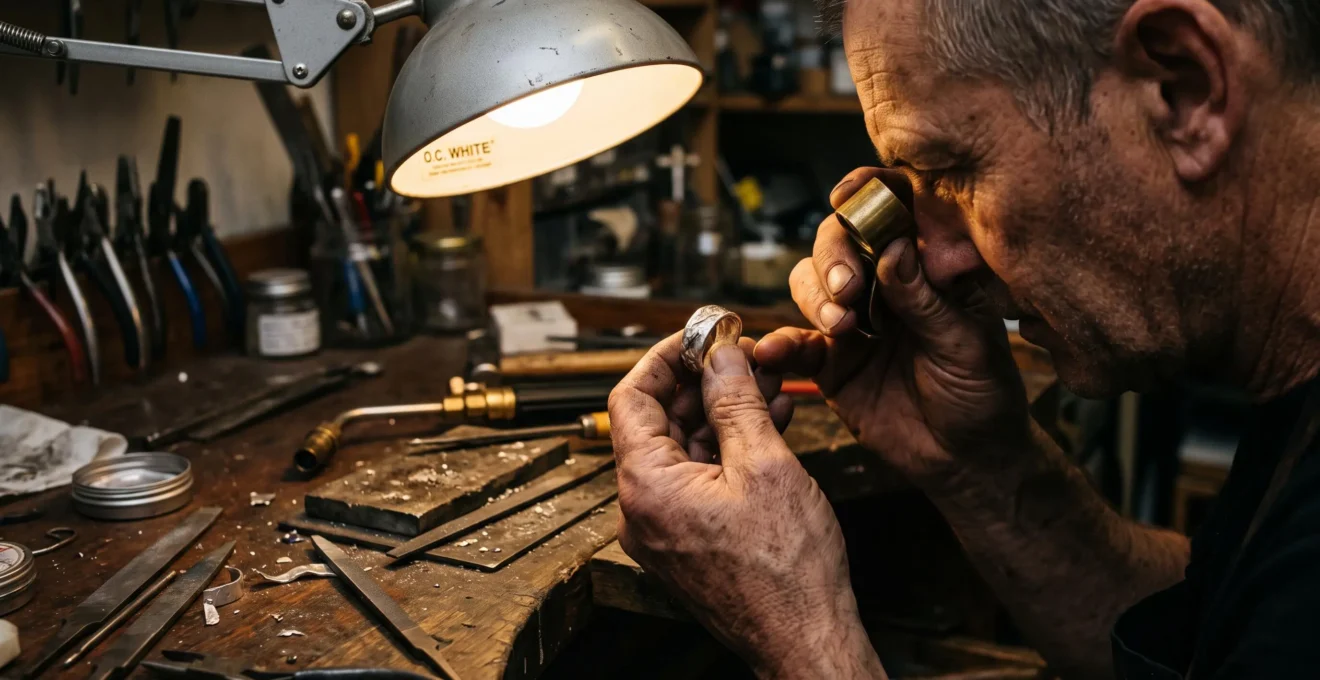
A silver necklace can be described as handmade, sustainable and ethically sourced without those three claims referring to the same thing. The metal might be recycled while the piece is assembled in an undisclosed factory. A genuine artisan might use machine-drawn wire without compromising the substantial handwork involved. Even an authentic hallmark establishes something different from fair working conditions.
To verify genuine ethical craftsmanship, examine three separate questions: who made the jewelry, where its silver came from and what independent evidence supports the seller’s statements. Look for identifiable workshops, descriptions of actual manufacturing operations, relevant sourcing documentation and prices consistent with the labor involved.
These checks do not require specialist equipment or an adversarial conversation. Most begin with product photographs, a few precise questions and an understanding of what certifications can—and cannot—prove. A credible seller should help establish a coherent connection between the metal, the maker and the finished piece.
Ethical silver jewelry: the essential verification rules
- Verify the making process: ask who manufactured the piece and which operations were completed by hand rather than trusting a handmade label.
- Separate sourcing from craftsmanship: recycled silver and responsible-mining certification address different concerns, neither automatically proving fair workshop conditions.
- Check evidence before paying: examine hallmark requirements, request specific documentation and assess whether the price plausibly covers skilled artisan labor.
- Why « Handmade » Silver Labels Often Hide Factory Production Lines
- How to Verify a Jeweller’s Credentials and Workshop Practices Before Buying
- Fairtrade Silver vs Recycled Silver: What Do These Certifications Actually Mean?
- The « Eco-Friendly » Claim That 70% of Conscious Buyers Fall For
- When Should You Ask About Silver Sourcing During the Purchase Process?
- The Filigree Fraud Using Factory Wire Sold at Artisan Prices
- The Fake Hallmark Scam That Fools 60% of Tourist Buyers
- How Much Should Genuinely Handcrafted Silver Jewelry Actually Cost?
Why « Handmade » Silver Labels Often Hide Factory Production Lines
Some jewelry marketed as handmade is substantially machine-produced, with manual polishing, assembly or finishing providing the visible human contribution. The term alone cannot establish how a piece was made. Genuine craftsmanship depends on the operations performed, the maker’s involvement and the accuracy of the seller’s description—not simply whether a human touched the finished jewelry.
Silver jewelry production exists along a spectrum. At one end, a silversmith manually forms metal, fabricates components, solders joints and finishes each piece. At the other, industrial casting, stamping and automated assembly reproduce designs in volume. Between them, small workshops legitimately combine hand skills with motorized polishing equipment, rolling mills or other tools.
These distinctions matter legally as well as commercially. Under the FTC guidance on handmade and hand-finished jewelry, an unqualified handmade representation in the United States requires the relevant shaping, forming, finishing and decoration to be accomplished through hand labor and manually controlled methods. The guidance also distinguishes descriptions such as hand-forged, hand-engraved and hand-polished.
This American framework should not be treated as universal law. Requirements and interpretations may differ elsewhere in the English-speaking world.
Visual inspection can nevertheless help identify questions worth investigating. Look for:
- Identical surface irregularities: recurring marks across supposedly individually made pieces may indicate reproduction from the same master or mold.
- Mold parting lines: faint seams can suggest casting, although legitimate artisans also use casting techniques.
- Perfectly repeated details: identical motifs across large inventories may indicate templates, dies or industrial production.
- Duplicated product photographs: the same images appearing under unrelated brands may suggest wholesale sourcing, image misuse or undisclosed resale.
None of these observations independently proves deception. Skilled silversmiths can produce exceptionally symmetrical objects, while authentic studio collections may reproduce designs through carefully controlled processes.
The economic incentive for vague labeling is straightforward: machine production can reduce the manual time required per piece, while artisan language may support higher retail prices. But claims that a particular percentage of brands uses only a small amount of handwork require evidence not established by the label itself.
Ask a more revealing question: Which parts were formed, assembled, soldered and finished by the maker, and which were cast, stamped or supplied by another workshop? A detailed answer is substantially more informative than an unrestricted handmade promise.
Authenticity does not require rejecting every machine. It requires an accurate description of what human skill contributed—and evidence that the advertised craftsmanship really occurred.
How to Verify a Jeweller’s Credentials and Workshop Practices Before Buying
Verify a jeweller by establishing the maker’s identity, locating the workshop, examining evidence of actual production and checking whether independent records support the business’s claims. Named craftspeople, consistent workshop documentation and specific explanations carry more weight than anonymous artisan stories. No single photograph or certificate proves everything; several mutually consistent details provide stronger reassurance.
Start with the person behind the product. A transparent brand should be able to identify who designed and manufactured the jewelry, even if commercial or privacy considerations limit disclosure of individual employees. For independent makers, a professional biography, workshop address or consistent portfolio can provide useful context.
Workshop photographs are valuable when they demonstrate relevant activities rather than generic images of tools. A short work-in-progress video can clarify how components are shaped, joined and finished. For an expensive commission, a live conversation with the maker may be reasonable.
Evidence should be assessed according to its independence and relevance:
| Evidence | What it can establish | Important limitation |
|---|---|---|
| Verifiable maker identity | Connects a person or workshop to the jewelry business | Does not prove every item was personally manufactured there |
| Workshop process footage | Shows particular tools, techniques and production activities | May not depict the specific item being sold |
| Business or trade registration | Supports the legitimacy of a registered operation | Does not independently certify ethical production |
| Independent certification | Supports claims within the certification’s defined scope | May concern metal sourcing rather than workshop labor |
| Seller’s written description | Creates a record of the advertised manufacturing process | Remains self-declared unless corroborated |
Digital due diligence adds another layer. Use reverse image search on the jewelry photographs and compare suspiciously identical pieces across online marketplaces. Check whether the seller’s business details, workshop location, declared manufacturing country and shipping arrangements make sense together.
Different shipping and production countries are not necessarily suspicious. A designer may manufacture in one location and fulfil orders through a distributor elsewhere. The important question is whether those arrangements are accurately disclosed.
Be particularly careful with cultural-origin claims. References to Balinese silversmiths, traditional Indian metalwork or another regional craft heritage are not evidence of a direct relationship with artisans in that region.
Five-step ethical jewelry verification checklist
- Identify the maker: record the named workshop, craftsperson or manufacturing partner and its declared location.
- Verify the process: obtain a written breakdown of which manufacturing stages were performed by hand and which used machinery.
- Cross-check photographs: run a reverse image search and save any materially identical wholesale or unrelated listings.
- Document sourcing: request the claimed silver origin, recycled-content details or applicable certification reference.
- Assess purchase protection: save the product description, item specification, invoice terms and return policy before paying.
A trustworthy seller may not possess elaborate documentation, especially when operating a small workshop. Consistent, precise answers are more useful than polished marketing materials that cannot be connected to an actual maker.
Fairtrade Silver vs Recycled Silver: What Do These Certifications Actually Mean?
Fairtrade-related precious-metal claims, Fairmined certification and recycled silver address different ethical questions. Responsible-mining frameworks focus on eligible mining operations and supply chains, while recycled-content claims describe recovered material. Neither automatically establishes how a finished ring was made or whether downstream jewelry workers received fair treatment. Buyers must verify each claim against the specific metal and product.
Fairtrade and Fairmined must not be treated as interchangeable labels. They are distinct certification systems with their own standards, licensing arrangements and rules for making product claims.
The official Fairmined Standard for precious metals concerns responsible artisanal and small-scale gold mining and associated precious metals, including silver within its applicable scope. Requirements address matters such as working conditions, environmental practices, traceability and socioeconomic development, with premiums intended to support mining communities.
However, the presence of silver in a certified supply chain cannot be inferred from a brand’s general reference to Fairmined. Buyers need evidence showing that the particular product claim is covered by the relevant sourcing and licensing arrangements.
Likewise, a seller referring to Fairtrade silver should identify the applicable certification scheme and demonstrate that the product qualifies. A certification applicable to one precious metal or purchasing arrangement must not automatically be extended to all silver jewelry sold by the brand.
Recycled silver has a different meaning. It describes silver recovered from qualifying material streams and returned to productive use through recovery and refining. The claim concerns material provenance rather than the working conditions of the people who form, solder, polish or package jewelry.
These distinctions create a useful decision framework:
| Priority | Relevant evidence | What it does not establish |
|---|---|---|
| Supporting responsible mining livelihoods | Applicable responsible-mining certification and documented sourcing arrangements | Fair conditions in every downstream jewelry workshop |
| Prioritizing recovered material | Defined recycled-content percentage and credible supplier documentation | Overall environmental superiority or ethical labor practices |
| Supporting individual artisans | Named makers, manufacturing records and credible workshop practices | The original silver’s mining or recycling history |
| Evaluating multiple ethical dimensions | Separate evidence for sourcing, fabrication and working conditions | An absolute guarantee that every impact has been eliminated |
Certification logos deserve careful scrutiny. Look for the program name, relevant license or certificate information, the actual product scope and a means of checking the claim with the scheme administrator. A valid company-level relationship does not necessarily cover every item.
It is also worth asking whether a sourcing claim describes segregated certified material, an authorized traceability arrangement or another permitted model under the particular standard. These approaches are not automatically equivalent.
The strongest purchase decision connects material provenance with independently assessed workshop practices instead of expecting one environmental or mining label to answer every question.
The « Eco-Friendly » Claim That 70% of Conscious Buyers Fall For
An unqualified eco-friendly claim is a greenwashing warning sign because it rarely explains which environmental impact has been reduced, how the reduction was measured or whether the statement was independently verified. The 70% figure in this heading is not an established deception rate. The defensible concern is unsupported environmental language, regardless of how many shoppers encounter it.
Silver jewelry can involve mining, refining, alloy preparation, manufacturing, transport and packaging. An environmental improvement in one stage does not automatically make the finished product sustainable across its full lifecycle.
The FTC’s summary of the Green Guides advises against broad, unqualified descriptions such as green or eco-friendly. Its guidance also addresses substantiation, recycled-content proportions and the limits of certification seals.
Instead of accepting an adjective, identify the measurable underlying statement.
| Marketing statement | Useful supporting evidence |
|---|---|
| « Made with recycled silver » | Recycled-content percentage, material scope and supplier documentation |
| « Ethically produced » | Defined ethical criteria, relevant workplace practices and independently verifiable evidence where available |
| « Low environmental impact » | Clearly defined impact categories, assessment boundaries and credible comparative data |
| « Sustainably packaged » | Specific packaging materials, composition and the environmental benefit actually claimed |
| « Certified responsible jewelry » | Certifier identity, applicable standard, license status and covered products or operations |
Recycled-content percentages must also be interpreted carefully. A statement about recycled silver does not necessarily describe the other metals in a sterling alloy, decorative components or packaging. Sellers should make the scope understandable.
An especially effective question is: « What percentage of the silver in this piece is recycled, and which refiner supplies it? »
A useful response identifies the percentage or accurately qualified claim, explains how the metal was obtained and describes the records supporting that information. A vague reply about loving the planet adds little evidence.
Environmental vagueness can justify examining other claims more carefully, including handmade production. It does not prove that a brand exaggerating one environmental benefit is statistically more likely to misrepresent craftsmanship; no such quantified relationship is established here.
Small workshops should not automatically be penalized for lacking elaborate environmental reports. A maker who openly describes material purchases, waste recovery and evidence limitations may communicate more reliably than a large brand relying on impressive but undefined slogans.
The goal is not to find a perfectly impact-free silver ring. It is to prefer specific, appropriately qualified claims over environmental assurances that cannot be tested.
When Should You Ask About Silver Sourcing During the Purchase Process?
Ask about silver sourcing before making an irreversible financial commitment, especially for expensive jewelry or custom commissions. For lower-value purchases, check product descriptions and seller policies first, then request clarification when ethical claims influence your decision. The ideal moment is when the seller can still provide evidence and you retain the option to walk away.
The appropriate level of scrutiny depends on the transaction. A bespoke engagement ring involves greater financial exposure and manufacturing complexity than an inexpensive ready-made pendant. The amount of supporting information reasonably expected may therefore differ.
Online shoppers should begin with the product page, workshop information, relevant certification details and return policy. Ask unresolved questions in writing before paying, so the seller’s representations remain available if a dispute later arises.
In a gallery or market, inspect the item and ask questions before completing the transaction. Do not assume that concerns about origin, metal content or workmanship will be easier to resolve once you have departed.
Three questions provide an efficient starting point:
- Where did the silver come from? Ask whether the seller knows its refiner, supplier, mining origin or recycled-content documentation.
- Who manufactured this particular piece? Distinguish the designer, workshop, subcontractor and retailer where relevant.
- Which operations were completed by hand? Request a specific description of forming, casting, assembly, soldering and finishing.
If certification is advertised, add a request for the applicable scheme and verification reference. The objective is not to overwhelm a craftsperson with technical jargon but to establish whether claims correspond to identifiable activities and evidence.
Seller behavior provides additional information. A candid admission that metal origin cannot be traced may be less concerning than invented-sounding precision. However, repeated evasion, contradictory explanations and pressure to purchase immediately warrant caution.
Consider the following explicitly hypothetical exchange. A customer asks where the silver was sourced. One seller responds, « All our products are ethical. » Another identifies a refiner but explains that the source of each recovered silver batch cannot be traced further. The second answer is narrower, yet easier to evaluate because it separates known information from unknown information.
For commissions, obtain a written brief specifying the design, material, production responsibilities, estimated costs, payment stages and agreed changes before placing a deposit. Confirm applicable cancellation rights and whether a custom item is excluded from ordinary returns under the relevant jurisdiction.
Good verification is a conversation supported by records, not a demand for impossible certainty. A maker willing to explain the limits of their knowledge may be demonstrating precisely the transparency buyers need.
The Filigree Fraud Using Factory Wire Sold at Artisan Prices
Filigree lookalikes can command artisan prices when sellers describe industrially reproduced silverwork as individually fabricated craftsmanship. Authentic filigree involves arranging delicate metal elements into intricate designs and securing them through skilled joining techniques. Machine-drawn wire can legitimately form part of this process; the misleading practice occurs when factory manufacture or minimal assembly is represented as extensive artisan handwork.
Traditional filigree can involve fine silver wires that are twisted, curled, positioned and soldered into patterns. Depending on the technique, artisans may produce wire themselves or obtain prepared material before executing the intricate decorative construction.
This distinction matters because machine-drawn wire alone does not make filigree inauthentic. The meaningful question is what work the maker personally performed, whether the assembled design was handcrafted and whether the retail description accurately reflects that process.
Mass production can imitate the appearance of labor-intensive filigree through casting, stamping, prefabricated elements or repetitive assembly. A cast pendant may reproduce fine-looking decorative details without involving the same sequence of hand-placed components.
Close inspection can reveal potential differences:
- Construction: individually arranged wires may reveal discrete joints and genuine spaces between elements, while cast imitations may reproduce the entire pattern as one piece.
- Repetition: perfectly matching decorative features across many items may warrant questions about molds or industrial templates.
- Surface detail: close examination may distinguish actual twisted strands from a molded representation of twisting.
- Weight and thickness: hollow stampings may feel different from other constructions, although weight alone cannot establish production methods.
Visible solder points and slight irregularities can be consistent with hand construction, but they are not definitive authenticity tests. Highly skilled artisans can produce regular patterns, while machines and casting processes can reproduce irregular textures.
Pricing offers a second line of inquiry. Genuine complex filigree may involve substantial time spent designing, preparing elements, arranging the pattern, soldering, cleaning and finishing. Ask how many hours of work the particular piece required and which operations account for that time.
In tourist markets and online stores, reverse image search can help reveal whether an allegedly unique filigree design appears in wholesale catalogs. Such matches deserve investigation, but shared photographs or designs do not independently prove the identity of the manufacturer.
Some artisans intentionally produce small series rather than one-of-a-kind objects. Repetition is compatible with honest craftsmanship when production methods and edition sizes are described accurately.
The value of genuine filigree lies in skilled fabrication and truthful provenance, not in a requirement that every individual wire must have been drawn without mechanical assistance.
The Fake Hallmark Scam That Fools 60% of Tourist Buyers
A silver stamp is not automatically a legally recognized hallmark. Authentic hallmarking depends on the country, applicable assay system, qualifying metal content and prescribed marks. Tourists are especially vulnerable when they cannot recognize local requirements or independently test the metal before leaving. The 60% figure in this heading is illustrative, not a verified international fraud statistic.
Hallmarking systems vary between jurisdictions. Some require independent assay verification for qualifying products, while other markets rely on different legal arrangements or use commercial fineness stamps without an equivalent compulsory independent hallmarking system.
In the United Kingdom, the UK government’s hallmarking guidance explains that a complete UK hallmark contains three compulsory components: a sponsor’s mark, a metal fineness mark and an assay office mark.
For qualifying silver articles, the UK hallmarking exemption threshold is 7.78 grams. This is a UK-specific requirement, not a rule that can be applied to jewelry purchased in every country.
7.78 g
UK silver hallmarking exemption threshold. Qualifying silver articles above this weight generally require hallmarking when offered for sale under the applicable UK rules.
UK government hallmarking guidance; Hallmarking Act 1973.
A simple « 925 » marking indicates a claimed fineness of 925 parts per thousand, conventionally associated with sterling silver. By itself, however, it should not be confused with a complete legally recognized UK hallmark.
The sponsor’s mark also should not be interpreted as the personal signature of the artisan who made the object. It identifies the registered party responsible for submitting the article under the hallmarking system.
At a market stall, a pocket loupe helps inspect whether marks are present and readable. Unusual spacing, inconsistent impressions or poorly formed characters may justify further investigation. Yet authentic stamps can show wear, and counterfeit stamps can be sharply executed. Visual neatness is not proof of legal authenticity.
A magnet may reveal some non-silver components if the item is strongly attracted, but lack of attraction does not prove sterling silver. Similarly, weighing a bracelet cannot establish its composition without reliable information about volume, construction and possible non-metallic components.
Professional precious-metal testing or recognized assay verification is more reliable than improvised market checks. Where the purchase is significant, arrange appropriate verification before paying or choose a dealer offering credible documentation and a clear return or dispute process.
Request a written invoice identifying the item, stated metal fineness, seller and relevant origin information. Keep photographs of the piece and its markings where practical.
Cross-border recovery options depend on the seller, payment method, purchase contract and applicable consumer law. A dispute after returning home may be difficult, but recovery is not universally impossible.
Above all, remember the boundary of the evidence: even a genuine legal hallmark verifies relevant precious-metal fineness, not the ethics of mining, workshop wages or the artistic techniques used.
Key considerations before evaluating the price
- Establish what labor was actually performed by hand; the advertised complexity of a design may not reflect its manufacturing method.
- Separate precious-metal value, artisan labor and ethical sourcing evidence when comparing apparently similar pieces.
- Judge a price against documented work and transparent business practices rather than treating either a bargain or a luxury markup as proof of authenticity.
How Much Should Genuinely Handcrafted Silver Jewelry Actually Cost?
Genuinely handcrafted silver jewelry should cost enough to cover its materials, skilled labor, workshop expenses and a commercially sustainable margin. There is no universal fair price: complexity, location, finishing requirements and retail arrangements vary. A credible evaluation compares the seller’s production description with plausible labor time and documented material costs, rather than treating price alone as evidence of authenticity.
The silver’s market value is a starting component, but it rarely explains the entire retail price of a labor-intensive piece. Manufacturing offcuts, refining losses, alloying, findings, consumables and other production inputs can also influence material expenditure.
Labor depends on the fabrication process. A simple formed ring may require fewer operations than complex stone-setting or hand-built filigree. The appropriate rate also depends on local living costs, skill, equipment, taxes and the realities of sustaining a workshop.
A practical price model is:
Plausible retail price = material costs + skilled labor + allocated workshop overhead + applicable sourcing and verification costs + selling expenses and margin.
This is a reasoning framework, not a mandated pricing formula or guarantee of fair wages. Different business models allocate costs differently.
Imagine two otherwise comparable silver pendants offered at different prices. In this explicitly hypothetical scenario, one is cast from an existing mold and polished in batches, while the other is individually fabricated through multiple stages of forming, soldering and finishing. If the second pendant requires substantially more skilled labor, its higher price may be justified—provided the seller can substantiate that work.
Conversely, a prestigious brand may charge a considerable premium for design, retail presentation or reputation without using more intensive handcraft techniques. A high price therefore deserves explanation rather than automatic trust.
For a practical assessment, ask the seller how long fabrication normally takes, whether preparation and finishing are included, and which parts are purchased ready-made. Then evaluate whether the price seems compatible with skilled labor compensation and reasonable operating costs in the maker’s location.
Low prices deserve context too. A workshop selling directly may avoid distributor margins, while a maker using standardized components can offer legitimately handcrafted assembly at a lower price than fully fabricated bespoke work. Neither circumstance automatically signals exploitation or deception.
Custom commissions require particular care. An authentic commission normally involves agreeing on design specifications and a price basis before production, with the possibility of documented adjustments if the design changes. Deposits and milestone payments should be clearly stated, including what happens if the project is cancelled or cannot be completed.
Ask for a description distinguishing original custom design work from modifications to existing catalog models. A reseller can offer genuine customization, but that service should not be falsely presented as entirely bespoke fabrication.
The most persuasive price justification combines an identifiable maker, believable production hours, clearly stated materials and a transparent explanation of the customer’s total cost. Certification expenses or responsible sourcing commitments may also contribute, but those costs should relate to actual practices rather than unsupported ethical branding.
For your next purchase, choose two comparable pieces, request their manufacturing and sourcing details in writing, and compare the evidence alongside the prices. Support the artisan whose claims are specific, consistent and credible—not simply the seller with the most convincing story.
Can silver jewelry be ethically made without an official certification?
Yes. A small workshop may use responsible practices without participating in a certification program. Credible evidence can include identifiable makers, transparent production methods, supplier records and information about working conditions. However, self-declared ethical practices should not be presented as independently certified, and the absence of certification leaves some claims harder to verify.
Does a 925 stamp guarantee that silver jewelry is genuine sterling silver?
No. A 925 stamp indicates a claimed silver fineness of 925 parts per thousand but is not, by itself, conclusive evidence of composition. Verification depends on the applicable hallmarking system, the reliability of the seller and, where necessary, professional precious-metal testing.
Is recycled silver always a better ethical choice than newly mined silver?
Not automatically. Recovered silver may help address demand for newly extracted material, but its precise environmental benefits depend on sourcing, recovery, refining and relevant assessment boundaries. Responsible newly mined silver may also support mining livelihoods under suitable arrangements. Neither material category independently establishes fair jewelry workshop conditions.
Can a machine-made component be used in authentic handcrafted jewelry?
Yes. Many genuine artisans use purchased components or machine-assisted preparation alongside skilled hand fabrication. Whether the finished item can accurately be marketed as handmade depends on the work performed and the legal standards applicable to the claim. Sellers should disclose material production distinctions rather than implying that every operation was manual.
What should a buyer do if a seller refuses to identify the silver’s origin?
Ask what level of traceability the seller can substantiate, such as its refiner or immediate metal supplier. Not every artisan can trace silver to a particular mine or recycled-material source. If the seller makes specific ethical-origin claims but cannot provide supporting evidence, treat those claims as unverified and consider another purchase option.