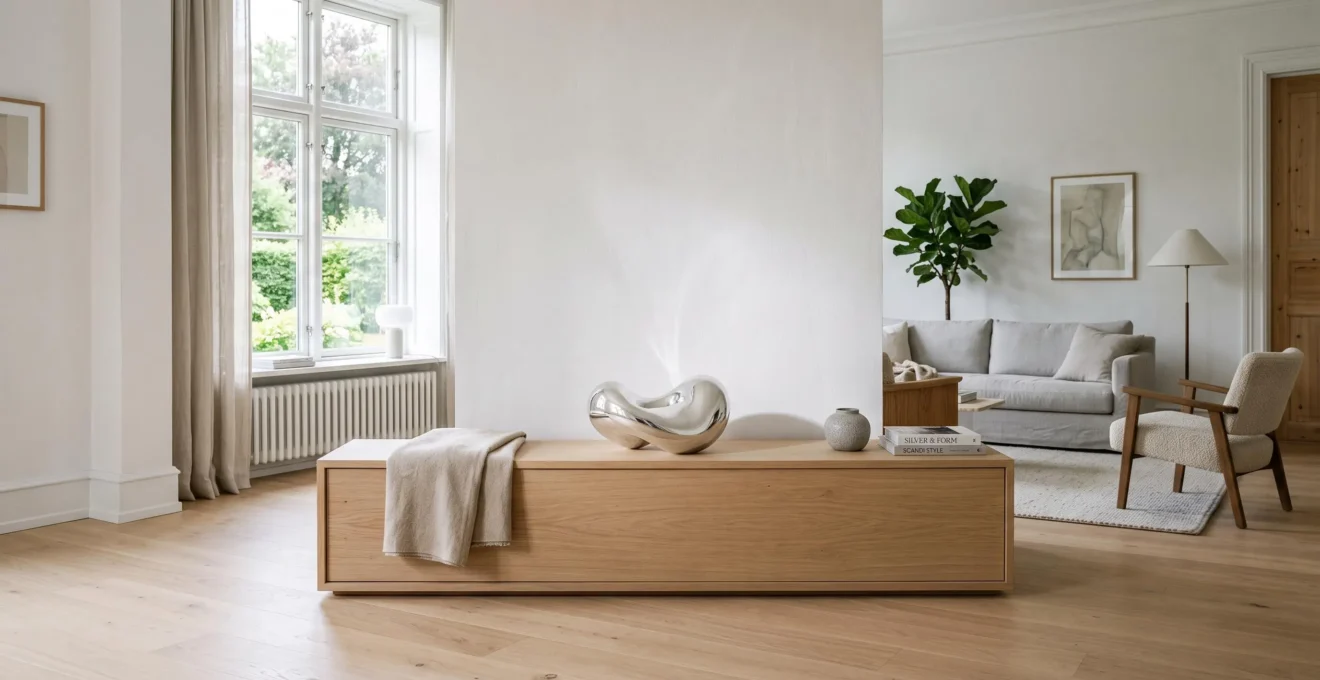
A collection of inherited silver ornaments can seem difficult to accommodate in a home defined by clean lines, open surfaces and muted colours. Elaborate candlesticks, antique bowls and engraved decorative objects often carry more visual detail than contemporary minimalist interiors appear to welcome.
Yet decorative silver does not have to be hidden away or replaced with modern accessories. The key is to control its visual weight, placement and relationship with surrounding materials. A single ornate piece can become a sculptural focal point, while a restrained arrangement of functional silver can contribute texture and reflected light without undermining the room’s simplicity.
Successful integration also requires consideration of preservation. Silver reacts to pollutants in the surrounding air, and poorly chosen shelves or display locations can create unnecessary maintenance. Combining considered styling with suitable storage allows cherished pieces to remain visible without sacrificing their condition or the calm character of the interior.
Decorative silver in minimalist interiors: the essentials
- Choose one focal silver object per surface and leave generous negative space around it.
- Use open shelving for accessible everyday pieces and protective cabinets for delicate or valuable ornaments.
- Limit exposure to humidity and tarnishing pollutants, and favour finishes that complement surrounding textures.
- Why Ornate Silver Ornaments Clash With Scandinavian Minimalist Aesthetics
- Traditional Display Cases vs Open Shelving: Which Suits Contemporary Silver?
- How to Balance Decorative Silver Ornaments With Functional Minimalist Principles
- The Display Location That Tarnishes Silver Ornaments 5× Faster
- When to Rotate Silver Ornament Displays for Protection and Visual Freshness
- Why « Handmade » Silver Labels Often Hide Factory Production Lines
- Why Matte Silver Finishes Suit Corporate Environments Better Than High Polish
- How Matte Silver Textures Create Understated Elegance in Minimalist Wardrobes
Why Ornate Silver Ornaments Clash With Scandinavian Minimalist Aesthetics
Ornate silver ornaments can clash with Scandinavian minimalism because their elaborate detailing, reflective surfaces and imposing proportions compete with the simplicity of the surrounding space. The problem is not silver itself but the amount of visual attention an object demands. Scale, silhouette and empty space determine whether an antique ornament feels disruptive or intentionally selected.
Scandinavian-inspired interiors commonly rely on pale timber, uncomplicated furniture shapes, natural illumination and a restrained material palette. A heavily engraved silver urn introduces competing decorative information: curved handles, intricate relief work, contrasting highlights and sometimes a pronounced historical character.
When several such objects occupy the same shelf, their reflections and ornamental details can fragment the visual composition. Instead of reading as individual treasured pieces, they form a concentrated display that draws attention away from the architecture and furniture.
However, historical character need not conflict with modern simplicity. An inherited silver vessel with a strong, recognisable silhouette can function like a sculpture. Against a plain wall, its age and craftsmanship become distinguishing qualities rather than sources of clutter.
Consider two possible arrangements. A carved silver bowl surrounded by matching miniature figurines, picture frames and candlesticks forms a visually dense cluster. The same bowl placed alone on a pale oak console becomes a deliberate contrast between historical ornament and contemporary restraint.
A useful selection test is to hold the object against an uncluttered, neutral background. Observe it from across the room before inspecting it closely. If the outline remains coherent at a distance, the piece may work as a focal object. If fine ornamentation overwhelms its silhouette, consider a more enclosed or deliberately traditional display setting.
Proportion matters as well. A large object requires more visual breathing room than a compact one. An ornate piece should not automatically be accompanied by several smaller silver accessories to soften its presence; additional reflections may intensify the very problem the arrangement was intended to solve.
Once the piece has an appropriate visual role, the next decision is whether open shelving or an enclosed display will best support both its appearance and preservation.
Traditional Display Cases vs Open Shelving: Which Suits Contemporary Silver?
Open shelving suits silver objects that are handled regularly and contribute to everyday styling, while a suitably constructed enclosed cabinet is generally preferable for delicate, valuable or rarely used pieces. The better option depends on dust, airborne pollutants, cabinet materials and accessibility. Glass alone does not guarantee protection, so display design matters more than appearance.
Open shelves allow silver to participate naturally in an interior. A polished tray can sit beneath a ceramic vase, while an understated bowl can share a shelf with books or textured stoneware. This arrangement avoids turning the collection into a separate museum-like feature.
The drawback is continuous exposure to household dust and airborne contaminants. More frequent handling and cleaning can also increase the risk of surface scratches, particularly on decorated or plated pieces.
Enclosed cabinets provide a different compromise. According to the Canadian Conservation Institute‘s preventive conservation guidelines for metal objects, well-designed display cases can help protect silver from dust, moisture and atmospheric pollutants. The guidance also describes the use of activated charcoal and protective fabrics in museum storage and exhibition settings.
A cabinet must nevertheless be made from compatible materials. An attractive wooden case with unsuitable interior finishes or inadequate seals may allow tarnishing gases to accumulate. Ordinary glass fronts should not be treated as reliable air-pollution barriers or as a proven method of slowing silver tarnish through ultraviolet filtering.
The practical differences become clearer when comparing everyday use with long-term preservation.
| Criterion | Open shelving | Enclosed display cabinet |
|---|---|---|
| Visual integration | Silver feels connected to everyday furnishings. | Creates a defined, curated collection. |
| Dust exposure | Regular dusting is usually necessary. | Can reduce dust deposition when properly enclosed. |
| Tarnish prevention | Depends heavily on room air and nearby materials. | Can improve protection with suitable construction and pollutant control. |
| Accessibility | Convenient for frequently used objects. | Better suited to pieces handled occasionally. |
| Maintenance | Easier access, potentially more frequent cleaning. | Less routine dusting, but enclosure materials need monitoring. |
Humidity and local conditions should influence the decision, but geography alone cannot determine it. A coastal home may face moisture-management challenges, while an inland home can still contain significant indoor sources of tarnishing pollutants. Inspect the actual display environment rather than assuming one region guarantees better preservation.
A hybrid arrangement often provides the most flexibility: reserve protective cabinet space for intricate heirlooms and leave one or two robust pieces visible on nearby open shelving. Compatible anti-tarnish fabric or appropriately selected pollutant-absorbing materials may improve preservation, but their effectiveness depends on use, enclosure design and replacement requirements.
This separation allows silver to remain part of a contemporary home without exposing every object to the same conditions or giving the entire collection equal visual prominence.
How to Balance Decorative Silver Ornaments With Functional Minimalist Principles
Decorative silver can support minimalist design when each piece has a clearly defined visual or practical function. A single reflective ornament can introduce light and texture, while a silver tray, bowl or candlestick can combine utility with ornament. The aim is not to eliminate decoration but to make each object’s contribution apparent.
A practical starting point is the one statement piece per surface principle. Give a console, floating shelf or side table one dominant reflective object rather than arranging several equally prominent silver pieces together.
This does not mean a surface must contain nothing else. A silver bowl can sit alongside a low stack of books or an understated ceramic object, provided the accompanying materials remain visually subordinate.
Silver’s reflective properties are especially useful in rooms with subdued finishes. A polished ornament catches available light and adds a highlight against matte plaster, timber or stone. Reflections may make a composition feel brighter, although one decorative object should not be expected to measurably increase the apparent size of an entire room.
Functional silver provides another way to integrate a collection naturally. A tray holding everyday objects, a bowl used for occasional serving or a pair of regularly used candlesticks may feel more consistent with minimalist principles than an equivalent number of purely ornamental pieces.
Nevertheless, utility is not a requirement for every treasured object. An inherited decorative vessel may deserve a place simply because its form, history or emotional importance justifies the space it occupies.
Negative space helps reconcile these priorities. As an initial styling guideline, leave an empty area around a prominent silver object equivalent to roughly two or three times its footprint. This is a compositional heuristic, not a formal design rule; adjust it to the object’s height, silhouette and viewing distance.
Before finalising a display, examine it from the room’s entrance. The object should be easy to recognise without overwhelming the surrounding furniture.
A five-step silver display styling checklist
- Choose a focal object: select one silver piece for the surface and record its approximate dimensions.
- Test the silhouette: photograph it against a plain background and check whether its overall form reads clearly.
- Clear surrounding space: remove competing reflective accessories and take a second photograph of the simplified arrangement.
- Check practical use: decide whether the item will be handled regularly or displayed mainly for appreciation, noting the decision.
- Review its position: inspect the arrangement from the room entrance and document the final placement with a photograph.
Once the visual composition works, preservation becomes the next constraint: even an aesthetically ideal location may expose silver to conditions that encourage tarnishing.
The Display Location That Tarnishes Silver Ornaments 5× Faster
Kitchens and bathrooms can be particularly unsuitable places for displaying silver because moisture, fluctuating temperatures and potential exposure to sulphur-containing pollutants may accelerate tarnishing. However, there is no established rule that silver tarnishes exactly five times faster in either room. The actual rate depends on local air quality, humidity, surrounding materials and the silver object’s composition.
Silver tarnish is primarily a chemical reaction between the metal and sulphur-containing gases in the atmosphere. On pure silver, the resulting surface compound is silver sulphide (Ag2S). Sterling silver can also develop copper sulphide because its alloy contains copper.
The Canadian Conservation Institute’s explanation of silver tarnishing establishes that higher relative humidity increases tarnishing rates when the concentration of hydrogen sulphide remains constant. This makes the environment surrounding an object especially important when selecting a display position.
A kitchen may expose silver to humidity from cooking, localised warmth and sulphur compounds associated with particular foods. Bathrooms can experience repeated increases in moisture levels. Neither room is automatically harmful under every condition, but both deserve closer scrutiny than a stable, well-ventilated living area.
Other locations may create avoidable problems. A shelf directly above a radiator or fireplace can experience repeated heating, while a position beside a sunny window may introduce temperature fluctuations. Sunlight is not itself the principal cause of silver sulphide tarnish, although heat and the condition of any protective coating can influence the suitability of a location.
Freshly decorated rooms also merit caution. Some paints and construction materials can release substances that promote tarnishing. The risk depends on their formulation and the conditions of use, rather than the simple fact that a room has recently been painted.
Nearby materials are equally significant. Rubber bands, certain wool fabrics and unsuitable storage or cabinet components can expose silver to sulphur compounds. A shelf lined with an incompatible material may therefore be less protective than an otherwise similar unlined surface.
Below 50% RH
The Canadian Conservation Institute recommends dry storage below 50% relative humidity for silver preservation. This is a conservation recommendation, not a universal humidity target for every household material or living space.
Canadian Conservation Institute, Understanding how silver objects tarnish.
For a practical placement assessment, inspect the proposed location for sustained moisture, nearby heating equipment, direct contact with potentially unsuitable materials and evidence of accelerated tarnishing on existing objects.
A useful household experiment is to document the condition of comparable silver pieces displayed in two different locations. Inspect them periodically over several months, keeping a record of visible changes. This may reveal a practical difference between the locations, although it cannot establish a universal tarnishing rate.
For valuable heirlooms, avoid experimenting with potentially harmful placements. Choose a protected environment from the outset and seek specialist conservation advice when the object’s condition or historical surface treatment is uncertain.
The most successful display position combines stable surroundings with the intended visual composition. Periodic inspection then helps determine whether the arrangement remains suitable over time.
When to Rotate Silver Ornament Displays for Protection and Visual Freshness
Silver ornaments should be rotated when a change improves the room’s appearance or allows vulnerable pieces to return to protective storage. There is no universal monthly or seasonal interval supported by conservation evidence. A practical approach is to coordinate rotation with existing household maintenance routines and inspect each object whenever it is moved.
Rotation serves two distinct purposes. From a design perspective, it changes the visual focus of a room without requiring additional purchases. From a preservation perspective, it can reduce the cumulative time a particular object spends exposed to airborne pollutants when the alternative is genuinely protective storage.
These objectives should not be confused. Moving silver from one exposed shelf to another does not necessarily protect it. Similarly, storing an object in an unsuitable box can be less desirable than leaving it in a stable display cabinet.
For a collection containing several decorative pieces, divide the objects into two or three groups according to their scale, finish and visual character. One group might contain a large polished bowl and restrained candlesticks. Another could feature smaller matte vessels and simple sculptural forms.
Display one group while keeping the others in storage materials suitable for silver. Appropriate anti-tarnish enclosures can help limit exposure to atmospheric contaminants. Where moisture management is necessary, carefully selected silica gel may be useful, provided its condition and suitability are monitored.
A rotation could coincide with seasonal cleaning or an intentional change to surrounding textiles and furnishings. There is no need to introduce a rigid schedule if the objects are already well protected and their appearance remains satisfactory.
Each rotation should include a condition check. Examine the silver for discolouration, scratches, loose components and changes in its surface finish. A simple dated photograph can help distinguish gradual deterioration from marks already present.
Do not automatically polish every object when it comes out of storage. Repeated polishing removes small amounts of surface material and can gradually soften engraving, reduce plating or disturb historically important patina. Valuable antique pieces may require a more conservative approach than ordinary contemporary tableware.
For example, a homeowner might alternate between an antique engraved bowl during the colder months and a simple brushed-silver vessel during warmer months. The change creates a different visual emphasis while offering an opportunity to inspect and protect the piece being put away.
This practice also encourages more selective ownership. When fewer pieces remain permanently visible, their craftsmanship, provenance and suitability become more important considerations.
Why « Handmade » Silver Labels Often Hide Factory Production Lines
A silver object described as handmade is not necessarily produced entirely by traditional hand-forming methods. Some products combine industrial casting, machine preparation and manual finishing. However, production descriptions are subject to different rules in different markets, and a handmade claim should not automatically be treated as misleading. Buyers need to distinguish verified manufacturing methods from vague promotional language.
This distinction matters particularly when selecting a small number of lasting pieces for a minimalist interior. A silver ornament may be visually attractive regardless of its manufacturing method, but its description should accurately reflect the workmanship involved.
Terms such as handcrafted, hand-finished, studio-made and artisan-inspired do not always communicate the same information. Hand-finishing can describe a genuine manual operation without implying that every component was formed by hand. A studio-made description may identify where an object was produced without establishing the precise techniques used.
Regulatory definitions also vary. In the United States, US federal rules on handmade and hand-finished jewellery claims distinguish representations concerning the manufacture of the whole object from claims about particular manual operations.
Under the applicable US guidance, an unqualified handmade representation for covered products entails requirements concerning manual shaping, forming, finishing and decoration. A claim of hand-polishing, by contrast, refers to that particular operation and does not establish that the entire object was handmade.
Such requirements should not be projected onto every country or every decorative object. The relevant jurisdiction and product category must be established before drawing legal conclusions about a seller’s description.
Physical details can provide useful clues. Identical mould seams on supposedly unique objects may justify asking about casting methods. Small variations in decorative finishing can suggest manual work, although they do not prove that the whole piece was made by hand.
Hallmarks and maker’s marks require similar care. A 925 marking indicates a claimed silver fineness of 925 parts per thousand, but it does not independently establish who made an object or whether it was handcrafted. In the United Kingdom, complete official hallmarks can provide independent confirmation of precious-metal fineness under the applicable hallmarking system; they are not certificates of handmade production.
Price can inform a purchasing decision but should not be treated as proof. An inexpensive ornament is not automatically mass-produced, just as an expensive object is not necessarily handmade.
A sensible purchasing process is to request the seller’s description of the production stages, examine available maker information and ask which operations were carried out manually. For substantial purchases, provenance and documentation are more dependable than visual impressions alone.
Craftsmanship verification supports selective buying, but it should not turn minimalism into an inflexible preference for handmade objects. A well-designed contemporary silver piece can have lasting aesthetic value even when industrial processes contributed to its manufacture.
Once an object’s material and construction are understood, surface finish becomes another important selection criterion, particularly in rooms where silver is regularly touched or exposed to changing light.
Why Matte Silver Finishes Suit Corporate Environments Better Than High Polish
Matte and brushed silver often suit contemporary offices and reception areas because their subdued reflections complement restrained architecture and make some everyday surface marks less conspicuous. High-polish silver provides stronger visual contrast but readily reveals fingerprints and fine scratches. Neither finish is universally superior: appearance, handling frequency and the feasibility of future restoration determine the better choice.
Commercial interiors commonly combine glass, concrete, timber and neutral-coloured furnishings. Within these settings, a highly polished silver vessel can behave like a small mirror, reflecting nearby movement, windows and artificial lighting.
This can be desirable when an object is intended to attract attention. A polished sculptural piece on a reception desk, for example, may create a deliberate focal point against otherwise subdued materials.
Matte silver operates differently. Its textured surface disperses reflections, producing a softer appearance that integrates more readily with low-sheen finishes. Brushed surfaces introduce directional texture, allowing an object to retain visual interest without relying on bright reflections.
There are practical differences as well. Fingerprints and fine marks can be especially noticeable on uninterrupted polished surfaces. A brushed finish may visually disguise some superficial handling marks, although scratches that cross its directional grain can become conspicuous.
This introduces a maintenance trade-off. Polished silver can sometimes be refinished to restore a more uniform reflective appearance, subject to the object’s construction and condition. Restoring a damaged brushed or matte finish may require specialist work to recreate its original texture.
Repeated abrasive polishing is not a suitable general solution for either finish, especially on silver-plated or historically significant pieces. Cleaning methods should reflect the surface treatment and the object’s value.
The same reasoning applies to domestic interiors. An entryway console, frequently used side table or accessible living-room shelf may benefit aesthetically from an understated finish. A polished heirloom can instead occupy a more protected location where its reflections remain part of the intended composition.
Consider the material immediately behind the object. Brushed silver against pale oak creates a restrained pairing of textures, while polished silver against dark stone or painted plaster creates stronger contrast. Either can work when the relationship is deliberate.
The distinction reaches beyond furniture and decorative accessories. Surface finish also influences how silver jewellery interacts with clothing, providing a consistent design principle between the home and personal style.
Key takeaways before choosing personal accessories
- Silver finishes create different relationships with surrounding materials: matte surfaces offer quieter texture, while polished surfaces provide stronger contrast.
- The right finish depends on handling, repairability and context rather than on a universal preference for minimal shine.
- A selective collection can connect interior decoration and personal style without requiring every silver item to match exactly.
How Matte Silver Textures Create Understated Elegance in Minimalist Wardrobes
Matte silver jewellery can complement a minimalist wardrobe by introducing a subtle metallic texture without the pronounced reflections of highly polished accessories. Its understated appearance works particularly well with restrained silhouettes and fabrics such as linen, wool and structured cotton. A small collection of versatile pieces can establish visual consistency without making identical finishes a requirement.
The connection between interior styling and personal accessories lies in the treatment of material, proportion and contrast. A brushed-silver vessel against a textured wall creates a similar visual relationship to a matte silver bracelet worn against a finely woven sleeve.
In both cases, the metal contributes detail without becoming the dominant element. Its surface interacts with surrounding textures rather than competing with them through intense reflection.
Colour is another consideration. Matte silver can complement cool greys, muted blues, charcoal and off-white clothing. It can also provide a subtle contrast against warmer neutrals such as oatmeal, sand or soft brown, particularly when the overall outfit remains restrained.
Highly polished silver is not incompatible with minimalist clothing. Its brighter finish can create a purposeful accent against smooth silk, satin or sharply tailored fabrics. The difference is one of emphasis: matte surfaces reinforce textural harmony, while reflective surfaces introduce stronger visual contrast.
A compact jewellery selection might consist of a brushed-silver cuff, small matte studs and a slim chain. These pieces can accompany different outfits without the need for numerous variations in size, colour or decorative detail.
The same purchasing considerations used for interior ornaments remain relevant. Check the actual metal content, examine construction quality and understand the care requirements of textured or plated finishes. A visually appealing surface does not establish the purity or manufacturing method of the underlying metal.
Matte jewellery should also be maintained with attention to its texture. Aggressive polishing may alter an intentionally brushed surface, while inappropriate abrasion can remove plating or soften decorative details. Follow care guidance appropriate to the piece rather than assuming all silver finishes can be cleaned identically.
A consistent design language does not require every accessory to share the same finish. One polished heirloom necklace may complement a collection of matte everyday jewellery, just as a single ornate silver bowl can coexist with restrained modern furnishings.
What matters is the hierarchy of visual attention. Let one element take prominence while the others support the composition through proportion, material and texture.
Begin with the silver pieces already owned, select those that suit everyday use or meaningful display, and give each a clear role. A considered collection is defined less by the number of objects it contains than by how comfortably each one fits into its surroundings.
Can antique silver ornaments work with modern furniture?
Yes. Antique silver can complement modern furniture when its proportions and visual prominence are carefully controlled. A single ornate object against simple timber, stone or painted surfaces often creates a more coherent arrangement than grouping numerous decorative pieces together. Preserve enough surrounding space for the object to be appreciated independently.
Should tarnish be removed from antique silver before displaying it?
Not automatically. Tarnish can alter an object’s appearance, but polishing removes a small amount of surface material and may affect engraving, plating or historically significant patina. For valuable antique silver, assess whether cleaning is necessary and consult a qualified conservator when the surface treatment or historical importance is uncertain.
Is sterling silver always better than silver-plated decoration?
No. Sterling silver and silver-plated objects have different constructions, durability considerations and care requirements. Sterling silver contains 92.5% silver by mass, while silver-plated objects have a layer of silver over another material. The better choice depends on design, intended use, condition, available documentation and budget. Plated surfaces require particular care because repeated polishing can wear through the silver layer.
Does a glass display cabinet completely prevent silver tarnish?
No. A glass cabinet may reduce dust and exposure to surrounding air, but protection depends on the enclosure’s construction, seals, internal materials and pollutant control. Some cabinets can themselves contain materials that release tarnishing compounds. Compatible liners, suitable enclosure materials and regular inspection are more important than glass doors alone.
Can different silver finishes be combined in the same minimalist room?
Yes. Matte, brushed and polished silver can coexist when the arrangement has a clear visual hierarchy. For example, one polished statement piece can contrast with a restrained matte accessory. Avoid placing several equally reflective or elaborate objects together unless the grouping has been deliberately composed around their differences in scale and texture.