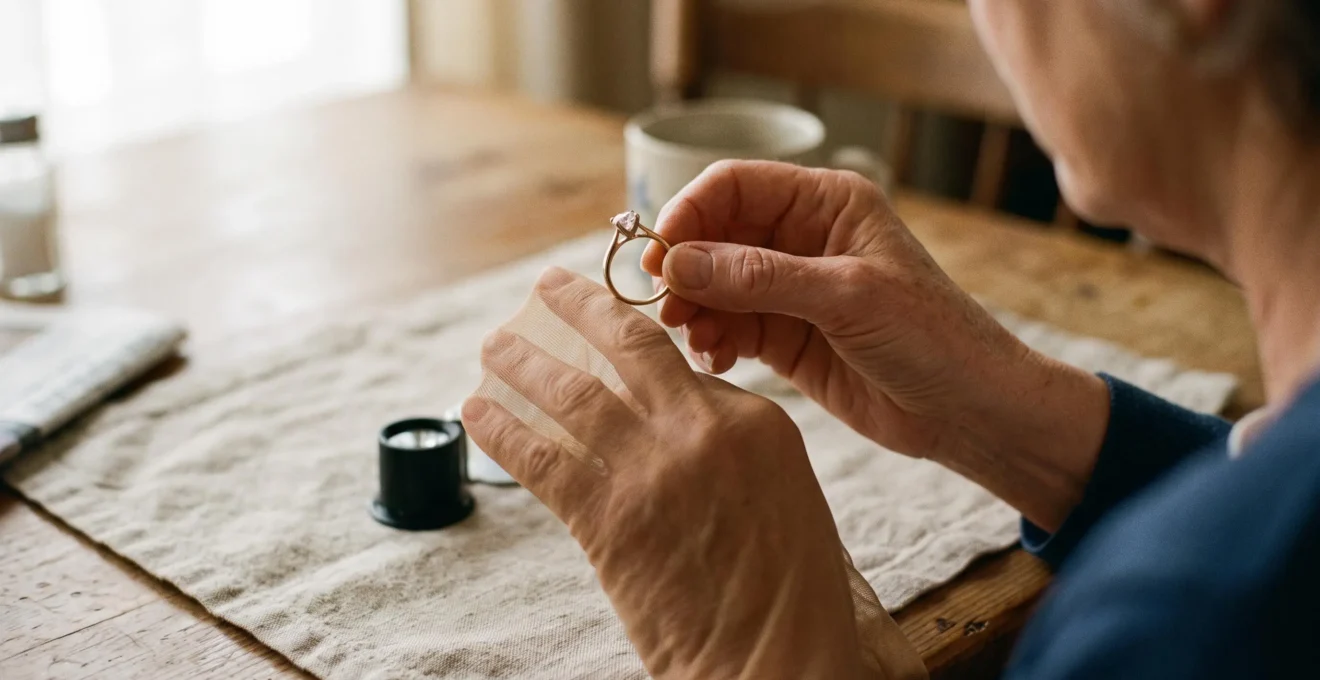
A gemstone can appear securely mounted while the metal holding it has already begun to wear. For jewelry worn daily, setting security depends on more than the number of prongs or the strength of the gemstone. The construction of the mounting, exposure to impacts, metal condition, setting height, and maintenance history all influence the risk of stone loss.
Buyers should examine how the setting protects vulnerable edges, whether its retaining components make reliable contact with the stone, and how easily damage can be detected. A low-profile bezel may suit someone handling tools throughout the day, while a carefully constructed prong setting may be appropriate for less demanding activities.
Visible inspection can identify warning signs, but it cannot establish the remaining mechanical strength of a mounting. The practical goal is to recognize avoidable risks, compare designs intelligently, and seek professional assessment before small defects become expensive failures.
Stone Setting Security: Essential Checks
- Assess exposed edges, prong condition, setting height, and construction quality together rather than judging security by appearance alone.
- Stop wearing jewelry if a stone moves, a prong catches fabric, or a setting shows visible deformation.
- Match protective settings and professional inspection frequency to actual activities, including gardening, exercise, and hands-on work.
- Why Prong Settings Fail During Gardening and Kitchen Work Specifically
- Bezel vs Prong Settings: Security Comparison for Active Lifestyles
- How to Inspect Prong Tension for Early Warning Signs of Stone Loss
- The Vibration Source That Gradually Loosens Stone Settings
- When to Schedule Professional Setting Inspections to Prevent Losses
- Closed Settings vs Open Prong Settings: Which Protects Stones During Sports?
- How to Assess Whether a Clasp Will Survive Daily Active Wear
- Which Silver Jewelry Actually Survives Gyms, Gardening and Childcare?
Why Prong Settings Fail During Gardening and Kitchen Work Specifically
Gardening and kitchen work expose prong settings to two different hazards: sudden mechanical displacement and gradual surface wear. A prong can catch against a rigid object and bend away from the gemstone, or its retaining tip can become progressively thinner through repeated abrasive contact. Both processes reduce security, but they produce different warning signs.
Direct impact is the more immediate threat. A ring may strike the edge of a saucepan, catch on a gardening glove, or press against a tool handle. The resulting force can act sideways against a prong, changing its position relative to the gemstone. Metal that remains intact may nevertheless lose the contact required to retain the stone.
Progressive abrasion is harder to notice. Soil contains mineral particles, and repeated contact with gritty surfaces can contribute to metal wear. Cleaning compounds may also affect finishes or interact with jewelry materials, although their effects depend on composition and exposure. Mechanical abrasion, chemical deterioration, and a single impact should not be treated as interchangeable causes.
Hand-intensive activities are especially relevant because gripping introduces pressure from directions that an exposed mounting may not tolerate well. A raised ring can repeatedly contact surrounding objects while the wearer concentrates on another task.
Four-prong solitaire settings deserve careful examination because the loss of one retaining contact can leave less redundancy. Six-prong designs provide additional contact points in many constructions, although poorly manufactured or badly worn prongs can undermine that advantage. Metal choice alone does not determine the outcome: platinum, gold alloy, prong thickness, work-hardening, and workmanship all influence deformation and wear.
The GIA‘s guide to engagement ring settings describes how mounting styles expose or protect gemstone edges and emphasizes the importance of construction quality. A shared-prong setting should not automatically be considered safer because neighboring stones may depend on common retaining elements.
A simple screening method is to move a clean, fine fabric very lightly across the prong tips. If the fabric catches, stop rather than pulling harder. A snag can indicate a projecting or damaged tip, although it does not establish whether the stone is loose. Do not deliberately scrape the mounting or attempt to straighten a prong yourself.
Removing a raised, delicate ring before gardening, abrasive cleaning, or heavy kitchen work is generally more reliable than depending on the setting to withstand every accidental contact. Damage found after an impact deserves professional attention even when the stone still appears correctly positioned.
Bezel vs Prong Settings: Security Comparison for Active Lifestyles
A bezel setting generally offers better protection against snagging and direct contact with a gemstone’s perimeter, while a prong setting leaves more of the stone visible and accessible to light. Neither design guarantees retention. A poorly constructed bezel can loosen, and a well-built prong setting can remain secure under appropriate wearing conditions.
In a full bezel, a continuous metal rim surrounds the gemstone’s girdle. This reduces direct exposure along the perimeter and removes many of the projecting tips that catch on clothing or equipment. Its continuous outline is particularly useful for wearers who frequently handle objects.
Prongs use smaller individual retaining points. They allow greater visibility around the gemstone and often produce a lighter appearance, but they concentrate security in components that can bend, thin, or become damaged independently.
The distinction becomes clearer when comparing practical operating conditions.
| Assessment criterion | Full bezel | Prong setting |
|---|---|---|
| Protection of gemstone perimeter | Continuous rim covers the girdle | Exposed areas remain between prongs |
| Snagging potential | Usually lower with a smooth profile | Higher when tips project or become lifted |
| Visual exposure | More metal surrounds the stone | More of the stone remains visible |
| Home inspection | Some retaining surfaces are concealed | Individual prong tips are more accessible |
| Repair considerations | Rim repairs may require specialized work | Individual prongs may be rebuilt or retipped |
| Best practical fit | Frequent hands-on activity | Wearers prioritizing visual openness and willing to inspect regularly |
A partial bezel offers an intermediate approach, protecting selected sections of the gemstone while retaining some open edges. V-shaped prongs can serve a similar protective purpose for pointed corners, such as those found on pear-shaped or marquise-cut stones.
Gemstone durability also changes the decision. Hardness measures resistance to scratching, not resistance to every impact. According to GIA’s explanation of gemstone durability beyond hardness, even diamonds can chip at thin girdles or vulnerable points. Opal and tanzanite require additional care against accidental blows.
Converting a prong-set solitaire to a bezel may be technically feasible, but it is not simply a matter of bending a rim around the existing mounting. A jeweler must assess stone dimensions, existing damage, metal construction, and the risks associated with removing and resetting the gemstone. More vulnerable gemstones may require particularly cautious handling.
Bezel maintenance also presents a less obvious challenge: the rim can conceal the stone seat, making some problems harder to recognize without magnification and professional testing.
For active daily wear, prioritize a well-constructed, low-profile mounting with protected edges. For occasional wear, a carefully maintained prong design may be a reasonable choice. The condition of the actual piece matters more than its setting category alone.
How to Inspect Prong Tension for Early Warning Signs of Stone Loss
Prong security can be screened at home by examining retaining tips under magnification, looking for visible gaps, listening for unexplained movement, and checking whether the gemstone shifts in its seat. These checks reveal possible defects rather than measuring actual holding force. Any confirmed movement, displaced prong, or suspicious gap requires professional assessment before further wear.
A secure prong tip normally extends over the appropriate edge or crown area of the gemstone and maintains close contact at its designed retaining position. The precise geometry depends on the cut and mounting. The metal should not appear suspended above the stone, sharply lifted, cracked, or displaced from its neighboring prongs.
Use consistent lighting and compare equivalent retaining points. A single prong looking noticeably higher, thinner, or differently angled than the others can be more informative than uniform surface scratches.
- Inspect the mounting visually. Under good lighting, use a jewelry loupe if available. Look for gaps, bent tips, missing metal, cracks, and unusual asymmetry.
- Check for signs of movement. Without pushing directly on the stone, notice whether normal, gentle handling produces clicking or rattling. Avoid forceful shaking or tapping.
- Screen for projecting tips. Lightly pass fine fabric across the mounting. Stop immediately if it snags.
- Observe stone orientation. If the gemstone visibly rotates or changes position during ordinary handling, consider the mounting insecure. Do not twist the stone to test it.
- Assess recent exposure. Record impacts, contact with grit, heavy gripping, or other events that may justify inspection even when no obvious defect is visible.
A clicking noise deserves attention, but it is not a definitive diagnosis: other movable jewelry components can also produce sound. Similarly, a dull-looking stone may simply require cleaning. Appearance alone cannot distinguish ordinary dirt from a problem beneath the setting.
Professional inspection becomes urgent when the stone moves, a prong has visibly shifted, a tip is broken, or the mounting has suffered a significant blow. A minor cosmetic scratch with no other symptoms may be discussed at a routine visit, but uncertainty about security should favor caution.
Five-Step Stone Security Inspection Checklist
- Photograph the setting from above and both sides in clear light; keep three reference images showing its current condition.
- Compare all visible prong tips under magnification; note any gap, deformation, crack, or unusual asymmetry.
- Perform one gentle fabric-snag screening without pulling or forcing the metal; record whether any tip catches.
- Document unusual clicking, visible gemstone movement, or a recent impact; create a dated description of each warning sign.
- Arrange a professional check if any structural warning appears; keep the inspection findings and recommended repairs with the jewelry records.
Home screening is most valuable when repeated consistently and stopped before it risks causing damage. It helps identify when to seek a jeweler’s assessment, not whether a loose stone can safely remain in use.
The Vibration Source That Gradually Loosens Stone Settings
Repeated shocks from powered equipment, heavy gripping, or vehicle vibration can contribute to setting deterioration, particularly when a mounting already contains worn or poorly seated components. The outcome depends on vibration intensity, impact transmission, material fatigue, construction, and existing damage. There is no established universal percentage of gemstone settings that loosen because of vibration.
The important mechanical distinction is between an isolated overload and cumulative stress. A sudden strike may bend a prong immediately. Repeated low-level loading may instead contribute to progressive deformation, wear at contact surfaces, or the growth of an existing defect.
However, ordinary movement should not be assumed to relax a properly manufactured prong automatically. The relationship between vibration exposure and actual gemstone loss is not sufficiently quantified by the supplied evidence to assign specific failure rates or service-life estimates.
Repeated loading matters most when it combines with direct mechanical contact. Consider someone operating lawn equipment while holding a vibrating handle. The ring may experience both transmitted vibration and pressure against the handle. If the mounting also strikes nearby metal surfaces, the resulting risk is not attributable to vibration alone.
Weightlifting presents another example. A raised setting can contact a bar while the band experiences substantial gripping pressure. Direct impact, friction, and deformation may be more important than vibration in this situation.
Driving over uneven surfaces can transmit vibration through the hands, but the actual load reaching a gemstone mounting depends on grip, steering-wheel contact, ring position, and many other factors. Routine typing generally involves far less severe contact than power-tool operation or heavy lifting; it should not automatically be classified as a major setting hazard.
The most relevant structural variables include:
- Height of the gemstone and mounting above the finger.
- Thickness, geometry, and previous deformation of retaining components.
- Metal alloy, manufacturing quality, and repair history.
- Stone dimensions and how accurately its seat supports the gemstone.
- Frequency and severity of impacts or gripping pressure accompanying vibration.
Some mounting designs rely on mechanical compression or specialized tension geometries, while conventional prong settings retain stones through formed metal contacts. These constructions should not be assumed to respond identically to cyclic loading. Nor should seating compounds be assumed to exist in every design.
A jeweler may correct looseness by adjusting retaining elements, rebuilding worn prongs, or resetting the stone where appropriate. Retipping adds metal to worn retaining areas; reseating may be necessary if the stone no longer sits correctly. The correct repair depends on diagnosis rather than a universal tightening procedure.
For wearers exposed to repeated mechanical loading, the useful response is to reduce unnecessary contact, inspect after unusual impacts, and increase professional attention when the construction or existing wear justifies it. Vibration awareness complements physical inspection; it does not replace it.
When to Schedule Professional Setting Inspections to Prevent Losses
Professional setting inspections should follow the intensity of wear, the mounting’s condition, and any applicable insurance requirements rather than a single universal calendar. Everyday wearers of raised or delicate prong settings generally warrant closer attention than people who wear the same jewelry occasionally. A known impact, loose gemstone, or damaged retaining element justifies immediate assessment regardless of the previous inspection date.
Scheduling becomes easier when linked to recognizable events. A routine annual review can provide a starting point for discussing maintenance with a jeweler, while higher-risk wear may call for more frequent checks. Before gardening season, extended travel, or work involving hand tools, an additional inspection may be worthwhile.
A professional assessment can examine areas that remain difficult to judge at home. The Jewelers Mutual professional jewelry inspection guide identifies loose gemstones, worn metal, damaged settings, weak clasps, and compromised links among relevant inspection concerns.
Using a loupe or microscope, a jeweler can inspect retaining surfaces and determine whether the stone is properly seated. Depending on the mounting, they may assess movement with suitable bench tools, examine cracks or thinning, and evaluate whether repair is necessary. Not every jeweler uses calibrated measuring equipment, and a visual inspection is not equivalent to a standardized mechanical strength test.
Preventive repairs may include reshaping a displaced prong, adding metal through retipping, rebuilding severely worn components, or resetting the gemstone. Such maintenance does not necessarily indicate defective original workmanship. Even properly manufactured jewelry experiences wear.
Some jewelers provide complimentary or low-cost visual inspections, sometimes alongside cleaning. Availability and charges differ between businesses, so confirm the service and whether any repair quotation is separate. Returning to a jeweler familiar with the piece can also make changes in its condition easier to evaluate over time.
Insurance requirements are another consideration. Some policies specify inspection or documentation conditions, but these are contractual and jurisdiction-dependent rather than universal rules. Check the applicable wording instead of relying on assumptions about annual inspections or automatic coverage.
If a gemstone is already loose, stop wearing the jewelry and place it in a secure container. If the stone has fallen out, retain it separately for assessment. Do not attempt to press it back into the mounting or use adhesive as a substitute for repair.
Retain purchase records, appraisals when applicable, photographs, and repair documentation. These materials may assist identification, valuation, or an insurance claim, although neither prior inspections nor documentation guarantees reimbursement.
A practical inspection schedule is one that responds to the jewelry’s condition and prompts timely repair. Its purpose is to identify defects before loss, not to promise that a setting will remain secure until a specified future date.
Closed Settings vs Open Prong Settings: Which Protects Stones During Sports?
Closed, bezel-style, and low-profile settings generally reduce snagging and protect more of a gemstone’s perimeter during physical activity than exposed, elevated prongs. However, setting choice alone cannot make jewelry safe for weightlifting, contact sports, or activities involving equipment. Removing rings before high-risk exercise is often the most effective way to protect both the jewelry and the wearer’s hand.
Sports introduce loads that differ from ordinary household movement. A barbell can press directly against a ring, a racket handle can repeatedly contact the setting, and a fall can transmit sudden impact into the mounting and gemstone.
A bezel removes many exposed prong tips and can reduce the chance of catching on clothing or equipment. It does not eliminate impact transmission. A sufficiently severe blow to the rim may deform the mounting or damage a vulnerable stone.
Setting height often matters as much as enclosure. A high bezel can project farther from the finger than a low prong mounting. Consequently, compare the complete profile rather than relying exclusively on the labels « open » and « closed. »
Flush settings place the gemstone close to or within the band surface. Channel settings protect stones between metal walls, although these designs must still be examined for secure construction and exposed edges. Tension-style settings should not automatically be regarded as protective: their security depends on precisely engineered retention, and parts of the gemstone may remain exposed.
The most useful comparison concerns the actual activity.
| Activity | Main concern | Practical decision |
|---|---|---|
| Weightlifting | Grip compression, ring deformation, equipment contact, and finger injury | Remove rings before lifting |
| Racket sports | Repeated handle contact and accidental impact | Remove exposed or raised gemstone jewelry |
| Contact and ball sports | Collisions, falls, snagging, and injury to others | Remove jewelry as required by safety rules and the activity |
| Swimming | Ring slipping off in water, particularly with temperature-related fit changes | Store valuable rings securely before entering the water |
| Low-impact exercise | Variable contact with clothing, surfaces, or equipment | Assess snagging and fit; remove when interference is possible |
| Gardening | Grit abrasion, gripping pressure, and tool impacts | Remove delicate stone-set rings before work |
Cold water can temporarily affect finger size and ring fit, increasing the possibility of a loose ring slipping off. This risk is distinct from failure of the stone setting itself and should be addressed separately.
Sports organizations and facilities may also restrict jewelry for participant safety. Even a flush ring can cause injury under heavy gripping or impact conditions, and its low profile should never be interpreted as an exemption from those restrictions.
When jewelry is intended for frequent activity, select smooth, robust, low-profile construction for ordinary wear, but maintain a separate removal routine for higher-risk sports. Protecting the setting and preventing hand injury are related but distinct priorities.
How to Assess Whether a Clasp Will Survive Daily Active Wear
A clasp is suitable for active daily wear when its closure engages reliably, its moving components show no significant wear, and the links connecting it to the jewelry remain sound. Closure design matters, but overall security also depends on spring condition, metal thickness, joint quality, and exposure to sudden pulling. A strong clasp cannot compensate for a weakened connecting ring.
Lobster clasps use a spring-loaded gate that closes against a retaining body. Their practical advantages include a relatively substantial locking shape and convenient operation. However, springs may weaken, gates can become damaged, and worn contact surfaces may prevent reliable closure.
Spring-ring clasps operate with a similar spring-return principle in a smaller circular format. Small components can be difficult to inspect and manipulate, although size and construction quality vary. A spring ring should not automatically be considered defective merely because it differs from a lobster clasp.
Threaded barrel clasps depend on properly engaging their screw connection. Wear, damaged threads, or incomplete fastening can compromise security. Magnetic clasps provide convenient closure but may separate when subjected to a pulling force sufficient to overcome magnetic retention.
A secondary safety chain can add redundancy to certain bracelets, particularly valuable pieces, but its strength and attachment points must also be appropriate. It does not justify wearing delicate jewelry during hazardous activities.
The following assessment distinguishes basic home screening from professional examination:
- Close the clasp fully and confirm that the gate returns to its intended position.
- Apply only gentle, steady tension suitable for the piece; do not pull sharply or deliberately stress the mechanism.
- Look for visible gaps, excessive sideways play, bent parts, and damaged metal.
- Notice whether the clasp closes positively; an unfamiliar weak or muted click may justify further examination but is not conclusive by itself.
- Inspect the jump rings, soldered joints, and adjacent links for separation, thinning, or deformation.
For ordinary daily bracelets and necklaces, a well-made lobster clasp often provides a useful balance between security, size, and ease of use. A properly manufactured threaded clasp can also be secure when completely fastened. Neither choice is universally superior because component quality and loading conditions vary.
The weakest connection may be the small jump ring attaching the clasp to the chain. If this ring opens or breaks, the jewelry can be lost even though the clasp remains closed. This makes the entire connection assembly, rather than just the visible locking mechanism, the correct unit of inspection.
Childcare introduces unpredictable pulling forces when small hands grasp necklaces or bracelets. Gym equipment introduces snagging risks, and workplace movement may repeatedly load exposed chains. For these activities, removal can be safer than selecting a nominally stronger clasp.
When buying jewelry, examine closure operation in person where possible and ask how its connecting components are assembled. A reliable clasp should be judged as part of the complete jewelry structure, not as an isolated accessory.
What to Remember Before Choosing Everyday Jewelry
- Structural damage matters more than cosmetic appearance: a polished surface can conceal a weakened setting, clasp, or connecting link.
- Protective design must suit the activity: smooth profiles help reduce snagging, but jewelry removal remains appropriate under heavy mechanical loading.
- Material choice should account for maintenance and deformation, not just resistance to tarnish or the initial purchase appearance.
Which Silver Jewelry Actually Survives Gyms, Gardening and Childcare?
Substantial, smoothly finished sterling-silver jewelry can tolerate many ordinary daily activities, but thin rings, delicate chains, raised gemstone settings, and lightweight clasps are poorly suited to repeated gripping, abrasive gardening, or sudden pulling. Gym use requires particular caution because sweat affects surface appearance while weightlifting can mechanically deform rings. Silver’s suitability depends on construction and exposure, not simply metal purity.
Sterling silver commonly contains 92.5 % silver, with the remainder consisting of alloying metals, often including copper. Alloying improves practical usability compared with fine silver, but the resulting jewelry can still scratch, bend, or suffer surface changes under demanding conditions.
Tarnishing is a chemical process distinct from mechanical failure. Sulfur-containing substances can produce dark surface compounds, while moisture and environmental exposure influence the rate of change.
The Sheffield Assay Office‘s explanation of silver tarnishing describes the role of sulfur-containing gases, humidity, fingerprints, and perspiration. It identifies relative humidity below 50% as a favorable storage condition for limiting tarnish under the circumstances discussed, rather than a universal threshold for preventing jewelry deterioration.
Activity should guide the selection of silver jewelry:
| Activity | Principal exposure | Recommended approach |
|---|---|---|
| Childcare | Pulling on chains, caught clasps, accidental impacts | Prefer uncomplicated, secure pieces; remove dangling jewelry when pulling is likely |
| Gardening | Grit, moisture, tool contact, repeated hand pressure | Remove thin bands, delicate chains, and stone-set jewelry before work |
| Gym and weights | Perspiration, grip compression, equipment contact | Remove rings and snag-prone jewelry, especially during lifting |
| Ordinary office wear | Light abrasion, skin contact, occasional knocks | Sturdy smooth designs are generally practical with routine care |
| Swimming | Chlorinated or salty water, possible loss through slipping | Remove and store jewelry beforehand |
Metal thickness and component geometry are more useful durability indicators than surface shine. A heavier-gauge bracelet with substantial connecting rings can offer greater resistance to accidental deformation than a thin ornamental chain, provided its workmanship is sound.
Rhodium or ruthenium plating may alter surface appearance and provide a protective barrier, but coatings gradually wear with use. They do not strengthen an underlying thin band or repair an insecure gemstone setting. Replating requirements depend on coating thickness and wear conditions.
Alternative silver-colored materials include stainless steel and titanium. Depending on the specific grade and construction, they can provide greater resistance to some forms of mechanical damage. Their appearance, weight, sizing, repairability, and suitability for particular wearers differ, so material substitution should not be treated as an automatic durability guarantee or an assured lower-cost option.
Skin reactions also require a separate assessment. Some people react to particular alloy constituents or surface contaminants, especially under prolonged moisture exposure. Discomfort should not be interpreted as evidence that the silver itself is mechanically unsound.
A practical maintenance routine includes wiping jewelry with an appropriate soft cloth after perspiration, drying it before storage, and avoiding unnecessary exposure to household chemicals, chlorinated water, and saltwater. Store silver clean and dry, away from materials that may release tarnish-promoting substances, including certain rubber products.
Polishing can address some surface discoloration and minor cosmetic marks, but repeated abrasive polishing removes small amounts of material. It cannot restore metal lost through structural wear. Bent prongs, damaged clasps, and loose stones require repair rather than routine cleaning.
For online purchases, request clear close-up photographs of the mounting, band profile, clasp, and connection points. Ask about alloy identification, metal dimensions, repair availability, and any gemstone-setting maintenance recommendations. A photograph cannot establish remaining mechanical strength, but it can reveal whether the design is suited to anticipated use.
The most reliable purchase decision combines a durable construction, realistic removal habits, and a willingness to maintain the piece. Choose jewelry for the activities it can reasonably withstand, inspect critical components before damage progresses, and obtain a professional opinion whenever security is uncertain.
Can a gemstone fall out even when all the prongs are present?
Yes. Prongs can remain visibly intact while losing their intended contact with the stone through deformation, wear, or problems at the gemstone seat. A complete set of prongs does not prove that the stone is secure. Visible movement, unusual gaps, or other structural warning signs justify professional examination.
Does a higher number of prongs always make a ring safer?
No. Additional prongs can provide more retaining contact points and redundancy, but the result depends on metal thickness, setting geometry, workmanship, and existing wear. A well-constructed four-prong mounting may outperform a poorly manufactured six-prong design. Security must be assessed on the individual piece.
Should a loose gemstone be tightened at home?
No. Bending prongs without appropriate tools and knowledge can damage the gemstone, fracture weakened metal, or create uneven retaining pressure. Stop wearing the piece, store it securely, and have a qualified jeweler examine the mounting. The repair may involve tightening, retipping, rebuilding, or resetting depending on the defect.
Can a ring pass a home inspection and still lose its stone?
Yes. Home checks cannot reliably reveal every hidden crack, weakened seat, or concealed retaining surface. A setting can also suffer new damage after inspection. Visual screening helps identify certain warning signs, while professional examination reduces uncertainty without guaranteeing future retention.
Does jewelry insurance eliminate the need for setting maintenance?
No. Insurance may provide financial protection for specified events under a particular policy, but it does not prevent physical loss or guarantee replacement of an irreplaceable gemstone. Coverage, deductibles, exclusions, appraisal requirements, and inspection conditions vary. Preventive maintenance and current documentation remain important.