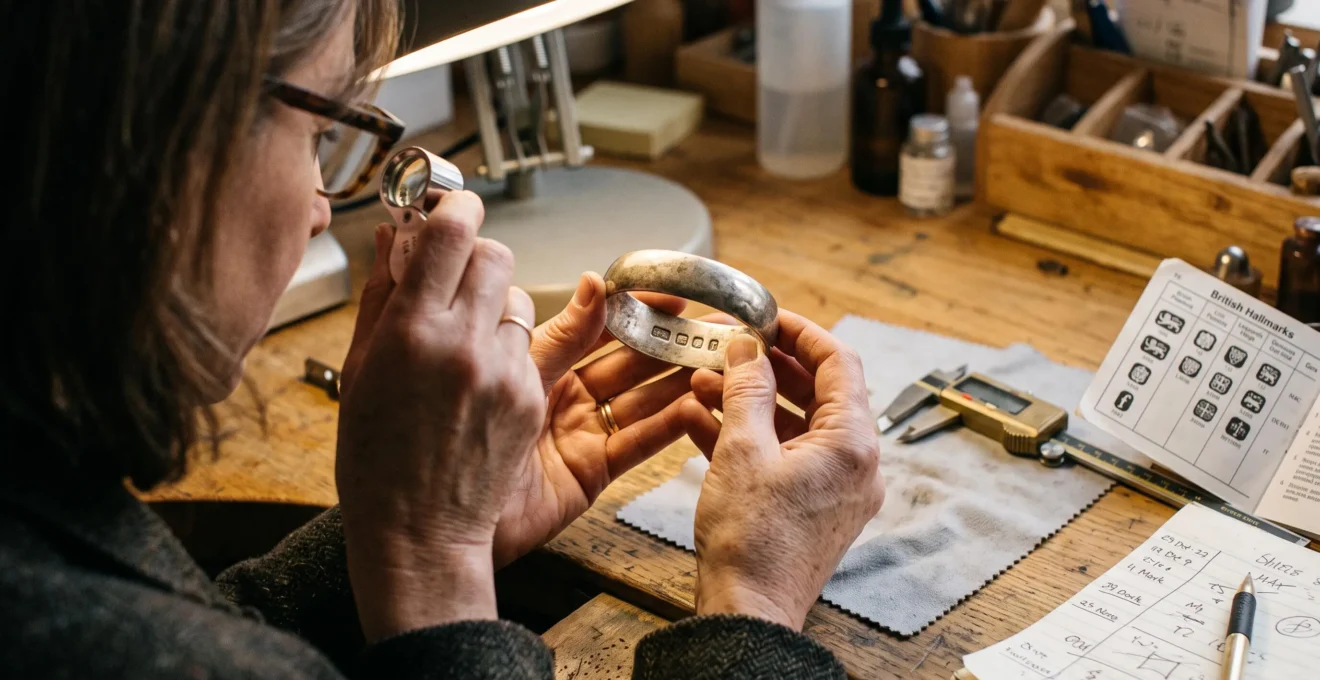
An inherited silver bracelet may carry more historical information in three tiny stamped symbols than in its entire decorative design. A lion, a crown, an unfamiliar set of initials or a letter inside a shaped shield can provide clues about metal purity, the assay office responsible for inspection and the period when the piece was hallmarked.
Decoding antique silver hallmarks begins with identifying the marking system, not guessing a year from an isolated letter. British, French and other European traditions developed different conventions, and a symbol that identifies an assay town in one system may have an entirely different meaning elsewhere.
Even a convincing hallmark cannot establish every aspect of authenticity. Historical marks must agree with the object’s construction, surface condition and documented registration history. For family silver, that distinction matters: a mark may support a date and origin while leaving questions about later alterations, replacement components or actual manufacture unanswered.
Antique silver hallmark identification at a glance
- Identify the country and assay system before interpreting individual symbols or date letters.
- Cross-check the sponsor’s mark, metal standard, assay office and date letter wherever applicable; a date letter generally identifies hallmarking rather than manufacture.
- Use magnification, construction details and specialist records to investigate inconsistencies instead of treating one stamp as conclusive proof.
- Why Hallmarks Reveal a Piece’s Age, Origin and Authenticity Instantly
- How to Photograph and Research Silver Hallmarks Using Online Databases
- Maker’s Marks vs Assay Marks: What Each Symbol Tells You
- The Reproduction Hallmark That Makes Modern Pieces Look Antique
- How Magnification Tools Reveal Subtle Hallmark Details Determining Value
- Hand-Drawn vs Machine-Pulled Wire: What Microscopes Reveal
- Why Millgrain Beading Instantly Identifies Edwardian and Art Deco Jewelry
- How Millgrain Beading Reveals Jewelry’s Historical Period and Craftsmanship Quality
Why Hallmarks Reveal a Piece’s Age, Origin and Authenticity Instantly
Silver hallmarks can reveal an object’s tested metal standard, the office responsible for hallmarking and, in some historical systems, the year of inspection. Their value comes from an established assay framework rather than their decorative appearance. However, the symbols must be interpreted together: a hallmark can establish a documented regulatory connection without independently proving when every component was manufactured.
In the British tradition, an assay office tests precious-metal articles and applies marks identifying the relevant standard and responsible parties. Under current UK regulations, a complete hallmark has three compulsory components: a registered sponsor’s mark, a metal fineness mark and an Assay Office mark. The date letter is optional.
The UK government‘s practical guidance on hallmarking explains these requirements under the Hallmarking Act 1973, as amended. Historical objects require interpretation against the rules and marking conventions applicable to their own period.
For many traditionally marked British antiques, a useful verification triangle combines the sponsor’s identity, the assay town and a date letter. The fineness or standard mark adds essential information about the metal itself. A credible identification requires the symbols to be historically compatible, not merely recognizable.
| Marking tradition | Primary identification clues | Important limitation |
|---|---|---|
| British | Sponsor, metal standard, assay office and historical date letters | The date letter must be matched to the correct office and letter cycle. |
| French | Official guarantee or title marks, with maker or responsibility marks where applicable | British date-letter tables cannot be used to date French marks. |
| Other European traditions | National or regional fineness, responsibility and control marks | The relevant country’s marking system and historical period must be established first. |
| American pieces | Fineness inscriptions, trademarks and manufacturer information | A sterling inscription does not imply the presence of a British-style assay date. |
Consider the British sterling standard of 925 parts silver per thousand, the higher 950 fineness found in some traditions and the historical British Britannia standard of 958 parts per thousand. These descriptions concern composition; they are not interchangeable with proof of age or craftsmanship. A higher silver content does not automatically command a higher antiques-market price.
The absence of a hallmark also requires context. Current UK silver hallmarking rules include a 7.78-gram weight exemption, while historical exemptions, wear, repairs and jurisdictional differences may explain missing or incomplete markings. Conversely, a seemingly complete set of punches may have been copied.
A hallmark provides a starting point for authentication, not a certificate covering an object’s entire history. Once its likely national system is identified, accurate photographs and reliable reference records become the next priority.
How to Photograph and Research Silver Hallmarks Using Online Databases
Reliable hallmark research begins with clear images that preserve the outline, lettering and depth of each punch. Photograph the marks under low-angle light, then identify the relevant assay office or national system before searching date letters and sponsor registrations. Online matches are useful evidence, but identification depends on comparing several features rather than accepting the first visually similar symbol.
Place the object on a stable, neutral surface. Use a smartphone’s macro capability or a close-focusing camera, and illuminate the hallmark from the side. Raking illumination casts small shadows across recessed details, making worn letters and shield boundaries easier to distinguish than direct frontal flash often does.
Photograph the entire object before taking close-ups. Record where the marks appear, include a small scale where practical and take several images while changing the direction of the light. Preserve unedited originals alongside any enlarged reference crops.
Organize the research around the hallmark system. On a traditionally marked British piece, identifying the assay office first helps narrow the correct date-letter tables. Compare the letter’s typeface and enclosing shield, not just the alphabetic character. Letters recur across different years, offices and marking cycles.
The Sheffield Assay Office‘s mark-identification records illustrate the importance of institutional archives. Sheffield used the Crown as its silver assay mark from 1773 until 1973, when the Rose replaced it. Its sponsor registers extend back to 1773, offering a basis for investigating registered identities.
Five practical steps for researching inherited silver hallmarks
- Document the whole piece. Photograph its front, back, fastening or underside and the exact hallmark location. Deliverable: a dated overview photo set.
- Capture each mark clearly. Use macro focus, oblique lighting and a scale where feasible. Deliverable: readable original images and individual symbol crops.
- Identify the marking system. Record the likely country, assay office and fineness standard, noting uncertainty. Deliverable: a preliminary hallmark identification sheet.
- Compare historical records. Check date-letter charts relevant to the office and match sponsor initials, lettering and shield shapes. Deliverable: a comparison record with candidate identifications.
- Record the conclusion and remaining doubts. Compare the research with the object’s construction and condition; identify whether expert inspection is needed. Deliverable: a short evidence-based dating assessment.
Some marks will remain unresolved. A sponsor’s initials may correspond to several registrations, a punch may be damaged or the piece may have passed through an importation system. Publicly accessible databases are not complete global registers.
If the stamp remains ambiguous or its appearance conflicts with the metal, an assay office identification service or a qualified specialist can examine the evidence. Where composition is uncertain, professional nondestructive metal analysis may provide complementary information without establishing the object’s age by itself.
Maker’s Marks vs Assay Marks: What Each Symbol Tells You
A maker’s or sponsor’s mark identifies a registered individual or business associated with submitting an article, whereas an assay mark identifies the authority responsible for testing and marking the metal. These marks answer different questions. Their historical compatibility strengthens an attribution, but a sponsor’s identity should never automatically be treated as the name of the craftsperson who made the piece.
In Britain, the historical expression “maker’s mark” often appears in reference works, while “sponsor’s mark” more accurately describes the modern registration function. A jewelry retailer, importer or other registered sponsor may submit an article without having physically manufactured it.
Assay marks provide a separate regulatory reference. The assay-office symbol identifies the responsible institution; fineness marks describe metal content; and historical date letters, when present and correctly identified, help establish when the hallmarking occurred.
For example, imagine a silver brooch with sponsor initials matching a known registration period and an assay date letter apparently associated with an earlier year. That discrepancy does not establish fraud. The researcher must first verify that the correct office, letter cycle, shield shape and sponsor registration have been identified.
Secondary punches may explain unexpected combinations:
- Import marks: historical importation regulations may account for marks different from those on domestically submitted pieces.
- Duty marks: certain historical British marks relate to duties imposed during particular periods and can offer additional chronological context.
- Cancellation or alteration-related marks: their interpretation depends on the governing system and the circumstances in which they were applied.
- Responsibility marks: these identify an accountable registered party under the relevant system, not necessarily the workshop that carried out every manufacturing stage.
When markings disagree, independently verified official assay information generally carries greater evidential weight concerning metal testing than an unsupported stylistic attribution. Yet the apparently official mark must itself be authenticated before it can support a conclusion.
The strongest reading explains every relevant stamp while acknowledging unresolved contradictions. Those contradictions become especially significant when marks have been copied onto modern reproductions.
The Reproduction Hallmark That Makes Modern Pieces Look Antique
Modern silver reproductions can carry numbers, symbols or decorative punches that resemble historical hallmarks without establishing antique age. A standalone “925” indicates a claimed fineness, not a British assay date, and a deliberately antique-looking stamp may be misleading. The critical test is whether the marking system, physical construction and documented historical context agree.
A numeric fineness inscription should not be confused with a complete officially applied hallmark. Genuine modern hallmarks are not evidence of antique manufacture, and an imitation of an official punch raises different questions from a legally permitted decorative or commemorative marking.
Hallmarking requirements and the legality of particular impressions vary by jurisdiction. A mark that merely resembles an old motif cannot be declared counterfeit without assessing what it represents, how it was applied and whether it purports to be an authorized assay mark.
Inspect the relationship between the impression and surrounding surface. A sharp punch within a heavily distressed area may deserve closer attention, particularly when the adjacent finish and wear patterns seem inconsistent.
However, punch sharpness alone is an unreliable dating method. Original marks can survive in protected locations, while genuine antiques may be polished or repaired. Conversely, reproductions can be deliberately scratched, chemically darkened or subjected to localized abrasion to simulate age.
| Observed feature | Possible explanation | Recommended verification |
|---|---|---|
| A standalone 925 stamp | Fineness declaration rather than a complete official hallmark | Investigate origin, manufacturer and independent metal evidence. |
| Unusually sharp impressions | Protected original marks, later application or reproduction | Compare surrounding wear, tool impressions and registration details. |
| Dark patina surrounding crisp punches | Natural surface variation, cleaning or artificial antiquing | Examine the punch recesses and adjacent surfaces under magnification. |
| Historically incompatible symbols | Misidentification, a replacement component or misleading marking | Check official historical combinations and examine construction. |
Professional metal testing can help establish whether the object matches its claimed fineness. Techniques such as X-ray fluorescence can be useful when applied by a suitably equipped specialist, although surface readings require caution with plated objects, soldered areas and compositionally different components.
Neither a convincing hallmark nor a laboratory fineness result alone authenticates historical manufacture. Both must be reconciled with the physical evidence, which is where careful magnification becomes particularly valuable.
How Magnification Tools Reveal Subtle Hallmark Details Determining Value
Magnification reveals hallmark features that ordinary photographs may conceal, including incomplete impressions, surface distortion, tool marks and evidence of later intervention. A practical 10x loupe can support initial inspection, while higher-quality optics and documented microscopy allow closer comparisons. These observations influence confidence in an attribution, but no isolated microscopic feature reliably establishes authenticity or financial value.
Begin with a clean optical view rather than maximum enlargement. Rotate the piece beneath angled illumination, checking the edges of each punch and the continuity of surrounding wear. Avoid aggressive polishing or abrasive cleaning before examination; the surface itself may retain useful historical evidence.
The American Museum of Natural History‘s conservation imaging methods describe how controlled illumination, magnification and photographic documentation help specialists study surface topography, manufacturing characteristics and condition.
For silver hallmarks, the practical observations include:
- Punch boundaries: determine whether the outline is complete, distorted or partly obscured by wear.
- Internal letter details: inspect narrow strokes and recesses that may distinguish similar registrations.
- Surface discontinuities: document cracks, abrasion or displaced metal without assigning an automatic cause.
- Possible reworking: examine overlapping impressions, adjacent solder work and abrupt changes in finish.
Wear must be interpreted across the object. A faded hallmark on a heavily handled surface is not inherently suspicious. Likewise, an unusually well-preserved mark may occur in a protected recess. More concerning is an unexplained difference between the mark, its immediate surroundings and the object’s broader construction.
Tool quality matters more than a manufacturer’s advertised magnification. A basic jeweler’s loupe offers portability, a well-corrected triplet can improve edge clarity, and a digital microscope is useful for storing comparative photographs. Excessive digital enlargement can magnify blur without revealing additional evidence.
10x
A practical starting magnification for inspecting fine hallmark details, not a mandatory legal standard or a guarantee of authentication.
Practical examination recommendation; the museum conservation reference supports magnified visual documentation without prescribing a universal jewelry magnification.
Magnified images also provide a more defensible basis for discussing condition with an appraiser. A legible mark, documented repair or suspected alteration may affect the confidence behind a valuation. The price effect remains dependent on provenance, rarity, condition, demand and the authenticity of the complete object.
On filigree jewelry, the inspection can extend beyond stamped marks to manufacturing traces in the silver wire itself, offering a second line of historical investigation.
Hand-Drawn vs Machine-Pulled Wire: What Microscopes Reveal
Microscopic examination of silver wire can reveal differences in diameter, surface texture, twisting, junctions and finishing. These features may help distinguish manufacturing methods or identify later repairs, particularly in filigree jewelry. However, wire drawn through a die can be remarkably uniform even when produced by historical hand-powered methods, so regularity alone cannot establish a modern manufacturing date.
Traditional wire production commonly involved drawing metal through progressively smaller openings. A craftsperson could control the process manually while still obtaining consistent dimensions. Modern machinery mechanizes and standardizes many stages, but both historical and contemporary techniques can leave overlapping physical characteristics.
Filigree offers a particularly informative examination surface. Fine strands may be twisted, flattened, curled and soldered into ornamental frameworks. Under magnification, the researcher can inspect how the wires terminate, intersect and attach to supporting elements.
| Feature | What it may reveal | Why it is not conclusive |
|---|---|---|
| Diameter variations | Differences in forming, drawing or finishing | Historical drawn wire can be uniform; modern work can be intentionally irregular. |
| Twist spacing | How decorative wire was manipulated | Hand and mechanized processes can produce similar patterns. |
| Solder joints | Assembly practices and possible repairs | Later repairs may obscure the original construction. |
| Wire endings | Cutting, finishing and attachment methods | Tool traces are not always unique to a particular period. |
A hypothetical inherited filigree brooch illustrates the method. Suppose its hallmark suggests an early historical period, while one replacement-looking decorative strand differs in color, finish and joint construction. That difference warrants examining whether the brooch has been repaired; it does not automatically invalidate the original hallmark.
Construction analysis is less informative for solid cast objects without wire elements. In those cases, casting characteristics, assembly techniques, repairs and documented marks offer more relevant lines of investigation.
Decorative finishing techniques can provide further stylistic context. One especially recognizable detail in historical jewelry is millgrain, whose tiny raised beads are often associated with Edwardian and Art Deco designs.
Why Millgrain Beading Instantly Identifies Edwardian and Art Deco Jewelry
Millgrain beading is strongly associated with delicate Edwardian jewelry and also appears in Art Deco designs, but it does not instantly authenticate either period. Its tiny raised beads can support a stylistic attribution when their execution, setting construction and surrounding ornament agree with the proposed date. Later jewelry frequently recreates historical millgrain effects, making corroboration essential.
Millgrain, also spelled milgrain, describes a fine beaded border worked along the edges of jewelry settings or decorative metal surfaces. Specialized rolling tools can raise repeated beads, creating texture and highlighting delicate contours.
Edwardian jewelry, commonly associated with the late nineteenth and early twentieth centuries, often favors airy metalwork, platinum and diamond settings, fine decorative borders and intricate openwork. Millgrain contributes to the light, lace-like appearance frequently seen in those designs.
Art Deco jewelry, especially associated with the 1920s and 1930s, tends toward stronger geometric organization, contrasting forms and structured ornament. Millgrain can appear within these compositions, although it does not define the style on its own.
The Gemological Institute of America’s educational overview of antique and vintage engagement-ring styles describes delicate milgrain and openwork as characteristic Edwardian details while distinguishing the geometric tendencies of Art Deco jewelry.
When comparing suspected period pieces, inspect the relationship between decoration and overall design:
- Edwardian-style work: look for fine decorative borders integrated into delicate openwork and graceful settings.
- Art Deco-style work: examine beaded details in relation to stepped forms, angular arrangements and deliberate contrasts.
- Later revival work: consider whether an otherwise modern setting reproduces historical motifs.
Neither bead density nor bead dimensions provide an independently validated period-specific dating rule. Millgrain existed outside the Edwardian and Art Deco periods and remains available to contemporary jewelers.
Craftsmanship can influence appraisal judgments. Consistent finishing, carefully aligned borders and coherent workmanship may support a quality assessment, but no universal market premium can be assigned to millgrain without considering the complete piece.
The next question is therefore not simply whether millgrain is present, but how its beads were formed, how they have worn and whether they belong to the object’s original construction.
Key takeaways before evaluating millgrain workmanship
- Historical style and authenticated manufacturing date are different conclusions; decorative resemblance cannot replace assay evidence.
- Inspect the continuity of beading across settings, corners and repaired areas rather than judging one undamaged section.
- Where construction and hallmark dates appear incompatible, document the discrepancy and investigate alterations before rejecting the entire piece.
How Millgrain Beading Reveals Jewelry’s Historical Period and Craftsmanship Quality
Millgrain workmanship can reveal how carefully a jewelry piece was finished and whether its decoration is consistent with a proposed historical period. Examine bead spacing, depth, alignment, wear and the treatment of curves under magnification. Differences may point toward repairs or alternative production methods, but even apparently hand-worked millgrain cannot independently establish an antique date.
Traditional millgrain can be made with a manually guided beading wheel that raises a sequence of small metal projections along an edge. Modern tools and manufacturing processes can reproduce a closely similar effect. A hand-guided tool may leave subtle changes in pressure or spacing, but carefully executed manual work can also be highly regular.
Use a 10x loupe to examine four observable characteristics:
- Spacing: look for variations in the distance between adjacent beads, noting whether the pattern changes near joins.
- Relief: inspect the depth and definition of individual beads without assuming that sharper features are newer.
- Curves and corners: assess whether the ornament follows the contours naturally or shows interruptions associated with fitting and finishing.
- Surface continuity: check for changes in color, abrasion, solder residue or texture around potentially restored sections.
Normal wear can flatten exposed beads, especially along edges subjected to frequent contact. Restoration may create a different pattern: a repaired section could display more distinct beading than surrounding areas or show evidence of renewed finishing after soldering. These differences must be compared with the local surface condition before being interpreted.
Consider a hypothetical silver brooch attributed to the nineteenth century through its hallmark. If the ornament includes exceptionally uniform beading alongside apparently later solder work, the possibilities include restoration, replacement components or an incorrectly dated attribution. None follows automatically from the beading alone.
The comparison becomes more useful when the hallmark has already been identified through a reliable historical record. An assay date supplies a chronological reference for the marked component; millgrain style and construction help evaluate whether the current decorative assembly appears consistent with that reference.
The opposite result is also informative. A legitimate historical hallmark on an object with later decorative modifications may still identify an authentic older component. An expert should distinguish originality, restoration and composite construction rather than reduce the entire assessment to genuine or fake.
Quality is assessed through the cohesion of the workmanship: consistent borders, precise transitions, well-finished settings and decoration proportionate to the design. These observations may assist valuation but need to be considered together with condition, attribution and market evidence.
Before insuring, selling or restoring valuable family silver, preserve clear photographs, record the strongest supported attribution and seek an experienced silver specialist’s opinion if the marks and craftsmanship disagree. A defensible historical description is more useful than an exact date unsupported by the evidence.
Can an antique silver piece be genuine without a hallmark?
Yes. Marking requirements differ by country, date, weight and type of object. Some pieces were legally exempt, while others may have lost readable marks through wear or alteration. The absence of a hallmark limits documentary identification but does not independently prove that a piece is counterfeit.
Does a British date letter establish the exact year a piece was made?
Not necessarily. A correctly identified date letter generally establishes a hallmarking year under the applicable historical system. Manufacture, assembly or later modification may have occurred at different times. The assay office, shield and letter cycle must also be identified correctly.
Does 925 stamped on inherited jewelry mean that it is antique sterling silver?
The number 925 indicates a claimed fineness of 925 parts silver per thousand, corresponding to sterling silver. By itself, the inscription does not authenticate the metal, establish an antique date or identify an official assay office. Additional markings, provenance and sometimes professional testing are needed.
Can a silver hallmark remain genuine after a piece has been repaired?
Yes. A genuine historical hallmark may remain on an original component even after repairs or replacements. The mark should not be assumed to authenticate every subsequently added element. Changes in solder work, surface finish and construction can help identify possible alterations.
Should an inherited silver bracelet be cleaned before its hallmarks are examined?
Examine and photograph the bracelet before undertaking aggressive cleaning. Abrasive polishing can remove surface information, soften already worn impressions and complicate the assessment of historical finish. For potentially valuable pieces, seek conservation or specialist advice before restoration.