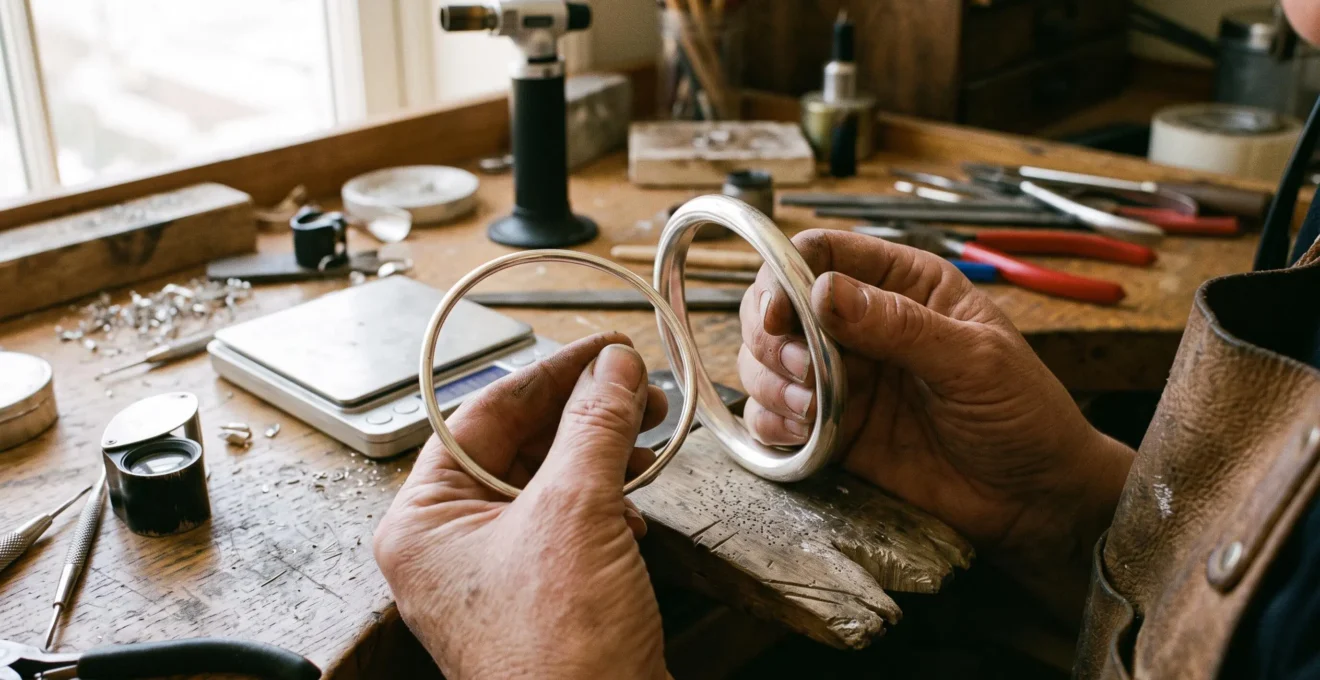
A £450 solid-cast silver bangle and a £120 hollow alternative can look remarkably similar on the wrist. Their £330 price difference, however, may reflect substantial differences in silver content, structural resistance, repair potential and manufacturing quality. Whether that premium represents good value depends on what the buyer expects the jewelry to withstand.
Solid silver construction is generally easier to repair after deformation and can offer greater resistance to crushing or denting. Hollow construction achieves a larger appearance with less metal, making it lighter and more affordable. Neither construction automatically guarantees good workmanship or a fair price.
For a bangle worn every day, the premium may buy meaningful longevity. For an occasional accessory, the less expensive hollow version might deliver nearly the same practical satisfaction. The important distinction is between paying for measurable metal content and durability, or simply paying more for a description that has not been verified.
Solid vs Hollow Silver: The Value Verdict
- Durability: Solid sections generally resist localized crushing better, although casting defects and poor design can undermine that advantage.
- Value: Compare actual gram weights, dimensions, purity and workmanship before accepting a three-to-five-times price premium.
- Buying decision: Solid construction often makes sense for heavily worn bangles and long-term keepsakes; hollow construction can be preferable for lightweight statement jewelry.
- Why Solid-Cast Pieces Survive Drops That Crack Hollow Counterparts
- Solid vs Hollow Bangles: Weight Comparison for Comfort vs Durability
- How to Verify Solid Construction Without Damaging the Piece
- The Density Test Blunder That Confuses Thick Plating With Solid Metal
- When to Invest in Solid Pieces vs When Hollow Construction Suffices
- Hollow vs Solid Silver Construction: The Durability Trade-Offs Explained
- Why Precision-Cast Silver Captures Details Impossible to Hand-Carve
- How to Spot Poor Casting Quality Before Buying Silver Jewelry
Why Solid-Cast Pieces Survive Drops That Crack Hollow Counterparts
Solid-cast silver jewelry can withstand impacts that deform or split a thin-walled hollow counterpart because its continuous metal cross-section provides more material to resist loading. A hollow tube relies on its outer wall for structural support. Nevertheless, drop outcomes depend on wall thickness, geometry, impact location, seams and casting quality, not construction alone.
Imagine two bangles with similar external dimensions. One is a hollow sterling silver tube; the other has a fully filled sterling silver cross-section. When either strikes a hard floor, the impact concentrates force over a small contact area.
The hollow tube may flatten locally, leaving a permanent dent. If the deformation is substantial, the wall can buckle or a vulnerable joint may open. The solid bangle can also deform, but its larger metal section may prevent the same degree of collapse under otherwise comparable conditions.
Denting and cracking are different failure modes. A dent changes surface geometry. A crack interrupts the metal’s continuity and can threaten the entire piece, especially if it propagates from an existing defect or solder joint.
Manufacturing method introduces another variable. Some hollow bangles are formed from silver sheet and joined by soldering. A poorly executed seam can become a vulnerable location during repeated flexing or accidental impacts. A genuinely one-piece solid casting avoids that particular longitudinal assembly seam, though it may contain other imperfections.
Seamless hollow tubing is also available, so assuming every hollow bangle has a soldered joint would be incorrect. Conversely, describing an item as cast does not prove that it contains no internal cavity.
Repair economics often matter more than surviving one dramatic fall. A solid bangle that develops a dent may sometimes be reshaped and polished by a competent jeweler. A crushed hollow tube may require specialized reconstruction, and the repair can become uneconomical relative to replacement.
Neither outcome is guaranteed: reshaping work-hardened silver can create additional problems, and sufficiently thick hollow sections may be repairable.
The structural advantage becomes most relevant when the piece frequently encounters desks, doorframes or other hard surfaces. That makes its weight and wearing comfort the next practical considerations.
Solid vs Hollow Bangles: Weight Comparison for Comfort vs Durability
Solid silver bangles generally weigh more than hollow bangles of similar external dimensions because they contain more metal. This additional mass can support greater resistance to deformation, but it may reduce all-day comfort. The best choice depends on wrist size, intended wear, design geometry and tolerance for weight rather than gram weight alone.
Consider a buyer comparing two visually similar sterling silver bangles. If the seller provides the external dimensions and actual gram weight of each, those measurements offer a useful starting point for evaluating the price difference.
However, weight is a comparison metric, not conclusive proof of construction. Different cross-sectional profiles, clasps, decorative elements and internal materials can affect the result.
For a meaningful comparison, request:
- Actual weight in grams for the exact product or size being purchased.
- Internal diameter or circumference, outer width and section thickness.
- Confirmation that the measured weight excludes packaging.
- Metal composition and whether the piece contains a hollow or filled section.
Comfort changes the value calculation. A substantial solid cuff might feel reassuring during a short fitting but become irritating during long periods of typing or repetitive wrist movement. A lighter hollow piece can offer similar visual impact without constantly reminding the wearer of its weight.
Wrist dimensions are particularly important. A heavy, poorly fitted bangle can move excessively, strike surrounding surfaces and create more opportunities for damage.
The choice is not always binary. A relatively thin solid design can offer a sensible balance between robustness and comfort. Some pieces use partially filled or weighted hollow construction, although buyers should establish exactly what the filler is before attributing additional weight to precious metal.
The following comparison clarifies the practical trade-off.
| Criterion | Solid construction | Hollow construction |
|---|---|---|
| Weight at similar dimensions | Generally heavier | Generally lighter |
| Large visual silhouette | Requires more metal | Achievable with less metal |
| Everyday wrist comfort | Depends on fit and mass | Often easier to tolerate |
| Crushing resistance | Usually advantageous at comparable geometry | Depends heavily on wall thickness |
| Material value | Typically greater silver content | Typically lower silver content |
Buyers with reduced dexterity may also prefer a lighter piece with an easy-to-use opening rather than a heavy, rigid cuff. The most expensive construction provides little benefit if the jewelry is uncomfortable enough to remain unworn.
Once the preferred balance is clear, the remaining challenge is establishing whether the seller’s description of solid construction is accurate.
How to Verify Solid Construction Without Damaging the Piece
Solid construction can be assessed without damaging jewelry by combining verified gram weight, dimensional measurements, interior inspection and written seller specifications. Seams, openings and manufacturing details can provide clues, but no single household observation proves that a bangle is solid throughout. Professional examination may be needed when the distinction materially affects the purchase price.
Start with clear photographs of the piece from multiple angles. Request close-ups of the interior, underside, clasp or terminal ends, where applicable. Look for openings that reveal the wall profile, signs of sheet construction or visible joining lines.
A visible seam can suggest assembled construction, but its absence does not guarantee a solid section. Seamless tubing and hollow castings may have no obvious exterior join.
Next, compare the item’s declared weight with its external dimensions. A substantially lower weight than a comparable confirmed-solid design may suggest hollow construction. This remains an inference, not a definitive test, especially for complex profiles.
Tapping the jewelry lightly may produce different sounds depending on geometry and resonance. Yet a dull or ringing sound cannot reliably classify an unknown piece because wall thickness, mounting, shape and how it is held all affect the result.
Purity markings require separate interpretation. According to the FTC guidance on buying silver jewelry, sterling silver contains 92.5% silver, and silver-plated products consist of a silver coating over another metal. A 925 stamp addresses composition, not whether the interior is hollow.
In the United Kingdom, the UK Government hallmarking guidance explains the independent verification of precious-metal fineness. The general silver exemption threshold is 7.78 grams, but a valid hallmark still does not certify solid geometry.
For expensive or disputed pieces, a qualified professional may use radiography to examine internal construction, alongside appropriate metal-analysis methods to assess composition. X-ray fluorescence primarily assesses elemental composition near the tested surface; it cannot, by itself, establish whether the entire interior is filled with sterling silver. Density measurement can provide supporting evidence but may be ambiguous for composite or sealed hollow objects.
Five Checks Before Paying a Solid-Silver Premium
- Request the actual gram weight. Record the seller’s measurement and identify whether it applies to the precise size offered.
- Obtain dimensional specifications. Save the inner diameter, outer profile and available thickness measurements.
- Inspect detailed photographs. Identify any visible openings, interior seams or suspicious joins and retain the images.
- Ask for written construction confirmation. Obtain an explicit answer stating whether the cross-section is solid sterling silver throughout, hollow or filled.
- Confirm the purchase protections. Retain the description, any available independent assessment and the seller’s written return conditions.
These steps reduce uncertainty without pretending that visual inspection equals laboratory certification. They also help identify misleading use of words such as heavy, solid and sterling.
The Density Test Blunder That Confuses Thick Plating With Solid Metal
Density and perceived heft can mislead buyers because a heavy jewelry piece is not necessarily solid sterling silver. Silver-plated base metals, weighted cavities and composite construction can alter mass and feel. Density testing requires accurate volume and mass measurements, and even a plausible result may not conclusively identify the metal distribution inside a complex object.
Consider a thick bangle described as heavy silver. Its weight might come from sterling silver throughout, a dense base metal with silver plating, or an interior filling material. These are commercially and materially different products.
Copper and brass are common metals that can be used beneath silver plating. Although their densities differ from silver, visual proportions and additional construction materials can make simple hand-feel comparisons unreliable.
The critical distinction is between metal purity and internal construction. Sterling describes the silver alloy’s composition; solid describes the absence of a hollow section when used in that geometrical sense. Neither concept should be inferred exclusively from the other.
For example, a genuinely hollow bangle can still be made from sterling silver. A heavier plated bangle can contain less silver despite feeling more substantial.
925
The fineness designation associated with sterling silver: 925 parts silver per thousand. This describes alloy composition, not construction or the absence of plating over another core.
Federal Trade Commission consumer guidance on precious-metal jewelry.
Buyers should distinguish between verifiable representations and descriptive marketing. A 925 fineness claim is meaningful for purity, subject to genuine marking and applicable rules. Terms such as heavy cast, substantial feel and luxury weight are not substitutes for measurable specifications.
A magnet may help identify certain magnetic components, but passing a magnet check does not prove sterling silver: many non-silver metals are also nonmagnetic. Inspecting high-contact edges for a contrasting underlying metal can reveal possible plating, although an intact plated surface may show no such signs.
For a high-premium purchase, written composition and construction disclosures are more valuable than informal demonstrations. Independent testing should be considered when the item’s authenticity remains disputed.
Once the construction and metal composition are sufficiently established, the purchasing question becomes economic: which version delivers the greater benefit over its expected useful life?
When to Invest in Solid Pieces vs When Hollow Construction Suffices
Solid silver jewelry is often worth the premium when the piece will experience frequent wear, accidental impacts or repeated professional maintenance. Hollow construction can be better value for occasional statement jewelry, large lightweight silhouettes and budget-conscious purchases. The correct decision depends on usage, repairability, documented silver content and the actual difference in price.
Return to the proposed £450 solid bangle and £120 hollow alternative. The solid option costs £330 more, or 3.75 times the hollow price. That difference should not automatically be interpreted as additional craftsmanship or additional recoverable silver value.
Some of the premium may represent more raw metal. The remainder can reflect casting complexity, finishing, distribution costs, design, branding and retail margin.
Consider how the following use cases change the buying rationale.
| Usage profile | Often preferable | Reason |
|---|---|---|
| Daily bangle worn during routine activities | Well-made solid | Better resistance to certain deformation risks |
| Occasional oversized statement cuff | Well-made hollow | Lower weight and cost for visual volume |
| Long-term heirloom with potential refinishing | Solid | More material may allow future restorative work |
| Large earrings or pendants | Hollow | Reduced weight can improve comfort |
| Buyer sensitive to wrist fatigue | Light hollow or slender solid | Fit and mass become primary considerations |
| Buyer seeking maximum recoverable silver content | Verified heavier sterling piece | Actual silver mass matters more than the description |
Both genuine hollow sterling and genuine solid sterling contain precious metal. Solid pieces generally contain more silver when external dimensions are comparable, but that does not guarantee a favorable resale price.
Scrap recovery depends on verified precious-metal weight and the terms offered by a refiner or buyer. Retail premiums for design and finishing may not be recovered, and selling or refining costs can reduce proceeds. Jewelry should not be treated as a dependable financial investment merely because its construction is solid.
Hypothetical Ownership Cost: £450 vs £120
Assume the £450 solid bangle remains usable for 20 years and the £120 hollow bangle must be replaced after five years. Four hollow purchases would cost £480, compared with £450 for one solid purchase, excluding maintenance, inflation and resale.
This illustrates how longevity could narrow the price gap. It is not a prediction of product failure: a carefully worn hollow bangle might last just as long, while a solid bangle could also require costly repairs.
Potential repairs deserve explicit consideration. Solid jewelry may permit reshaping, soldering or refinishing, provided its alloy condition and design allow the work. Hollow jewelry can also be repaired, but thin walls and enclosed spaces may increase complexity.
Skin sensitivity should not be confused with construction. A person reacting to a particular alloy component should check the complete metal composition rather than assume that a solid item is more skin-compatible than a hollow one. A genuinely sterling hollow piece may be a better choice than an unsuitable alternative alloy.
Very heavy jewelry is also not automatically appropriate for sleep, sports or manual work. Removing bangles during hazardous or high-impact activities can protect both the wearer and the jewelry.
To interpret those costs intelligently, it helps to understand the mechanical differences between hollow tubes, assembled sections and solid castings.
Hollow vs Solid Silver Construction: The Durability Trade-Offs Explained
Solid and hollow silver jewelry differ primarily in how metal occupies the cross-section and carries mechanical loads. Solid pieces contain metal throughout the relevant section, while hollow pieces enclose an internal space. Their durability depends on wall geometry, seams, material condition and workmanship. Hollow construction is not necessarily fragile, and solid construction is not automatically defect-free.
Several manufacturing arrangements fall under these broad descriptions:
- Seamless hollow tube: A formed tube with an internal cavity and no longitudinal assembly seam.
- Seamed hollow tube: Silver sheet shaped and joined along a seam, potentially creating a structurally sensitive region.
- Filled hollow construction: A shell containing another material or partial internal support rather than a completely open cavity.
- Solid cast construction: A cast object whose relevant cross-section is filled with metal rather than an intentionally formed internal cavity.
The differences become important when forces act on the piece. A hollow tube subjected to crushing pressure can experience localized wall buckling. A jointed design may develop seam damage if the joint is poorly made or overloaded. A solid section has more metal to resist a similar load, but its geometry may still permit bending or cracking.
A thick-walled hollow bangle can therefore outperform a slender solid design under some loading conditions. Similarly, a well-fabricated joint may remain sound through ordinary use, while a defective casting can fail unexpectedly.
Environmental exposure adds another consideration. Water, cleaning agents and perspiration can affect silver jewelry’s appearance and maintenance requirements. If moisture or contaminants enter an inadequately sealed cavity, inspection and cleaning may be more difficult. This possibility should not be generalized to every hollow piece.
Construction also helps explain material cost. At similar alloy purity and external size, a truly solid piece normally contains more metal. Yet the difference in selling price cannot be attributed to metal weight alone without actual gram figures and comparable manufacturing specifications.
For the £450-versus-£120 comparison, requesting both weights and checking the workmanship is more informative than assuming that the price ratio directly represents a difference in structural performance.
This distinction becomes particularly relevant in cast jewelry, where a sophisticated manufacturing method can produce excellent detail without necessarily guaranteeing structural integrity.
Why Precision-Cast Silver Captures Details Impossible to Hand-Carve
Precision casting can reproduce intricate three-dimensional forms, recessed textures and repeated decorative details that would be difficult or uneconomical to create by hand with conventional filing or carving. It does not make such artistry categorically impossible through other techniques. The advantage lies in faithful geometric reproduction, production flexibility and the ability to form complex shapes.
In lost-wax casting, a model establishes the desired shape. The model is surrounded by investment material, the wax is removed, and molten metal occupies the resulting cavity. Once the metal solidifies, the casting is released and finished.
The Metropolitan Museum of Art explanation of lost-wax casting describes the roles of wax models, molds and metal-delivery features. It also explains an essential limitation of the term cast: using an internal core can produce hollow cast objects.
Consequently, lost-wax cast does not mean solid throughout. A product can be cast, hollow, or both, depending on the manufacturing process.
For decorative silver bangles, casting offers the ability to reproduce elaborate reliefs and sculptural transitions. Repeated designs can also be generated from reusable tooling, allowing a complex form to be produced multiple times without hand-carving every detail from the beginning.
The amount of finishing work remains an important variable. Casting reproduces a shape, but it does not automatically create flawless edges, polished recesses or uniform surfaces. Sprue removal, surface correction and polishing still influence the final appearance.
Buyers evaluating a more expensive cast piece should inspect:
- Definition and consistency of fine ornamental edges.
- Surface smoothness in recessed areas.
- Evidence of incomplete metal filling or visible pits.
- How cleanly sprue attachment points have been removed.
- Whether the overall finish matches the seller’s workmanship claims.
Complex detail may support a higher price when accompanied by demonstrably careful production and finishing. It does not, by itself, explain why one piece should cost several times more than a visually similar alternative.
High-quality casting requires both effective design reproduction and sound metal. The final inspection should therefore focus on defects that are easy to overlook in attractive product photographs.
What Matters Before Choosing
- Construction claims need evidence: A cast finish, hallmark or substantial weight does not independently prove a solid sterling cross-section.
- Workmanship changes the equation: Visible defects and poor finishing can undermine the value of additional metal.
- Price must be explainable: A substantial premium deserves meaningful differences in silver mass, manufacturing quality, design or long-term utility.
How to Spot Poor Casting Quality Before Buying Silver Jewelry
Poor silver casting quality can often be suspected through visible porosity, incomplete detail, irregular surfaces and careless finishing. These signs matter because defects may affect both appearance and durability. Photographs can identify potential concerns, but they cannot reliably reveal every internal flaw, so expensive purchases may justify professional inspection and clearer seller documentation.
Begin with the highest-resolution photographs available. Examine shadowed recesses, decorative junctions and transitions between thick and thin elements. These areas may reveal flaws that polished front-facing product images conceal.
Small, scattered surface pits can indicate porosity or finishing problems. Irregularities do not automatically mean that the piece is structurally unsafe, but extensive porosity deserves attention.
The GIA article on jewelry workmanship and forensic inspection describes a jewelry examination in which extensive metal porosity raised serious quality concerns. The example demonstrates why a piece’s manufacturing condition deserves scrutiny beyond its outward style or nominal metal content.
A GIA Jewelry Inspection Revealing Significant Porosity
In a documented jewelry-forensics training example, inspection of a ring revealed extensive metal porosity. The condition was considered serious enough for a recommendation that the ring be remade.
When the ring was subsequently presented again, the original porosity had been filled with solder instead of the ring being remade. The case illustrates why cosmetic intervention does not necessarily resolve underlying manufacturing concerns. It does not establish a numerical failure rate for cast silver bangles.
Buyers should also inspect raised edges, decorative symmetry and transitions between polished and textured areas. Flash lines or unfinished sprue locations may suggest that finishing received insufficient attention. On matched earrings, noticeable asymmetry can warrant questions, unless the design intentionally varies.
Stock photography complicates evaluation. An image reused across multiple listings may illustrate the design without showing the exact item being sold. Requesting photographs of the specific piece provides a better basis for judging visible workmanship.
Seller responses are part of the assessment. A refusal to disclose actual weight, uncertainty about metal composition or contradictory descriptions of casting and hollow construction should prompt additional verification. Missing specifications are not proof of poor casting, but they prevent informed value comparison.
Finally, compare the asking price with documented silver content and observable workmanship. A basic material-value sense check uses the declared sterling weight, its silver fraction and a separately verified silver market price. Such a calculation estimates metal content value, not a fair retail price; labor, waste, finishing, distribution and margins remain additional considerations.
Small-batch jewelry may receive extensive individual finishing, but production scale alone does not prove superior quality. Mass-produced pieces can also meet demanding standards, while limited-edition pieces may still contain defects.
For the buyer choosing between £450 solid and £120 hollow silver, the next sensible action is to request the actual gram weight, close-up photographs, written confirmation of the construction and available return terms for both pieces. If those details do not establish a meaningful advantage for the more expensive bangle, the premium remains unproven.
Can a hollow sterling silver bangle be genuine silver?
Yes. Hollow construction describes an internal cavity, not necessarily a different metal composition. A hollow bangle can be made from genuine sterling silver, just as a solid bangle can. Purity and internal geometry must be evaluated separately.
Does solid sterling silver jewelry always contain more recoverable value?
Not always. Solid jewelry generally contains more silver than hollow jewelry of equivalent dimensions and alloy composition, but actual metal weight matters. The amount recoverable through resale or refining also depends on verification, transaction costs and buyer terms. Retail craftsmanship premiums are not guaranteed to be recovered.
Can a jeweler repair a crushed hollow silver bangle?
Sometimes. Repairability depends on wall thickness, deformation, seams, accessibility and the condition of the metal. Minor damage may be repairable, whereas severe crushing or splitting may require disproportionate work. A professional assessment is needed before deciding whether to repair or replace the piece.
Does a 925 hallmark prove that a silver bangle is solid?
No. A 925 fineness designation refers to sterling silver composition, meaning 92.5% silver. It does not identify wall thickness, hollow cavities, internal fillers or the manufacturing process. A legitimate hallmark supports metal-fineness identification under the relevant system, not certification of solid construction.
Is it reasonable to pay almost four times more for a solid silver bangle?
It can be reasonable when the higher price reflects substantially more verified silver, superior workmanship, an appropriate design and meaningful long-term benefits. For a £450 solid bangle versus a £120 hollow alternative, the price ratio is 3.75. Without comparable weights, dimensions, construction confirmation and quality evidence, that ratio alone cannot establish whether the premium is justified.